English Conversation for Beginners: Phrases, Dialogues and Practice
 Yurii Rebryk · Updated September 7, 2026 · 17 min read
English conversation for beginners works on a small base: about 40 ready phrases for five jobs (greet, introduce, ask and answer, repair, close) and a handful of short exchanges you repeat until they come out without thinking. Below you get 47 phrases grouped by function, seven original A1–A2 dialogues with a voice trainer, and one six-step practice method that works for every unit.
In this article
- The five parts of a simple English conversation
- Essential English conversation phrases for beginners, grouped by function
- Seven beginner English conversation dialogues to practice, A1–A2
- How to practice each dialogue: one method for every unit
- Common beginner conversation problems and quick fixes
- What to practice next
The page is for A1–A2 learners: you know some words and basic grammar, but starting, keeping and ending a short conversation still feels hard. Jump to the essential phrases, the seven beginner dialogues or the practice method, or read in order. Every unit works as text, without audio, an account or an app.
The Council of Europe’s CEFR self-assessment grid describes spoken interaction at A1 as “I can interact in a simple way provided the other person is prepared to repeat or rephrase things at a slower rate of speech and help me formulate what I’m trying to say,” and at A2 as “I can communicate in simple and routine tasks requiring a simple and direct exchange of information on familiar topics and activities” (CEFR self-assessment grid, Europass). Both descriptions assume repetition, slower speech and help from the other person. Asking for them is part of the level, not a sign you have failed it. If you are not sure where you stand, the free English level test gives a CEFR estimate in 18 questions.
The five parts of a simple English conversation
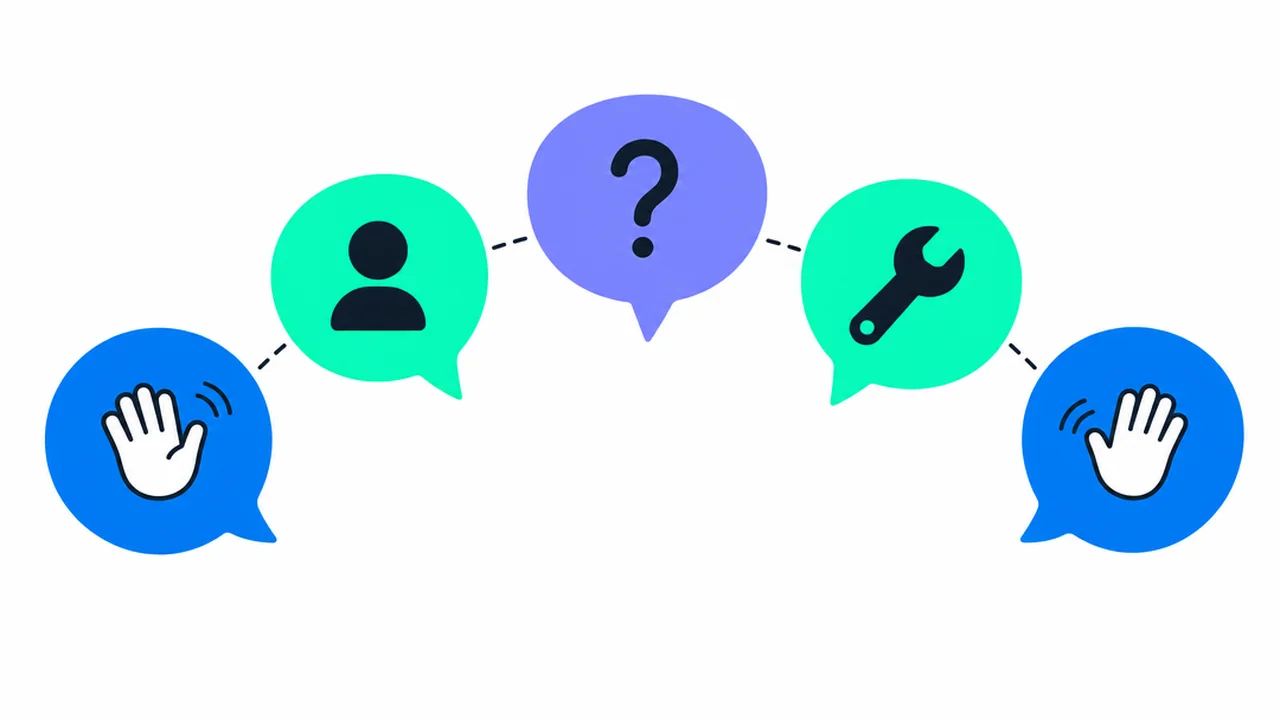
A simple English conversation has five parts, and each part has a job. Greet. Introduce yourself or say why you are there. Ask, answer and add one follow-up. Repair when you miss something. Close politely. Beginners freeze most often at part three (nothing to add after the answer) and part four (a missed word stops everything), so those two parts get the most phrases below.
| Part | Job | Example line |
|---|---|---|
| 1. Greet | Open the exchange and show you are friendly | “Hi, how’s it going?” |
| 2. Introduce or set the situation | Say who you are or what you need | “I’m Maya, I’m new on the design team.” / “Hi, I have an appointment at ten.” |
| 3. Ask, answer, follow up | Keep it going with one more question | “Where are you from?” “Brazil. What about you?” |
| 4. Repair | Fix a missed word or a fast sentence | “Sorry, can you say that again?” |
| 5. Close | End politely and leave the door open | “Well, I need to go. See you later.” |
Put together, the five parts make a full exchange in six short lines: “Hi, I don’t think we’ve met. I’m Tom.” “Hi, Tom. I’m Maya, I’m new on the design team.” “Where are you from?” “Brazil. Sorry, can you say your name again?” “Tom.” “Thanks, Tom. Well, I need to go. See you later.” Unit 1 below turns that skeleton into a complete dialogue.
Basic English conversation at this level is not a vocabulary list: the number of words you know matters less than having one ready phrase for each part. It is also not a grammar test. A short answer with a mistake keeps the conversation going; silence ends it.
Essential English conversation phrases for beginners, grouped by function
The 47 basic English conversation phrases below are grouped by what they do, not by topic, because the same phrase serves a coffee shop, a phone call and a first day at work. Each group has a short use note. Learn two or three phrases per group first; the dialogues in the next section use all of them in context.
Greetings and introductions (9 phrases)
Use note: in the US, “Hi” and “Hey” are normal in almost every situation, including work. “How’s it going?” is a greeting, not a real question, and “Good, thanks. How about you?” is the whole expected answer.
- “Hi, I’m Maya.” Your name right after “I’m”. “My name is” is correct but sounds like a form.
- “Nice to meet you.” After hearing a name for the first time.
- “Nice to meet you too.” The reply. Add “too”.
- “How’s it going?” Greeting for people you already know.
- “Good, thanks. How about you?” The standard answer, with the question returned.
- “I don’t think we’ve met.” A friendly way to start with a stranger at work or at a party.
- “Are you new here?” Opens a conversation with a newcomer.
- “Where are you from?” Safe once the other person has mentioned moving, traveling or being new.
- “What do you do?” Asks about a job. Answer with “I’m a…” or “I work in…”.
Simple questions and follow-ups (9 phrases)
Use note: a follow-up is one more question after the answer. It is the difference between an exchange and a conversation, and “What about you?” works after almost any answer.
- “What about you?” Returns any question. The most reusable follow-up in English.
- “Do you like it?” After someone mentions a job, a city or a class.
- “Really? Why?” Shows interest and asks for a reason in two words.
- “What time?” After any plan or appointment.
- “Which one?” When there are two or more options: parks, buses, sizes.
- “How long does it take?” For trips, waits and deliveries.
- “Is it far?” After directions.
- “Do you have any plans this weekend?” The usual Friday question in US offices.
- “Do you want to come?” The simplest invitation.
Polite requests and short reactions (12 phrases)
Use note: “Can I have…?” and “Could you…?” are the polite forms for ordering and asking; “I want” sounds abrupt in English even with “please”. Short reactions (“Sounds good”, “Perfect”) show you followed and keep your turn short.
- “Excuse me.” Gets attention politely before a question.
- “Can I have a medium latte, please?” The ordering formula: “Can I have” plus the item plus “please”.
- “Could you help me?” To staff in any store or office.
- “I’m looking for…” Names what you need: a T-shirt, the exit, batteries.
- “Do you have this in a medium?” Sizes, colors and other options.
- “Can I pay by card?” Also “Do you take cards?”
- “How much is it?” Price for one thing; “How much is that?” for the total.
- “Sounds good.” Agreement with a plan.
- “That sounds fun.” Positive reaction to an invitation.
- “Perfect.” One-word confirmation; “Great.” does the same job.
- “No problem.” The reply to “thank you” or “sorry” in casual US English.
- “Thanks so much.” Warmer than “thank you”, common everywhere.
Clarification and repair (10 phrases)
Use note: repair language is the group beginners need most and learn last. Say the repair phrase immediately, before the other person moves on; a two-second pause and a smile is not a repair.
- “Sorry, can you say that again?” The all-purpose repeat request.
- “Could you speak more slowly, please?” When the speed, not the words, is the problem.
- “Sorry, what does ‘commute’ mean?” Ask for one word; people explain gladly.
- “I don’t know that word.” Honest and fast; the other person will rephrase.
- “Do you mean…?” Offers your guess so they only need to say yes or no.
- “Straight, then left at the bank?” Repeat the key facts back. Checks directions, times and prices without a full question.
- “Can you spell that?” For names, streets and emails.
- “Sorry, the line is not very good.” Blames the phone, not your English, and gets a repeat.
- “Oh, I see.” Shows the repair worked; “Got it.” is the shorter version.
- “Sorry, my English is still basic. One more time?” Use once per conversation at most; it resets expectations and buys patience.
Closing and goodbye (7 phrases)
Use note: US conversations end in two steps, a signal (“Well, I need to go”) and a goodbye (“See you later”). Skipping the signal sounds sudden; skipping the goodbye sounds cold.
- “Well, I need to go.” The signal. “Anyway, I should get going” is the same move.
- “It was nice talking to you.” After a first conversation.
- “See you later.” Also “See you tomorrow” and “See you Saturday, then”.
- “Have a good day.” Works with strangers and colleagues; “Have a good evening” after five.
- “You too.” The reply to any “Have a good…”.
- “Thanks for your help.” Closes an exchange with staff or a stranger who helped.
- “Take care.” Warm and casual, for people you know.
Rule of thumb: pick two phrases from each group, ten in total, and use them in the first three dialogues before you learn the rest. Ten automatic phrases beat forty half-remembered ones.
Seven beginner English conversation dialogues to practice, A1–A2
Each unit below is a complete lesson: the situation, six key phrases, the dialogue with a voice trainer, short notes, substitutions, and a transfer prompt with a success check. Units 1 to 3 are A1 (short turns, present tense, high-frequency words). Units 4 to 7 are A2 (simple reasons, past and future, slightly longer turns). Every dialogue includes one repair line, because that is where real beginner conversations break.
1. Meeting someone new at work (A1)
Situation: Maya starts a new job. In the office kitchen she meets Tom, who works on another team. Speaking goal: introduce yourself, ask two questions, get a name repeated and end the chat.
Key phrases: “I don’t think we’ve met.” · “Nice to meet you too.” · “Are you new here?” · “Sorry, can you say your name again?” · “What do you do here?” · “See you later.”
Meeting someone new
A1- Tom
Hi, I don’t think we’ve met. I’m Tom.
- Maya
Hi, Tom. I’m Maya, nice to meet you.
- Tom
Nice to meet you too. Are you new here?
- Maya
Yes, today is my first day. I work with the design team.
- Tom
Oh, nice. Where are you from, Maya?
- Maya
I’m from Brazil. Sorry, can you say your name again?
- Tom
Sure. Tom, T-O-M.
- Maya
Tom, thank you. And what do you do here?
- Tom
I’m on the sales team. Well, I have a meeting now, see you later.
- Maya
See you later, Tom. Have a good day.
Practise this dialogue
Listen to the whole exchange, then take one role: your partner’s lines are read aloud, you say yours into the microphone and see which words came through.
Notes: “I don’t think we’ve met” is the friendly US opener for a stranger at work; it is not rude. Answer “Nice to meet you” with “too”. Asking someone to repeat their name is normal, and spelling it (“T-O-M”) is the usual help. “Have a good day” closes with a stranger or a colleague equally well.
Substitutions: your name and country; “design team” → your team, your company or “I’m a student”; “today is my first day” → “I started last week”; “I’m on the sales team” → “I work in support” or “I’m an engineer”.
Make it yours: introduce yourself with your real name, city and job or team in three sentences, then ask the other person one question. You pass when you can greet, introduce yourself, ask one question, get a name repeated and close, with the text covered.
2. Talking about your day and daily routine (A1)
Situation: Ana and Ben are neighbors. They meet at the mailboxes on a weekday evening. Speaking goal: describe your working day in the present simple, ask one question back and deal with one unknown word.
Key phrases: “How’s it going?” · “Do you work from home?” · “I start at nine and finish at six.” · “Sorry, the commute? I don’t know that word.” · “What do you do after work?” · “Have a good evening.”
Talking about your day
A1- Ben
Hi, Ana. How’s it going?
- Ana
Good, thanks. Busy day. How about you?
- Ben
Pretty good. Do you work from home?
- Ana
No, I go to the office. I start at nine and finish at six.
- Ben
Is the commute okay?
- Ana
Sorry, the commute? I don’t know that word.
- Ben
The trip to work. How do you get there?
- Ana
Oh, I see. By bus, about thirty minutes. What do you do after work?
- Ben
I usually cook dinner and watch a show. Anyway, I need to go, have a good evening.
- Ana
You too, Ben. See you tomorrow.
Practise this dialogue
Listen to the whole exchange, then take one role: your partner’s lines are read aloud, you say yours into the microphone and see which words came through.
Notes: “Busy day” is a complete answer in casual speech; no verb needed. “I don’t know that word” gets a plain explanation (“the trip to work”) and costs nothing. Frequency words (“usually”, “on Fridays”, “twice a week”) turn one fact into a routine, which is exactly what an A1 description of daily life needs.
Substitutions: “work from home” → “study at the university”; “start at nine and finish at six” → your real hours; “by bus, about thirty minutes” → “by car, ten minutes” or “I walk”; “cook dinner and watch a show” → your own evening.
Make it yours: describe your own weekday in four sentences (start time, how you get there, one thing after work, one weekly activity), then ask “What about you?”. You pass when you can give the routine, stop the partner on one unknown word and close, without reading.
3. Ordering at a coffee shop (A1)
Situation: Omar orders a drink and a snack at a busy coffee shop. Lena is the barista. Speaking goal: order with “Can I have”, answer two quick questions, ask for one repeat, ask the price and give your name.
Key phrases: “Can I have a medium latte, please?” · “Hot, please.” · “Sorry, can you repeat that?” · “To go, please.” · “How much is it?” · “Omar, O-M-A-R.”
Ordering at a coffee shop
A1- Lena
Hi there. What can I get for you?
- Omar
Hi. Can I have a medium latte, please?
- Lena
Sure. Hot or iced?
- Omar
Hot, please. And a blueberry muffin.
- Lena
Got it. For here or to go?
- Omar
Sorry, can you repeat that?
- Lena
For here, or to go?
- Omar
To go, please. How much is it?
- Lena
That’s seven fifty. Can I get a name for the order?
- Omar
Omar, O-M-A-R. Thank you.
Practise this dialogue
Listen to the whole exchange, then take one role: your partner’s lines are read aloud, you say yours into the microphone and see which words came through.
Notes: “What can I get for you?” is the standard barista opener in the US, and the whole answer is “Can I have… please”. Expect two quick questions, size and “for here or to go”, and answer in two words. Staff repeat gladly, so “Sorry, can you repeat that?” is safe even with a line behind you. Giving and spelling your name for the cup is normal.
Substitutions: “medium latte” → “small coffee”, “large iced tea”; “blueberry muffin” → “a bagel”, or nothing; “hot” ↔ “iced”; “to go” ↔ “for here”; add “Can I pay by card?” before you give your name.
Make it yours: order the drink and snack you would really buy, including size and “for here or to go”, then ask the price. You pass when you can place the full order, ask for one repeat and give your name, with the text covered.
4. Shopping: asking for help finding an item (A2)
Situation: Priya wants a plain black T-shirt in a clothing store. Dan works there. Speaking goal: get attention, say what you are looking for, ask about a size, check a word you do not know, ask the price and pay.
Key phrases: “Excuse me, can you help me?” · “I’m looking for…” · “Do you have this one in a medium?” · “Sorry, the fitting rooms?” · “How much is it?” · “I’ll take two. Can I pay by card?”
Shopping for a T-shirt
A2- Priya
Excuse me, can you help me? I’m looking for a plain black T-shirt.
- Dan
Sure. They’re on the back wall, next to the jeans.
- Priya
Thanks. Do you have this one in a medium?
- Dan
Let me check. Yes, here you go, and the fitting rooms are on the left if you want to try it on.
- Priya
Sorry, the fitting rooms?
- Dan
The small rooms where you can try on clothes. On the left, past the register.
- Priya
Oh, got it. Thank you. And how much is it?
- Dan
It’s eighteen dollars, and today it’s two for thirty.
- Priya
Okay, I’ll take two. Can I pay by card?
- Dan
Of course. The register is right here.
Practise this dialogue
Listen to the whole exchange, then take one role: your partner’s lines are read aloud, you say yours into the microphone and see which words came through.
Notes: “Excuse me, can you help me?” plus “I’m looking for” gets staff moving in any store. Repeating the unknown word with rising intonation (“Sorry, the fitting rooms?”) is a complete repair; you do not need a full sentence. “I’ll take two” is how you decide out loud, and “Can I pay by card?” starts the payment without more words.
Substitutions: “plain black T-shirt” → “a phone charger”, “running shoes”, “batteries”; “medium” → “a size 8”, “in blue”; the deal → “Is it on sale?”; “Can I pay by card?” → “Do you take cash?”
Make it yours: name one thing you bought this month and ask for it, with one detail (size, color or type) and the price. You pass when you can ask for help, add the detail, repair one word and pay, without reading.
5. Asking for directions (A2)
Situation: Jess is new in town and needs the train station. She stops Marco on the street. Speaking goal: ask for directions, ask the speaker to slow down, repeat the key facts back, ask one follow-up and thank him.
Key phrases: “Excuse me, do you know where the train station is?” · “Sorry, could you say that more slowly, please?” · “Straight, then left at the bank.” · “Is it far?” · “Is there a coffee shop near the station?” · “Thanks so much for your help.”
Asking for directions
A2- Jess
Excuse me, do you know where the train station is?
- Marco
Sure, go straight down this street, then turn left at the bank. It’s about five minutes on foot.
- Jess
Sorry, could you say that more slowly, please?
- Marco
Of course. Straight down this street, left at the bank, and then you’ll see the station.
- Jess
Straight, then left at the bank. Is it far?
- Marco
No, about five minutes. You can’t miss it.
- Jess
Great. Is there a coffee shop near the station?
- Marco
There’s one right across the street from the entrance.
- Jess
Perfect. Thanks so much for your help.
- Marco
No problem. Have a good trip.
Practise this dialogue
Listen to the whole exchange, then take one role: your partner’s lines are read aloud, you say yours into the microphone and see which words came through.
Notes: “Do you know where … is?” is softer than “Where is …?” and easier for a stranger to answer. Directions arrive fast; asking for slower speech is normal, and Marco simply shortens the sentences. Repeating the facts back (“Straight, then left at the bank”) is the strongest check on the whole page: it works for times, prices and phone numbers too. “You can’t miss it” means “it is easy to see”.
Substitutions: “train station” → “the nearest pharmacy”, “the bus stop”, “a bank”; “left at the bank” → “right at the light”, “past the school”; “five minutes on foot” → “two stops on the bus”; the follow-up → “Is there an ATM near there?”
Make it yours: ask for a place you actually need this week (a clinic, a gym, a post office) and repeat the directions back in your own words. You pass when you can ask, slow the speaker down, repeat the two key facts and close, with the text covered.
6. A short phone call: rescheduling an appointment (A2)
Situation: Luis calls a dental office to move his Thursday appointment because he has to work. Kim answers the phone. Speaking goal: say who you are and why you are calling, give a reason, ask for a repeat on a bad line, choose a new time and spell your name.
Key phrases: “Hi, this is Luis Ortega.” · “I have an appointment on Thursday at ten, but I can’t come.” · “Sorry, could you repeat that? The line is not very good.” · “Do you have anything next week in the afternoon?” · “Tuesday at three is good.” · “O-R-T-E-G-A.”
Rescheduling by phone
A2- Kim
Good morning, Riverside Dental, this is Kim. How can I help you?
- Luis
Hi, this is Luis Ortega. I have an appointment on Thursday at ten, but I can’t come because I have to work.
- Kim
No problem. Would you like to reschedule?
- Luis
Sorry, could you repeat that? The line is not very good.
- Kim
Of course. Do you want to choose a new day and time?
- Luis
Yes, please. Do you have anything next week in the afternoon?
- Kim
Let me see. We have Tuesday at three or Wednesday at four thirty.
- Luis
Tuesday at three is good.
- Kim
Great, you’re all set for Tuesday at three with Dr. Patel. Can you spell your last name for me?
- Luis
Sure, O-R-T-E-G-A. Thank you very much, goodbye.
Practise this dialogue
Listen to the whole exchange, then take one role: your partner’s lines are read aloud, you say yours into the microphone and see which words came through.
Notes: on the phone, say “This is Luis”, not “I am Luis”. State the problem and the reason in one breath: “I have an appointment…, but I can’t come because I have to work.” Blaming the line is a polite repair that any receptionist accepts. “You’re all set” means “everything is done”; the answer is a thank-you and a goodbye, and offices expect you to spell your last name.
Substitutions: “dental office” → “a hair salon”, “the doctor”, “a car repair shop”; “I have to work” → “I’m sick”, “I’m traveling”; “next week in the afternoon” → “this Friday morning”; the two times → your real availability.
Make it yours: call to move a real appointment or booking from your life, with your name, the current time, a one-line reason and two possible new times. You pass when you can open the call, explain the change, repair once and confirm the new time, without reading.
7. Making plans for the weekend (A2)
Situation: Chris invites his coworker Nadia to a picnic on Saturday. Speaking goal: accept an invitation, ask about time and place, check one detail, offer to bring something and confirm.
Key phrases: “Do you have any plans this weekend?” · “Do you want to come?” · “That sounds fun. What time?” · “Sorry, which park?” · “Can I bring something?” · “See you Saturday, then.”
Making weekend plans
A2- Chris
Hey, Nadia. Do you have any plans this weekend?
- Nadia
Not really. Why?
- Chris
A few of us are going to the park on Saturday. Do you want to come?
- Nadia
That sounds fun. What time?
- Chris
Around two. We’re going to bring some food.
- Nadia
Saturday at two. Sorry, which park?
- Chris
Lincoln Park, near the lake. I can send you the address.
- Nadia
Great, can I bring something? I can make a salad.
- Chris
Sure, that would be great. See you Saturday, then.
- Nadia
See you Saturday. Thanks for inviting me.
Practise this dialogue
Listen to the whole exchange, then take one role: your partner’s lines are read aloud, you say yours into the microphone and see which words came through.
Notes: “Not really. Why?” is the natural answer to the plans question, and it invites the invitation. “Do you want to come?” is a real invitation in the US, not just politeness; accept with “That sounds fun” and a question. Checking one detail (“which park?”) before you agree is expected, and “See you Saturday, then” confirms the plan without a longer sentence.
Substitutions: “going to the park on Saturday” → “trying a new restaurant on Friday”, “watching the game on Sunday”; “around two” → your time; “I can make a salad” → “I can bring drinks”; to decline politely → “I’d love to, but I’m busy on Saturday. Maybe next time?”
Make it yours: invite your partner to something you would really do this weekend, with a day, a time and a place, and let them ask two questions. You pass when you can invite or accept, check one detail and confirm the plan, with the text covered.
How to practice each dialogue: one method for every unit
The same six steps work for all seven units and take about ten minutes per dialogue. They run from easiest to closest to real speech, and the last two steps are where the conversation becomes yours. The method is also the simplest form of English speaking practice for beginners that produces speech, not just recognition.
- Read the situation and name the goal. Say it in one sentence before you start: “I need to order a coffee and ask the price.”
- Say every line aloud and notice the key phrase. Play the dialogue in the trainer, then read both roles yourself, slowly, marking the six key phrases as you reach them.
- Perform both roles. Choose a role in the trainer, let the partner’s lines play and say yours; then switch. The word-match score shows which words did not come through; repeat only those lines.
- Replace the highlighted details with your own. Use the substitution list: your name, your drink, your hours, your appointment. Say the whole dialogue again with the new details.
- Cover the text and rebuild the exchange from the key phrases. Keep only the six key phrases visible. Your version does not need to match the original; it needs to hit the five parts.
- Answer the transfer prompt in your own words. Speak for thirty to sixty seconds without any text, then run the success check in the unit’s box.
Add a listen-and-repeat pass before step three if pronunciation is the problem; the shadowing guide shows how to copy rhythm and stress line by line, and the pronunciation practice guide covers the sounds that get misheard most. One unit a day, five days a week, is a full beginner routine; the daily English speaking practice guide shows how to fit it into fifteen minutes.
Practice these dialogues with a partner who answers back
Fluently is an AI speaking coach: you hold conversations and role-plays by voice (a coffee order, a phone call, a first day at work), and after each answer it shows what to fix in your pronunciation, fluency, vocabulary and grammar. Start with the free 4-minute speaking assessment. iOS and Android; free to download, with a subscription for regular practice.


For more situations to rehearse after the seven here, the English speaking practice hub covers conversations, role-plays, meetings and interviews.
Common beginner conversation problems and quick fixes
Five problems stop most A1–A2 conversations, and each has a fix you can apply in the next dialogue you practice.
| Problem | Quick fix | Say this |
|---|---|---|
| One-word answers | Add one detail or one reason | “Brazil. I moved here in May.” / “No, I go to the office. I start at nine.” |
| No follow-up, so the conversation stops | Return the question or ask about the answer | “What about you?” / “Do you like it?” |
| A missing word mid-sentence | Describe the thing or ask for the word instead of stopping | “The small rooms where you try on clothes.” / “Sorry, what is the word for…?” |
| You did not understand | Ask for a repeat, slower speech or one word | “Sorry, can you say that again?” / “Could you speak more slowly, please?” |
| Unclear ending, the goodbye feels awkward | Signal first, then say goodbye | “Well, I need to go. See you later.” |
Self-check after any real conversation: did you add one detail, ask one follow-up and repair once? Three yes answers mean the level is working, whatever mistakes you made on the way.
What to practice next
- More questions and topics: the English conversation topics guide has question sets by situation and level, and the question generator makes new ones on demand.
- One-speaker texts: the English speaking practice texts are graded read-aloud passages for building rhythm between dialogues.
- English at work: the business English conversation guide covers meetings, calls and small talk with colleagues.
- The next level: when the seven units here feel easy and you pass every success check, move to intermediate English conversation (B1–B2), and later to advanced English conversation (C1–C2).
Frequently asked questions
How can I practice English conversation for beginners without a partner?
Use the voice trainer in each dialogue above: it reads the partner’s lines, you say yours, and the word-match score tells you which words did not come through. Then do steps four to six of the method without any text: substitute your details, cover the lines, answer the transfer prompt out loud. The guide to practicing English speaking alone adds recording and self-talk routines, and an AI conversation partner such as Fluently answers back and corrects you.
How many phrases should a beginner learn first?
Ten: two from each of the five groups. The most useful ten are the greeting and its reply, one introduction, “What about you?”, “Can I have…, please?”, “Excuse me, can you help me?”, “Sorry, can you say that again?”, “I don’t know that word”, one repeat-back check, and “Well, I need to go. See you later.” Use them in units 1 to 3 until they come out without thinking, then add the rest of the 47 group by group.
Do I need audio or a native speaker to use these dialogues?
No. Every unit works as text: read both roles aloud, cover the lines, and answer the transfer prompt. Audio helps with rhythm and stress, so use the trainer’s model reading when you can, but the success check is the same with or without it: start, ask or answer, repair once, close.
What is the difference between A1 and A2 in conversation?
At A1 you exchange short, present-tense information (name, job, order, time) and depend on the other person repeating and slowing down. At A2 you handle routine tasks with a simple, direct exchange: a reason (“I can’t come because I have to work”), a past or future reference, a choice between two options. Units 1 to 3 on this page are A1 and units 4 to 7 are A2; if the A2 units feel comfortable, the intermediate guide is the next step.
What should I say when I don’t understand someone?
Say the repair phrase at once: “Sorry, can you say that again?” for a whole sentence, “Could you speak more slowly, please?” for speed, “Sorry, what does … mean?” for one word. If you caught part of it, repeat that part back (“Tuesday at three?”) so the other person only needs to confirm. Nodding and hoping is the one strategy that fails, because the next question builds on the part you missed.
Is it a problem if I make grammar mistakes in these dialogues?
Not at this level. A short answer with a mistake keeps the conversation going; silence ends it. Fix one recurring error per unit, for example the third-person “s” or “I have to”, and leave the rest for later. The CEFR descriptions for A1 and A2 measure whether you can exchange information on familiar topics, not whether the grammar is clean.