English Level Test
The English level test on this page is free and estimates your CEFR level, A1 to C2, from 18 multiple-choice questions on grammar, vocabulary and usage. Answer one question per screen, go back if you change your mind, and see your level and score on this page when you finish. No time limit, no account, no email, no microphone or headphones. Speaking is not tested here: use the English speaking test for that. See a sample result before you start.
Question 1 of 18
She ___ a teacher at my school.
How the English level test works
- Answer 18 questions in a fixed order. Three questions per level, A1 to C2, so they get harder as you go. Every question is multiple choice with four options and one correct answer.
- One question per screen. Next stays inactive until you choose an option, so nothing is submitted by accident. Back returns to any earlier question, and you can change the answer.
- No timer, no skipping. Every question needs an answer. If you are unsure, pick the most likely option: the cut-offs leave a margin for the odd lucky guess above your level, so one guess does not move you up a band.
- Result on the same page. After question 18, See results shows your CEFR band and its name, your score out of 63 and a short description of what the level usually means in conversation. Nothing to download, nothing to sign up for.
- Retake whenever you like. Retake the test clears all 18 answers and starts again from question 1. The questions do not change, so leave real practice time between runs.
Before you start
- Free, with no account. All 18 questions and the result cost nothing, and there is no email form, payment or card at any point. The Fluently app linked from the result is a separate download with its own free speaking assessment.
- Runs in the browser. Phone or computer, nothing to install. The test uses no microphone, camera or headphones.
- No time limit. Work at your own pace and go back to any earlier question until you press See results.
- Unlimited retakes. The same 18 questions every time, so space retakes out.
- Nothing is saved. Closing or reloading the page clears your answers and result, and there is no history or progress tracking. Note your level and score if you want to compare them with a later run.
What happens to your answers
Scoring happens inside the page: the test does not send your answers or your result to a server, and it keeps nothing after you leave, so there is nothing to store, share or delete. The site’s general visit analytics run on this page as on every other page, as described in the privacy policy. If you continue to the Fluently app from the result, the app has its own sign-up, covered by the same policy.
Try three sample questions
The three items below show the format and the kind of decision each question asks for. They are not part of the scored test, so the answer is given with each one.
- Grammar, B1 range. The colleague ___ desk is next to mine is on leave this week.
who · whose · which · whom
Answer: whose. Items like this check sentence structure and verb forms; they say nothing about how you would say the sentence out loud. - Vocabulary in context, B2 range. The client asked us to ___ the deadline by two weeks because the budget was not approved yet.
expand · extend · enlarge · prolong
Answer: extend. Items like this test whether you recognize the word that fits, which is easier than producing it yourself mid-sentence. - Usage and register, C1 range. Which reply fits a message to your manager?
Yeah, no worries, I’ll handle it. · Sure, I can take care of that by Thursday. · Fine. Will do. · Okay okay, got it.
Answer: the second. Items like this check whether you can tell casual from professional wording in writing.
What the test measures
| Area | What the questions ask | What you get, and the limit |
|---|---|---|
| Grammar | Complete a sentence with the right verb form, tense, preposition, conditional, passive or inverted structure. | Part of one overall band. Recognizing the correct form on a screen is easier than producing it at speaking speed. |
| Vocabulary in context | Choose the word that fits a short work or everyday sentence; at C1 and C2 the options are low-frequency words with close meanings. | Part of the same band. Tests recognition, not the words you can produce on demand. |
| Usage and register | Pick the sentence that fits a formal email, or the linking word that fits between two ideas. | Part of the same band. Only a few items, so treat it as a hint rather than a measurement. |
The result is one combined CEFR band: there are no section scores, and the test does not list the questions you missed. Not measured at all: reading comprehension (no passages), listening (no audio), writing (nothing is typed) and speaking, including pronunciation. To check the spoken side, test your spoken English with the speaking test in the Fluently app.
See a sample result
Below is the result screen from a real run of this test, line by line, with the score exactly as the page shows it.
| Result line | What it means |
|---|---|
| B1, Intermediate | The CEFR band the score falls into, with its common name. |
| Score: 21 of 63 | Weighted points from the 18 questions (see the next section). 21 sits inside the B1 range of 14 to 24, four points below the B2 line, so a mid-B1 rather than a borderline one. |
| Level description | What B1 usually means in conversation: familiar topics, simple connected sentences, pauses to find words, trouble following fast group discussion. |
| Note | A reminder that a multiple-choice quiz estimates grammar and vocabulary, and that real speaking can sit a band lower or higher. |
| Next steps | A button to practice speaking in the Fluently app, and Retake the test. |
Not on the result screen: section scores, a list of missed questions, a strengths and gaps summary, or a certificate. For this B1, the next step is intermediate English conversation practice, plus the speaking test if the spoken side matters to you.
How the score becomes a CEFR level
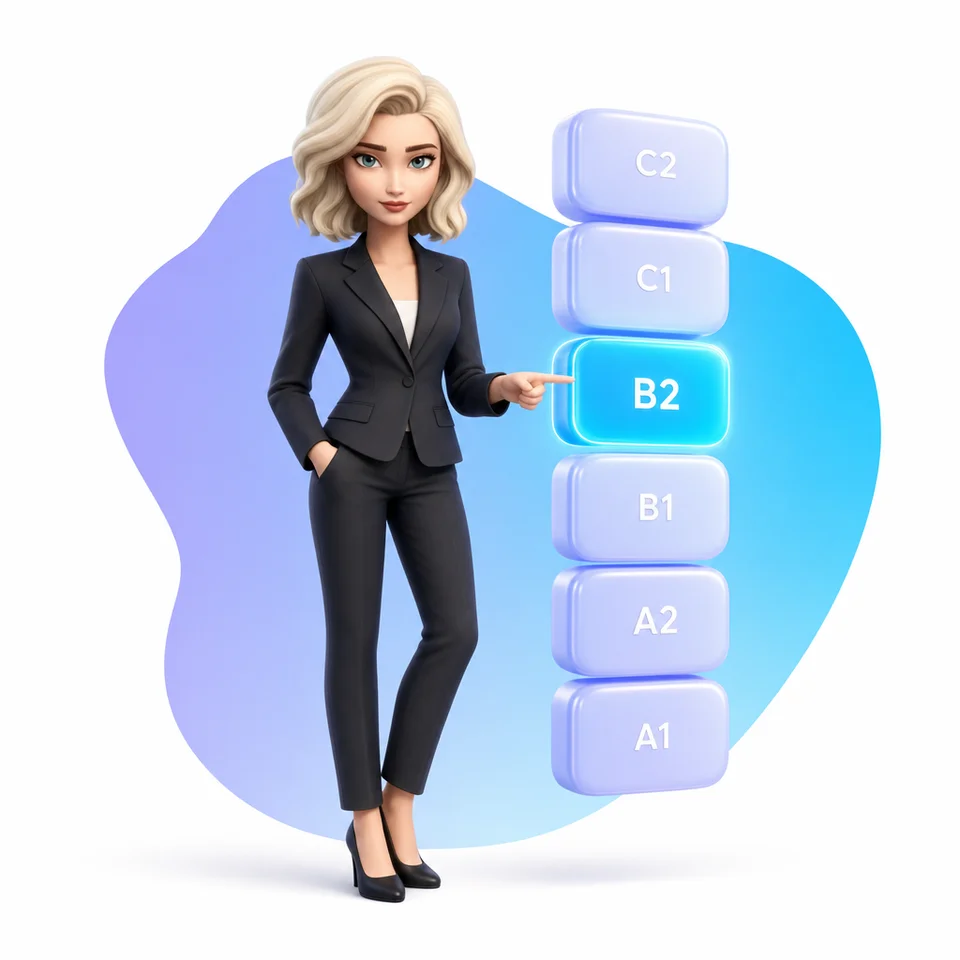
Each question is worth as many points as its level: A1 questions score 1 point, A2 questions 2 points, and so on up to 6 points for C2. Three questions per level make 63 points in total. Your band is the range your total falls into:
| Score out of 63 | Level |
|---|---|
| 0 to 6 | A1 Beginner |
| 7 to 13 | A2 Elementary |
| 14 to 24 | B1 Intermediate |
| 25 to 37 | B2 Upper intermediate |
| 38 to 54 | C1 Advanced |
| 55 to 63 | C2 Proficient |
Each cut-off sits halfway between clearing one level and clearing the next, so a learner who answers everything up to their level and guesses one harder question right stays in band. It also means two people with the same number of correct answers can get different levels: which questions you got right counts for more than how many.
The cut-offs come from the structure of the question bank, not from a calibration study against exam results, and 18 items is a small sample. Both are reasons the result is an estimate, and why the page labels it as one.
What your CEFR level means
The CEFR, the Common European Framework of Reference for Languages, is the six-level scale published by the Council of Europe that schools, employers and exam boards use to describe language ability. The summaries below paraphrase its global scale. The framework covers listening, reading, speaking and writing, while this test checked grammar, vocabulary and usage, so read the table as orientation rather than as a list of abilities you have just proved.
| Level | Council of Europe description, in short |
|---|---|
| A1 Beginner | Understands and uses familiar everyday expressions and very basic phrases; can introduce themselves and ask and answer questions about personal details; interaction works when the other person talks slowly and clearly and is ready to help. |
| A2 Elementary | Understands sentences and common expressions on matters of immediate relevance (personal and family information, shopping, work); handles simple, routine exchanges of information; describes their background and immediate surroundings in simple terms. |
| B1 Intermediate | Understands the main points of clear standard input on familiar matters at work, school and leisure; deals with most situations that come up while traveling; produces simple connected text and describes experiences, plans and opinions with brief reasons. |
| B2 Upper intermediate | Understands the main ideas of complex text, including technical discussion in their own field; interacts with enough fluency and spontaneity that regular exchanges with native speakers work without strain on either side; explains a viewpoint with the advantages and disadvantages of the options. |
| C1 Advanced | Understands a wide range of demanding, longer texts and recognizes implicit meaning; expresses ideas fluently and spontaneously without much obvious searching for words; uses language flexibly and effectively for social, academic and professional purposes. |
| C2 Proficient | Understands with ease virtually everything heard or read; summarizes information from different spoken and written sources into a coherent account; expresses themselves spontaneously, very fluently and precisely, with finer shades of meaning even in complex situations. |
Level test vs speaking test
| English level test (this page) | English speaking test | |
|---|---|---|
| Where it runs | In the browser, on this page | In the Fluently app on iOS or Android |
| What you do | Answer 18 multiple-choice questions | Talk with an AI tutor for about four minutes |
| What it measures | Grammar, vocabulary and usage | Pronunciation, fluency, vocabulary and grammar, from what you actually said |
| Result | One CEFR band and a score out of 63 | Four skill scores and an estimated CEFR level |
| Needs | Nothing: no account, microphone or time limit | The app and a microphone |
Take the level test for the overall placement, and the speaking test when the question is why meetings feel harder than emails. The two results often differ by a band, and the gap between them shows where practice time should go. Test your spoken English when you are ready, or view all English tests.
What to do after the test
| Your result | Next step |
|---|---|
| A1 or A2 | Beginner English conversation practice: short dialogues and set phrases you can use straight away, before free-form conversation makes sense. |
| B1 or B2 | Intermediate English conversation practice: longer exchanges, opinions and work situations. |
| C1 or C2 | Advanced English conversation practice: nuance, register and discussion at native speed. |
| Any level | Build a daily routine: practice English speaking with feedback after every answer, and test your spoken English to see whether your speaking matches the band. |
If pronunciation is what lets you down in conversation, start with English pronunciation practice; this test did not score it. For a routine that raises the level rather than just measuring it, read how to improve your English speaking.
How to interpret the result
Your result is an estimate of language knowledge from 18 written items. It is good at separating an A2 learner from a B2 one and weak at fine distinctions: a strong B1 and a weak B2 can land on either side of the cut-off, and a score within a point or two of a boundary (24 and 25, say) is better read as B1 to B2 than as one band.
It says nothing about listening, reading longer texts, writing or speaking. Many professionals read at B2 and speak closer to B1, because conversation adds pronunciation, listening and word retrieval under time pressure, and a written quiz cannot see that gap.
Retest after real practice, not the next day: the questions do not change, so the useful comparison is a run now and a run after a few weeks of work. The result is a free self-check, not a certificate. If an employer, university or visa office asks for your level, they will ask for a recognized exam such as IELTS, TOEFL or a Cambridge qualification, which tests all four skills under supervision; nothing on this page replaces that.
Take the test at the top of this page. 18 multiple-choice questions, free, no account, and your CEFR estimate appears on the same screen. If you already have a result, the table above gives the next step for your band.
Check the spoken half in the Fluently app
The level test covers what you know. Fluently’s free speaking assessment covers what you can say: about four minutes of spoken answers, scored for pronunciation, fluency, vocabulary and grammar, followed by daily practice aimed at the weakest of the four. Free to download on iOS and Android.


Frequently asked questions
Is the English level test free?
Yes, all of it: the 18 questions and the result, with no email, account, payment or card. The Fluently app that the result links to is a separate download with its own free speaking assessment and a paid subscription for ongoing practice; nothing on this page requires it.
Do I need an account to take the test?
No. There is no sign-in on this page, and the result appears without one. The flip side is that nothing is saved: if you want to compare runs, note your level and score before you leave.
How long does the English level test take?
There is no timer. The test is 18 multiple-choice questions on single screens, so it takes a few minutes, and you can go back to change earlier answers until you press See results.
Which skills does the test measure?
Grammar, vocabulary and usage, through written multiple-choice items: verb forms, prepositions, conditionals, word choice in context, and which sentence fits a formal message. It does not test listening, reading passages, writing or speaking, and it gives one overall band rather than a score per skill.
Is the result an official certificate?
No. It is an approximate CEFR estimate for choosing practice material and tracking progress. Employers, universities and immigration offices ask for recognized exams such as IELTS, TOEFL or Cambridge qualifications, which test all four skills under supervision.
Can I retake the English level test?
As often as you like: Retake the test resets all answers. The 18 questions stay the same, so a retake the same day mostly measures memory. A run now and a run after a few weeks of practice is the comparison worth making.
How can I test my speaking separately?
Take the English speaking test in the Fluently app: about four minutes of spoken answers to an AI tutor, scored for pronunciation, fluency, vocabulary and grammar, with an estimated CEFR level. Comparing it with this test shows whether your speaking lags behind what you know.
What happens if the test is interrupted?
Your answers live only in the open browser tab. Losing your internet connection mid-test does not matter as long as the tab stays open, because scoring happens in the page itself. If you close or reload the page, the test starts again from question 1; there is no resume, so finish in one sitting.