English Shadowing Practice: A Step-by-Step Guide and Exercises
 Yurii Rebryk · Updated September 9, 2026 · 12 min read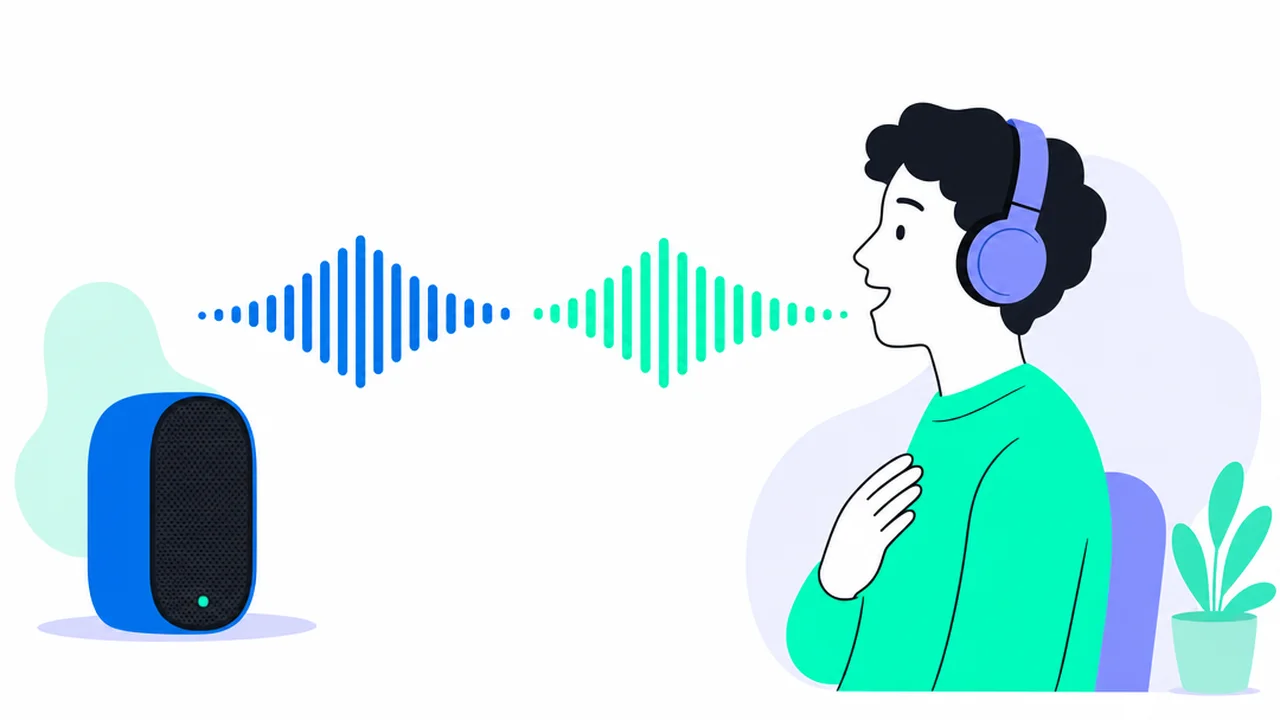
English shadowing practice means speaking along with a short recording, a fraction of a second behind the speaker, after you already understand what is being said. The target is timing rather than words: where the stress falls, how words link, which syllables almost disappear. Below you get a playable guided exercise, the eight-step method, material by level and an observable way to check progress.
In this article
- Try it now: a guided English shadowing exercise
- What is English shadowing, and what is it not?
- How to practice English shadowing step by step
- What English shadowing helps you practice: rhythm, stress, linking, weak forms
- How to choose shadowing material by level
- English shadowing practice materials: what to use and what to do with it
- A 10-minute shadowing routine and a weekly plan
- Common English shadowing mistakes
- How to check your shadowing progress
Most explanations of shadowing stop at “repeat after the audio”. The sections below go further: what the drill trains according to the research, an exercise you can run right now in the browser, the difference between a clip that works and one that wastes ten minutes, and a checklist for telling whether your shadowing is improving.
Try it now: a guided English shadowing exercise
The passage below is a 68-word voice message from a colleague, written for B1–B2 learners and full of the features shadowing is good at: linked words, weak forms, a question next to short statements. The trainer under the passage reads it with your browser’s built-in voice at normal or slow speed, records you, and reports your pace and the share of words that came through clearly (recording works in Chrome, Edge and Safari; no sign-in). Work through it in this order:
- Listen once for meaning, eyes off the text. Who is Dana, what happened, what does she want? If you can answer, the passage is at the right level.
- Read the transcript once. Check any word you are unsure of and note the contractions: it’s, I’m.
- Echo the two hardest chunks with the slow reading. Good candidates are “I just got out of the meeting” and “Could you take a look at them tonight?”. Pause after each chunk, say it, move on.
- Shadow the whole passage at normal speed, twice. Start speaking as soon as the voice starts, stay half a beat behind, and keep going when you drop a word.
- Record one shadowed run and check one feature. Suggested target: did you stress meeting, update, proposal, changes and tonight, and hurry through almost everything between them?
- Change one line. Say the last three sentences with your own details: a different document, a different deadline, a different time to talk.
Guided shadowing exercise: a voice message from a colleague
B1–B2Hey, it’s Dana. I just got out of the meeting, and I wanted to give you a quick update before you head out. The client liked the proposal, but they want to see a couple of changes to the timeline.
I’m going to send you my notes in a minute. Could you take a look at them tonight? Nothing urgent. We can talk it through in the morning.
Read it aloud
Listen to a model reading, then record yourself. You get your speaking pace, the share of words that came through clearly, and the words to repeat.
Self-check after your recording: the trainer’s word share tells you which words got lost. For the timing check, record the same run on your phone’s voice recorder, play it right after the model, and listen only for whether the stressed words land in the same places. One mismatch is the target for the next run.
The browser voice gives you a clear, even model, which is what a first attempt needs. Once the passage feels easy, shadow a person: real speakers link and reduce more freely, and that is the version you will meet in meetings.
What is English shadowing, and what is it not?
Shadowing is the act of vocalizing speech you are listening to as simultaneously as possible; that is the definition Yo Hamada and Yuichi Suzuki use in their classification of 16 shadowing techniques (RELC Journal, 2022). The technique was first used to train simultaneous interpreters and entered English teaching in Japan in the 1990s, where most of the research on it has been done since.
In practice, the shadowing technique has three moving parts. You understand the passage before you start. You speak over the recording without pausing it, staying a fraction behind the model. And you copy delivery, not only words: which syllables carry the stress, where words join, how the pitch moves at the end of a question.
The technique is easiest to define by what it is not:
- Not listen-and-repeat. Repeating after a pause is a different task: you hold the sentence in memory and reproduce it. Hamada’s summary of the research (The Language Teacher, 2021) draws exactly that line: in listen-and-repeat, attention splits between perception and recalling the sentence; in shadowing, attention goes almost entirely to the incoming sounds. Pausing is the fallback inside a shadowing session, not the drill itself.
- Not passive listening. A podcast playing in the background trains nothing about your mouth. Shadowing is production: your speech muscles run the same movements as the speaker, at the speaker’s speed.
- Not reading aloud. Reading gives you the words and lets you set your own pace. In shadowing, the recording sets the pace and you match it, which is why a shadowed run sounds more compressed and more rhythmic than the same text read from the page.
- Not accent replacement. The goal is intelligible timing and clearer speech. In the best-known study of shadowing for pronunciation, listeners rated learners as more comprehensible and more fluent, while the accent rating did not change (details in the research section below).
| Activity | When you speak | What it mainly trains |
|---|---|---|
| Shadowing | Over the audio, a fraction behind the speaker, without pausing | Perception of fast speech, timing, stress and linking |
| Listen-and-repeat | After the sentence ends, with the audio paused | Accuracy on individual sounds and words; memory for the sentence |
| Listening | You do not speak | Comprehension |
| Reading aloud | At your own pace, from text | Articulation and word stress, without a timing model |
How to practice English shadowing step by step
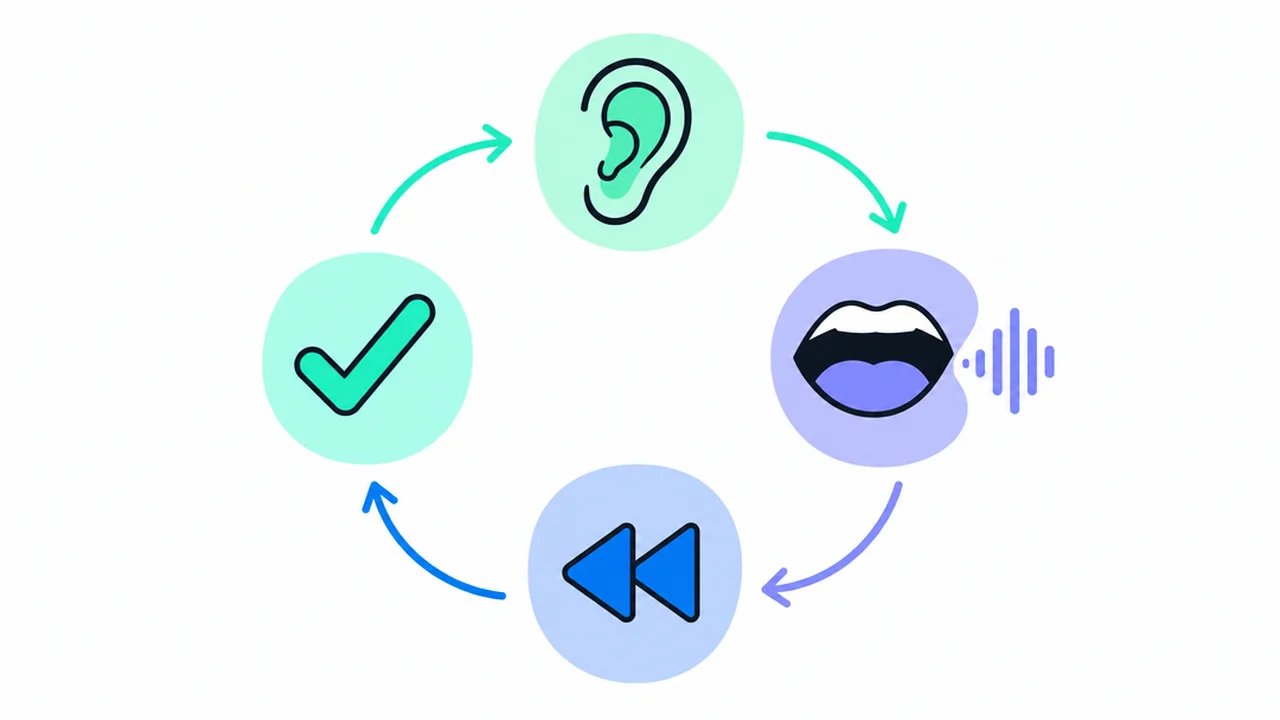
One clip, eight steps, ten to fifteen minutes. Each step ends with a result that tells you whether you are ready for the next.
1. Choose a short, clear clip
Pick 30–60 seconds of one speaker, with no music and a transcript you trust. Note its level, topic and accent before you start; the American English voice message above is one option, and the material section below lists more. Result: you can name the speaker, the topic and the length in one sentence.
2. Listen for meaning first
Play the clip once or twice without the text and without speaking. Result: you can say what the speaker wants and why. If you cannot, the clip is too hard for shadowing today; keep it for listening practice.
3. Check the transcript and vocabulary
Read the transcript once, resolve every unknown word, and mark the contractions and reductions you expect (going to becoming gonna, a couple of losing its final sound). Do not read aloud yet. Result: nothing in the text is a surprise.
4. Echo the difficult chunks
Play the two or three hardest phrases one at a time, pause, and say each one. Use slow playback here if you need it. Result: every chunk can be said at something close to natural speed.
5. Shadow just behind the speaker
Play the whole clip at normal speed and speak along, about half a syllable behind. Use headphones, or one earbud in and one ear free, so you hear the model over your own voice. Drop words rather than stopping. Result: two uninterrupted runs, however imperfect.
6. Compare one observable feature
Record a run and check one criterion only: the stressed words, the linking between two specific words, the rise on a question, or a clear final consonant. Result: one concrete difference between the model and you, written down.
7. Repeat at natural speed
Shadow the clip again with that single correction in mind. Do not slow the audio down for this run. Result: the difference you noted is smaller, and the run stays uninterrupted.
8. Change or answer one line
Take one sentence from the clip and make it yours: swap the details, or answer it as if the speaker were talking to you. Result: a sentence with the clip’s rhythm and your own content, which is the whole reason for the exercise.
What English shadowing helps you practice: rhythm, stress, linking, weak forms
Shadowing works on the layer of speech that word lists never touch. Shuhei Kadota’s book on shadowing (Routledge, 2019) separates four effects: an input effect on listening comprehension, a practice effect on holding new words and phrases in phonological memory, an output effect on stages of speech production, and a monitoring effect on noticing your own speech. For a learner, those translate into five things to listen for.
| Feature | What to notice | Where it is in the guided passage |
|---|---|---|
| Sentence stress and rhythm | English stretches the stressed syllables and squeezes everything between them; the beats fall on content words. | “I just got OUT of the MEETing” and “a QUICK UPdate”: two or three beats per phrase, the rest hurried. |
| Linking | A final consonant joins the next vowel, so word boundaries move. | “got out of” sounds like go-dou-dof rather than three separate words; “take a look at them” runs as one chain. |
| Weak forms | Function words shrink to a short, neutral vowel: to, of, and, can, them. | “wanted to”, “a couple of changes”, “we can talk it through”. |
| Reductions and flaps | Casual American speech turns a t between vowels into a quick d-like tap and merges common pairs. | “got out” and “meeting” with a tapped t; “going to” often becomes gonna. |
| Intonation | Yes/no questions rise at the end; statements and short closers fall. | “Could you take a look at them tonight?” rises; “Nothing urgent.” drops. |
Two findings set realistic expectations. Jennifer Foote and Kim McDonough (Journal of Second Language Pronunciation, 2017) had 16 learners shadow dialogues for eight weeks, at least four times a week for a minimum of ten minutes; 22 listeners rated recordings before, midway and after. Comprehensibility and fluency improved significantly. Accentedness did not.
Yo Hamada (Language Teaching Research, 2016) ran nine shadowing lessons with 43 Japanese university learners. Phoneme perception improved in both the lower- and the intermediate-proficiency group, but only the lower group improved on the listening comprehension test. Shadowing sharpens how you hear fast speech, and the biggest listening gains go to learners who still struggle to catch words.
What shadowing does not train is retrieval. The words are handed to you, so no session teaches you to find them under pressure; that is the job of conversation practice, and the reason a shadowing routine needs a speaking task attached. For individual problem sounds, the sentence-level drill also runs too fast to fix a single vowel; the English pronunciation practice guide covers minimal pairs and stress drills for that.
How to choose shadowing material by level
The clip decides most of the outcome. Level, in CEFR terms, sets how long, how fast and how reduced the speech can be; the free English level test gives an estimate in a few minutes if you are unsure. The Council of Europe’s CEFR Companion Volume (2020) describes B1 pronunciation as generally intelligible, with stress and intonation that do not prevent understanding, and B2 as generally appropriate intonation with correctly placed stress. Shadowing is the drill that moves you from the first description to the second.
| Level | Clip | Speaker and support | One target per session |
|---|---|---|---|
| A2 (beginners) | 15–30 seconds, everyday topic, simple sentences | One slow, clear speaker; transcript visible; echo every chunk before the first full run | Word stress and clear word endings (-s, -ed) |
| B1 | 30–45 seconds, a story or an update | Natural pace; transcript for the first passes only | Sentence stress and the most common weak forms |
| B2 | 45–60 seconds, an opinion or an explanation | Natural pace with reductions; transcript only to check | Linking across word boundaries and thought groups |
| C1 | 60–90 seconds, dense or fast speech | A different speaker each week; no transcript on the final runs | Intonation that carries contrast and emphasis; independent variation |
Hamada’s review of shadowing research (RELC Journal, 2018) recommends that beginners start with shadowing for listening, quietly and with an easy text, and move to shadowing for pronunciation once they can follow the audio. The A2 passage below is built for that first stage; the B2–C1 passage after it adds contrast, hedging and longer thought groups.
Beginner shadowing passage: a short self-introduction
A2My name is Leo, and I work in a small office near the train station. Most days, I get up at seven, make coffee, and check my email. I usually walk to work because it takes only twenty minutes. It’s a nice way to start the day. On Fridays, we finish early and have lunch together.
Read it aloud
Listen to a model reading, then record yourself. You get your speaking pace, the share of words that came through clearly, and the words to repeat.
Advanced shadowing passage: explaining a decision
B2–C1Honestly, I went back and forth on this for a couple of weeks. The original plan was to launch everything at once, which sounded efficient on paper. But the more I looked at the numbers, the less convinced I was. If one piece failed, we wouldn’t have known which one.
So we split the rollout into three stages, and I think that was the right call, even though it pushed the final date back by almost a month. Fewer surprises, and a lot less stress.
Read it aloud
Listen to a model reading, then record yourself. You get your speaking pace, the share of words that came through clearly, and the words to repeat.
Whatever the level, a clip you can shadow has the same four properties: one speaker, no music or cross-talk, a transcript, and the accent you want to sound closer to. Choose one reference accent and stay with it for a few weeks; the passages on this page are written for an American English model, and British or other varieties work the same way once you pick one.
English shadowing practice materials: what to use and what to do with it
Every item below names a level, a length, a model and one action, so choosing the next clip takes under a minute. Items on this site work in the browser without an account; the rest are types of recording you already have access to. Use recordings you can legally listen to, and nothing you shadow ever needs to be published.
TV dialogue works for shadowing once you can follow an episode with English subtitles. Four quote pages give short lines from series with the hard words transcribed and the stress marked: Money Heist quotes, The Rookie quotes, Lucifer quotes and quotes from the Netflix series Dahmer – Monster.
| Material | Level | Length | Model | What to do |
|---|---|---|---|---|
| Guided voice message (this page) | B1–B2 | 68 words, about 30 seconds | Your browser’s English voice | The full eight steps; reuse for two or three sessions |
| Beginner self-introduction (this page) | A2 | 57 words, about 25 seconds | Your browser’s English voice | Echo each sentence at slow speed, then two full runs at normal speed |
| Advanced decision passage (this page) | B2–C1 | 85 words, about 40 seconds | Your browser’s English voice | Shadow without the text on the last run, then retell the decision in your own words |
| English speaking practice texts | By level | Short monologues | Read-aloud trainer with a model reading | Pick one text at your level and run steps 2–8 on it |
| Intermediate English conversation | B1–B2 | Short two-person dialogues | Everyday and work exchanges | Shadow one speaker’s lines, then say them without the audio |
| A podcast episode with a transcript | B1+ | Cut 30–60 seconds of one speaker | The host you want to sound like | Loop the cut for a week; drop the transcript on the final runs |
| An audiobook sample or a narrated article | B2+ | 45–60 seconds | A professional narrator with clear articulation | Use for stress and thought groups; narration is too even for reductions |
| A talk or interview with captions | B2+ | 30–45 seconds | A real speaker with natural reductions | Best for linking and weak forms; check the captions against the audio first |
| A voice message or meeting recording you already have | B1+ | 20–40 seconds | A colleague whose register you need | Ask before recording anyone; shadow the exact phrases you will reuse at work |
A 10-minute shadowing routine and a weekly plan
A session does not need more than ten minutes if every minute has a job. The split below is a working example, not a fixed prescription:
- Minutes 1–2: listen. Two plays of the clip without the text, then one with it.
- Minutes 3–4: notice and chunk. Mark the stressed words, echo the two hardest phrases.
- Minutes 5–7: shadow. Three uninterrupted runs at normal speed.
- Minutes 8–9: compare and repeat. Record one run, check one feature, shadow once more with the fix.
- Minute 10: transfer. Change or answer one line out loud.
Across a week, the plan follows two numbers from the research. Foote and McDonough’s learners practiced at least four times a week for at least ten minutes, and Hamada’s 2021 procedure notes that gains from one script flatten after about five runs, citing Shiki and colleagues (2010). So: four to five sessions a week, two clips per week, each clip used for two or three sessions.
| Day | Clip | Focus |
|---|---|---|
| Monday | Clip 1, first session | Steps 1–5: meaning, transcript, chunks, two full runs |
| Tuesday | Clip 1, second session | Steps 5–8: three runs, record, one fix, one changed line |
| Wednesday | Clip 1, third session | Runs without the transcript; record the best one and keep it |
| Thursday | Clip 2, first session | New clip, same level, a different speaker if possible |
| Friday | Clip 2, second session | Record, fix, transfer; answer the clip in your own words for 30 seconds |
| Weekend | Optional | Re-shadow last week’s clip once and notice what has become easy |
Shadowing fits best as the first ten minutes of a longer speaking session, because the rhythm you just copied carries into whatever you say next. The daily English speaking practice plan shows where those ten minutes sit in a full routine.
Common English shadowing mistakes
Shadowing fails in predictable ways, and most of them look like effort:
- Clips that are too long or too fast. A five-minute episode invites mumbling along with the audio on. If you cannot hear the structure of a sentence, you cannot copy it; cut one clean minute and work that.
- Skipping comprehension. Shadowing text you do not understand turns into noise imitation. Hamada’s procedure puts learning the content, or choosing an easy text, before the first pass.
- Reading instead of listening. With the transcript in front of you on every run, your eyes set the pace and the audio becomes background. Use the text for the first passes, then hide it.
- Staying slow. Slow playback is a bridge for hard chunks. If every run is at reduced speed, you are training a rhythm nobody speaks.
- Chasing single sounds. At full speed there is no attention left for one vowel. Fix stubborn sounds separately with minimal pairs, then bring them back into the clip.
- Chasing accent erasure. The measurable outcomes are comprehensibility and fluency. A learner who sounds clearer and keeps their accent has succeeded.
- Never transferring the line. A session that ends with imitation trains imitation. Step 8 exists so that the rhythm shows up in your own sentences.
- Making it the whole practice. Shadowing hands you the words. It cannot teach you to find them; conversation does that, and the guide to practicing English speaking alone shows how to build the rest of a solo session around it.
How to check your shadowing progress
Progress in shadowing is audible within a few weeks if you measure the same clip the same way. Keep one benchmark clip, record a shadowed run of it in week one, and record it again every two weeks. Then go through the checks below; each one is something you can hear or count, not a feeling.
| Check | How to test it | What improvement sounds like |
|---|---|---|
| Timing gap | Shadow at normal speed without the text | You stay half a syllable behind through the whole clip instead of falling a sentence behind |
| Stress placement | Play the model and your phone recording back to back | The loud syllables land in the same places; the small words stay small |
| Linking | Listen for the two chains you marked (for example “got out of”) | They come out as one movement, not three words with gaps |
| Words that came through | The share reported by the trainer after a recording | The percentage rises on the same passage; the “words to repeat” list shrinks |
| Pace | The words-per-minute figure from the trainer | Your pace on the passage moves toward the model’s and stays steady across runs |
| Transfer | Say a changed line without the audio | Your own sentence keeps the clip’s rhythm; a weak form shows up without planning |
None of the checks needs a score from software, but feedback after you speak shortens the loop. Fluently, the app we build, is a speaking coach rather than a shadowing tool: you hold a conversation or a role-play on a work topic, and after each answer it points out what to fix in pronunciation, fluency, vocabulary and grammar. Shadowing before a session, then speaking freely inside it, is the pairing that moves copied rhythm into your own speech.
Put the rhythm you copied into a real conversation
Shadow a clip for ten minutes, then open Fluently and talk: a meeting update, an interview answer, a role-play on the topic you just shadowed. After each answer you get feedback on pronunciation, fluency, vocabulary and grammar, so the timing you practiced shows up in sentences you build yourself. Free to download on iOS and Android, with a free 4-minute speaking assessment to start.


Frequently asked questions
Is shadowing the same as repeating after the speaker?
No. In repeating, you pause the audio and reproduce the sentence from memory; in shadowing, the audio keeps playing and you speak over it a fraction behind. Hamada’s summary of the research separates them by where attention goes: repeating spends part of it on recalling the sentence, shadowing spends almost all of it on the incoming sounds. Use pause-and-repeat for the two or three hardest chunks, then return to continuous shadowing at normal speed.
Is English shadowing good for beginners?
Yes, with the right clip and the right goal. Hamada’s 2018 review recommends that beginners start with shadowing for listening: an easy, short text, understood first, shadowed quietly to sharpen perception. In his 2016 study, the lower-proficiency group was the one whose listening comprehension improved. Choose 15–30 seconds of one slow, clear speaker, keep the transcript visible, echo each chunk before a full run, and move to pronunciation-focused shadowing once you can follow the audio comfortably.
How long should I practice shadowing each day?
Ten to fifteen focused minutes is a full session; the drill demands continuous attention and quality drops fast once you tire. The strongest evidence on pronunciation gains comes from learners who practiced at least four times a week for a minimum of ten minutes over eight weeks. Frequency matters more than length: five ten-minute sessions across the week beat one hour on Sunday.
Should I use a transcript for English shadowing?
Use it early and drop it later. Read the transcript before the first shadowing pass to resolve vocabulary and spot contractions, keep it visible for the first one or two runs if you cannot keep up, then hide it. Shadowing with the text on every run turns into reading aloud: your eyes set the pace, and the audio stops being the model. Clips with no reliable transcript are better used for listening practice.
Can I slow the audio down when shadowing?
Yes, for specific chunks, not for whole sessions. Slow playback is the fallback for a phrase you cannot catch at natural speed: echo it slowly, then go straight back to normal speed for the full runs. Staying slow trains a rhythm nobody uses and removes the timing pressure that makes shadowing work. In the trainer above, use the slow reading for the chunk step and the normal reading for everything else.
Does shadowing improve speaking or only pronunciation?
Both, within limits. In the Foote and McDonough study, listeners rated learners as more comprehensible and more fluent after eight weeks of shadowing, so delivery improved on two counts, not one. What shadowing does not build is the ability to find words and build sentences under pressure, because the words are supplied. Pair it with conversation practice: shadow for ten minutes, then speak freely on the same topic so the rhythm you copied carries into speech you produce.