Daily English Speaking Practice: A Simple 15-Minute Routine
 Yurii Rebryk · Updated August 30, 2026 · 11 min read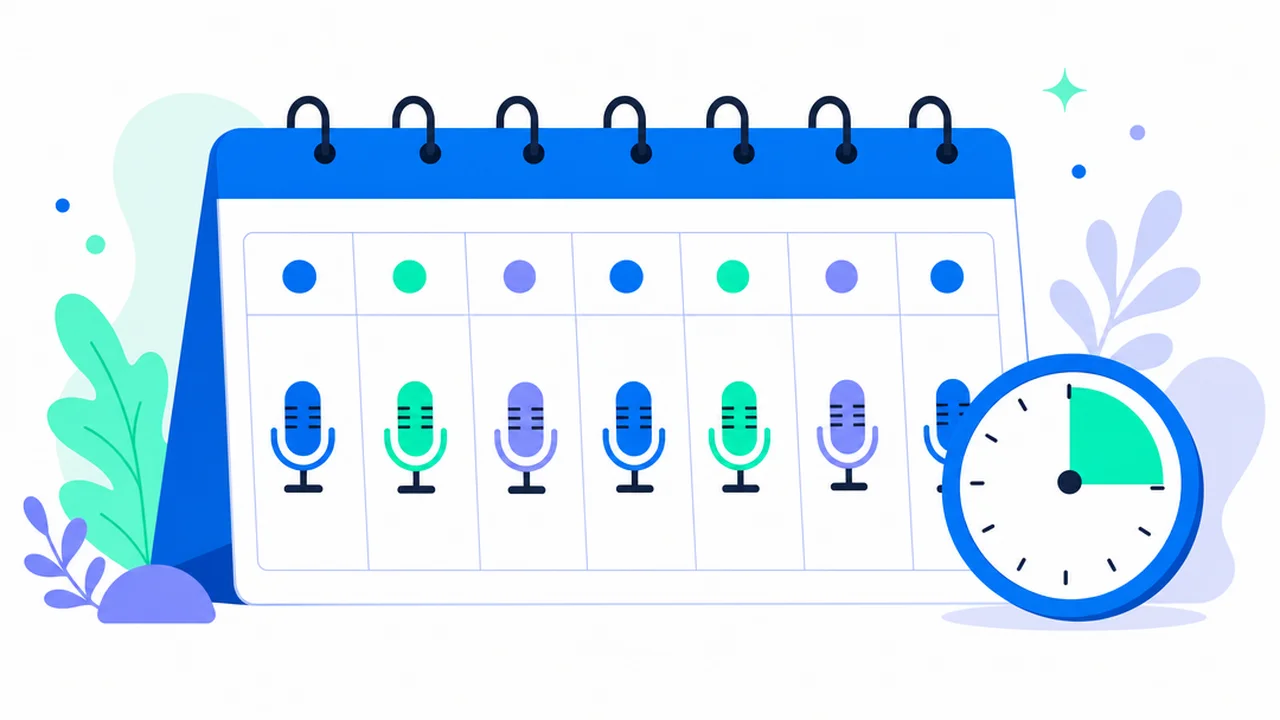
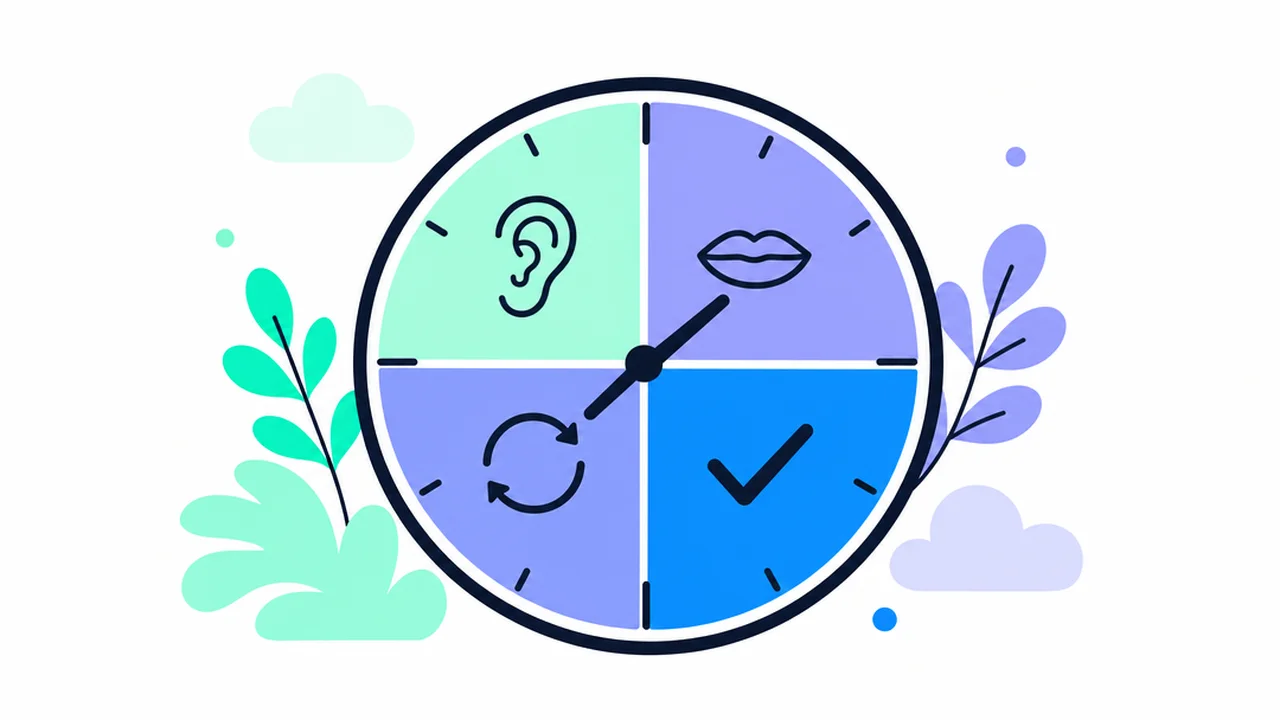
Daily English speaking practice works when the session is short enough to repeat and every minute ends in speech. The routine below takes 15 minutes: read a short text aloud (3 minutes), drill one speaking skill (4), answer a realistic prompt in real time (5), then review one thing and repeat the task (3). A weekly plan rotates the focus without changing the structure, and every block runs alone.
In this article
The table is the whole routine; start with it today. The sections below add model texts, worked examples and the weekly rotation.
| Block | Minutes | What you do | Check one thing |
|---|---|---|---|
| 1. Warm up and read aloud | 3 | Read a short text out loud twice: once for comfort, once for phrasing. | Did you finish every sentence without restarting? |
| 2. Practice one speaking skill | 4 | Shadow a sentence, expand a phrase or retell the facts of the text, always out loud. | Did the target phrase appear in a sentence of your own? |
| 3. Respond or role-play in real time | 5 | Answer a realistic prompt for about a minute, then two follow-ups; paraphrase around missing words. | Did you keep talking when a word was missing? |
| 4. Review one thing and repeat | 3 | Pick one criterion, repeat the block-3 task once, compare the two attempts. | Was the repeat better on that one thing? |
Your 15-minute daily English speaking routine
The four blocks are a sequence, not a menu: the warm-up puts fresh phrases in your ear, the skill block turns one of them into an exercise, the response block uses it under light pressure, and the review block turns the session into a correction. One example runs through all four: a colleague visiting from another office asks where to go for lunch.
1. Warm up and read aloud (3 minutes)
Trains: a comfortable pace and clear phrasing, not perfect pronunciation. First pass for comfort: easy speed, no self-correction. Second pass for phrasing: group words into chunks and pause at meaning boundaries, not after every word.
Use the passage below or any short paragraph you were going to read anyway: a news item, a work message, a review. Listen to the model reading first, then record your two passes.
Warm-up text: the lunch place near the office
A2–B1There is a small Vietnamese place two blocks from our office, on the corner by the pharmacy. It opens at eleven thirty, and the line gets long after twelve fifteen. Most people order the chicken noodle soup, which comes with fresh herbs and lime on the side. The staff are quick, so you can be back at your desk in forty minutes. If you want a table by the window, go early or go late.
Read it aloud
Listen to a model reading, then record yourself. You get your speaking pace, the share of words that came through clearly, and the words to repeat.
Check one thing: did you finish every sentence without restarting? If not, slow the first pass down tomorrow. The trainer shows your words per minute; a steady number matters more than a high one. For more texts at your level, the English speaking practice texts are graded and written to be read aloud.
2. Practice one speaking skill (4 minutes)
Trains: one sub-skill at a time, reproduced out loud rather than recognized silently. Choose one exercise, not three.
- Phrase expansion (the default). Take one sentence from the warm-up text and say it three more times, adding something each time.
- Short shadowing. Replay one sentence of the model reading and say it a beat behind, matching the stress and rhythm. The full method is in the English shadowing practice guide.
- Retrieval. Close the text and say five things it told you about the place, in your own sentences.
Phrase expansion, worked through with “The line gets long after twelve fifteen”:
- Add a reason: “The line gets long after twelve fifteen, because three offices nearby all break at twelve.”
- Add a detail: “The line gets long after twelve fifteen, especially on Fridays, when the special is pork belly.”
- Add a recommendation: “The line gets long after twelve fifteen, so if you hate waiting, order for pickup on the way over.”
Planned in your head does not count; every version must be spoken. Check one thing: did the target phrase appear, correctly, in a sentence of your own? That transfer is the whole job of the block.
3. Respond or role-play in real time (5 minutes)
Trains: retrieving language under light pressure, plus the most useful conversation skill there is: paraphrasing around a missing word instead of stopping.
The prompt: a colleague visiting from another office asks, “Where should we go for lunch today?” Listen to the model answer once, then record your own, about a minute long, about a real place near you. Do not copy the model; borrow its shape: a recommendation, one reason, one practical detail, a question back.
Model answer: “Where should we go for lunch today?”
B1Good question. There is a Vietnamese place about two blocks from here that I would recommend. It is small, so if we leave at twelve we will get a table without waiting. The soup is the thing to order: it is big, it is fresh, and it is not heavy, so nobody falls asleep in the afternoon meeting. If you would rather have something quick, there is also a sandwich counter on the ground floor of our building, but honestly it is nothing special. One more thing: the Vietnamese place takes cash or card, no app payments, so bring a card. Shall I book us a table, or do you want to just walk over at twelve?
Read it aloud
Listen to a model reading, then record yourself. You get your speaking pace, the share of words that came through clearly, and the words to repeat.
Then ask two follow-up questions out loud and answer them: “How do we get there?” and “Is there anything vegetarian?” Saying the question aloud matters, because questions have their own grammar and rhythm.
When a word is missing, describe around it (“the machine where you pay”) and keep going. Check one thing: did you keep talking, or stop to search for the word? One prompt per session is enough; when yours start to repeat, the library of English conversation topics has months of material.
4. Review one thing and repeat (3 minutes)
Trains: turning practice into correction, the difference between talking daily and improving daily. One minute to choose, two to repeat.
Pick exactly one criterion and judge the session against only that:
- Hesitation: how many sentences did you restart?
- Clarity: which sentence would a stranger ask you to repeat?
- Target phrase: did the phrase from block 2 show up?
- Filler word: count one filler (“like”, “you know”, “so”) and nothing else.
- Recurring error: one grammar slip that appeared twice.
Then answer the block-3 prompt once more with that single fix in mind, and compare attempt two with attempt one. That comparison is the day’s entire progress measure, and it takes ten seconds. In the running example you noticed “like” opening almost every sentence; the repeat tracks only that.
The repeat is the step most learners skip, and it has the clearest evidence behind it. In a classroom experiment reported in Language Learning, 24 ESL students gave three speeches of 4, 3 and 2 minutes per session. The group that repeated the same speech paused for shorter stretches, filled more of the time with speech, and kept those gains on tests one and four weeks later, on new topics; the group that spoke on three different topics lost its gains after training ended (de Jong and Perfetti, Language Learning, 2011).
A weekly English speaking practice plan
The daily structure never changes; the weekly plan changes what blocks 2 and 3 focus on. Start on any day, and if a focus produced a clear improvement, repeat it the next day instead of moving on.
| Day | Focus | What changes in blocks 2 and 3 | Example prompt |
|---|---|---|---|
| Monday | Fluency and word retrieval | A familiar prompt in block 3; the repeat aims at fewer avoidable pauses. | “Talk me through your workday yesterday, start to finish.” |
| Tuesday | Clarity and imitation | Block 2 becomes short shadowing of the model reading; reuse one phrase in an original answer. | “Describe the area around your office to someone who has never been there.” |
| Wednesday | Role-play | Block 3 becomes a two-role dialogue; play both sides when you have no partner. | Moving a meeting (the dialogue below). |
| Thursday | Summarize and explain | Block 3 retells a short article or explains a process, without a script. | “Explain how your team decides what to work on next.” |
| Friday | Spontaneous response | Block 3 is two or three follow-up questions you did not prepare. | “What would you change about your commute, and why?” plus two follow-ups invented on the spot. |
| Weekend | Review or rest | A short free-choice session, a look through the session log, or a day off. | Your choice, or nothing. |
Wednesday’s role-play is ready below. Listen to the whole exchange, then take Nadia’s role or Chris’s; alone, run it twice and switch roles.
Wednesday role-play: moving a meeting
A2–B1- Nadia
Hi Chris, do you have a minute? I need to ask about tomorrow’s planning meeting.
- Chris
Sure. What’s up?
- Nadia
A client call just landed at ten, right when the meeting starts. Could we move it to eleven?
- Chris
Eleven is tight for me. I have a dentist appointment at twelve. Would two o’clock work?
- Nadia
Two works for me. Should I update the invite, or will you?
- Chris
I’ll do it now. Same room, same agenda?
- Nadia
Same agenda, but let’s keep it to thirty minutes so you’re not late for the dentist.
- Chris
Perfect. See you at two.
Practise this dialogue
Listen to the whole exchange, then take one role: your partner’s lines are read aloud, you say yours into the microphone and see which words came through.
Then change one variable and improvise the same conversation: the meeting moves to Friday, or Chris cannot do two o’clock either. The improvised version is the real practice; the scripted one is its warm-up.
How to adapt the routine to your time and level
Shorten by removing blocks, never by removing spoken output or the review. A short session that ends in a spoken repeat counts; a long silent one does not.
- 5 to 10 minutes: 2 minutes of read-aloud, 4 on the prompt, 2 of review and repeat. Block 2 goes first, because block 3 already forces retrieval.
- Beginner (A1 to A2): short prompts about concrete, familiar things (your street, your last meal, your desk); prepare the answer before saying it, and say it twice. Keep the review to one question: did I finish my sentences? Role-play can wait a few weeks. If you are not sure of your level, the free English level test places you on the CEFR scale in 18 questions.
- No partner: the routine already runs solo: read aloud, shadow the model reading, speak both roles in the role-play, and use the trainers on this page to hear your attempts. For the complete solo system, with self-talk, recording and a feedback loop you build alone, see how to practice English speaking alone.
- 20 to 30 minutes: extend block 3 to two or three prompts and run a second review-and-repeat cycle. More speaking without more review is how sessions grow to forty minutes while progress stays flat.
How to track progress, build the habit and avoid mistakes
A one-line session log and a weekly check-in
Keep one line per day: the date, the prompt, the review target, and a note about the repeat. For example: Sep 2 · “Where should we go for lunch?” · filler word “like” · repeat had 2 instead of 7. Thirty seconds, and you have a record you can check.
Once a week, read the log for signals you can observe, not feelings:
- Longer uninterrupted answers on the same kind of prompt.
- Fewer avoidable pauses in the repeat than in the first attempt, week after week.
- Clearer delivery: fewer sentences you would want to say again.
- Faster paraphrasing when a word is missing.
Once a month, add an outside reference: the free English speaking test scores a short recording on pronunciation, fluency, vocabulary and grammar, so you can see which of the four moved. Nobody can promise a fixed date for fluency; starting levels and daily exposure vary too much. The log gives you evidence of movement, which is what keeps a habit alive.
How to make daily English speaking practice a habit
Habits form through repetition after the same cue, and the timeline is longer than the popular “21 days”. In a habit-formation study by Phillippa Lally and colleagues, volunteers repeated a self-chosen daily behavior after one fixed cue, such as after breakfast. Automaticity rose quickly at first and plateaued after an average of 66 days, sooner for simple actions than for elaborate routines, and missing the occasional day did not seriously impair the process (Gardner, Lally and Wardle, British Journal of General Practice, 2012).
Three rules follow:
- Anchor the session to a cue that already exists: after the first coffee, right after closing the laptop. A cue inside an existing daily routine is the starting point the same study recommends.
- Prepare tomorrow’s prompt at the end of today’s session, so starting takes zero decisions.
- Keep the minimum small enough for your worst day. Five minutes done beats forty planned, and simple actions become automatic sooner than elaborate ones.
Short and daily also beats long and weekly for a memory reason. A meta-analysis of 317 experiments on distributed practice found that spreading study over separate occasions beat massing the same total time into one in all but 12 of 271 comparisons, whether the test came a minute later or more than a month later (Cepeda et al., Psychological Bulletin, 2006). The studies cover verbal recall rather than speaking, but the phrases you retrieve in block 3 are that kind of material. Five 15-minute sessions across a week are five spaced occasions; one 75-minute Sunday session is one.
If you miss a day: do the next feasible session at its normal length. Do not double the workload, and do not restart the week; the rotation has no required starting day.
Mistakes that quietly end daily speaking practice
- Correcting everything at once. One review target per session; the rest waits its turn.
- Overloading beginners with long prompts. A two-sentence answer said twice beats a two-minute answer said badly once.
- Turning the session into grammar study. Look the rule up afterwards; the fifteen minutes are for speaking.
- Counting passive input as practice. Watching, silent reading and listening count only when they end in spoken production.
- Changing the prompt while the old one is still improving. Move on when the answer feels automatic, not before.
- Tracking minutes instead of change. “I practiced 15 minutes” measures effort; the log measures what changed.
Give block 3 a partner that answers back
Real-time response is the hardest block to run alone, because nothing replies. Fluently is an AI speaking coach for exactly that slot: you hold a voice conversation or role-play on an everyday or work situation, and after each answer it shows what to fix in your pronunciation, fluency, vocabulary and grammar, so block 4 has a specific target. Start with the free 4-minute speaking assessment; the app is on iOS and Android, with a trial and then a subscription.


Fifteen minutes is small on purpose: one text, one skill, one prompt and one correction, most days, with a log that shows whether it is working. Start with the warm-up text above; tomorrow’s session is already planned.
Frequently asked questions
How can I practice English speaking every day?
Fix the routine so you never plan from scratch: read aloud, one skill, one real-time prompt, one review and a repeat. Tie it to a cue that already exists in your day and prepare the next prompt at the end of each session. The trainers on this page cover the first week; after that, rotate prompts from the conversation topics library.
Is 15 minutes of English speaking practice enough?
Yes, if all fifteen minutes end in spoken output and the session closes with a review and a repeat. Spacing research favors frequent short sessions over rare long ones for the same total time, and a short session also keeps your attention on one fix. Extend it when you want to, but protect the daily minimum first.
What should a beginner practice first?
Reading aloud and short prepared answers, not open conversation. Use two- or three-sentence prompts about familiar, concrete things, say each answer twice, and keep the review to one question: did I finish my sentences? Add the role-play block once prepared answers feel comfortable, usually after a few weeks.
Can I follow this routine without a speaking partner?
Yes. Reading aloud and shadowing need no partner, the model answer gives you something to listen to before you speak, and in the role-play you say both sides, switching roles on the second run. An AI conversation partner adds unpredictable replies to block 3 if you want them, but the routine does not depend on one.
What should I do if I miss a day?
Do the next feasible session at its normal length. In the habit study above, a single missed day did not seriously slow habit formation, so there is nothing to catch up on; doubling the workload only makes the next session harder to start. The rotation has no required starting day, so continue with whichever focus is next.
Should I practice the same topic or change topics every day?
Repeat a prompt while it is still producing improvements: a second day with fewer pauses is exactly the progress you want, and repeated speeches are what kept fluency gains in the classroom study above. Change the prompt once the answer feels automatic, because a new topic forces new word retrieval. The weekly plan rotates the focus of the session, not only the topic.