20 Scaffolding Interview Questions and Answers for Scaffolders and Trade Tests
 Yurii Rebryk · Updated September 20, 2026 · 20 min read
Scaffolding interview questions and answers cover four areas: your experience, scaffold parts and types, safety and inspection rules, and supervision for senior roles. Below are 20 questions with sample answers in short spoken English, quick trade-test answers and a rules table by country. Technical answers quote OSHA, the UK Work at Height Regulations and Abu Dhabi’s scaffolding code, because the numbers differ by site. Numbers in sample answers are examples: use your own.
In this article
- What a scaffolding interview or trade test checks
- Scaffold parts and their names in UK and US English
- Scaffolder interview questions about your experience (1–6)
- Technical scaffolding questions and answers (7–12)
- Scaffolding safety and inspection questions (13–17)
- Scaffolding supervisor and inspector interview questions (18–20)
- Scaffold trade test questions and short answers
- Scaffolding rules by country: the numbers in one table
- How to practice scaffolding answers out loud
What a scaffolding interview or trade test checks
A scaffolding interview checks that you have done the work you claim and that you will be safe from day one. The technical part, spoken or written, covers parts, loads, inspections and fall protection; some employers add a practical task, such as finding faults in a bay.
Expect many safety questions. In the US alone, the Bureau of Labor Statistics recorded 52 fatal falls to a lower level from scaffolding in 2020, a figure OSHA quotes on its scaffolding safety page.
The numbers depend on where you work. The answers below quote three free rulebooks: OSHA’s scaffold standard for US construction (29 CFR 1926.451), the UK Work at Height Regulations 2005 and Abu Dhabi’s Code of Practice 26.0, Scaffolding (version 4.1, February 2026). Sites in Saudi Arabia, Qatar, India, the Philippines and elsewhere follow national rules and often the client’s own standard, so confirm the numbers with the employer. If a number surprises you, ask: “Which standard does this site follow?”
In education, “scaffolding questions” means breaking a question into smaller steps. This page is about scaffolds on construction and industrial sites.
Scaffold parts and their names in UK and US English
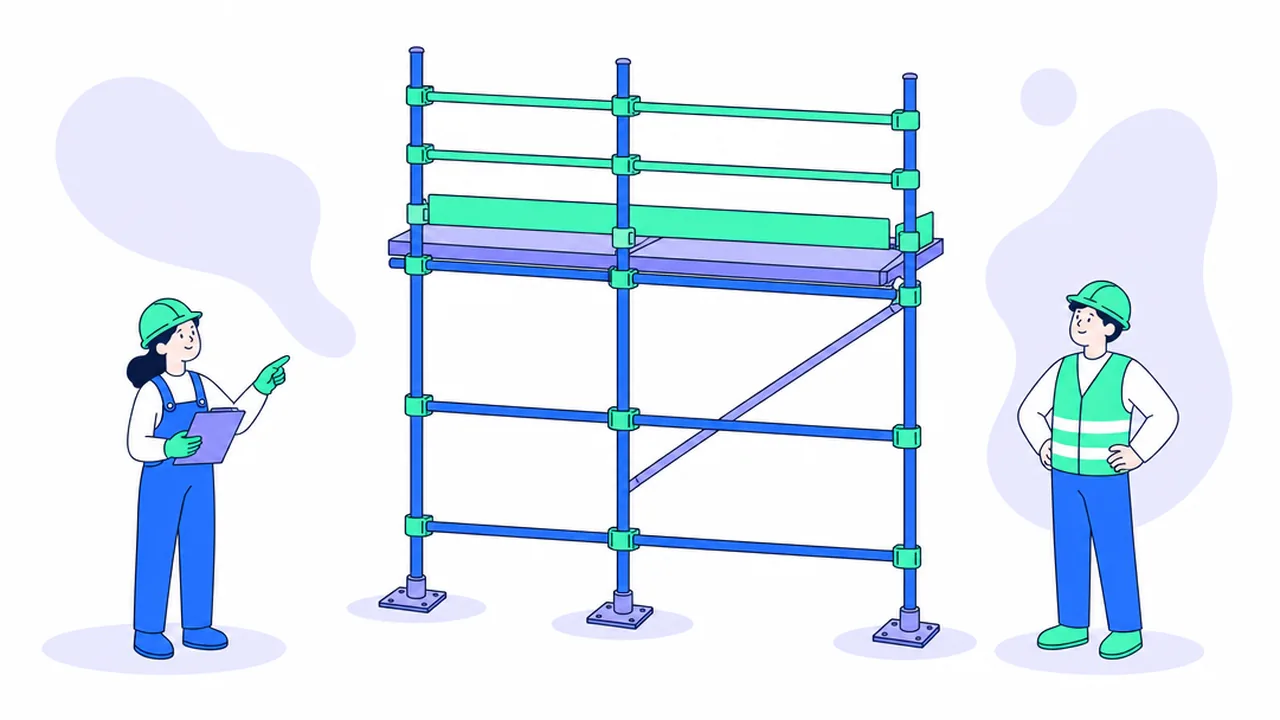
Question lists for scaffolders usually begin with the parts: name it, say what it does. Abu Dhabi uses the UK names, OSHA the American ones.
| Part (UK and Abu Dhabi name) | OSHA (US) name | What it does |
|---|---|---|
| Standard | Upright, post | Vertical tube that carries the load down to the base |
| Ledger | Runner (ledger) | Horizontal tube along the length of the scaffold, joining the standards |
| Transom | Bearer (putlog) | Horizontal tube across the width; the boards rest on it |
| Brace | Brace | Diagonal tube that holds the frame in shape and stops sway |
| Base plate | Base plate | Steel plate under each standard that spreads the load |
| Sole board | Mudsill | Timber under the base plates on soft or uneven ground |
| Coupler (fitting) | Coupler | Clamp that locks two tubes together |
| Guardrail and mid-rail | Toprail and midrail | Edge protection that stops people falling off the platform |
| Toe board | Toeboard | Board on the platform edge that stops tools and materials falling |
| Tie | Tie | Connection to the building that stops the scaffold moving toward it or away from it |
| Board | Plank | The walking and working surface of the platform |
The American names come from OSHA’s definitions in 29 CFR 1926.450, where a bearer (putlog) carries the platform and a runner is the lengthwise member. The British names follow the usual tube and fitting terms (Wikipedia article on scaffolding).
Scaffolder interview questions about your experience (1–6)
These questions check that your experience matches the job and that you mention safety unprompted. Answer in 30 to 60 seconds, name real projects, and never claim a card you do not have: the follow-up is usually “Tell me more.”
1. “Tell me about your scaffolding experience.”
Give the years, the scaffold types and the size of the jobs, and describe your own role rather than the team’s.
Tell me about your scaffolding experience.
B1I have six years of experience as a scaffolder. I started as a helper, carrying materials and learning the parts. For the last three years I have erected and dismantled tube and coupler and cuplock scaffolds, mostly on building projects and one refinery shutdown.
I usually work in a team of four or five. I can read a simple scaffold drawing, and I always work with the inspection and tag system on site.
Read it aloud
Listen to a model reading, then record yourself. You get your speaking pace, the share of words that came through clearly, and the words to repeat.
2. “Which scaffold systems have you worked with?”
The interviewer compares your systems with their equipment. Tube and coupler, cuplock and ringlock, frame scaffolds and mobile towers are built differently; a gap is fine if you say it honestly.
Sample answer: “Mostly tube and coupler, which I can build from a drawing. I have also used cuplock and ringlock. For maintenance I have built aluminium mobile towers to the manufacturer’s manual. I have not worked on suspended scaffolds, but I am ready to learn.”
3. “What scaffolding training or certificates do you have?”
Employers want proof: bring the cards and say the exact name and level. The UK scheme CISRS runs an Overseas Scaffolder Training Scheme (OSTS) with operative Levels 1 to 4 plus inspection and supervisor courses; in October 2026 its centres included Abu Dhabi, Qatar, Oman, India and Nepal. Abu Dhabi’s code asks for a Scaffolding Competency Certificate (from an approved third-party provider for scaffolds over 10 metres and suspended scaffolds) and names PASMA or an equivalent for mobile towers.
Say: “I hold a CISRS OSTS Level 2 card and a PASMA certificate for mobile towers. I also have working-at-height and harness training from my last company. The cards are here with me. My next step is the basic inspection course.” Name only the cards you hold.
4. “Are you comfortable working at height?”
Comfort at height means discipline: harness checks, clipping on, guardrails first. The UK regulations give collective protection such as guardrails priority over harnesses (regulation 7), and Abu Dhabi’s code has scaffolders clip on whenever they work outside an area protected by at least one guardrail at 950 mm.
Model answer: “Yes, I’m comfortable at height, but I never take it lightly. Before work I check my harness: straps, buckles, stitching and hooks. Outside the guardrails, I’m clipped on. And I want to know the rescue plan before I go up.”
5. “Can you work outdoors in heat and wind?”
Gulf employers want to hear that you know the weather rules. The 2026 midday bans on outdoor work:
- Saudi Arabia: 12:00 to 3:00 pm, 15 June to 15 September (Saudi Press Agency, 15 June 2026).
- United Arab Emirates: 12:30 to 3:00 pm, 15 June to 15 September (Gulf News on the MoHRE announcement, 8 June 2026).
- Qatar: 10:00 am to 3:30 pm, 1 June to 15 September (The Peninsula on the Ministry of Labour decision, 31 May 2026).
Wind is the other limit. OSHA bans work on scaffolds in storms or high winds unless a competent person decides it is safe and workers have fall arrest or wind screens (1926.451(f)(12)), and HSE says never to use a tower scaffold in strong winds (HSE guidance on tower scaffolds).
Sample answer: “Yes. I have worked two summers outdoors in the Gulf. I drink water all day, take the breaks and watch my team for heat illness. We do the heavy carrying early and stop at midday. In strong wind we stop work until the supervisor says it is safe.”
6. “Tell me about a time you stopped work because it was unsafe.”
This behavioral question tests whether you speak up. Tell one real event in four steps (what happened, your task, what you did, the result) in under a minute: the STAR shape from the guide to English for job interviews.
Say: “Last year we came to finish a scaffold and found two ties missing: another trade had removed them to reach a window. I stopped my team, put a red tag on the access and told the supervisor. We replaced the ties, the inspector checked it, and we restarted an hour later.”
Technical scaffolding questions and answers (7–12)
Technical questions have one correct answer. Give the fact, the number with its unit, and the rule it comes from.
7. “What are the main types of scaffolds?”
OSHA’s scaffolding eTool names two basic types: supported scaffolds, standing on rigid members such as poles, legs, frames and outriggers, and suspended scaffolds, hanging on ropes from above. Scissor and aerial lifts count as other supported scaffolds. A question about “three types” usually expects supported, suspended and aerial lifts, the eTool’s three user groups.
Model answer: “There are two basic types. A supported scaffold stands on the ground on standards, frames or legs. A suspended scaffold hangs on ropes from above, like a swing stage. Tube and coupler, cuplock, frame scaffolds and mobile towers are all supported. Count aerial lifts separately and you have three types.”
8. “Which couplers do you use, and where?”
The examiner listens for which fittings carry load. A right-angle (double) coupler joins ledgers and transoms to standards, a putlog (single) coupler holds a board-bearing transom on a ledger, a swivel coupler joins tubes at any other angle, and a joint pin or sleeve coupler joins two tubes end to end. Only right-angle and swivel couplers make a load-bearing connection (Wikipedia, scaffolding).
Sample answer: “A right-angle coupler, or double, fixes ledgers to standards: a load-bearing joint. A putlog coupler holds a transom on the ledger, a swivel fixes a brace at an angle, and a sleeve coupler or joint pin joins tubes end to end. I check every fitting is tight before I move up.”
9. “How do you prepare the ground and the base?”
Foundations are the first thing an inspector looks at. OSHA requires standards on base plates and mud sills or another firm foundation, level and rigid footings, and no unstable supports such as loose bricks or concrete blocks (1926.451(c)(2)). Abu Dhabi’s code sets a minimum sole board of 225 × 450 mm and asks for sole boards on sand, soil or fill.
Say: “First I check the ground is firm and level enough for the loaded scaffold. Every standard goes on a base plate, with sole boards on soil or sand, never on bricks or blocks. I level the first lift with adjustable base plates and check the standards are plumb.”
10. “How much load must a scaffold support?”
This question tests the safety factor and what “load” means. OSHA says each scaffold and component must support its own weight and at least 4 times the maximum intended load (1926.451(a)(1)): everything reasonably expected on it at one time, meaning people, equipment, tools and materials. OSHA’s non-mandatory Appendix A rates light duty at 25 pounds per square foot, medium at 50 and heavy at 75.
Model answer: “Under OSHA, a scaffold and every part of it must hold its own weight plus four times the maximum intended load: everyone and everything on it at one time. On site I follow the load on the tag or the drawing.”
11. “When does a scaffold need ties? What is the 4 to 1 rule?”
Tie questions test stability and who decides the tie pattern. Under OSHA, a supported scaffold taller than four times its base width (4:1) must be tied, guyed or braced: the first tie at the horizontal member closest to the 4:1 height, then at least every 20 feet vertically for scaffolds 3 feet wide or less (26 feet for wider ones), at each end and at least every 30 feet horizontally (1926.451(c)(1)). Abu Dhabi’s code adds ties when the scaffold is sheeted or netted, used for loading, or carries a hoist or rubbish chute.
Sample answer: “The 4 to 1 rule comes from OSHA: when a scaffold is more than four times as high as its base is wide, it must be tied, guyed or braced. So a 1.5 metre base needs ties from about 6 metres. I follow the tie pattern on the drawing or in the manufacturer’s guide, and I add ties when the scaffold is sheeted, because sheeting catches the wind.”
12. “How wide must a working platform be?”
Platform rules are where the numbers differ most between rulebooks. OSHA also limits the gaps between boards, and between boards and uprights, to 1 inch (2.5 cm) (1926.451(b)).
| Rule | OSHA (US) | Abu Dhabi CoP 26.0 |
|---|---|---|
| Minimum width | 18 inches (46 cm) for platforms and walkways | 600 mm (3 boards) for light, short work; above 2 m: 800 mm (4 boards) for people only, 1.0 m (5 boards) with materials, 1.2 m (6 boards) for masons |
| Board overhang | At least 6 inches (15 cm) past the centre line of the support unless cleated; no more than 12 inches (30 cm) for boards 10 feet long or shorter | No more than 150 mm or 4 times the board thickness, whichever is less |
Say: “It depends on the site’s rules. Under OSHA the minimum is 18 inches. Under the Abu Dhabi code, a platform over 2 metres is four boards, 800 millimetres, for people only, and five boards with materials. Every board is supported at both ends, with a short overhang so it can’t tip.”
Scaffolding safety and inspection questions (13–17)
Safety questions show what you will do when nobody is checking. Give the rule, then say what you do on site, in that order.
13. “How often must a scaffold be inspected, and by whom?”
Two things matter here: the inspection cycle and who signs it off. OSHA: a competent person inspects for visible defects before each work shift and after anything that could affect the structure (1926.451(f)(3)). UK: after assembly and, for construction platforms with a possible fall of 2 metres or more, within the previous 7 days and after storms or other exceptional events; the report is written within the working period and a copy given within 24 hours (regulation 12; HSE information sheet CIS47). Abu Dhabi: before first use, within every 7 days, after alteration or repair, and after strong winds.
How often must a scaffold be inspected?
B1–B2A competent person inspects the scaffold after it is built and before anyone uses it. After that, it depends on the rules on site. Under OSHA, it is before every shift. Under the UK rules and the Abu Dhabi code, it is at least every seven days.
It is also inspected after any change, after strong wind or a storm, and after any damage, for example if a vehicle hits it. Every inspection is written down, and the tag is updated.
Read it aloud
Listen to a model reading, then record yourself. You get your speaking pace, the share of words that came through clearly, and the words to repeat.
14. “What do green, yellow and red scaffold tags mean?”
The interviewer checks that you read the tag before you climb. Colour tags are a site system, not one law: commonly green for safe to use, yellow for use with the condition written on the tag, and red for do not use. The legal hooks are real: the UK requires a scaffold that is not available for use to carry warning signs and be physically closed off (Schedule 3, paragraph 11), and Abu Dhabi’s code requires marking with the erection date, use, loading, last inspection and inspector’s name.
Sample answer: “On my last site, green meant inspected and safe. Yellow meant use it with the condition on the tag, like ‘harness must be worn’. Red meant do not use. I read the whole tag before I climb: the date, the load and who inspected it.”
15. “When is fall protection needed, and how high are guardrails?”
Edge-protection numbers depend on the rulebook. OSHA protects every worker more than 10 feet (3.1 m) above a lower level; on scaffolds placed in service since 2000, top rails sit at 38 to 45 inches (0.97–1.2 m), mid-rails about halfway, and toeboards, where used, are at least 3.5 inches (9 cm) high (1926.451(g) and (h)). The UK sets no height trigger: the rules apply wherever a fall could cause injury (regulation 2), with a top guardrail of at least 950 mm and no gap over 470 mm (Schedule 2). Abu Dhabi uses the same 950 and 470 mm, with toe boards of at least 150 mm.
Model answer: “Under OSHA, anyone more than 10 feet up needs guardrails or a harness, with the top rail at 38 to 45 inches. On UK and Abu Dhabi sites, the top guardrail is at least 950 millimetres, with no gap over 470. Guardrails come first; the harness is the backup.”
16. “How do you get on and off a scaffold safely?”
Access is where shortcuts happen. OSHA requires ladders, stair towers or ramps when a platform is more than 2 feet above or below the access point and bans climbing cross braces (1926.451(e)(1)); a portable ladder extends 3 feet above the landing, with its foot out a quarter of its working length (1926.1053). Abu Dhabi’s code says 75 degrees (one out for every four up), 1.05 m (5 rungs) above the platform, and a landing every 9 metres.
Say: “I use a stair tower, or a ladder in its own bay with a trap door, never the braces. The ladder is tied at 75 degrees, one out for every four up, and goes at least a metre above the platform so I have a handhold.”
17. “How do you dismantle a scaffold safely?”
A good answer gives the sequence and stops anything falling. OSHA allows dismantling only under a competent person’s supervision (1926.451(f)(7)). Abu Dhabi’s code sets the method: clear the platforms, work in reverse order of erection, keep ties and braces until the general dismantling reaches them, close off dismantled sections, and pass materials hand to hand or lower them on a gin wheel.
Sample answer: “First we close the area below with barriers and signs and clear the platforms. Then we take it down in reverse order, from the top, one lift at a time. Ties and braces stay in until we reach them. We pass tubes hand to hand or lower them on a gin wheel, and never throw anything.”
Scaffolding supervisor and inspector interview questions (18–20)
Supervisor, foreman and inspector interviews add responsibility: who decides, who signs, and how hazards are controlled.
18. “What does a competent person do on a scaffold job?”
The role carries authority as well as knowledge. OSHA defines a competent person as one who can identify existing and predictable hazards and has the authority to take prompt corrective measures (1926.450). Under OSHA that person supervises erection, alteration and dismantling, inspects before each shift, trains the erecting crew (1926.454) and decides whether work continues in high wind.
Model answer: “A competent person sees the hazards and has the authority to fix them at once. That person supervises the build and the dismantling, inspects before each shift and decides if it is safe to work in wind. If a worker breaks a rule, I stop the work, then talk to the person alone. If it happens again, I report it.”
19. “What do you check when you inspect a scaffold?”
Inspectors work in a fixed order, from the base up. Abu Dhabi’s code sets the minimum: built to the manufacturer’s instructions or design drawing, a suitable supporting structure, secure working platforms and safe access. A checklist:
| Area | What to check |
|---|---|
| Base | Firm, level ground; base plates and sole boards; no bricks or blocks; no digging or water near the feet |
| Standards and bracing | Standards plumb; ledgers level; braces in place and none removed |
| Ties | Number and pattern as on the drawing; none moved or removed by other trades |
| Platforms | Fully boarded to the right width; boards supported at both ends; no gaps or trip hazards |
| Edge protection | Guardrail, mid-rail and toe board on every open edge, at the right heights |
| Access | Ladder or stair tower secure and extending above the platform; trap doors closed |
| Loading | No materials stacked above the load on the tag or the drawing |
| Record and tag | Inspection written down; tag updated with the date, the load and the inspector |
Say: “I start at the base and work up: ground, base plates and sole boards, then standards, braces and ties, then platforms, guardrails and access, against the drawing. If it passes, I sign the record and update the tag; if not, it goes on red.”
20. “What are the main hazards on a scaffold, and how do you control them?”
Supervisors and inspectors must name the hazards and the order of controls. OSHA’s scaffolding eTool lists four hazards common to all scaffolds: falls, collapse from instability or overloading, being struck by falling tools or materials, and electrocution near overhead power lines. Abu Dhabi’s code requires a risk assessment before building and adds cranes and vehicles, weak supporting surfaces, corrosive substances, and high winds. Controls go in order: a less hazardous scaffold, a design change, isolating the scaffold, and only last a harness and fall arrest.
Sample answer: “The four big hazards are falls, collapse, falling objects and electricity. Before we build, I assess the ground, power lines, traffic and weather. Guardrails and toe boards stop falls and falling objects, ties and the right load prevent collapse, and distance protects from power lines. A harness is the last protection, not the first.”
Scaffold trade test questions and short answers
Written trade tests and inspector interviews also ask short one-answer questions. For figures not listed, such as a coupler’s safe working load, quote the manufacturer’s data or design guide, not memory.
| Question | Short answer | Rule |
|---|---|---|
| Outside diameter of a steel scaffold tube? | 1.90 inches (48.3 mm) | OSHA Appendix A |
| Can you mix steel and aluminium parts? | No: steel clamps can crush aluminium tube. Also avoid mixing tube diameters or modular systems | Abu Dhabi CoP 26.0, 3.8 |
| What do one-, two- and three-person platform ratings mean? | 250 lb at mid-span; 500 lb (250 lb 18 inches each side of centre); 750 lb | OSHA Appendix A |
| How close can a scaffold come to power lines? | Insulated: 3 ft (0.9 m) under 300 volts, 10 ft (3.1 m) from 300 volts to 50 kV. Uninsulated under 50 kV: 10 ft. Over 50 kV: 10 ft plus 0.4 in (1 cm) per kV over 50 | OSHA 1926.451(f)(6) |
| Post spacing for a light-duty tube and coupler scaffold? | Up to 4 × 10 ft; runners no more than 6 ft 6 in apart vertically | OSHA Appendix A (guidance) |
| Angle of longitudinal bracing? | 45 degrees, plus or minus 5 | OSHA Appendix A (guidance) |
| What is a bracket scaffold? | A platform on brackets fixed to a wall or formwork. Frame-scaffold side brackets carry people only, unless engineered for more | OSHA 1926.450; 1926.452(c)(5) |
| What is an outrigger (cantilever) scaffold? | A platform on beams projecting beyond the wall; the inboard end is at least 1.5 times the outboard end | OSHA 1926.452(i) |
| When is an engineer’s design needed? | OSHA: tube and coupler or frame scaffolds over 125 ft, pole scaffolds over 60 ft. Abu Dhabi: over 10 m, freestanding or suspended scaffolds, among other cases | OSHA 1926.452; CoP 26.0, 3.2.3 |
| Largest gap between platform and wall? | Abu Dhabi: over 225 mm needs inside edge protection, extra boards or harnesses | Abu Dhabi CoP 26.0, 3.4.1 |
| During erection, how far below can the last platform be? | Abu Dhabi: 2.4 m (3 m in housing work) | Abu Dhabi CoP 26.0, 3.4.1 |
Scaffolding rules by country: the numbers in one table
The numbers from questions 10 to 17, side by side. Learn the column for the site you are applying to, and name the rulebook in your answer.
| Rule | OSHA (US construction) | UK Work at Height Regulations 2005 | Abu Dhabi CoP 26.0 (2026) |
|---|---|---|---|
| Inspection | Before each work shift and after any event that could affect the structure | After assembly; within every 7 days where a person could fall 2 m or more; after exceptional events | Before first use; within every 7 days; after alteration, repair, strong wind or storms |
| Top guardrail | 38–45 in (0.97–1.2 m) | At least 950 mm | At least 950 mm |
| Mid-rail | About halfway between the top rail and the platform | No gap over 470 mm | No gap over 470 mm; required on platforms above 2 m |
| Toe board | At least 3.5 in (9 cm), where used | “Suitable and sufficient” to stop people and objects falling | At least 150 mm |
| Fall protection | Required more than 10 ft (3.1 m) above a lower level | The rules apply wherever a fall could cause injury | Erectors clip on outside guardrail-protected areas |
| Strength and stability | Own weight plus 4 × the maximum intended load; tie above 4:1 height to base | Strength and stability calculations, unless built to a recognised standard configuration | Tower height no more than 3 × the smallest base dimension, unless the manufacturer says otherwise |
| Ladder access | Side rails 3 ft above the landing; foot out ¼ of the working length | Long enough to stick out above the landing, or another firm handhold | 75 degrees; 1.05 m (5 rungs) above the platform; landing every 9 m |
Sources for the UK column beyond those cited above: Schedule 3 (calculations and standard configurations) and Schedule 6 (ladders). Abu Dhabi figures are from CoP 26.0, sections 3.4 to 3.14.
How to practice scaffolding answers out loud
A correct number said unclearly sounds wrong. Give each technical answer in two or three short sentences: the fact, the number with its unit, the rulebook.
- Say units in full: “nine hundred and fifty millimetres”, not “mm”.
- Never guess a number. Say: “I don’t remember the exact figure. I would check the drawing.”
- Watch four site words (Cambridge Dictionary): scaffolding (SKAF-ul-ding), ledger (LEJ-er), plumb (PLUM, silent b), lanyard (LAN-yerd). More drills: the English pronunciation practice guide and the 40 most difficult words to pronounce in English.
Say each answer aloud three times: reading, without reading, then in half the time. Then run the warm-up below as the Candidate; the trainer plays the examiner.
Trade test warm-up: six quick technical questions
B1–B2- Examiner
Let’s start with the parts. What is a transom?
- Candidate
A transom is a horizontal tube that goes across the width of the scaffold. The boards sit on it.
- Examiner
And a ledger?
- Candidate
A ledger runs along the length of the scaffold and joins the standards.
- Examiner
Can you climb the cross braces to reach the platform?
- Candidate
No. Braces are not access. I use the ladder or the stair tower.
- Examiner
How often is a scaffold inspected on this site?
- Candidate
Sorry, which standard does this site follow?
- Examiner
Our client uses the UK rules.
- Candidate
Then after it is built, at least every seven days, and after any change or bad weather.
- Examiner
What does a yellow tag mean?
- Candidate
You can use the scaffold, but only with the condition written on the tag, for example a harness.
- Examiner
Last one. What is the minimum height of the top guardrail?
- Candidate
On a UK or Abu Dhabi site, 950 millimetres.
Practise this dialogue
Listen to the whole exchange, then take one role: your partner’s lines are read aloud, you say yours into the microphone and see which words came through.
For the general questions, the free browser mock interview reports answer length, pace in words per minute and filler words, with a coach’s note. Choose Screening classics or Behavioral: it has no scaffolding field and does not check technical accuracy. Similar sets: forklift operator and warehouse associate interview questions.
Practice your interview English with feedback
Fluently is an AI speaking coach for iOS and Android. Say your answers out loud and get feedback on pronunciation, fluency, vocabulary and grammar. The app and a four-minute speaking assessment are free; full practice is a subscription after a free trial.


Frequently asked questions
What is the 3 to 1 rule in scaffolding?
The 3 to 1 rule says a tower scaffold’s height to the working surface is no more than three times its smallest base dimension. Abu Dhabi’s CoP 26.0 sets it for mobile and static towers “unless otherwise specified by the manufacturer, supplier or designer” and also uses 3 to 1 as the safety factor for drill-in and chemical anchors. OSHA uses other ratios: 4 to 1 for when a supported scaffold must be tied or braced, and 2 to 1 or less for a mobile scaffold that workers ride (1926.452(w)). Give the ratio and its rulebook, then add: “I follow the tower manufacturer’s manual.”
What questions are asked in a scaffolding supervisor interview?
Supervisor and foreman interviews keep the safety questions and add planning: “How do you plan a scaffold from a drawing?”, “When does a scaffold need an engineer’s design?” (see the trade test table), “How do you split a crew across three jobs?” and “What do you hand over to the client?”. In Abu Dhabi, the erector gives a handover certificate that stays on site until the scaffold is dismantled.
How do I prepare for a scaffolding trade test?
Learn every part by both names and be ready to point to it. Learn the numbers for your site’s rulebook. Bring your cards, originals and copies. Practice each answer aloud in two or three sentences, because a short, clear answer is easier to mark. A practical part can include naming fittings, finding faults in a bay or building a small section, so ask the recruiter what to expect.
What is scaffolding?
Scaffolding is a temporary structure that holds people and materials at height while a building or plant is built, repaired or maintained. OSHA defines a scaffold as “any temporary elevated platform (supported or suspended) and its supporting structure (including points of anchorage), used for supporting employees or materials or both” (1926.450). In an interview, add the two basic types, supported and suspended, with one example of each.
Can I get these scaffolding interview questions and answers as a PDF?
Yes: open your browser’s print menu and choose “Save as PDF”, or screenshot the parts table and the rules-by-country table, which are the most useful parts offline. The rulebooks are free too: OSHA’s scaffold standard and the UK Work at Height Regulations are web pages, and Abu Dhabi’s CoP 26.0 is a PDF from the Abu Dhabi Public Health Centre (all linked on this page).