20 Forklift Operator Interview Questions and Answers, With the Safety Rules Behind Them
 Yurii Rebryk · Updated September 14, 2026 · 20 min read
Forklift operator interview questions and answers fall into three groups: your experience and certification, technical safety checks, and how you behave when the shift is busy. Below are 20 common questions, each with what the interviewer is checking and a sample answer in clear spoken English. The technical answers follow OSHA’s forklift standard, 29 CFR 1910.178, so they hold up when a supervisor asks a follow-up or puts you on a truck for a practical test.
In this article
- Forklift operator interview questions about experience and certification (1–5)
- Technical forklift interview questions and correct answers (6–14)
- Forklift driver interview questions about safety and behavior (15–20)
- More forklift operator interview questions to prepare
- Forklift certification in the US, UK, South Africa, Philippines and India
- Forklift words to say clearly in the interview
- How to practice forklift interview answers out loud
- Forklift operator screening questions for employers
Jump to the experience and certification questions (1–5), technical questions (6–14), safety and behavior questions (15–20), general HR questions, certification by country, forklift words or the practice dialogue. To keep a copy, print the page or save it as a PDF from your browser.
A forklift operator interview checks whether you are legally ready to drive, know the safety rules by heart and keep them when the shift is behind. Expect a practical test too: US rules require an evaluation of each operator’s driving in the workplace (29 CFR 1910.178(l)(2)(ii)). Forklift operator, forklift driver and lift truck operator are one US occupation, with about 792,500 jobs in 2024 (O*NET 53-7051).
About the numbers in the sample answers: years, dates and shift details are examples. Swap in your own; a practical test will show whether your answer matches your driving.
Forklift operator interview questions about experience and certification (1–5)
Experience and certification questions decide whether the interview is about training you or placing you on a shift. Name the trucks, the setting and how recently you drove. New operators have their own answers under questions 1 and 2.
1. “Tell me about your forklift experience.”
The interviewer wants to know whether your trucks and workplace match theirs. Name the truck types, the setting (dock, racking, yard, cold store) and how recent it is: “two years on a reach truck, until last month” says more than “five years”.
Sample answer (experienced operator)
B1–B2I have three years of experience as a forklift operator at a food distribution warehouse. Most of that time I drove a sit-down electric counterbalance truck, loading trailers at the dock.
For the last year I also used a reach truck in narrow aisles, up to the top racks. I do a pre-shift check every day, and I report problems the same shift.
Read it aloud
Listen to a model reading, then record yourself. You get your speaking pace, the share of words that came through clearly, and the words to repeat.
New to the job: “I finished a forklift course in June, on a counterbalance truck. I did the pre-shift check, stacked loads at different heights and passed the practical test. I haven’t worked as an operator yet, but I worked a year as a warehouse picker, so I know how to stay clear of the trucks on a busy dock.”
2. “Are you forklift certified?”
In the US, “certified” means the employer certifies that you were trained and evaluated; the record shows your name, the training date, the evaluation date and who did them (1910.178(l)(6)). Say which trucks, and when.
Experienced: “Yes. My last employer trained and evaluated me in March 2025, on a counterbalance and a reach truck. I have a copy with the dates and the trainer’s name. I know you will evaluate me on your own trucks, and I’m happy to do a practical test today.”
New to the job: “I have a training certificate for a counterbalance truck from June. I know it doesn’t replace your own evaluation, so I’m ready for a test on your trucks and to work under supervision until you certify me.”
The rule behind it: US training is formal instruction, practical training and an evaluation of your driving, with re-evaluation at least every three years (1910.178(l)(4)(iii)). Training from a past job counts only after the new employer evaluates you ((l)(5)). Workers under 18 may not operate forklifts in US non-farm jobs (29 CFR 570.58).
Not the same thing: forklift certification is not a car driver’s license, and a training-school card is not the employer’s certification. HSE’s L117 guidance for the UK says it directly: “There is no such thing as a lift-truck ‘licence’.” Other countries are in the country table.
3. “Which types of forklifts have you operated?”
Truck-type questions check whether you can drive their fleet on day one and are honest about trucks you have not used. In the US, a new truck type triggers refresher training (1910.178(l)(4)(ii)), so “I haven’t driven that one yet” is a normal answer.
| Truck | OSHA class | Typical work |
|---|---|---|
| Sit-down counterbalance, electric | Class I (electric motor rider truck) | Docks, trailers, general moves in the warehouse |
| Counterbalance, propane or diesel, cushion tires | Class IV | Indoor and dock work on smooth floors |
| Counterbalance, pneumatic tires | Class V | Yards and outdoor surfaces |
| Reach truck (stand-up) | Class II (narrow aisle) | Put-away and retrieval in narrow aisles and high racks |
| Order picker | Class II (narrow aisle) | Picking single cases at height |
| Powered pallet jack (walkie or rider) | Class III (hand or hand/rider truck) | Pallet moves at floor level, loading trailers |
| Telehandler (variable reach) | Class VII (rough terrain) | Construction sites, placing loads with a telescoping boom |
Classes follow OSHA’s forklift eTool. A hand pallet jack with no motor is not on the list: the standard covers only trucks with an electric motor or an engine (1910.178(a)(1)).
Sample answer: “Mostly a sit-down electric counterbalance for trailers, and a reach truck in narrow aisles for about a year. I’ve used a powered pallet jack too. I haven’t driven a telehandler or an order picker, so I’d need training and an evaluation on them first.”
4. “Why do you want to work as a forklift operator here?”
Here the interviewer checks whether you know what this site does and whether you will stay. Connect one thing from the job ad to your own experience.
Say: “I like work where I can see the result: trailers loaded, racks full, nothing damaged. Your ad says you run reach trucks in high racking on two shifts. That matches what I did last year, and I want to stay at one site and grow.”
5. “Can you work shifts, nights, overtime, and in cold or hot areas?”
Long hours and hot or cold work areas are normal: on O*NET’s profile of the occupation (updated 2026), 74% of US industrial truck operators work more than 40 hours a week, and 68% face very hot or cold temperatures every day (O*NET 53-7051). For nights, give concrete habits, not “I just stay focused.”
Sample answer: “Yes, days or nights, and overtime too, especially with a day’s notice. Before a night shift I sleep in the day with my phone off, and on the truck my phone stays in my pocket. If I’m too tired to drive safely, I tell my lead. I’ve worked half of each shift in a cold store, so I know how to dress for it.”
Technical forklift interview questions and correct answers (6–14)
Technical forklift questions have right and wrong answers, and the person asking usually knows them. The answers below follow the US standard, 29 CFR 1910.178, and OSHA’s forklift eTool. Outside the US the physics is the same but the rule numbers differ: follow the employer’s procedure.
6. “What do you check before you start your shift?”
The interviewer listens for a fixed order and a clear stop rule. Each forklift is examined at least daily before use, and after each shift where trucks run around the clock; defects are reported and corrected (1910.178(q)(7)).
Sample answer: the pre-shift check
B1–B2I do two checks. First, with the key off, I walk around the truck: tires, forks, mast chains and hoses for cracks or leaks, then the fluid levels, the data plate and the seat belt.
On an electric truck I check the battery cables. On a propane truck I check that the tank is locked in place and the relief valve points up.
Then I start it and test the brakes, steering, horn, lights, lift, lower and tilt. If anything fails, the truck doesn’t go out. I tag it, write it on the checklist and tell my supervisor.
Read it aloud
Listen to a model reading, then record yourself. You get your speaking pace, the share of words that came through clearly, and the words to repeat.
OSHA’s pre-operation guidance uses the same two checks and adds a warning worth saying: never put your hands inside the mast; use a stick to check chain tension.
7. “How do you know if a load is too heavy for the forklift?”
Interviewers want to hear “data plate” and “load center”, not a guess. Only loads within the truck’s rated capacity may be handled (1910.178(o)(2)).
The data plate gives the maximum weight at a stated load center: the distance from the fork face to the load’s center of gravity. Trucks up to 30,000 pounds are normally rated at 24 inches, and a longer load lowers the safe weight. The worked example from Appendix A to the OSHA standard:
| Step | Number |
|---|---|
| Truck rating on the data plate | 3,000 lb at a 24-inch load center |
| Maximum load moment (3,000 × 24) | 72,000 inch-pounds |
| A load 60 inches long has a 30-inch load center | 72,000 ÷ 30 |
| Maximum safe weight for that load | 2,400 lb |
Sample answer: “I read the data plate: the maximum weight at a load center, usually 24 inches. If the load is longer or off-center, the safe weight is lower. If I don’t know the weight, I check the label or ask. I never add counterweight or let someone ride on the back to lift more.”
8. “What is the stability triangle?”
The stability triangle question checks whether you understand why forklifts tip over. Overturns are the leading cause of forklift-related deaths, about 25% of them, according to a 2001 NIOSH alert quoted in OSHA’s forklift eTool. Per Appendix A, the steer axle pivots at its center, so even a four-wheel truck stands on three points.
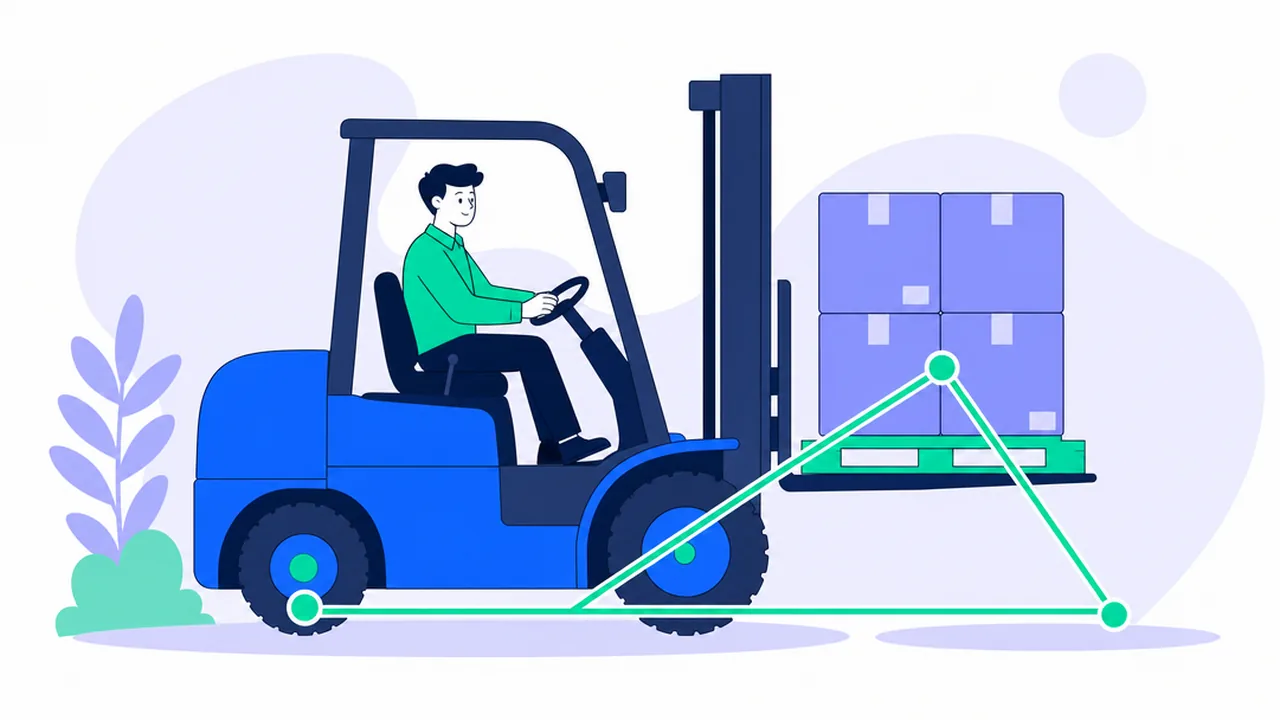
A clear answer: “A counterbalance forklift stands on three points: the two front wheels and the pivot in the middle of the rear axle. While the center of gravity stays inside that triangle, the truck is stable. A high load, a fast turn, hard braking, a slope or tilting forward with the load up can move it outside. So I carry the load low and tilted back, and I turn slowly.”
Expect a tip-over follow-up. On a sit-down counterbalance truck, OSHA’s answer is: do not jump, stay in the truck, hold the steering wheel tight, brace your feet, and lean forward and away from the impact. On a stand-up truck with rear entry, step backward off the truck (OSHA eTool, traveling and maneuvering).
9. “How do you drive on a ramp with a load?”
The ramp question is about which way the load points. On grades over 10%, a loaded truck is driven with the load upgrade, and on any grade the load is tilted back and raised only enough to clear the surface (1910.178(n)(7)).
| Situation | Direction of travel | Forks point |
|---|---|---|
| Loaded, going up | Forward | Uphill |
| Loaded, going down | In reverse, looking downhill | Uphill |
| Empty, going up | In reverse, looking uphill | Downhill |
| Empty, going down | Forward | Downhill |
Table source: OSHA eTool, ramps and grades, which also says to turn before a ramp, never on it.
Say: “With a load, the load points uphill: forward going up, in reverse going down. Empty, the forks point downhill. I go slowly, keep the load tilted back and low, and I never turn on the ramp.”
10. “What do you do if the load becomes unstable while you are moving it?”
The right answer is to stop and fix the problem. Only stable or safely arranged loads may be handled (1910.178(o)(1)), and OSHA advises against carrying damaged goods unless they are wrapped or banded (OSHA eTool, load handling).
Sample answer: “I stop smoothly, because braking hard throws the weight forward. I lower the load and set the brake, then look at what moved. If the wrap is broken or a box has shifted, I restack or rewrap it, or ask for help. If anything fell, I keep people clear and report it.”
11. “How do you keep pedestrians safe?”
The habit to show is driving as if people on foot have not seen you. The driver looks in the direction of travel, slows down and sounds the horn at cross aisles and blind spots, and travels with the load trailing if it blocks the view (1910.178(n)(4), (n)(6)). No one may stand or pass under raised forks ((m)(2)).
Sample answer: “I slow down and use the horn at cross aisles, doors and blind corners, and I make eye contact before I pass someone. If the load blocks my view, I drive in reverse or ask for a spotter. Nobody walks under the forks, and nobody rides on the truck.”
12. “What do you do when you get off the forklift?”
Getting off the forklift is really about when a truck counts as unattended: when the operator is 25 feet or more away, or cannot see it (1910.178(m)(5)).
Say: “If I go more than 25 feet away or can’t see the truck, it’s unattended. Then I lower the forks fully, put the controls in neutral, turn the power off and set the brake, and on a slope I block the wheels. Even when I stay close, the forks go down and the brake goes on. I park in a marked area, away from exits and fire equipment.”
13. “How do you change a propane tank or charge a battery safely?”
Fuel and battery questions start with whether you may do the job at all: OSHA’s guidance says only trained and authorized people should replace LPG containers (OSHA eTool, internal combustion), and only trained people should charge and change batteries (OSHA eTool, electric).
Sample answer: “Only if I’m trained and the site allows it. I change a propane tank only in the right place, away from exits and heat, with gloves and a face shield, because liquid propane can cause frostbite. Then I check that the tank is locked in, the relief valve points up and nothing leaks. I charge batteries only in the charging area, with the brake set, no smoking and eye protection on.”
The rule behind it: batteries are charged only in a designated area, with the truck braked, no smoking and no flames or sparks nearby (1910.178(g)), because batteries give off hydrogen gas toward the end of charging and the acid can splash.
14. “What do you do if the forklift has a problem during your shift?”
An unsafe truck stops, even on a busy shift. A defective or unsafe truck is taken out of service until it is repaired (1910.178(p)(1)), by authorized personnel ((q)(1)).
A strong answer: “I stop in a safe place, lower the forks and switch it off. I tag it out of service, write it on the checklist and tell my supervisor straight away. I don’t keep driving to finish the job. A fuel leak, soft brakes or a horn that doesn’t work all mean the truck stops.”
Forklift driver interview questions about safety and behavior (15–20)
Behavioral forklift driver interview questions check whether you keep the rules when the shift is behind. Answer with a short true story in STAR order: situation, task, action, result. Under a minute is enough.
15. “Tell me about a near miss. Did you report it?”
A near-miss question is about reporting, not a perfect record. In the US, a near miss triggers refresher training (1910.178(l)(4)(ii)), so reporting is part of the system. “I’ve never had a near miss” sounds less believable than a small, honest example.
Sample answer: a near miss
B1–B2Last winter, a coworker stepped out from behind a rack while I was reversing. I had slowed down at the corner, so I stopped in time, but it was close.
I reported it the same shift. We found that the mirror on that corner was broken, and it was replaced that week. Now I use the horn at that corner every time.
Read it aloud
Listen to a model reading, then record yourself. You get your speaking pace, the share of words that came through clearly, and the words to repeat.
16. “What would you do if your supervisor asked you to work faster than is safe?”
Deadlines are normal: on the same O*NET profile, 75% of US industrial truck operators meet strict deadlines every day (O*NET 53-7051). The rule stays the same: the truck always runs at a speed that lets it stop safely (1910.178(n)(8)).
Sample answer: “I’d keep a speed where I can stop safely and tell the supervisor what is slowing me down, like a blocked aisle. Often the fix isn’t speed but a better pick order or a second truck. If I’m asked to skip a check or carry an overweight load, I’d say no politely. A dropped pallet costs more time than a slow one.”
17. “What would you do if you saw a coworker driving a forklift unsafely?”
A good answer has an order: stop the danger, talk to the person, then tell the supervisor. In the US, an operator seen driving unsafely gets refresher training (1910.178(l)(4)(ii)), so reporting helps the driver too.
Say: “If someone could get hurt right now, I’d warn them straight away. After that, I’d talk to the driver calmly, one to one. If it happens again, I’d tell the supervisor. It’s not about getting someone in trouble.”
18. “How do you make sure you pick and put away the right pallet?”
Accuracy matters because a pallet in the wrong location is lost stock: 68% of industrial truck operators on the O*NET profile rate being exact as extremely important (O*NET 53-7051).
Sample answer: “I scan the pallet before I lift it and the location when I place it, and I say the location to myself: aisle, bay, level. If the scanner and the label don’t match, I stop and check. Broken wrap or a crushed corner means the pallet doesn’t go up into the rack.”
19. “What do you do if you see a spill or a wet floor on your route?”
A spill question checks whether you protect the people behind you, not only yourself. The driver must slow down for wet and slippery floors (1910.178(n)(10)), and floors must be kept free of hazards such as leaks and spills (1910.22(a)(3)).
Sample answer: “I slow down and stop before it. I don’t drive through oil or water with a load, or brake hard on it. If there’s a safe way around, I take it. Then I block it off and tell my lead, so nobody else hits it. If the leak is from my truck, the truck is tagged out.”
20. “Why should we hire you?”
Sum up your case in 30 seconds with three points the interviewer has already heard: your safety habits, your trucks and how you work with people.
Sample answer: why hire you
B1–B2Because I’m safe and steady. I do my checks every shift, I report problems early, and I keep my speed under control when it’s busy.
I’ve loaded trailers on a counterbalance and worked the top racks on a reach truck, so I can help on the dock and in the aisles. And I talk to the people on foot, and I ask when I’m not sure.
Read it aloud
Listen to a model reading, then record yourself. You get your speaking pace, the share of words that came through clearly, and the words to repeat.
More forklift operator interview questions to prepare
Most forklift interviews add general HR questions. Keep each answer to one or two sentences with a forklift detail; full phrases are in the guide to English for job interviews.
| Question | What to say |
|---|---|
| “What are your strengths?” | One you can prove: “I’m careful. I do my check every shift and have no damage reports.” |
| “What is your greatest weakness?” | A real one you are fixing, never a safety habit: “I was slow on the scanner, so I practiced on quiet shifts.” |
| “Why did you leave your last job?” | Short and positive: the contract ended, you moved, or you want more hours. Don’t criticize the old employer. |
| “What are your salary expectations?” | A range from job ads for the same role in your area, and flexibility for the right shift. |
| “When can you start?” | A real date, plus any notice you owe. |
| “Tell me about a time you worked under pressure.” | A STAR story: three trailers due at once, you agreed the order with the lead, all left on time with no damage. |
| “Are you a leader or a team player?” | Both, with an example: “I work in a team, and I show new pickers where to walk around the trucks.” |
| “Which attachments have you used?” | Name them: side shifter, fork positioner, clamp, rotator. A truck with a non-factory attachment must be marked with the combined weight (1910.178(a)(5)). |
| “Do you have any questions for us?” | Ask about the fleet, how new operators are evaluated, the shift pattern and how near misses are reported. |
Forklift certification in the US, UK, South Africa, Philippines and India
Forklift certification is not one license you carry from job to job. In the US and the UK the employer confirms you are trained for its own trucks. South Africa requires an accredited training certificate for listed machines, and the Philippines has a national qualification, TESDA’s NC II. Say which scheme your training was under.
| Country | Rule | What you show | Refresher or re-evaluation |
|---|---|---|---|
| United States | 29 CFR 1910.178(l); construction sites use the same training rules (1926.602(d)) | Employer certification: your name, training and evaluation dates, trainer | Evaluation at least every 3 years; refresher after unsafe driving, an accident or near miss, a new truck type or a changed workplace |
| United Kingdom | HSE code of practice L117 (third edition, 2013) | Basic training certificate, then job-specific and familiarisation training and written authorisation from the employer | No fixed period; HSE gives 3–5 years as an example; a retest may be needed after an accident or near miss |
| South Africa | Driven Machinery Regulations, 2015, regulation 18(11) (guidelines, 2017) | Training for that type of machine; for listed machines, a certificate from a provider accredited by the Transport SETA | Ask the employer |
| Philippines | TESDA Training Regulations, Heavy Equipment Operation (Forklift) NC II (Revision 01, 2019) | National Certificate (NC II) after an assessment; course graduates and experienced workers can apply | Renewal by assessment under the current regulations |
| India | Rules differ by state and employer | Your training certificate; be ready for a test on the employer’s trucks | Ask the employer |
UK basic courses typically take 3 to 5 days, according to L117, and accredited certificates show the accrediting body, the provider’s number and the instructor (HSE, accreditation schemes). The Philippine NC II course has a nominal 221 hours, including 40 hours of supervised industry learning. In the Gulf and elsewhere, ask the employer which training it recognizes.
Forklift words to say clearly in the interview
Forklift words are short nouns, and the risk in an interview is saying them too fast. Say each example aloud, slowly, with the stress on the number or the key noun.
| Term | What it means | Say it in a sentence |
|---|---|---|
| Data plate (capacity plate) | The plate on the truck that shows the maximum weight at a load center | “I check the data plate before I lift anything unusual.” |
| Load center | The distance from the face of the forks to the load’s center of gravity | “The plate says 3,000 pounds at a 24-inch load center.” |
| Counterbalance | A truck with weight built into the back to balance the load on the forks | “I drove a sit-down counterbalance on the dock.” |
| Mast | The upright frame the forks move up and down on | “I check the mast chains for wear.” |
| Reach truck | A narrow-aisle truck whose forks reach forward into the rack | “I used a reach truck up to the top racks.” |
| Spotter | A person on foot who guides the driver when the view is blocked | “If I can’t see, I ask for a spotter.” |
| Near miss | An event that could have caused injury or damage but did not | “I reported the near miss the same shift.” |
Documents also say lift truck (the UK code’s term) and powered industrial truck (the wider OSHA term). Say “three thousand pounds” and “twenty-four inches” slowly; drills for stress and clear sounds are in the English pronunciation practice guide.
How to practice forklift interview answers out loud
Practice each forklift interview answer as a list of actions said aloud in order, then with someone who interrupts. Take one role in the dialogue below and say your lines aloud.
Pre-shift check, with a follow-up under pressure
B1–B2- Interviewer
Walk me through your pre-shift check.
- Ravi
Sure. First I check the truck with the key off: tires, forks, chains, hoses, fluid levels and the data plate.
- Interviewer
What are you looking for on the forks?
- Ravi
Cracks or bends, and the condition of the retaining pin and the heel. If a fork is damaged, the truck doesn’t go out.
- Interviewer
And with the engine on?
- Ravi
Brakes, steering, horn, lights, lift, lower and tilt. On an electric truck, I also look at the battery cables.
- Interviewer
Say the brakes feel soft, and you have a trailer to load in ten minutes.
- Ravi
Then the trailer waits. I tag the truck, write it on the checklist and tell you or the lead. If there’s another truck, I check that one and use it.
- Interviewer
Have you ever had to do that?
- Ravi
Yes, once. The horn didn’t work on a night shift. I reported it, and we used the second truck until maintenance fixed it.
Practise this dialogue
Listen to the whole exchange, then take one role: your partner’s lines are read aloud, you say yours into the microphone and see which words came through.
For the general questions, the free browser mock interview asks questions aloud and reports your answer length, pace and filler words. It has no forklift track: choose Screening classics for questions like 1, 4 and 20, and Behavioral for 15 to 17. It does not check technical answers. The English speaking test shows which of pronunciation, fluency, vocabulary and grammar needs the most work.
Say your answers out loud, with feedback
Fluently is an AI speaking coach for iOS and Android. Practice your interview answers aloud and get feedback on pronunciation, fluency, vocabulary and grammar after each one. The app is free to download and starts with a free four-minute speaking assessment; full practice is a subscription after a free trial.


Forklift operator screening questions for employers
Employers can use the 20 questions as they are: answers to 2, 6, 7, 9 and 12 can be checked against the standard, and 14 to 16 show whether a candidate stops a bad truck, reports near misses and holds the line on speed. The interview does not replace the evaluation: each operator is trained and evaluated before driving, except trainees under direct supervision (1910.178(l)(1)(ii)). For roles without a truck, use the warehouse associate interview questions.
Frequently asked questions
What are 5 safety rules for a forklift?
Five OSHA rules cover most interview answers: inspect the truck before every shift and take it out of service if it fails; never exceed the data plate capacity at the real load center; keep the load low and tilted back, and uphill on grades over 10%; slow down and sound the horn at cross aisles; and when you leave the truck, lower the forks, neutralize the controls, shut off the power and set the brake (29 CFR 1910.178).
Which methods create a hazard when operating a forklift with a heavy load?
Traveling with the load raised, tilting forward with the forks up except to pick up or place a load, turning on a ramp or driving down it load-first, sharp acceleration, braking or turning, and a load longer or more off-center than the rated load center. Appendix A says to carry a maximum load in the lowest position, with slow, even acceleration (OSHA, Appendix A).
What is on a forklift operator assessment or test?
In the US there is no single national test: the employer combines formal instruction, practical training and an evaluation of your driving in the workplace. UK guidance lists typical practical tests: a pre-shift check, using the controls, traveling loaded and empty, inserting forks without damaging the pallet, 90° turns with a load in a confined area, stacking at different levels, loading a vehicle and parking (HSE L117, Appendix 2).
What are the big 3 interview questions for a forklift job?
Usually “Tell me about yourself”, “Why do you want this job?” and “Why should we hire you?”. In a forklift interview they become questions 1, 4 and 20 above. Prepare a 30-second answer for each, with your truck types and one safety habit.
Do these questions work for reach truck, telehandler or warehouse interviews?
For reach trucks and order pickers, yes: questions 6 to 14 hold, with extra attention to high racking. Telehandlers on construction sites follow the same operator training rules (29 CFR 1926.602(d)), with more questions on stability, because the boom places loads far in front of the machine. For jobs without a truck, use the warehouse associate questions.