40 Difficult Words to Pronounce in English (With IPA, Examples and Fixes)
 Yurii Rebryk · Updated September 16, 2026 · 18 min read
The 40 difficult words to pronounce in English below run from colonel (KER-nul) and Worcestershire (WUSS-ter-sher) to rural, squirrel, sixth, February and quinoa. For each word you get the US and UK pronunciation in IPA from the Cambridge Dictionary, checked against Oxford Learner’s, plus the stressed syllable, the usual mistake, a one-line fix and an example sentence, grouped by why the word is hard.
In this article
- How to read this list of difficult words
- Silent letters: 7 words where you skip a letter
- Spelling that lies: 7 words that sound nothing like they look
- Disappearing syllables: 6 words that are shorter than they look
- Stress traps: 7 words where the strong syllable moves
- th, r and consonant clusters: 7 words that are hard to say fast
- Loanwords: 6 words that kept their foreign sound
- What are the 10 hardest words to pronounce in English?
- Which of these words have two correct pronunciations?
- What are the most difficult sounds in English?
- How to practice difficult words: hear, build, record
Jump to the silent letters, spelling that lies, disappearing syllables, stress traps, th, r and consonant clusters, loanwords, the 10 hardest, the words with two correct pronunciations, the difficult sounds behind them, or the three read-aloud passages that use all 40 words.
How to read this list of difficult words
The 40 words are grouped by the six reasons a word is hard: a silent letter, letters that stand for other sounds, a lost syllable, unexpected stress, piled-up consonants or a foreign sound. Each row gives the IPA from the Cambridge Dictionary, American (US) first, then British (UK), and links to the entry with both recordings; the respelling (KER-nul) puts the stressed syllable in capitals, and Cambridge’s pronunciation guide explains the symbols.
The counts in this article are our own tally of those Cambridge transcriptions: US and UK are identical for 12 of the 40 words, and 24 have a schwa (ə or ɚ) in the American form, 5 of them only as an optional one.
Silent letters: 7 words where you skip a letter
Seven of the 40 words have a letter you should not say: the b in debt, subtle and plumber, the p in receipt, the s in island, the l in salmon and the d in Wednesday.
| Word | IPA (US · UK) | Say it | Usual mistake and fix | Example |
|---|---|---|---|---|
| 1. debt (money you owe) | /det/ (same in both) | DET | Saying the b. Fix: it rhymes with “bet”; the b is silent, as in “doubt”. | “We paid off the debt in two years.” |
| 2. subtle (small and not obvious) | US /ˈsʌt̬.əl/ · UK /ˈsʌt.əl/ | SUH-tl | “SUB-tul”, with a b. Fix: no b; it rhymes with “shuttle”. | “There is a subtle difference between the two offers.” |
| 3. receipt (proof that you paid) | /rɪˈsiːt/ (same in both) | rih-SEET | “ri-SEEPT”, with a p. Fix: no p; the word ends like “seat”. | “Can I get a receipt, please?” |
| 4. island (land with water all around it) | /ˈaɪ.lənd/ (same in both) | EYE-lund | “IZ-land”, with an s. Fix: no s; start with the word “eye”. | “We took a ferry to the island.” |
| 5. salmon (a pink-orange fish) | /ˈsæm.ən/ (same in both) | SAM-un | “SAL-mon”, with an l. Fix: no l; it starts like the name “Sam”. | “I’ll have the grilled salmon.” |
| 6. plumber (a person who fixes water pipes) | US /ˈplʌm.ɚ/ · UK /ˈplʌm.ər/ | PLUM-er | “PLUM-ber”, with a b. Fix: b after m is silent, as in “climb” and “thumb”. | “We need a plumber; the kitchen sink is leaking.” |
| 7. Wednesday (the day after Tuesday) | /ˈwenz.deɪ/ (same in both) | WENZ-day | “WED-nes-day”, three syllables. Fix: two syllables; the first d and the second e are silent. | “The meeting moved to Wednesday.” |
Four of these letters were never said in English: Oxford Learner’s notes that the b in debt came “by association with the Latin word” debitum, the -p- in receipt “was inserted in imitation of the Latin spelling”, and the l in salmon is “influenced by Latin”. Island got its s in the 16th century from the unrelated word isle, and in all four words the pronunciation never followed the spelling.
Spelling that lies: 7 words that sound nothing like they look
In these seven words every letter is there, but the letters stand for different sounds: colonel has an r sound where the first l is written, choir starts with kw, and the o in women sounds like the i in “win”.
| Word | IPA (US · UK) | Say it | Usual mistake and fix | Example |
|---|---|---|---|---|
| 8. colonel (a senior army officer) | US /ˈkɝː.nəl/ · UK /ˈkɜː.nəl/ | KER-nul | “ko-lo-NEL”, reading the letters. Fix: say it exactly like “kernel”. | “The colonel answered questions from the press.” |
| 9. Worcestershire (a dark, spicy sauce; also an English county) | US /ˌwʊs.tɚ.ʃɚ/ · UK /ˌwʊs.tə.ʃə/ (before “sauce”) | WUSS-ter-sher (US also WUSS-ter-sheer) | “wor-ses-ter-SHIRE”, every letter said. Fix: three syllables; “Worcester” is WUSS-ter. | “Add a few drops of Worcestershire sauce.” |
| 10. choir (a group of singers) | US /ˈkwaɪ.ɚ/ · UK /kwaɪər/ | KWY-er | Starting with “ch” as in “chair”. Fix: start with “kw”; it rhymes with “fire”. | “She sings in a choir on Sundays.” |
| 11. women (more than one woman) | /ˈwɪm.ɪn/ (same in both) | WIM-in | Saying it like “woman”, or “wo-MEN”. Fix: woman is /ˈwʊm.ən/, women is /ˈwɪm.ɪn/: only the first vowel changes. | “Three women joined the team this month.” |
| 12. iron (a metal; a tool for pressing clothes) | US /aɪrn/ · UK /aɪən/ | EYE-ern (UK: EYE-un) | “EYE-ron”, following the spelling. Fix: the r sound comes after the vowel, and in British English it disappears. | “I need to iron my shirt before the interview.” |
| 13. thorough (careful and complete) | US /ˈθɝː.ə/ · UK /ˈθʌr.ə/ | THUR-uh or THUR-oh (UK: THUH-ruh) | Mixing it up with “through” or “though”. Fix: two syllables: the th of “think”, then “ur”. | “Thanks for the thorough review.” |
| 14. recipe (instructions for cooking a dish) | US /ˈres.ə.pi/ · UK /ˈres.ɪ.pi/ | RES-uh-pee | “ree-SIPE”, two syllables with a silent e. Fix: three syllables; the final e is “ee”. | “Can you send me the recipe?” |
Colonel and choir changed their spelling centuries ago and kept their old sounds: Oxford Learner’s traces colonel to the obsolete French form coronel, “source of the modern pronunciation”, and choir to Middle English quer, respelled in the 17th century “due to association with Latin chorus and modern French choeur”. Cambridge gives kernel the same transcription as colonel, so the two make a perfect practice pair.
Disappearing syllables: 6 words that are shorter than they look
In these six words a written vowel is not said, so the spoken word has fewer syllables than the written one: vegetable has three syllables, chocolate two. Mischievous is the reverse trap: people add a syllable that is not there.
| Word | IPA (US · UK) | Say it | Usual mistake and fix | Example |
|---|---|---|---|---|
| 15. comfortable (relaxed; feeling no pain) | US /ˈkʌm.fɚ.t̬ə.bəl/ · UK /ˈkʌm.fə.tə.bəl/ | KUMF-ter-bul | “com-FOR-ta-ble”, stress in the middle. Fix: stress the first syllable and let “for” shrink to almost nothing. | “Are you comfortable with this plan?” |
| 16. vegetable (a plant you eat, like a carrot) | /ˈvedʒ.tə.bəl/ (same in both) | VEJ-tuh-bul | “ve-ge-TA-ble”, four syllables. Fix: three syllables; the second e is silent. | “Which vegetable do you want with the rice?” |
| 17. chocolate (a sweet food made from cocoa) | US /ˈtʃɑːk.lət/ · UK /ˈtʃɒk.lət/ | CHAHK-lut (UK: CHOK-lut) | “cho-co-LATE”, three syllables. Fix: two syllables; the ending is a short “lut”, not “late”. | “She brought dark chocolate for the team.” |
| 18. temperature (how hot or cold something is) | US /ˈtem.pɚ.ə.tʃɚ/ · UK /ˈtem.prə.tʃər/ | TEM-pruh-cher (US also TEM-per-uh-cher) | “tem-pe-ra-TOUR”, with a strong ending. Fix: only TEM is strong; the ending is a weak “cher”. | “The temperature drops fast at night.” |
| 19. February (the second month) | US /ˈfeb.ruː.er.i/ · UK /ˈfeb.ru.ər.i/ | FEB-roo-air-ee (also FEB-yoo-air-ee) | “feb-ru-AR-y”, every letter at full strength. Fix: stress FEB only; dropping the first r is accepted (see the table below). | “The contract ends in February.” |
| 20. mischievous (playfully naughty) | US /ˈmɪs.tʃə.vəs/ · UK /ˈmɪs.tʃɪ.vəs/ | MIS-chuh-vus | “mis-CHEE-vee-us”, an extra syllable. Fix: three syllables, stress on MIS; there is no “ee-us” ending. | “The puppy gave us a mischievous look.” |
Dictionaries treat the short forms as standard: Oxford Learner’s lists the three-syllable /ˈkʌmftəbl/ first for comfortable, in both British and American English. February has the same history as debt: its spelling changed in the 15th century “due to association with the Latin word”, which is why the first r is so easy to lose.
Stress traps: 7 words where the strong syllable moves
These seven words are hard because the stress is not where learners expect it, often because a related word is stressed differently: PHOtograph but phoTOGrapher, proNOUNCE but pronunciAtion.
| Word | IPA (US · UK) | Say it | Usual mistake and fix | Example |
|---|---|---|---|---|
| 21. hierarchy (a system of levels, from top to bottom) | US /ˈhaɪ.rɑːr.ki/ · UK /ˈhaɪə.rɑː.ki/ | HY-rar-kee (UK: HY-uh-rah-kee) | “hi-RAR-chee”, stress on the second syllable and ch as in “chair”. Fix: stress HY; the ch is a k. | “The company has a flat hierarchy.” |
| 22. determine (to decide; to find out) | US /dɪˈtɝː.mɪn/ · UK /dɪˈtɜː.mɪn/ | dih-TER-min | “de-ter-MINE”, ending like “mine”. Fix: stress TER; the end is a short “min”. | “This test will determine your level.” |
| 23. photographer (a person who takes photos) | US /fəˈtɑː.ɡrə.fɚ/ · UK /fəˈtɒɡ.rə.fər/ | fuh-TAH-gruh-fer (UK: fuh-TOG-ruh-fuh) | “PHO-to-gra-pher”, copying “photograph”. Fix: the stress moves to the second syllable and the first o becomes a weak “uh”. | “The photographer asked us to stand closer.” |
| 24. career (the jobs you do over your working life) | US /kəˈrɪr/ · UK /kəˈrɪər/ | kuh-REER | Stress on the first syllable, so it sounds like “carrier”. Fix: a weak “kuh”, then a strong REER that rhymes with “here”. | “I want to build a career in finance.” |
| 25. epitome (a perfect example of something) | US /ɪˈpɪt̬.ə.mi/ · UK /ɪˈpɪt.ə.mi/ | ih-PIT-uh-mee | “EP-i-tome”, rhyming with “home”. Fix: four syllables, stress on PIT, and the final e is “ee”. | “This hotel is the epitome of comfort.” |
| 26. hyperbole (exaggeration for effect) | US /haɪˈpɝː.bəl.i/ · UK /haɪˈpɜː.bəl.i/ | hy-PER-buh-lee | “HY-per-bowl”, like a sports final. Fix: four syllables, stress on PER, and the final e is “ee”. | “Calling it the worst day of my life was hyperbole.” |
| 27. pronunciation (the way a word is said) | /prəˌnʌn.siˈeɪ.ʃən/ (same in both) | pruh-NUN-see-AY-shun | “pro-NOUN-ciation”, copying the verb. Fix: the verb is pronounce /prəˈnaʊns/, but the noun says “nun”, not “noun”; the main stress is on AY. | “Her pronunciation has improved a lot this year.” |
Misplaced stress makes a word harder to recognize. In a 2005 study in TESOL Quarterly, John Field asked native and non-native listeners to write down recorded speech in which word stress and vowel quality had been changed. The two groups reacted to misplaced stress in very similar ways, and how much intelligibility suffered depended on which way the stress moved and whether the vowels changed with it. The same mechanism separates the noun and the verb in record and present; the list of English words with multiple meanings covers those pairs.
th, r and consonant clusters: 7 words that are hard to say fast
These seven words have no spelling trick; they are hard for the mouth. Sixth ends in three consonants in a row, /ksθ/; strengths ends in ng, th and s; rural and squirrel pack r and l into two short syllables.
| Word | IPA (US · UK) | Say it | Usual mistake and fix | Example |
|---|---|---|---|---|
| 28. sixth (number 6 in a series) | /sɪksθ/ (same in both) | SIKSTH | “sikth” or “sixt”, one sound dropped. Fix: k, s and th after the vowel; say “six”, then add the th. | “Our office is on the sixth floor.” |
| 29. strengths (good qualities; plural of strength) | /streŋθ/ for strength (same in both; Oxford also /streŋkθ/), plus /s/ | STRENGTHS | “strenks” or “strengs”, the th dropped. Fix: ng, then th, then s; a light k between ng and th is fine. | “What are your strengths?” |
| 30. clothes (things you wear) | US /kloʊðz/ · UK /kləʊðz/ | KLOHTHZ (or KLOHZ) | “clo-thes”, two syllables. Fix: one syllable; dictionaries also accept /kloʊz/, the same sound as the verb “close”. | “I packed my clothes last night.” |
| 31. world (the earth and everyone on it) | US /wɝːld/ · UK /wɜːld/ | WERLD | “word” with the l dropped, or “wor-uld” in two syllables. Fix: one syllable; from the “er” go straight to l, then d. | “She has worked all over the world.” |
| 32. rural (in the countryside) | US /ˈrʊr.əl/ · UK /ˈrʊə.rəl/ | ROOR-ul | Rolled or tapped r’s, or the middle swallowed into “rule”. Fix: two syllables, ROOR + ul; keep the tongue tip off the roof of the mouth for both r’s. | “She grew up in a rural area.” |
| 33. squirrel (a small animal with a long, bushy tail) | US /ˈskwɝː.əl/ · UK /ˈskwɪr.əl/ | SKWER-ul (UK: SKWIR-ul) | “es-kwi-REL”, with an added vowel and the wrong stress. Fix: two syllables, stress on the first; in American English the first one is “skwer”. | “A squirrel ran across the road.” |
| 34. specific (exact, clearly stated) | /spəˈsɪf.ɪk/ (same in both) | spuh-SIF-ik | “pacific”, the s dropped, or “e-specific”, a vowel added. Fix: start with s and go straight to p; stress SIF. | “Can you be more specific?” |
Strengths is worth extra practice before any job interview, because “What are your strengths?” comes up in so many of them; the guide to English for job interviews has a model answer to say out loud. The cluster rule carries over to other words: say the shorter word first (six, strength, month), then add one sound at a time (sixth, strengths, months).
Loanwords: 6 words that kept their foreign sound
These six words came into English from French, Italian and, through Spanish, Quechua, and they kept part of their original sound: the zh in genre, the final stress in entrepreneur, the “keen” at the start of quinoa.
| Word | IPA (US · UK) | Say it | Usual mistake and fix | Example |
|---|---|---|---|---|
| 35. entrepreneur (a person who starts a business) | US /ˌɑːn.trə.prəˈnɝː/ · UK /ˌɒn.trə.prəˈnɜːr/ | ahn-truh-pruh-NUR | “EN-tre-pre-new-er”, stress at the start. Fix: four syllables, main stress on the last one, which rhymes with “fur”. | “He left his job to become an entrepreneur.” |
| 36. genre (a type of music, film or book) | US /ˈʒɑːn.rə/ · UK /ˈʒɑ̃ː.rə/ | ZHAHN-ruh | “JEN-ree”, starting with j. Fix: start with the sound in the middle of “vision”, /ʒ/. | “What genre of music do you like?” |
| 37. niche (a small, special area or market) | US /nɪtʃ/ · UK /niːʃ/ | NITCH or NEESH | Thinking only one form is right. Fix: Oxford Learner’s lists both /niːʃ/ and /nɪtʃ/ for British and American English; pick one and keep it. | “She found her niche in product design.” |
| 38. cache (stored data; a hidden store) | /kæʃ/ (same in both) | KASH | “ka-SHAY”, like “cachet”, or “catch”. Fix: it sounds exactly like “cash”. | “Clear the cache and reload the page.” |
| 39. quinoa (a grain-like seed) | US /kɪnˈwɑː/ · UK /ˈkiːnwɑː/ | KEEN-wah (US also kin-WAH) | “kwi-NO-uh”, read as English. Fix: no kw; start with “keen” and end with “wah”. | “The salad comes with quinoa and avocado.” |
| 40. espresso (a small, strong coffee) | US /esˈpres.oʊ/ · UK /esˈpres.əʊ/ | es-PRES-oh | “ex-PRES-oh”, with an x. Fix: there is no x; the word starts with “es”. | “One espresso and two teas, please.” |
The source language explains the sound: Oxford Learner’s traces genre, niche, entrepreneur and cache to French, where ch is “sh”, so cache is “cash” and niche can be “neesh”. Espresso is Italian for “pressed out” coffee and never had an x, and quinoa is the Spanish spelling of the Quechua word kinua.
What are the 10 hardest words to pronounce in English?
There is no official ranking, but these 10 of the 40 are the ones to practice first: the spelling gives almost no help, and most of them also appear in other published lists of hard words.
| Word | Say it | Why it is hard |
|---|---|---|
| Worcestershire | WUSS-ter-sher | 14 letters, only 7 sounds in British English |
| colonel | KER-nul | An r sound where the first l is written |
| squirrel | SKWER-ul (UK: SKWIR-ul) | skw, r and l in two short syllables |
| rural | ROOR-ul | Two r sounds and an l, with only short vowels between |
| sixth | SIKSTH | Three consonants after one vowel, ending in th |
| strengths | STRENGTHS | str at the start, ng, th and s at the end |
| February | FEB-roo-air-ee | The first r is easy to lose; FEB-yoo- is also accepted |
| mischievous | MIS-chuh-vus | Three syllables, not four: no “ee-us” ending |
| hierarchy | HY-rar-kee | Stress on HY, and the ch is a k |
| quinoa | KEEN-wah | Spanish spelling: there is no kw sound |
Lists of 50 or 100 difficult words add rarer words with the same traps: draught (DRAHFT; American spelling draft), facade (fuh-SAHD), paradigm (PAIR-uh-dime, silent g), macabre (muh-KAH-bruh), onomatopoeia (on-uh-mat-uh-PEE-uh) and anemone (uh-NEM-uh-nee). Long regular words such as otorhinolaryngologist are long rather than hard: read them syllable by syllable.
Which of these words have two correct pronunciations?
Native speakers say these eight words from the list two ways, and Cambridge or Oxford Learner’s records both, so a form that differs from yours is not always a mistake. The tables above show the main form; this table shows the accepted alternative.
| Word | Form 1 | Form 2 | Where it is listed |
|---|---|---|---|
| niche | /niːʃ/, NEESH | /nɪtʃ/, NITCH | Both, for UK and US English: Oxford Learner’s |
| clothes | /kloʊðz/, with th | /kloʊz/, like “close” | Cambridge (US) and Oxford Learner’s (UK and US) |
| February | /ˈfeb.ruː.er.i/, FEB-roo- | /ˈfeb·juˌer·i/, FEB-yoo- | Cambridge, American English section |
| Wednesday | /ˈwenzdeɪ/, ends in “day” | /ˈwenzdi/, ends in “dee” | Oxford Learner’s (UK and US), Cambridge (US) |
| comfortable | four syllables, /ˈkʌmfətəbl/ | three syllables, /ˈkʌmftəbl/ | Oxford Learner’s lists the three-syllable form first |
| temperature | three syllables, /ˈtemprətʃə(r)/ | four syllables, /ˈtem.pɚ.ə.tʃɚ/ | Oxford Learner’s (three), Cambridge US (four) |
| quinoa | /ˈkiːnwɑː/, KEEN-wah | /kiˈnəʊə/, kee-NOH-uh | Oxford Learner’s; Cambridge US also /kɪnˈwɑː/ |
| strength | /streŋθ/ | /streŋkθ/, with a light k | Cambridge (both), Oxford Learner’s (k form) |
Before you correct someone: check the full dictionary entry, not only the first line. A colleague who says NITCH, KLOHZ or WENZ-dee is using a dictionary form. A colleague who says “ex-PRES-oh”, “KO-lo-nel” or “pro-NOUN-ciation” is not.
What are the most difficult sounds in English?
The most difficult sounds in English for learners are th (/θ/ in “think”, /ð/ in “this”), the American r, the dark l at the end of a word, long against short vowels, the schwa, and clusters of consonants such as /ksθ/ in sixth. The th sounds are hard for a structural reason: in Ian Maddieson’s chapter of the World Atlas of Language Structures (2013), sounds of this type occur in just 43 of the 566 languages surveyed, 7.6%. Most learners have no version of them in their first language.
| Sound | In these words from the list | What usually goes wrong | How to make it | Test pair |
|---|---|---|---|---|
| th: /θ/ (no voice), /ð/ (voice) | sixth, strengths, thorough; clothes | Replaced by t, s or f (“tink”, “sikst”), or by d or z for /ð/ | Tongue tip lightly against or just between the upper front teeth; push air through. Add voice for /ð/. | think / sink, three / tree, they / day |
| American r: /r/, /ɚ/, /ɝː/ | rural, squirrel, world, colonel, career | A tapped or rolled r, or an r that disappears | Pull the tongue tip back so it touches nothing; round the lips a little. In American English say every written r; in British English only before a vowel. | right / light, correct / collect |
| Dark l at the end of a word | world, rural, squirrel, subtle | The l is dropped (“word” for world) or gets an extra vowel (“wor-uld”) | Tongue tip on the ridge behind the upper teeth, back of the tongue raised as for “oo”. | world / word, mile / my |
| Long /iː/, short /ɪ/ | receipt (/iː/), women (/ɪ/), niche (either) | Both said the same, so “ship” and “sheep” match | /iː/ is longer, with spread lips; /ɪ/ is short and relaxed. | ship / sheep, live / leave |
| Schwa /ə/ | salmon, recipe, photographer, chocolate, specific and 14 more | Every vowel said at full strength: “sal-MON”, “PHO-to-gra-pher” | Stress one syllable and let the others shrink to a short “uh”. | PHOtograph / phoTOGrapher |
| Consonant clusters | sixth /ksθ/, strengths, specific /sp/, world /ld/ | A vowel added (“e-specific”) or a consonant dropped (“sikth”) | Build up slowly: six, then sixth; strength, then strengths. | six / sixth, strength / strengths |
| /ʒ/, as in “vision” | genre | Replaced by j: “JON-ruh” | Like sh, but with voice: the middle sound of “vision” and “measure”. | vision, measure, usual |
Difficult words to pronounce with a lisp: a lisp, in Cambridge’s definition, means saying “s” and “z” sounds like “th”, so “sin” sounds like “thin”. The hardest words on this list for a lisp mix s with th or repeat it: sixth, strengths, specific, mischievous. Keep the tongue tip behind the upper teeth for s; a lisp that does not change with practice is one for a speech-language pathologist.
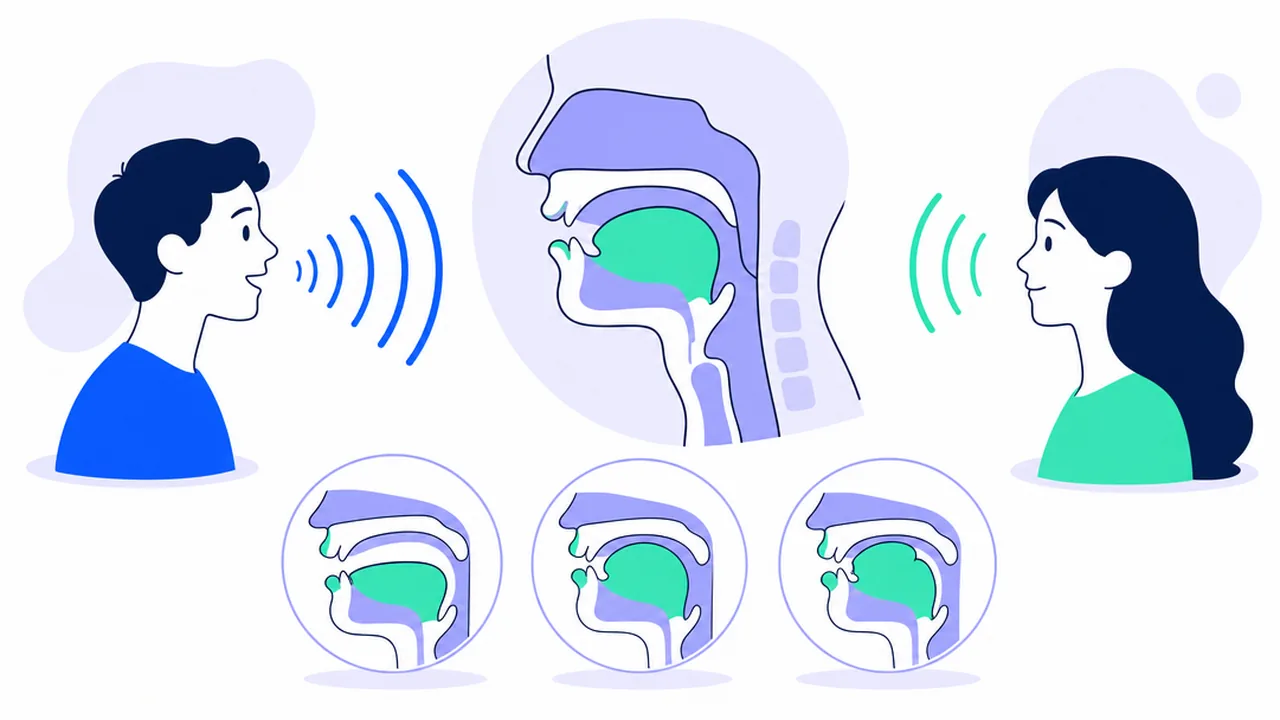
Which of these sounds is hardest for you depends on your first language. The English pronunciation practice guide has a table of trouble spots by native language and ten minimal pairs to drill them.
How to practice difficult words: hear, build, record
A difficult word sticks after four steps: hear it from a dictionary, build it up syllable by syllable, test the sound against its pair, then say it inside a sentence and record yourself. The last step matters most, because a word you can say alone can still break at normal speed in a sentence.
- Hear it. Open the Cambridge entry (every word in the tables links to it), play the American or British audio three times and choose one. Find the stress mark (ˈ) before you say anything.
- Build it. Say it slowly by syllables, then at normal speed: KER, KER-nul. For clusters, start from the shorter word: six, sixth.
- Test the contrast. If the problem is a sound rather than a spelling, use a minimal pair such as think / sink or world / word: say both, record both, and check that they sound different.
- Say it in a sentence and record it. Read the passages below, record yourself, and play the recording next to the dictionary audio. The guide to practicing English speaking alone covers recording routines; English shadowing practice (repeating a recording a split second behind the speaker) is the step after that.
The three passages below use all 40 words. Listen first, then record yourself; the trainer under each passage plays the text, records you and shows your pace in words per minute.
At work: 17 of the 40 words
B1–B2On Wednesday, the new photographer sent a thorough plan for the February campaign. It was specific about dates and costs, and every receipt was attached.
Our company has a flat hierarchy, so the entrepreneur who started it reads every plan herself. She said the career page needs new photos, and that a subtle change in color could determine how people see the brand.
In my interview she asked about my strengths. I felt comfortable, but I spoke slowly and checked my pronunciation of every long word.
Later, the IT team cleared the cache on my laptop. I want to find my niche here and pay off my student debt by next year.
Read it aloud
Listen to a model reading, then record yourself. You get your speaking pace, the share of words that came through clearly, and the words to repeat.
At home: 11 of the 40 words
B1Tonight’s recipe is simple: salmon with quinoa and one green vegetable. Add a few drops of Worcestershire sauce and cook the fish at a low temperature.
After dinner, we have dark chocolate and a small espresso.
Tomorrow a plumber is coming to fix the sink, so I need to iron my clothes tonight and be ready at eight.
Read it aloud
Listen to a model reading, then record yourself. You get your speaking pace, the share of words that came through clearly, and the words to repeat.
A weekend away: 12 of the 40 words
B1–B2For our sixth trip together, we took a ferry to a small rural island. The women from the local choir sang at the harbor, and the town felt like the epitome of a quiet weekend.
An old colonel told us stories from all over the world. A mischievous squirrel stole bread from his table, and he called it the worst crime of the century. That was hyperbole, of course.
In the evening we watched a film. I still can’t name the genre: half comedy, half mystery.
Read it aloud
Listen to a model reading, then record yourself. You get your speaking pace, the share of words that came through clearly, and the words to repeat.
Success check: read one passage at your normal speed without stopping. If a word makes you slow down or restart, go back to its row, build it up again, and read the sentence it sits in three more times.
For longer texts with the same trainer, the graded English speaking practice texts run from A2 up to B2–C1. For an outside view of your pronunciation and fluency together, the free English speaking test in the Fluently app takes about four minutes of spoken answers.
Hear what you actually said
A dictionary tells you how colonel should sound; it cannot tell you how you said it. Fluently is an AI speaking coach for iOS and Android: you answer out loud, and the app gives feedback on pronunciation, fluency, vocabulary and grammar. The download is free and starts with a free four-minute speaking assessment; full practice is a subscription after a free trial. Fluently is rated 4.8 on the App Store from 5.8K ratings (October 2026).


Frequently asked questions
What is the hardest word to pronounce in English?
There is no official ranking, but Worcestershire is a common answer: 14 letters that make only 7 sounds in British English, /ˌwʊs.tə.ʃə/ in Cambridge’s entry, said WUSS-tuh-shuh. For everyday speech, colonel (KER-nul), sixth (SIKSTH) and squirrel are the ones worth practicing first, because they come up in conversation and the spelling gives no help.
What are 20 tricky words?
Twenty tricky everyday words to say, all from the list above and simple enough for children: Wednesday (WENZ-day), February, vegetable (VEJ-tuh-bul), chocolate (CHAHK-lut), comfortable, temperature, island (EYE-lund), clothes, squirrel, women (WIM-in), iron, sixth, world, salmon (SAM-un), recipe, plumber, receipt, choir (KWY-er), mischievous and rural. For young children, ASHA lists z, v and th among the sounds that take longer to learn. In UK schools, “tricky words” also means common words such as “said” and “was” that children cannot yet sound out with phonics, a term from the 2007 Letters and Sounds programme.
What are the 44 sounds in English?
The 44 sounds are the phonemes of standard British English: 24 consonants, 12 vowels and 8 diphthongs, two vowels in one glide, as in “say” /eɪ/ and “boy” /ɔɪ/. The British Council’s phonemic chart for teachers has one symbol for each of the 44. The Oxford Learner’s pronunciation guide lists the same 24 consonants and 8 diphthongs but 14 vowel symbols, adding the weak vowels /i/ (happy) and /u/ (actual), so its table has 46. Four symbols there (the vowel in “got” and the diphthongs in “near”, “hair” and “pure”) are marked “British English”.
How do you pronounce a word correctly if you have never heard it?
Look it up in a learner’s dictionary such as Cambridge or Oxford Learner’s, play the audio for the accent you are learning, and read the IPA for two things: the stress mark (ˈ) and the letters that have no symbol, because those are silent. Say it slowly by syllables, then at normal speed inside a short sentence. Be most careful with words borrowed from French or Italian and with place names, where the spelling follows history rather than sound.