20 Stock Associate Interview Questions and Answers for Stocker and Overnight Jobs
 Yurii Rebryk · Updated · 15 min read
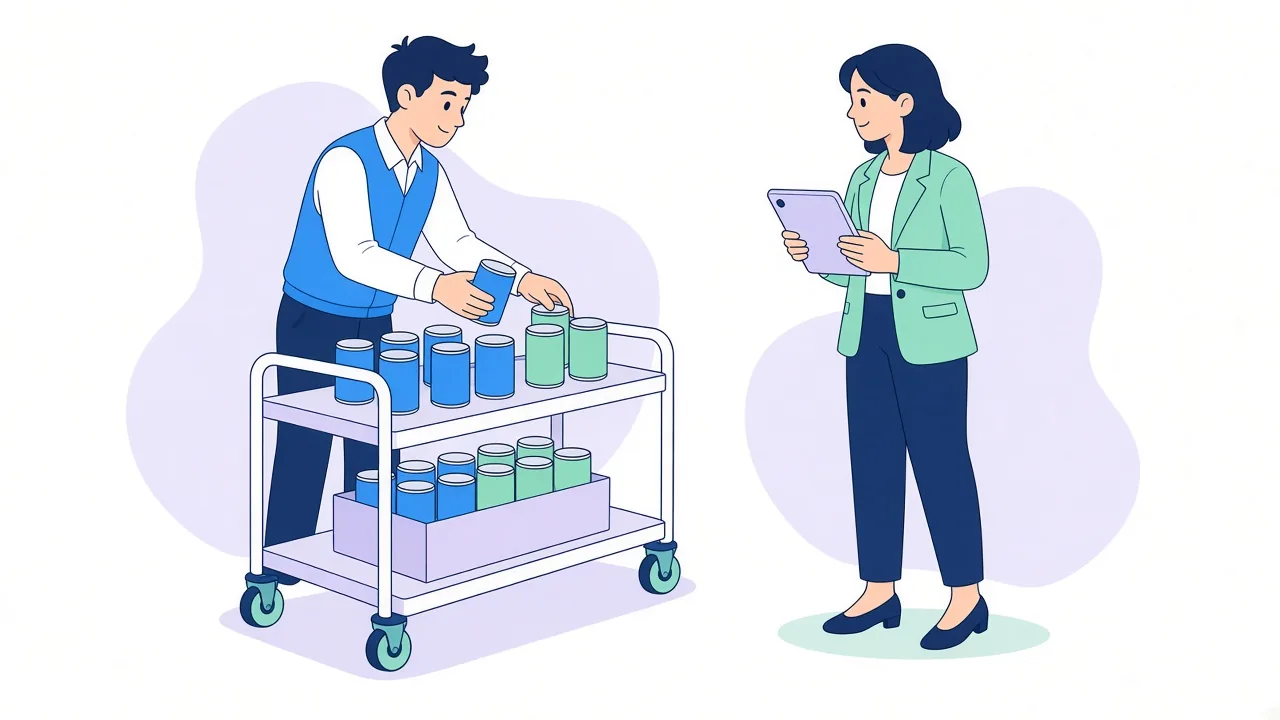
Stock associate interview questions check four things: that you can lift and move stock safely, keep shelves accurate (rotation, prices, counts), cover the shifts the store needs, and stay helpful when a customer stops you. Below are 20 questions with sample answers in plain spoken English and what each one tests. Specific answers about trucks, scanners and shifts beat general claims about hard work.
Start speaking with confidence today
Fluently is free to start. Take a free AI speaking assessment to see your level, then practice with games that build your vocabulary and pronunciation.


In this article
- Stock associate interview questions about you and your schedule (1–5)
- Stocking and inventory interview questions (6–12)
- Stock associate safety and lifting questions (13–14)
- Speed, customer and teamwork questions for stockers (15–20)
- More stock associate and retail interview questions
- Stock associate rules by country: lifting, equipment and age
- Stock associate interview answers for freshers
- Practice a stock associate interview question out loud
- Say stockroom words clearly in English
Stock associate interview questions about you and your schedule (1–5)
These 20 questions fit a stock associate, stocker or overnight stocker interview in a store; print the page or save it as a PDF to keep them. Numbers and store names in the sample answers are examples: swap in your own.
1. “Tell me about yourself.”
Give a short summary in order: what you do now, proof you can stock, and why this store. Listen to the model, then record your own.
Tell me about yourself
B1I’m a stock associate with two years of experience at a discount clothing store. I unload the truck twice a week and keep my departments full and tidy.
I use a handheld scanner for price checks and counts, and I follow the floor plan for each section.
I’m applying here because your overnight shifts fit my schedule, and I like seeing what I finished at the end of the night.
Read it aloud
Listen to a model reading, then record yourself. You get your speaking pace, the share of words that came through clearly, and the words to repeat.
No experience yet? Lead with reliability: “I’m finishing high school, I’ve worked weekends at my uncle’s shop for a year, and I’ve never missed a shift.”
2. “Why do you want to work as a stock associate here?”
The interviewer wants a reason that will survive a 5 a.m. truck, plus one fact from the store’s careers page.
You could say: “I like physical work with a clear result: an empty pallet and full shelves. I shop here, so I know how busy the store gets. Your careers page says new staff train in more than one department, and I’d like to learn receiving too.” Use a fact from their real careers page.
3. “What stocking or retail experience do you have?”
Interviewers want proof here: the store type, three stock tasks you did and one result.
Sample answer: “I worked eighteen months at a grocery store in dry goods and dairy. I unloaded the truck, stocked to the shelf labels and rotated dates. My aisles usually passed the manager’s morning walk with no gaps, and I showed two new hires how to rotate.” Fresher version: “I sorted donations at a food bank every Saturday for a year and kept the storage room labeled.”
4. “What does a stock associate do?”
This question checks that you know the job beyond “putting things on shelves”. O*NET, the US Department of Labor’s job database, lists stocker tasks such as receiving and counting stock, marking items with tags, comparing invoices with what actually arrived and answering customers’ questions (O*NET 53-7065.00, updated 2026).
A strong answer: “A stock associate gets product from the truck to the shelf, in the right place at the right price. That means unloading, stocking, rotating, checking labels, keeping the backroom in order and helping customers find things. An empty or wrong shelf loses the sale.”
5. “Can you work overnight, early mornings and weekends?”
Stock work follows the delivery schedule, so give exact days and limits. For the BLS job group that includes stockers, “work schedules vary and may include nights and weekends” (BLS Occupational Outlook Handbook).
Say: “Yes. I can work overnight Sunday to Thursday and any weekend. My only limit is Friday nights until June, because of a class. I can start on the 3rd, and I have a ride to the store at night. I’d rather tell you now than after an offer.”
Under 16 in the US? 14- and 15-year-olds may stock shelves, but only outside school hours, between 7 a.m. and 7 p.m. (9 p.m. from June 1 to Labor Day) and up to 3 hours on a school day (DOL Fact Sheet #43). Where state law is stricter, it applies. Ask for an evening or weekend slot.
Stocking and inventory interview questions (6–12)
Questions 6 to 12 test a stocker’s routine: answer step by step, in the order you work.
6. “How do you unload a truck and work the freight?”
“Working the freight” means getting a delivery from the truck to the shelves. O*NET lists comparing “merchandise invoices to items actually received” as a stocker task, so mention the check first.
Sample answer: “First I check the delivery against the packing list and note anything short or damaged. Then we break down the pallets, sort the boxes by department onto carts and work them to the aisles. Overstock goes to the backroom with a label. At the end I flatten the boxes and clear the floor.” Receiving-desk jobs go deeper: see the shipping and receiving clerk questions.
7. “How do you stock a shelf to the planogram?”
A planogram is “a schematic drawing or plan for displaying merchandise in a store so as to maximize sales” (Merriam-Webster). Stocking to it means every product sits behind its own shelf label; pulling products to the front edge is called facing.
Say: “I find the shelf label first and match the item number, not just the picture, because sizes look alike. I fill from the back, face the product and turn the labels out. If something has no label, I don’t squeeze it in somewhere else; I ask my lead.”
8. “How do you rotate stock?”
Rotation means older product sells first. FIFO, “first in, first out” (Cambridge Dictionary), puts older stock in front of the new delivery. For dated food, use FEFO, first expired, first out: the earliest date goes in front, even if it came on a later truck.
| Label date | What it means | What you do |
|---|---|---|
| “Sell-by” (US) | How long the store displays the product; not a safety date (USDA FSIS) | Earliest date in front |
| “Best if used by” (US), “best before” (UK) | Quality, not safety (FSIS; GOV.UK) | Rotate; follow markdown rules |
| “Use-by” (UK) | Tells you “when the food is no longer safe to eat” (GOV.UK) | Pull before the date |
Sample answer: “Every time I stock, I pull the old product forward and put the new product behind it. For dated items I check the dates first, because a new delivery can have an earlier date than the shelf. Anything at the store’s pull date goes to the backroom for markdown or write-off.”
9. “How do you make sure prices and shelf labels are right?”
Pricing questions check that the shelf price matches the register. Match the SKU (stock-keeping unit), “a number or set of numbers given to a product to show which particular one it is” (Cambridge Dictionary), not just the name. In the US, the model inspection in NIST Handbook 130 (2026) passes a store when at least 98% of sampled items ring up correctly; states and cities choose whether to adopt it.
You could say: “I scan the item and the shelf label and check that the number and the price match. When a sale starts, I change the signs on time and take the old ones down. If a label is missing or wrong, I print a new one or tell my lead right away.”
10. “Have you used a handheld scanner? How do you count inventory?”
Your answer tells the interviewer how much scanner training you need. For counts, interviewers listen for one habit: recount before you report a difference.
Sample answer: “I used a handheld scanner every shift for price checks and backroom locations, and I helped with weekly cycle counts. When my count didn’t match the system, I counted again, checked the backroom and the displays, and then reported the difference to my manager.” Never used one? “Not yet, but I learn devices quickly, and I’d ask for the store’s guide.”
11. “What do you do with damaged or expired products?”
Damaged-goods questions test safety and honesty. O*NET lists the task as “dispose of damaged or defective items, or return them to vendors”, and each store has its own return-to-vendor process.
Say: “I pull it off the shelf right away, so no customer buys it. If it’s leaking or broken glass, I block the spot and clean it up safely. Then I scan it out as damaged, or put it in the return-to-vendor area with a note, as the store’s process says.”
12. “How do you keep the backroom organized?”
Interviewers ask about the backroom to see whether you put things where others can find them. OSHA’s grocery guidelines suggest keeping heavy and fast-moving items within easy reach.
A strong answer: “Everything gets a place and a label, by department. Heavy items go on the middle shelves, light ones up high. Overstock goes on a shelf, never on the floor, so walkways and fire exits stay clear. When I finish a cart, I flatten the boxes and take them to the cardboard area.”
Stock associate safety and lifting questions (13–14)
Stocking is physical work: in O*NET’s survey, 68% of stockers stand “continually or almost continually” and 43% bend or twist more than half the time (O*NET).

13. “How much can you lift, and how do you lift heavy boxes?”
Give an honest weight and a safe method. OSHA’s grocery store guidelines make no specific recommendation on a maximum weight; they note that some industry groups encourage packages of 40 pounds or less and another suggests 50 pounds as a maximum (OSHA, Guidelines for Retail Grocery Stores). The method: check the weight, keep the load close, keep your back straight, lift with your legs and turn your whole body.
You could say: “I can lift about 50 pounds, many times a shift. I test the box first, keep it close and lift with my legs, not my back. For anything heavier or awkward, I use a cart or a pallet jack, or I ask a coworker for a two-person lift.” Name a weight you really lift.
14. “How do you use a box cutter, ladder and pallet jack safely?”
Equipment questions check the rules you follow when nobody is watching:
- Box cutter: use the correct safety cutter and keep it sharp, because dull tools need more force (OSHA grocery guidelines).
- Ladder: keep three points of contact when climbing, face the ladder and don’t stand on the top step unless it was designed for that (OSHA ladder QuickCard).
- Electric pallet jack: in the US it counts as a powered industrial truck (OSHA truck classes), so the employer must train and evaluate you first and re-evaluate you at least every three years (29 CFR 1910.178).
Try: “I cut away from my body and close the blade every time I put the cutter down. On a ladder I keep three points of contact. I’ve used a manual pallet jack, and I’d use an electric one only after your training.” Driving a forklift too? See the forklift operator interview questions.
Speed, customer and teamwork questions for stockers (15–20)
Short stories from real shifts work best for the last six questions.
15. “How do you work fast without making mistakes?”
A fast shelf with wrong labels makes work for the next shift, so the interviewer wants to hear your system.
A strong answer: “I set up first: the right cart, my cutter, my scanner and a trash bag. I work one aisle at a time, top shelf to bottom, checking labels as I go, so I don’t have to come back. At the end I walk the aisle once to fix gaps. My speed comes from routine, not rushing.”
16. “You’re halfway through your list and a truck arrives. What do you do?”
Candidates have reported this question from department store stock interviews on Glassdoor. It tests whether you follow the manager’s priorities, not your own list.
Say: “I’d finish the small step I’m on, so I don’t leave a mess in the aisle, and ask my lead what comes first. Usually it’s the truck, because the driver is waiting. I’d tell the lead what’s left on my list, so nothing is forgotten, and go back to it after.”
17. “A customer asks for help while you’re stocking. What do you do?”
Customers come first, even on a stocking shift: 58% of stockers in the O*NET survey rated dealing with the public as extremely important.
Sample answer: “I stop, smile and help. If I know where the item is, I walk the customer there instead of pointing. If it’s not on the shelf, I check the scanner or the backroom, and if we’re out, I say when the next delivery comes. Then I move my cart out of the way.” Fresher version: “At my school’s book fair I helped parents find titles while I refilled the tables.”
18. “A coworker isn’t doing their share. What do you do?”
This was the first question on Glassdoor’s retail stock associate page in October 2026. Tell a real story: the situation, what you did and the result.
A coworker falls behind (a hard answer)
B1–B2On an overnight shift last winter, my partner on the dairy aisle kept stopping to check his phone, and we were behind before the 5 a.m. check.
I didn’t go to the manager first. I asked him quietly if something was wrong. His child was sick at home, so I suggested a short break to call, and I took the heavy carts for an hour.
We finished on time, and the next time it happened, he told the lead himself.
Read it aloud
Listen to a model reading, then record yourself. You get your speaking pace, the share of words that came through clearly, and the words to repeat.
No work story? Use a school project: “One person did nothing, so I asked which part they could do and agreed a deadline with them.”
19. “What are your strengths and weaknesses?”
Pick a strength the job needs and prove it, then a real weakness that is not a core duty, with the fix. “I’m a perfectionist” sounds rehearsed.
You could say: “My strength is reliability: in a year I was never late for a 4 a.m. truck. A weakness: I used to stay quiet when I didn’t understand an instruction, and I made mistakes on a new planogram. Now I repeat instructions back to my lead before I start.”
20. “Do you have any questions for us?”
Ask one or two questions about the shift itself:
- “What does a normal shift look like, and when does the truck usually arrive?”
- “Which departments would I start in?”
- “How do new stock associates learn the scanner and the pallet jack?”
- “How far ahead will I see my schedule?”
More stock associate and retail interview questions
These general retail questions come up too; one or two sentences each is enough.
| Question | What to say |
|---|---|
| “Why should we hire you?” | One reason with proof: “I’m reliable on early shifts and already know rotation.” |
| “Why did you leave your last job?” | Short and forward-looking (hours, school, a move); never criticize a former boss. |
| “What pay are you looking for?” | A range that fits the posting. As a US guide, O*NET lists a 2025 median of $17.95 an hour ($37,330 a year) for stockers and order fillers. |
| “Can you also work the register?” | O*NET lists checkout among stocker tasks. Yes if you can; if not, “Not yet, but I’m happy to learn.” |
| “What if you saw a coworker stealing?” | Don’t confront anyone; report what you saw, with the time and place, to a manager. |
| “How do you handle pressure, like the holiday rush?” | Priorities from the lead, one aisle at a time, no shortcuts on safety. |
| “How do you take criticism?” | One example: the feedback, what you changed, the result. |
| “Tell me about a mistake or a missed deadline.” | What happened, how you fixed it and what you do now to prevent it. |
| “How do you handle repetitive work?” | Small goals, like one cart every half hour, with the same care on the last box. |
| “Do you prefer working alone or in a team?” | Both: aisles alone overnight, trucks as a team. |
| “You see a spill in the aisle. What do you do?” | Block it off, call for help and clean it the store’s way. |
Stock associate rules by country: lifting, equipment and age
None of these countries requires a licence to stock shelves; the rules cover lifting, equipment and young workers. Check the official page, because rules change.
| Where | Lifting | Equipment and age |
|---|---|---|
| United States | OSHA’s grocery guidelines make no maximum-weight recommendation. | Forklift or electric pallet jack only after employer training (29 CFR 1910.178). Under 18: generally no forklifts (DOL Fact Sheet #43) and no operating or unloading balers or compactors (#57). Ages 14–15: no ladders, freezers or meat coolers (#43). |
| United Kingdom | The employer must avoid hazardous manual handling where reasonably practicable and assess the rest (Manual Handling Operations Regulations 1992); “the law does not set specific weight limits” (HSE). | Lift trucks: training to HSE’s L117 standard (basic, specific job, familiarisation); basic courses typically take 3–5 days (HSE). |
| South Africa | The employer must have an ergonomic risk assessment done by a competent person before any work with ergonomic risks starts (Ergonomics Regulations, GN R1589 of 2019). | Lift trucks: the employer must use an operator trained for that type of machine, and forklift operators need a training certificate from an accredited provider (Driven Machinery Regulations, 2015, reg. 18(11)). |
| Uganda | An employee “shall not be required to lift, carry or move a load which is heavy and likely to cause him or her injury” (OSH Act 2006, section 89). | Forklifts count as lifting machines: only a trained, competent person (or a supervised trainee) may operate one, and nobody under 18 (OSH Act 2006, section 72). |
Stock associate interview answers for freshers
A fresher can still get a stock associate job. In the BLS job group that includes stockers, workers usually need no formal education and typically learn on the job in a month or less; new employees may shadow an experienced worker (BLS).
| If you have done this | Use it for | What you can say |
|---|---|---|
| Fast food or café work | 5, 15, 17 | “I worked weekend rushes and kept my station stocked.” |
| Delivery or farm work | 6, 13 | “I lifted all day and asked for help with heavy loads.” |
| Food bank volunteering | 8, 11, 12 | “I sorted donations by date and labeled the shelves.” |
| School or sport teams | 18, 19 | “I showed up every week and helped teammates who fell behind.” |
Never invent experience; for situations you haven’t lived, say “I would…” and give the steps. Related entry-level roles have their own sets: warehouse associate interview questions and warehouse inventory clerk interview questions.
Practice a stock associate interview question out loud
A scenario question can come with follow-ups. Read the candidate’s lines out loud; the trainer plays the manager.
The truck arrives early
B1- Manager
It’s 6 a.m. and you’re facing the cereal aisle. The truck arrives early. What do you do?
- Amara
I finish the shelf I’m on, so the aisle is safe, and I ask you which comes first.
- Manager
The truck. And one box of jars is leaking.
- Amara
I put it to one side, mark it as damaged and tell you, so you can report it to the supplier.
- Manager
There’s a 60-pound box. Can you lift it alone?
- Amara
I’d rather not. I’ll use the hand pallet jack or ask someone for a two-person lift.
- Manager
The store opens at 7, and the aisle still has gaps.
- Amara
I’ll fill the gaps from the first cart and finish the rest after opening, without blocking customers.
Practise this dialogue
Listen to the whole exchange, then take one role: your partner’s lines are read aloud, you say yours into the microphone and see which words came through.
For a timed run, the free browser mock interview reports answer length, pace and filler words. It has no stock associate track, so choose the screening and behavioral questions. For a baseline of your spoken English, take the English speaking test.
Say stockroom words clearly in English
Stress the syllable in capitals, following the Cambridge Dictionary and Merriam-Webster:
| Word | Say it | Example |
|---|---|---|
| aisle | ILE (silent s) | “Aisle 7 is done.” |
| inventory | IN-vun-tor-ee | “We count inventory on Sunday nights.” |
| merchandise | MER-chun-dize | “New merchandise goes behind the old.” |
| planogram | PLAN-uh-gram | “I stock to the planogram.” |
For phrases that open an answer or buy time, see the English for job interviews guide.
Say your stock associate answers out loud
Fluently is an AI speaking coach for non-native English speakers on iOS and Android. You answer out loud and get feedback on pronunciation, fluency, vocabulary and grammar. It is free to start: take a free AI speaking assessment to see your level, then practice with games that build your vocabulary and pronunciation. Conversations with your AI tutor come with Fluently Premium.
Frequently asked questions
Is a stock associate a hard job?
It is more physical than complicated. BLS describes the work in the job group that includes stockers as usually repetitive and physically demanding, with lifting, bending and kneeling, and on-the-job training typically lasts a month or less (BLS).
What is stock experience in retail?
Stock experience is any hands-on work with a store’s merchandise: unloading deliveries, stocking and facing shelves, rotating dates, pricing or counting inventory. On a résumé, write tasks with numbers, such as “Unloaded and stocked two trucks a week.”
Are inventory associate or storekeeper interview questions the same?
Largely. Expect the same core on scanners, counts, damaged goods and records; inventory roles usually go deeper on counting and less on customers. Prepare questions 6 to 14 here, then the inventory clerk set.
Are Walmart overnight stocker interview questions different?
The core is the same at any big chain: availability, lifting, speed with accuracy and teamwork. For overnight stocking, expect more questions about working nights reliably and working without a manager nearby, so prepare questions 5, 15 and 18, and add one fact from the company’s careers page to question 2.
Can I do a stock associate interview if English is my second language?
Yes. The interviewer checks that you understand instructions and can report a problem clearly, not that you sound like a native speaker. Use short sentences, repeat instructions back, and check your level with the free English level test.