English Levels Explained: What CEFR A1 to C2 Mean and How Exams Compare
 Yurii Rebryk · Updated November 5, 2026 · 11 min read
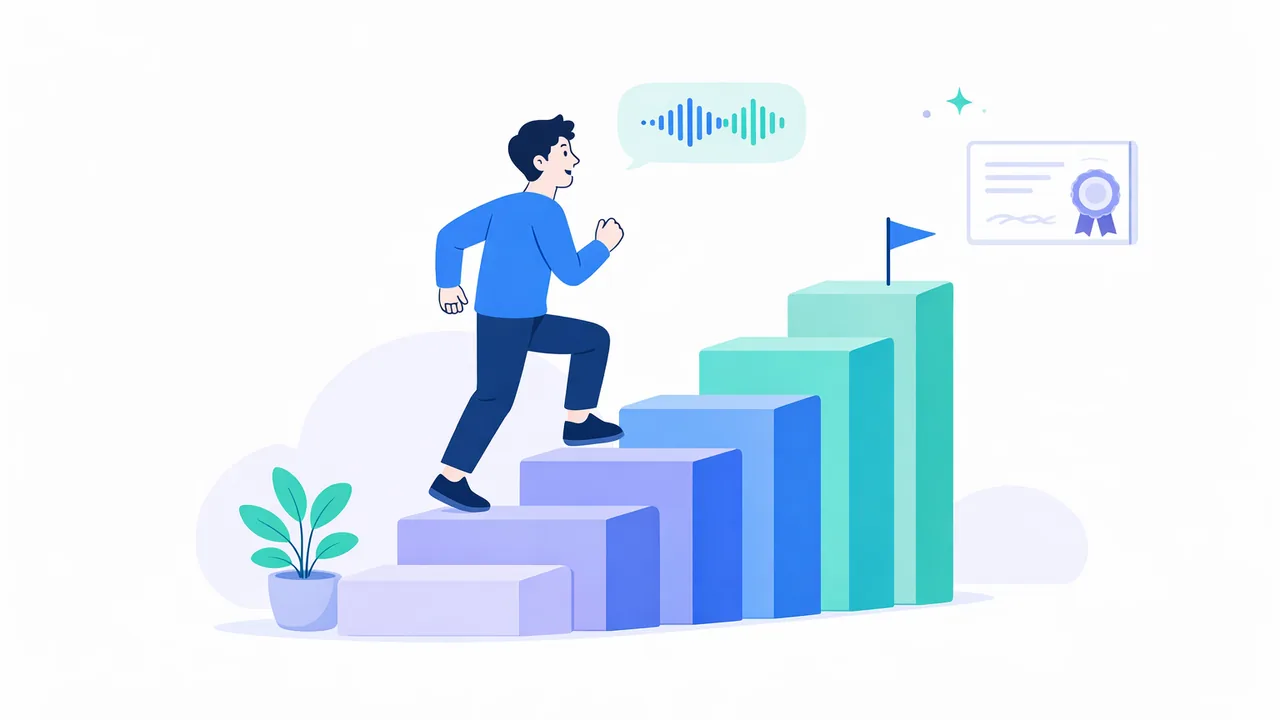
English levels are usually described on the CEFR, a six-level scale from A1 to C2 in three bands: basic (A1, A2), independent (B1, B2) and proficient (C1, C2). At B1 you can handle familiar topics and most travel situations in simple connected sentences; at B2 you can explain a point of view and talk with native speakers without strain on either side. The scale comes from the Council of Europe, and the major English exams publish how their scores map to it.
This guide explains each level in plain words, shows what an answer sounds like at each one and lists the official exam equivalents for IELTS, TOEFL iBT, TOEIC, Cambridge English and Eiken. To see where you are now, take the free English level test in your browser or the English speaking test in the Fluently app.
Start speaking with confidence today
Fluently is free to start. Take a free AI speaking assessment to see your level, then practice with games that build your vocabulary and pronunciation.


In this article
What the CEFR is
The CEFR, the Common European Framework of Reference for Languages, was published by the Council of Europe in 2001. It describes language ability at six levels by what a learner can do, from A1 for beginners to C2 for people who have mastered the language, and it works the same way for English as for any other language. Schools, exam boards and employers use it so that a level means the same thing across countries and tests.
The six levels sit in three bands: basic user (A1, A2), independent user (B1, B2) and proficient user (C1, C2). Your level can differ from skill to skill. Eiken score reports show a CEFR level for each skill, and ETS sets separate TOEIC minimums for listening, reading, speaking and writing, so you can be B2 in reading and B1 in speaking.
The six CEFR levels at a glance
The descriptions below paraphrase the Council of Europe’s global scale, the one-paragraph summary of each level. The names in the first column are the labels our level test uses.
| Level | Band | What you can do |
|---|---|---|
| A1 Beginner | Basic | Understand and use everyday expressions and very basic phrases. Introduce yourself and ask and answer simple questions about where you live, people you know and things you have. Conversation works if the other person speaks slowly and clearly and is ready to help. |
| A2 Elementary | Basic | Understand sentences and common expressions about everyday matters such as family, shopping, your area and work. Handle simple, routine exchanges on familiar topics and describe your background and surroundings in simple terms. |
| B1 Intermediate | Independent | Understand the main points of clear standard speech on familiar topics at work, school or leisure. Deal with most situations while traveling. Talk in simple connected sentences about experiences, plans and opinions, with short reasons. |
| B2 Upper intermediate | Independent | Understand the main ideas of complex texts, including technical discussion in your field. Talk with native speakers with enough fluency and spontaneity that neither side is under strain. Explain a viewpoint and the pros and cons of different options. |
| C1 Advanced | Proficient | Understand demanding, longer texts and catch implied meaning. Express yourself fluently and spontaneously without obvious searching for words. Use English flexibly for social, academic and professional purposes. |
| C2 Proficient | Proficient | Understand virtually everything you hear or read with ease. Summarize information from different sources into one clear account. Express yourself spontaneously, very fluently and precisely, with fine shades of meaning even on complex subjects. |
Cambridge English also uses a Pre-A1 level, below A1, in its exams for young children who are just starting.
What speaking sounds like at each level
The global scale covers all four skills. For speaking, the clearest way to hear the difference is to compare answers to the same question. The answers below to “Tell me about your job” were written for this guide to illustrate each level. They are not recordings or official test samples.
| Level | What it sounds like | Example answer |
|---|---|---|
| A1 | Short memorized phrases, long pauses, mostly the present tense. Needs a patient listener. | “I am Ana. I work in hotel. Receptionist. I like.” |
| A2 | Simple sentences joined with and, but and because. Fine on routine topics, lost when the conversation moves somewhere new. | “I work in a hotel in the city center. I check in guests and answer the phone. It is busy, but my colleagues are nice.” |
| B1 | Connected sentences with reasons and examples. Can tell a short story about a problem at work, with pauses to find words and mistakes in longer sentences. | “I’ve worked at the front desk of a hotel for three years. Most days I check guests in and deal with problems, like when a room isn’t ready yet. It can be stressful, but I like it because I can meet people from many different country.” |
| B2 | Explains and defends a point of view, compares options and answers follow-up questions without long pauses. | “I run the front desk team at a mid-sized hotel, so my day is split between scheduling, training new staff and handling complaints. The hardest part is staying calm with an upset guest, because you need to fix the problem and keep them on your side at the same time.” |
| C1 | Fluent and spontaneous. Chooses words to fit the situation and builds long, well-organized answers. | “On paper I run the front office, but in practice I spend most of my time smoothing over things that went wrong somewhere else, whether that’s an overbooking or a guest who feels nobody took them seriously.” |
| C2 | Precise and natural, with humor, understatement and fine shades of meaning, even on complex topics. | “Officially I run front-office operations, though ‘firefighter’ might be the more honest job title. Most of it comes down to reading people: knowing when a guest wants a quick fix and when they mostly want to be heard.” |
Look at what changes from row to row. Answers get longer, sentences connect, the speaker first gives reasons and then weighs options, and word choice moves from the first word that comes to mind to the word that fits. Those are the things to practice when you want to move up. They are also why a grammar quiz and a speaking test can put the same person at different levels.
English exam scores and CEFR levels
Each major English exam publishes how its scores line up with the CEFR, and two of them warn that the match is approximate: IELTS says its 9-band scale has no one-to-one correspondence with the CEFR, and ETS calls its TOEIC minimum scores guidelines rather than rigid cut-offs. Use the tables to read a score you already have, not to convert one exam into another exactly.
IELTS, TOEFL iBT and Cambridge English
| CEFR | IELTS (overall band) | TOEFL iBT (1–6 scale) | Cambridge English Scale |
|---|---|---|---|
| C2 | 8.5–9 | 6 | 200–230 |
| C1 | 7–8 | 5–5.5 | 180–199 |
| B2 | 5.5–6.5 | 4–4.5 | 160–179 |
| B1 | 4–5 | 3–3.5 | 140–159 |
| A2 | Not mapped | 2–2.5 | 120–139 |
| A1 | Not mapped | 1–1.5 | 100–119 |
- IELTS. The official chart starts at band 4 and uses the overall band, not the section scores. IELTS notes that band 5 sits on the B1/B2 border, that the C1 threshold falls between 6.5 and 7, and that 8.5 and above is C2, with band 8 borderline.
- TOEFL iBT. Since January 21, 2026, TOEFL reports each section and the total on a 1–6 scale in half-band steps; the total is the average of the four sections, rounded to the nearest half band. For two years, score reports also show a comparable score on the old 0–120 scale, and ETS suggests that a requirement of 80 on the old scale becomes 4, and 100 becomes 5.
- Cambridge English. Each exam targets one level: A2 Key targets A2, B1 Preliminary B1, B2 First B2, C1 Advanced C1 and C2 Proficiency C2. Each also reports the level above and the level below, except C2 Proficiency, which reports only the level below. B2 First, for example, reports 160–179 as B2, 180–190 as C1 (grade A) and 140–159 as B1.
TOEIC
ETS sets a minimum score for each CEFR level separately for each skill. There is no C2 minimum, and the mapping covers section scores rather than the Listening and Reading total.
| CEFR | Listening (5–495) | Reading (5–495) | Speaking (0–200) | Writing (0–200) |
|---|---|---|---|---|
| C1 | 490 | 455 | 180 | 180 |
| B2 | 400 | 385 | 160 | 150 |
| B1 | 275 | 275 | 120 | 120 |
| A2 | 110 | 115 | 90 | 70 |
| A1 | 60 | 60 | 50 | 30 |
Because the minimums are per section, a total does not give you a level. 400 + 385 = 785 is the lowest total with both sections at B2, but 450 in Listening and 335 in Reading also add up to 785 and leave Reading at B1. ETS also notes that only 45 percent of its 22 panelists backed a Reading C1 minimum, below the two-thirds it otherwise required, and that the Speaking and Writing minimums were adjusted from the study’s recommendations.
Eiken (Japan)
The Eiken Foundation of Japan (Japanese page) reports a CEFR level from the four-skill Eiken CSE total: A1 starts at 1400, A2 at 1700, B1 at 1950, B2 at 2300 and C1 at 2600. Each grade can report only a set range of levels, and Grades 4 and 5 report none. If you add a grade’s first-stage and second-stage pass marks, the lowest passing total falls in A1 for Grade 3, A2 for Grades Pre-2 and Pre-2 Plus, B1 for Grade 2, B2 for Grade Pre-1 and C1 for Grade 1. These sums are our arithmetic, not a table the Eiken Foundation publishes.
How long it takes to move up a level
Cambridge English estimates that a learner needs roughly 200 guided learning hours to move from one CEFR level to the next. Cambridge calls the figures approximate: your language learning background, how intensively you study, your age and how much you study outside lessons all change them.
| Level | Approximate guided learning hours from beginner |
|---|---|
| A1 | 90–100 |
| A2 | 180–200 |
| B1 | 350–400 |
| B2 | 500–600 |
| C1 | 700–800 |
| C2 | 1,000–1,200 |
Cambridge’s own example counts these as hours of lessons and supervised study. Read the figures as rough planning numbers. If speaking is your weakest skill, give it a fixed share of your study time instead of hoping it catches up on its own.
How to find your English level
- A free online level test. Our English level test gives an approximate CEFR level from 18 multiple-choice questions on grammar, vocabulary and usage. It runs in your browser with no account and does not test listening or speaking.
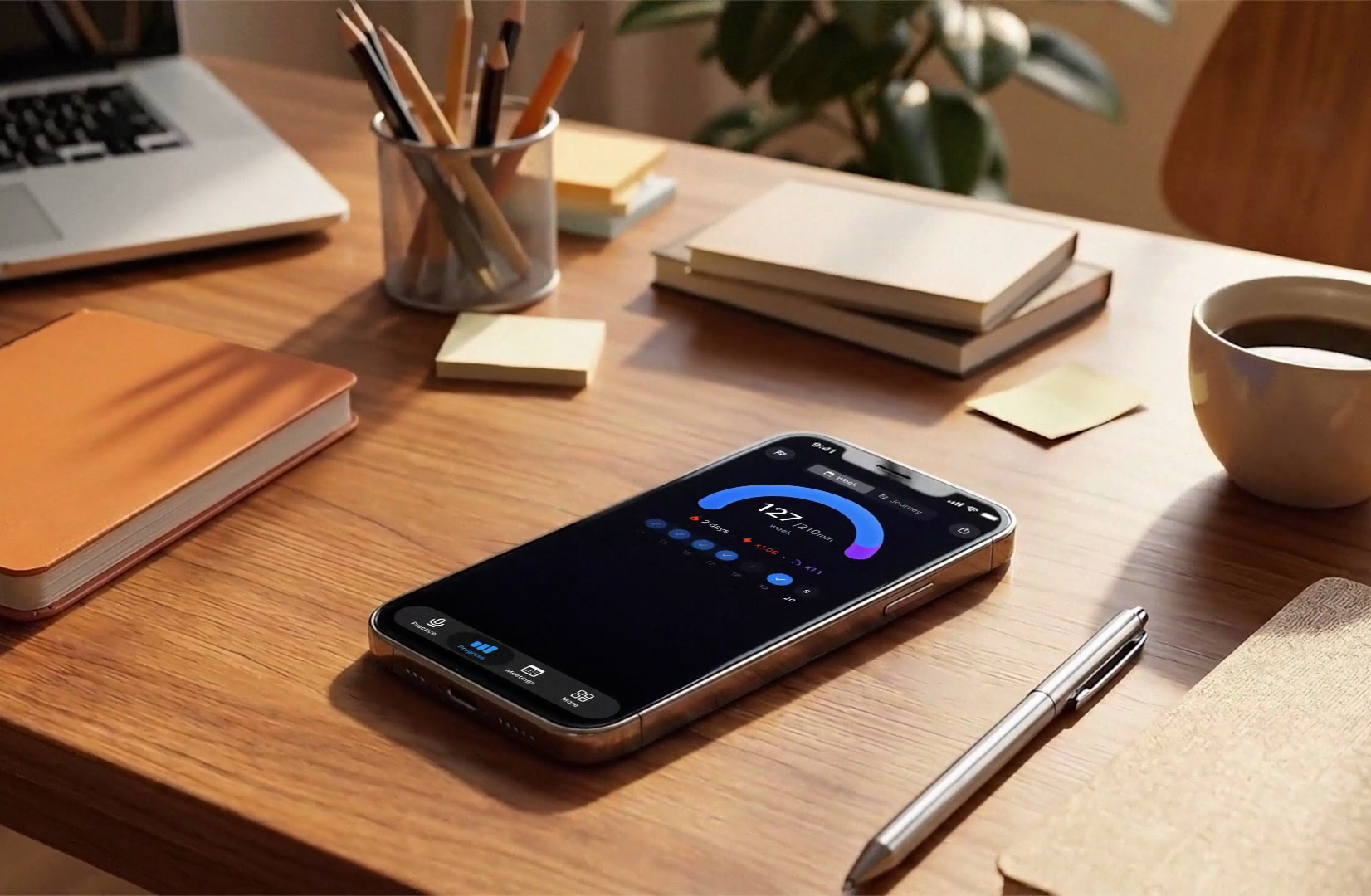
- A speaking assessment. The English speaking test runs in the Fluently app: you answer an AI tutor’s questions out loud for about four minutes. The result screen shows an estimated CEFR level, an overall score and scores for pronunciation, vocabulary, grammar, fluency and coherence. The app calls it a first estimate that gets more accurate as you keep talking.
- An official exam. If you need proof of your level for a university, an employer or a visa, check which exams and scores they accept. The tables above show what those scores mean on the CEFR.
- A teacher. A short conversation with a teacher can show your speaking level and which mistakes hold you back.
Free tests give an estimate, not a certificate. If the written test and the speaking test put you at different levels, the gap shows which skill to practice first.
Find your speaking level in the app
How to move up a level with speaking practice
Each step up asks for something specific in speaking. Find the row that starts at your current level and practice its exercise.
| Step | What changes | A speaking exercise |
|---|---|---|
| A1 → A2 | From single phrases to simple sentences about your life, work and routine. | Answer ten everyday questions, such as “Where do you live?” and “What do you do on weekends?”, out loud in full sentences, and record the answers. |
| A2 → B1 | From separate sentences to connected ones: what happened, in what order and why. | Retell your last weekend in one minute using first, then, because and so. |
| B1 → B2 | From describing to explaining: give an opinion, support it and answer the follow-up question. | Pick an opinion question and answer it in 90 seconds with two reasons and one counterargument, then answer “Why do you think that?” |
| B2 → C1 | From getting your point across to choosing how you say it: register, paraphrase and longer, organized turns. | Explain one process from your job to a new colleague, then explain it again to a senior manager in half the time. |
| C1 → C2 | From fluent to precise: nuance, idiom and summaries of several sources. | Summarize a podcast episode or a meeting in two minutes, then argue for the side you disagree with. |
Three habits help at every step: speak every day, get feedback on what you actually said, and say each corrected sentence again before you move on. Our guide to improving your English speaking covers a full routine, and practicing English speaking with AI shows how to set up a chatbot as a practice partner. For conversation material at your level, see English conversation for beginners, intermediate English conversation and advanced English conversation.
Practice for your next level with Fluently
A Fluently call works like a phone conversation with an AI tutor. Choose a topic or describe your own situation, such as a client call next week, and the tutor plays the other side and asks follow-up questions. After your turn, correction cards show a grammar fix, a more natural way to say your sentence or a better word, and the conversation keeps going. If you get stuck, ask for a hint. Your scores for pronunciation, fluency, vocabulary, grammar and coherence update as you practice, so you can see which skill is moving.
Fluently is free to start. Take a free AI speaking assessment to see your level, then practice with games that build your vocabulary and pronunciation. Conversations with your AI tutor come with Fluently Premium.
See your speaking level, then work on the next one