20 Road Worker Interview Questions and Answers, Plus the South African Road Worker Assessment
 Yurii Rebryk · Updated · 15 min read
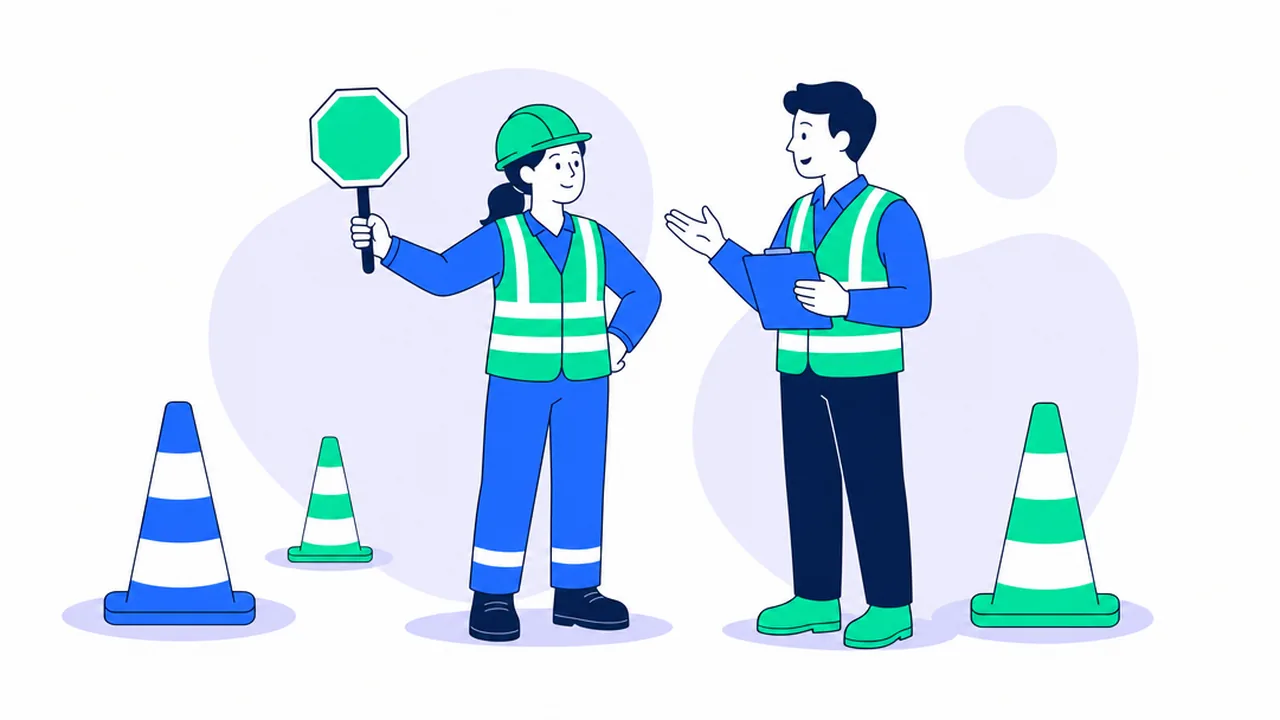
Road worker interview questions test four things: safety next to traffic, PPE, fitness for heavy outdoor work and teamwork. In South Africa, provincial roads departments add a road worker assessment: every shortlisted candidate does a practical exercise based on the post and an integrity (ethical conduct) assessment. Below are 20 questions with sample answers in plain spoken English, a 10-question practice quiz on flagging and roadworks signs, and fresher versions.
Start speaking with confidence today
Fluently is free to start. Take a free AI speaking assessment to see your level, then practice with games that build your vocabulary and pronunciation.


In this article
- What is the road worker assessment in South Africa?
- Road worker assessment practice questions: signs, flagging and safety
- Road worker interview questions about you (1–5)
- Road safety and traffic interview questions (6–12)
- Technical road work questions: potholes, compaction and drains (13–15)
- Teamwork, integrity and pay questions (16–20)
- More road worker interview questions
- Road worker safety rules by country
- Practise a flagging question out loud
What is the road worker assessment in South Africa?
The road worker assessment is the selection step South African provincial roads departments run for shortlisted applicants. Three 2026 road worker adverts in the Public Service Vacancy Circular (KwaZulu-Natal, 99 posts; Limpopo, 6 posts; Mpumalanga, 7 posts) use the same sentence for all their posts: shortlisted candidates “shall undertake two pre-entry assessments. One will be a practical exercise to determine a candidate’s suitability based on the post’s technical and generic requirements and the other must be an integrity (ethical conduct) assessment.”
| Stage | What to expect |
|---|---|
| Application | Z83 form and a detailed CV, usually online. KwaZulu-Natal wants job dates as DD/MM/YYYY. |
| Practical exercise | Based on the duties in the advert; the format is not published. |
| Integrity assessment | Ethical conduct: answer honestly and consistently (questions 16–18). |
| Interview | A panel asks about you, safety and teamwork: the 20 questions below. |
| Checks | Criminal record, citizenship, credit record, qualifications and employment (KwaZulu-Natal). |
Formats vary by department and region, but the duties show what can be tested. Mpumalanga’s road workers “render patch work, bush clearing, erect road signs, clean drainage and remove rubbish on the road”. KwaZulu-Natal adds culverts, guardrails, road studs and “barricade the work area”, and asks for “skills in the aptitude of figures”.
Not every road job uses this process. In Zibambele, KwaZulu-Natal’s EPWP road maintenance programme, participants “were nominated by their community” and trained in road maintenance and safety (Vuk’uzenzele, October 2015). Private contractors set their own steps.
Not a road worker test: the RTMC paper in searches for “road worker assessment” is an exemplar exam for the Occupational Certificate: Road Traffic Safety Officer (SAQA ID 101875), a 3-hour, 100-mark written exam for a different job (RTMC exemplar paper).
Road worker assessment practice questions: signs, flagging and safety
These ten practice items are not an official past paper. Items 1–9 follow the South African Road Traffic Signs Manual, Volume 2, Chapter 13 (SARTSM, Department of Transport, digitised May 2012); item 10 follows the OHS Act.
| Question | Answer |
|---|---|
| 1. What colour are temporary roadworks signs? | Black symbols and borders on a yellow background, so drivers can tell them from permanent signs. STOP, YIELD, NO ENTRY and ONE WAY signs are exceptions. |
| 2. How does a flagman stop traffic? | Faces the traffic, holds the flag out horizontally across the lane and raises the free arm, palm forward. |
| 3. Can the red flag wave traffic on? | No. The flagman stands parallel to traffic, flag out of view, and signals with the free arm. |
| 4. How does a flagman slow traffic? | From the stop position, moves the flag up and down at a steady pace. |
| 5. Where does a flagman stand? | On the shoulder or in the barricaded lane, never in the traffic lane; alone, and in rural areas visible from at least 150 m. |
| 6. What size is the flag? | At least 450 × 450 mm, fluorescent red-orange or red, on a staff at least 1 m long. |
| 7. Flagmen or a STOP/GO board? | Flagmen under 200 vehicles an hour on sections up to 100 m; STOP/GO boards above 200 vehicles an hour on longer sections. |
| 8. When are temporary traffic signals used? | For one-way traffic at night, when control without inter-visibility between the two ends is not satisfactory, and as recommended above 500 vehicles an hour. |
| 9. What colour are overalls and hard hats? | Red-orange, orange or yellow, plus a high-visibility vest for traffic control or work near traffic. |
| 10. When must you report an injury? | As soon as practicable, and not later than the end of that shift unless reporting was not possible (OHS Act 85 of 1993, section 14). |
Figures questions. Practise simple site maths like this (practice items):
| Figures question | Answer |
|---|---|
| A patch is 1.2 m long and 0.8 m wide. What is its area? | 1.2 × 0.8 = 0.96 m² |
| A patch needs 150 kg of cold-mix asphalt in 25 kg bags. How many bags? | 150 ÷ 25 = 6 |
| A hole is 150 mm deep; layers are 75 mm at most. How many layers? | 150 ÷ 75 = 2 |
| Cones every 10 m along a 150 m line, one at each end. How many cones? | 15 gaps, so 16 cones |
Road worker interview questions about you (1–5)
Keep each answer under a minute. Names, places and numbers in sample answers are examples: swap in your own.
1. “Tell me about yourself.”
A Gauteng road worker listed this first among questions at a Department of Roads and Transport interview (Indeed, April 2026). Give your experience, one safety habit and your reason.
Tell me about yourself (road worker)
B1My name is Thabo. For two years I’ve worked on a road maintenance team for a contractor near Pietermaritzburg.
I patch potholes, clean drains, and put out cones and signs before we start. I always wear my vest, hard hat and safety boots, and I’ve worked as a flagman.
I want this post because I like outdoor work, and I want to keep learning in a department team.
Read it aloud
Listen to a model reading, then record yourself. You get your speaking pace, the share of words that came through clearly, and the words to repeat.
No experience? Say: “I finished Grade 10 last year. I’ve done heavy work on my family’s farm, so I’m used to shovels and long days outside. I learn fast and I follow safety rules.”
2. “Why do you want to work as a road worker?”
Interviewers want a reason that will survive hot days and early starts.
Sample answer: “I like physical work outdoors and seeing the result at the end of the day: a road that is safe again. My community has bad potholes, so I know what good maintenance means. I also want steady work where I can learn more equipment.” Freshers can add one proof of hard work, such as farm or building work.
3. “What road work have you done, and which tools can you use?”
Name tasks and tools, then be honest about what you have not used.
You could say: “Mostly patching and drainage. I’ve used picks, shovels, rakes, a hand rammer and a plate compactor, and I’ve set out cones and signs. I haven’t driven a roller, but I’d like to learn.” Fresher version: “I haven’t worked on a road yet, but I’ve used shovels, picks and wheelbarrows on a building site.”
4. “Are you fit for heavy outdoor work in all weather?”
This checks that you know the job: shovelling, lifting and standing in sun and rain for a full shift.
A strong answer: “Yes. I’ve done physical work for years, with no health problems that stop me lifting or standing all day. In summer I drink water often. In rain I wear my rain suit and take more care near traffic, because drivers see less.” Freshers can mention sport or farm work instead.
5. “Can you work early starts, overtime and weekends?”
Give exact facts and any limits now, not after the offer.
Say: “Yes. I can start at six, and I can stay late when a job must be finished before the lane opens. My only limit is the first Sunday of the month, and I’m telling you now so you can plan.”
Road safety and traffic interview questions (6–12)
Road work happens next to moving traffic, so expect several safety questions.
6. “What is PPE, and why is it important?”
The Gauteng candidate was asked “the meaning and importance of PPE”: personal protective equipment. SARTSM says overalls and hard hats at roadworks “should be red-orange, orange or yellow”. The OHS Act (section 15) says no person shall “intentionally or recklessly interfere with or misuse anything which is provided in the interest of health or safety”.
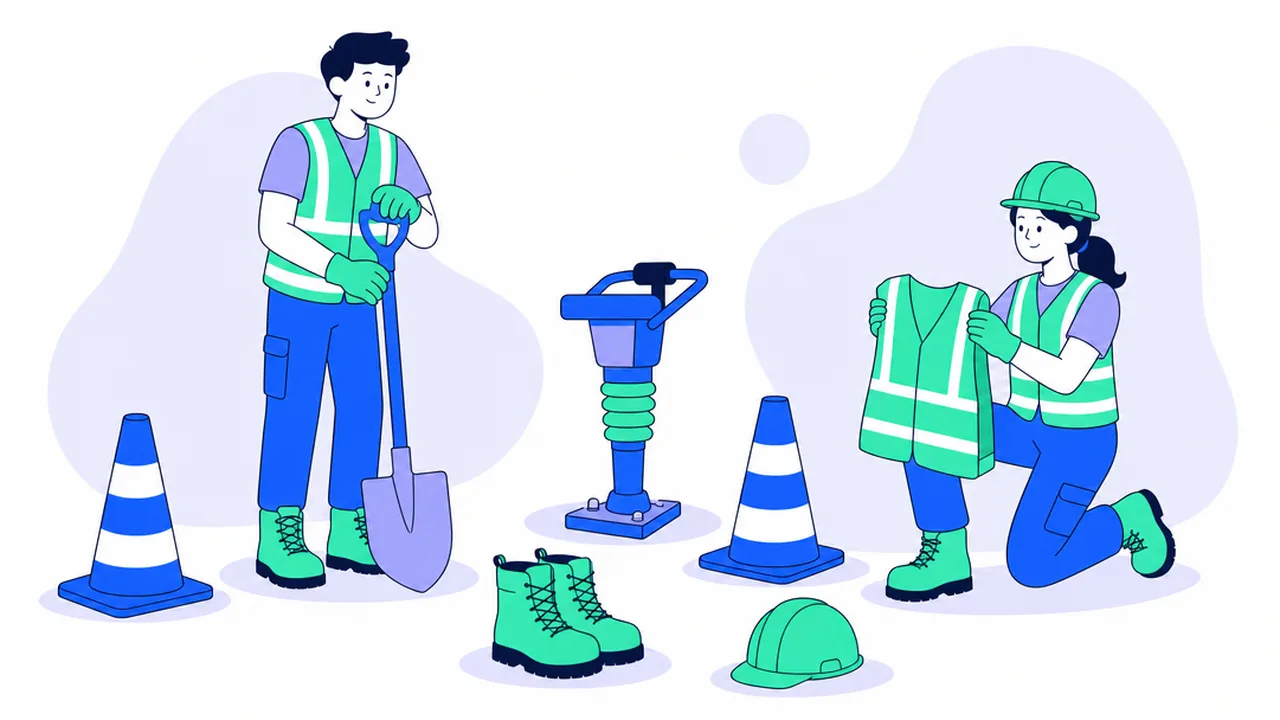
Sample answer: “PPE is personal protective equipment: my reflective vest, hard hat, safety boots and gloves, plus ear and eye protection when I use a compactor. It protects my body, and the vest makes drivers see me. I check it before the shift, and if something is damaged I report it.”
7. “How do you stay safe when you work next to traffic?”
SARTSM warns that “the most insignificant maintenance operation could result in the death of a worker” if the site is not alert. The US MUTCD Part 6 says all workers “should be trained on how to work next to motor vehicle traffic”.
Model answer: “I stay inside the coned area and never step into a live lane. When I put out or collect cones, I watch the traffic and don’t turn my back on it for long. I listen for the flagman’s warning. If a car enters the work area, I move away first and report it after.”
8. “How do you stop traffic with a flag or a stop/go board?”
Flagging questions check that you use the standard signals drivers expect (South African rules in the quiz above).
Say: “To stop traffic, I face the cars, hold the flag out flat across the lane and raise my free hand, palm forward. To let them go, I stand side-on, take the flag out of view and wave them on with my free arm, never with the red flag. I stand on the shoulder, and I stay in sight or radio contact with the flagman at the other end.”
9. “What do the yellow signs at roadworks mean?”
In South Africa, temporary roadworks signs use “a black symbol, letter or border on a yellow background”, so drivers can tell them from permanent signs (SARTSM 13.1–13.2). The US uses black on orange for work zone warning signs (MUTCD Part 6).
You could say: “Yellow signs show temporary conditions at roadworks, like a closed lane, a lower speed limit or a detour. I put them where the plan or the supervisor says, keep them clean so they reflect at night, and remove them when the work ends.”
10. “You see a hazard on site. What do you do?”
Hazard questions test whether you speak up. Section 14 of the OHS Act says every employee must report an unsafe or unhealthy situation “as soon as practicable” to the employer or the health and safety representative.
Sample answer: “If I can make it safe quickly, I do it. If I can’t, I warn the people nearby and tell my supervisor straight away. Once I saw a deep hole where the team parked the truck. I put a cone on it and reported it before lunch.”
11. “How do you lift and carry heavy materials safely?”
Cold-mix asphalt usually comes in bags of 25 to 40 kg (CSIR pothole guide, 2010). The UK Health and Safety Executive’s good handling technique: plan the lift, keep the load close to your waist, avoid twisting, and don’t lift more than you can easily manage.
A strong answer: “First I look at the load and the path. If it’s too heavy, I use a wheelbarrow or ask for help. I stand close with my feet apart, bend my knees a little, keep the bag near my waist and turn with my feet, not my back.”
12. “How do you protect yourself from heat on a long summer shift?”
OSHA’s Water. Rest. Shade. guidance says workers “should be encouraged to drink water frequently while working in the heat not just if they are thirsty”, with electrolyte drinks on jobs over two hours.
Say: “I drink water all day, a little at every stop, not only when I’m thirsty. I take breaks in the shade and watch my team for dizziness or confusion. If someone feels sick, we stop them working, cool them down and tell the supervisor.”
Technical road work questions: potholes, compaction and drains (13–15)
Technical answers below follow the CSIR’s technical guide to potholes, written for South African roads (December 2010).
13. “How do you repair a pothole?”
For a shallow asphalt patch, after the site is made safe with signs and traffic control, the guide gives this order:
- Mark the patch with straight lines, including the whole failed area plus some sound road.
- Cut and clean: cut the edges (a diamond saw gives clean ones), dig out loose material and sweep the hole.
- Tack coat: paint the bottom and sides with bitumen emulsion.
- Fill with hot-mix or cold-mix asphalt, in layers of 75 mm or less if the hole is deeper.
- Compact each layer with a hand tamper or plate compactor.
- Check with a straight edge: 5–10 mm above the road, swept, then open to traffic.
Sample answer: “After the cones and signs are out, I mark straight lines around the hole, cut and clean it, paint tack coat, fill in layers, compact each one and leave it a little high.” Neat, well-sealed edges matter: the guide says the join between patch and road “is the area that fails most frequently”.
14. “How do you use a plate compactor safely?”
The CSIR guide lists hand rammers, small plate compactors and pedestrian rollers as the usual patching tools, and notes that material which is too wet compacts poorly.
You could say: “Before I start, I check fuel, oil and the guards, and I wear ear protection, eye protection and boots. I compact thin layers slowly, with overlapping passes, and keep my feet away from the plate. I never leave it running alone. If the material is too wet, I tell the supervisor.”
15. “Why do drains and culverts need regular cleaning?”
KwaZulu-Natal hires road workers for a Drainage Team, and Mpumalanga’s duties include “clean drainage”. The reason is water: the CSIR guide says “there is no doubt that water is the primary cause of potholes”.
A strong answer: “Water destroys roads. If a drain or culvert is blocked, water stands next to the road or gets into the cracks, the layers get weak and the potholes come back. So I clear mud, grass and rubbish from side drains and culverts, especially before the rains, and report damage like a broken pipe.”
Teamwork, integrity and pay questions (16–20)
Questions 16–18 also prepare you for the integrity assessment: answer the way you would act.
16. “How would you handle a misunderstanding with a colleague?”
Gauteng’s panel asked this one too. A good answer is calm, private and quick.
Say: “I’d talk to my colleague privately at the break, not shout on site. I’d listen first, then explain my side calmly. Once a colleague and I disagreed about where to put the cones. We asked the team leader, followed the plan and were fine after. If we can’t agree, the supervisor decides.”
17. “A colleague does something unacceptable at work. What would you do?”
The Gauteng candidate reported this integrity question too. Safety and honesty come before friendship.
Model answer: “If it’s dangerous, like working near the lane without a vest, I stop him straight away and tell him why. If it’s dishonest, like taking site materials home, I report it to the supervisor. I’d rather lose a friend than see someone hurt or the whole team blamed.”
18. “Your supervisor tells you to do something you think is unsafe. What do you do?”
The OHS Act asks employees to “carry out any lawful order” and obey safety rules, and also to report unsafe situations. A good answer respects the supervisor and still protects people.
An unsafe instruction
B1–B2I’d stop and ask first, politely: “Before I start, can we check this? The cones don’t cover the hole, and cars are passing very close.”
Most of the time the supervisor has a reason, or we fix it quickly together.
If it’s still unsafe, I don’t do that part. I explain why and ask to speak to the safety representative. Every safe instruction, I follow.
Read it aloud
Listen to a model reading, then record yourself. You get your speaking pace, the share of words that came through clearly, and the words to repeat.
19. “What salary do you expect?”
Public service adverts fix the salary: all three 2026 road worker adverts above pay R170 226 a year at level 3. For private contractors, check the advert or ask the recruiter.
Sample answer (government post): “The advert says level 3, and I’m happy with that.” For a contractor: “I’m looking for the normal rate for this work here. What is the rate for this team?”
20. “Do you have any questions for us?”
KwaZulu-Natal’s advert lists blacktop, drainage, grader, signs and maintenance teams, so asking which one you would join shows you read it.
- “Which team would I join, and what does a normal day look like?”
- “What safety training do new road workers get, for example on flagging?”
- “What time does the team start, and where do we meet?”
- “What PPE do you issue, and what should I bring?”
More road worker interview questions
| Question | What to say |
|---|---|
| “What are your strengths and weaknesses?” | A strength with proof (“I’ve never missed a start time”), then a real weakness outside the core duties, with the fix. |
| “Why did you leave your last job?” | Short and positive: the contract or season ended. Never criticise a former boss. |
| “How do you work under pressure?” | One example, such as reopening a lane before peak traffic without skipping a safety step. |
| “Do you have a driver’s licence?” | Yes or no, with the code. KwaZulu-Natal’s 2026 driver operator posts, a separate advert, ask for Code EC with a PrDP. |
| “What do you do if a machine breaks down?” | Switch it off, make the area safe, report it, and carry on with hand tools if the supervisor agrees. |
| “Can you read a plan or measurements?” | Say what you can do: read a tape measure, set out cones at set distances, follow a simple sketch. |
| “What do you do at the end of a shift?” | Clean and pack tools, collect cones and signs, leave the road safe, report damage or injuries. |
Road worker safety rules by country
Rules differ by country and employer; check the site rules too.
| Country | Rules to know |
|---|---|
| South Africa | Employees must obey safety rules and report hazards and injuries (OHS Act, section 14). Roadworks signing and flagging follow SARTSM Volume 2, Chapter 13, which calls the selection and training of flagmen “essential”. |
| United States | Flagging must follow MUTCD Part 6 (OSHA 29 CFR 1926.201). The MUTCD says the STOP/SLOW paddle “should be the primary and preferred” hand-signaling device, flags “shall not be used to signal road users to proceed”, and work zone staff wear Class 2 or 3 high-visibility apparel. |
| Saudi Arabia | A midday outdoor work ban for private-sector employers runs 12:00–15:00 from 15 June to 15 September (2026 announcement). |
| United Arab Emirates | No work in direct sun in open places 12:30–15:00, 15 June to 15 September; asphalt laying is exempt only if it cannot wait (UAE government portal). |
| India | Building workers aged 18–59 with 90+ days of construction work (roads included) in the past year can register with their state construction workers’ welfare board (Code on Social Security, 2020, section 106). |
| Nigeria, others | Ask which safety induction, PPE and summer hours apply. |
Practise a flagging question out loud
Expect “what if” follow-ups. Say the candidate’s lines out loud.
A driver ignores the stop signal
B1- Interviewer
You are flagging at one end of a lane closure. A driver ignores your stop signal. What do you do?
- Sipho
I stay on the shoulder, warn the team, and radio the other end to hold their traffic.
- Interviewer
The next driver stops and shouts that he is late.
- Sipho
I stay polite: “Sorry, sir, one lane is closed. You can go in about two minutes.”
- Interviewer
Then your radio stops working.
- Sipho
I keep my side stopped and phone the supervisor. We release traffic only when both ends agree.
- Interviewer
Why not wave the cars through with your flag?
- Sipho
The red flag means stop or slow. I wave traffic on with my free arm, only when the lane is clear.
Practise this dialogue
Listen to the whole exchange, then take one role: your partner’s lines are read aloud, you say yours into the microphone and see which words came through.
For timed practice, the free browser mock interview runs screening and behavioral questions and reports answer length, pace and filler words; it has no road worker track and does not check technical content. For interview phrases, see English for job interviews. Related site trades: scaffolding interview questions and electrician assistant interview questions.
Say your answers out loud before the panel
Fluently is an AI speaking coach for non-native English speakers on iOS and Android. You answer out loud and get feedback on pronunciation, fluency, vocabulary and grammar. It is free to start: take a free AI speaking assessment to see your level, then practice with games that build your vocabulary and pronunciation. Conversations with your AI tutor come with Fluently Premium.
Frequently asked questions
Is there a road worker assessment test PDF with answers?
Not an official one. The adverts describe the assessment in one sentence and do not publish the practical exercise, so treat files shared online as unofficial. To keep this page, print it and choose Save as PDF.
What qualifications do you need to be a road worker in South Africa?
It depends on the advert. In 2026, Mpumalanga asked for Grade 10 with no work experience, KwaZulu-Natal for NQF level 1 or 2 (ABET level 2 certificate or equivalent), and Limpopo for a qualification at NQF level 4.
How do you apply for a government road worker job in South Africa?
Find the post in the weekly Public Service Vacancy Circular or the province’s e-Recruitment portal, and submit the Z83 form and a detailed CV before the closing date. Quote the reference number of the exact centre.
Is the traffic officer assessment the same as the road worker assessment?
No. Traffic officer and provincial inspector posts are law-enforcement jobs advertised separately; in KwaZulu-Natal’s 2026 circular they sit under the Road Traffic Inspectorate, with different requirements.
Do you need good English for a road worker interview?
You need to understand instructions and explain yourself clearly; KwaZulu-Natal’s advert lists “good verbal and written communication skills”. Short sentences are enough. To check your level, try the English speaking test.