20 Electrical Assistant Interview Questions and Answers (Electrician’s Helper)
 Yurii Rebryk · Updated · 15 min read
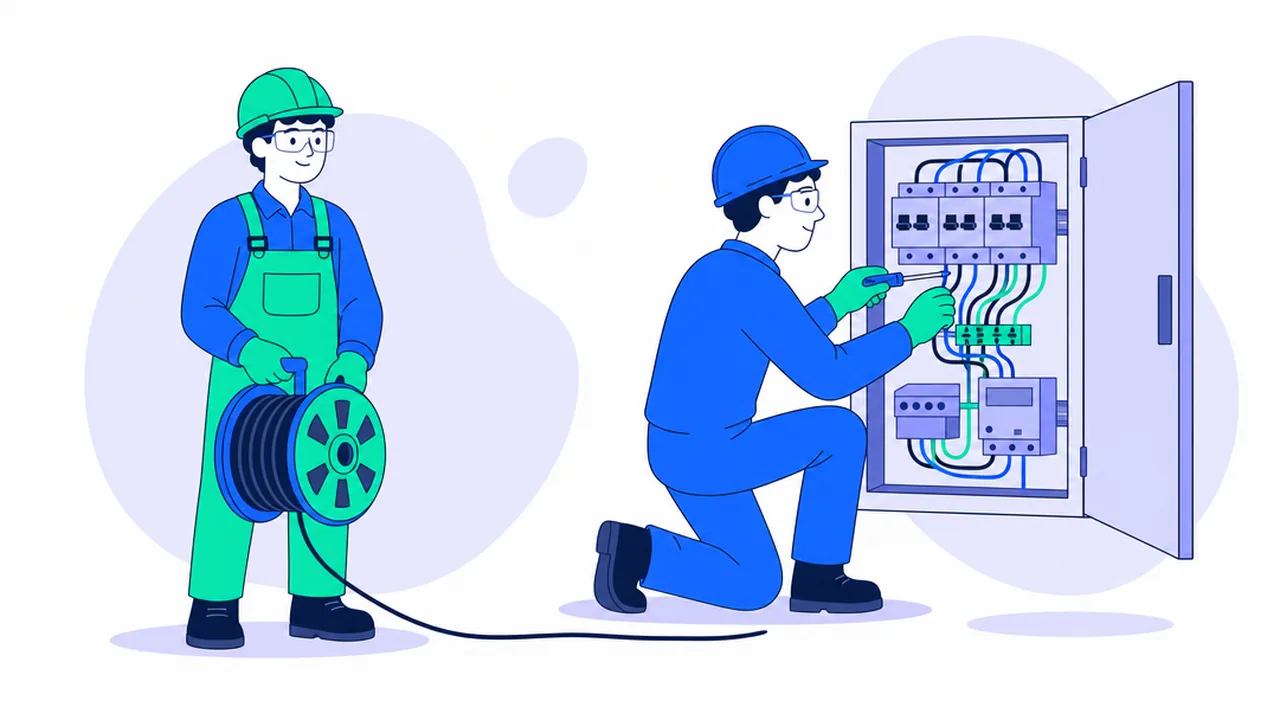
Electrical assistant interview questions test three things: basic electrical knowledge (Ohm’s law, AC and DC, breakers, earthing), safety habits (lockout, testing for dead, PPE, ladders) and whether you will work safely under a qualified electrician. The 20 questions below come with sample answers in plain spoken English, the correct technical content with sources, fresher versions, and training rules for the US, South Africa, India, Kenya and Saudi Arabia.
Start speaking with confidence today
Fluently is free to start. Take a free AI speaking assessment to see your level, then practice with games that build your vocabulary and pronunciation.


In this article
- Electrical assistant interview questions about you and the job (1–5)
- Basic electrical questions and answers for electrician assistants (6–12)
- Electrical safety interview questions: lockout, PPE and ladders (13–16)
- Teamwork and work-habit questions for electrical helpers (17–20)
- More electrical helper interview questions
- Electrician’s assistant rules by country
- Practice an electrical assistant interview question out loud
Electrical assistant interview questions about you and the job (1–5)
The first five questions check who you are and whether you understand the role. Keep each answer under a minute; every name and number in the sample answers is an example, so swap in your own.
1. “Tell me about yourself.”
“Tell me about yourself” wants a short story in order: what you do now, the hands-on work behind it, and why you want to assist an electrician.
Sample answer: “I’ve worked for two years as a labourer for a building contractor. I carried materials, dug cable trenches and often helped the electricians pull cable. Last year I finished a basic electrical course at a technical college, and now I want to work full time as an electrician’s assistant and start an apprenticeship.”
Tell me about yourself (fresher)
B1I’m 20, and this year I finished a basic electrical course at a technical college. In the workshop I wired lighting circuits from diagrams and used a multimeter on circuits that were switched off.
On weekends I work at a hardware store, so I know most tools and cables by name. I want to learn the trade properly on real sites, under an experienced electrician.
Read it aloud
Listen to a model reading, then record yourself. You get your speaking pace, the share of words that came through clearly, and the words to repeat.
2. “Why do you want to work as an electrical assistant?”
Give a reason that survives weeks of carrying cable. A former IBEW journeyman wireman, answering an apprentice on Quora, advised: “Speak more about how you want to contribute and less about how you are going to benefit.”
Say: “I like work where I can see the result at the end of the day: a light that works, a neat cable run. I’ve always built and repaired things. Electrical work is a skill I can grow in for years, and I want to learn it properly from a qualified electrician.”
3. “What does an electrical assistant do?”
The job-description question checks that you see the role as support work. O*NET, the US Department of Labor’s job database, says electrician helpers “help electricians by performing duties requiring less skill”, such as supplying or holding materials and tools and cleaning the work area; its task list adds cutting and bending wire and conduit, drilling holes and pulling wire (O*NET 47-3013.00, 2026).
A strong answer: “I support the electrician so the work goes faster and safer. I bring the right tools and materials, cut cable and conduit, drill holes, pull wire and keep the site clean. I don’t decide how things are wired, and I don’t work on anything live. If I’m not sure, I ask first.”
4. “What tools and meters can you use?”
Name the tools you can use today and be honest about the rest; a list of every tool in the catalogue sounds invented.
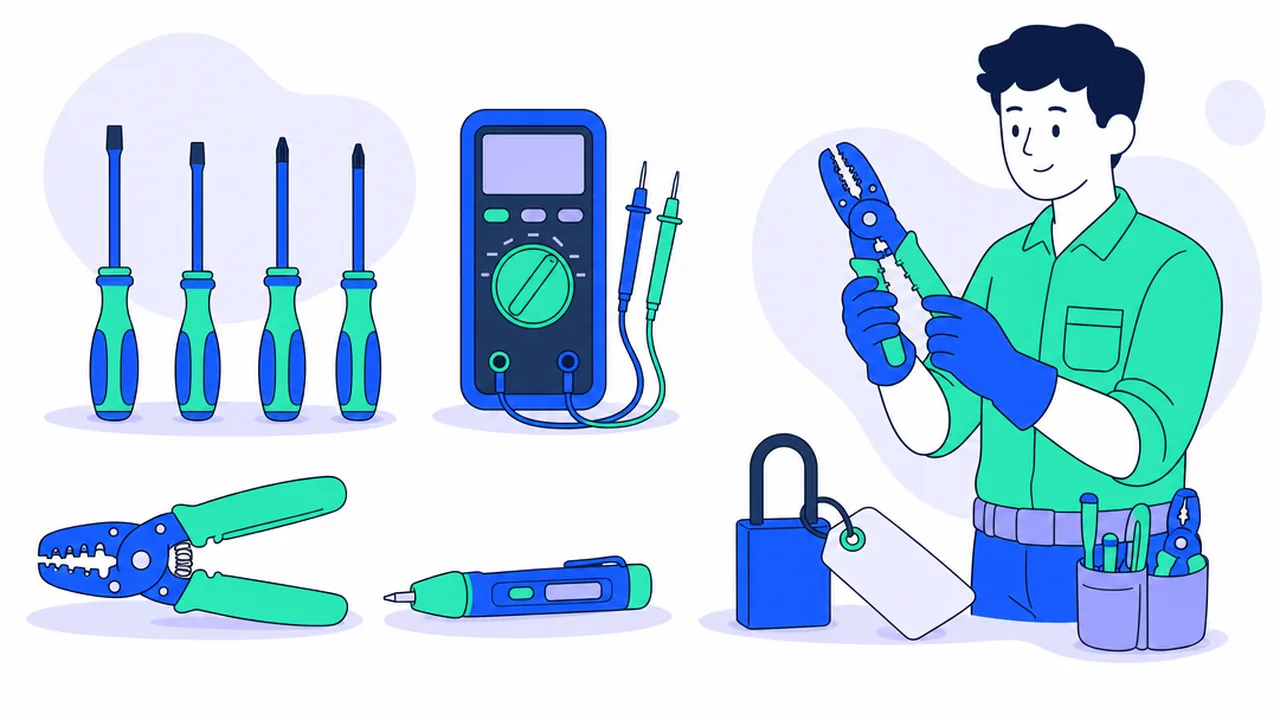
You could say: “Insulated screwdrivers, side cutters, wire strippers, a tape measure and a level, plus a drill and a hammer drill. I can check continuity with a multimeter on circuits that are switched off. I haven’t used an insulation tester yet, so I’d like someone to show me first.” No experience: name the tools from your course and add, “I learn a new tool quickly once someone shows me.”
5. “Can you read a wiring diagram or a floor plan?”
Electricians want an assistant who can find a point on the plan and pull the right cable to it. In the US, apprentice classes cover “electrical theory, blueprint reading, mathematics, electrical code requirements, and safety and first-aid practices” (BLS Occupational Outlook Handbook).
Sample answer: “Yes, simple ones. I can find sockets, switches and lights from the symbols and the legend. For a complex drawing, I’d ask the electrician to walk me through the first page.” Fresher version: “In college we wired one-way and two-way lighting circuits from diagrams.”
Basic electrical questions and answers for electrician assistants (6–12)
Basic electrical questions have short, correct answers, and interviewers notice guessing. Kenya’s regulator tests the same ground in the written and oral interview for its entry-level C2 electrical worker licence: AC and DC, voltage, current and resistance, fuses, MCBs and RCDs, cable colour coding and earthing (EPRA assessment areas, 2025).
6. “Can you explain Ohm’s law?”
Ohm’s law says the current through a conductor is proportional to the voltage across it: V = I × R, so current = voltage ÷ resistance (HyperPhysics, Georgia State University). Worked example: 12 volts across 6 ohms drives 12 ÷ 6 = 2 amps; double the resistance and the current halves to 1 amp.
Say: “Ohm’s law links voltage, current and resistance: V equals I times R. If I know two, I can work out the third. For example, 12 volts across 6 ohms gives 2 amps.”
7. “What is the difference between series and parallel circuits?”
In a series circuit the whole current flows through every part and the voltage is divided; in a parallel circuit each branch gets the full supply voltage and the current splits (HyperPhysics).
Sample answer: “In series, everything is on one path, so if one part fails, everything stops. In parallel, each branch gets the full voltage, so one light can fail and the others stay on. That’s why lights and sockets in a building are wired in parallel.”
8. “What is the difference between AC and DC?”
The US Department of Energy explains that direct current “runs continually in a single direction, like in a battery”, while alternating current reverses direction many times a second (60 in the US) and is easy to step up or down with a transformer. Computers, LEDs, solar cells and electric vehicles run on DC (energy.gov).
Try: “DC flows one way, like from a battery. AC changes direction many times a second. The grid uses AC because a transformer can change its voltage easily.”
9. “What is the difference between a fuse, a circuit breaker and a GFCI or RCD?”
Fuses and breakers protect the wiring; GFCIs and RCDs protect people. Fuses melt and breakers trip when too much current flows, so wires do not overheat. A ground-fault circuit interrupter (GFCI) compares the current going out with the current coming back and cuts the power if the difference exceeds 5 milliamperes, in as little as 1/40 of a second (OSHA, Controlling Electrical Hazards). Kenya and the UK call it a residual current device (RCD); the UK regulator HSE says one rated at no more than 30 mA “can save your life” (HSE).
Model answer: “A fuse melts and has to be replaced; a breaker trips and can be reset. Both protect the cables. A GFCI or RCD protects people: if current leaks out, maybe through a person, it switches off very fast.”
10. “Why is earthing or grounding important?”
Grounding (earthing in South Africa, India, Kenya and the UK) means “intentionally creating a low-resistance path that connects to the earth”; if insulation fails, the equipment grounding conductor “directs unwanted current directly to the ground” instead of through a person (OSHA). US rules require that path to be “permanent, continuous, and effective” (29 CFR 1910.304).
Sample answer: “Earthing gives fault current an easy path to the ground. If a live wire touches a metal case, the current goes down the earth wire, not through a person, and the protection trips. So I report a broken earth pin or a missing earth wire straight away.”
11. “What do the wire colours mean?”
Wire colours depend on the country and the age of the building. US colours below follow OSHA; UK colours follow IEE Wiring Matters, 2005, which says work starting after 31 March 2006 must use the new colours.
| Conductor | US | UK, new | UK, before 2006 |
|---|---|---|---|
| Earth / ground | Green, or green with yellow stripes | Green and yellow | Green and yellow |
| Neutral | White or gray | Blue | Black |
| Live, single phase | Often black or red; never green, white or gray | Brown | Red |
| Live, three phase | Check the local code | Brown, black, grey | Red, yellow, blue |
South Africa, India, Kenya and Saudi Arabia set colours in their own wiring rules, and old buildings may keep old colours. Whatever the colour, HSE says conductors “should be proven dead, using appropriate test equipment” before work starts.
A strong answer: “In the US, green is ground, white is neutral and black or red is usually hot. In UK-style wiring, brown is live, blue is neutral and green-yellow is earth. But a colour only tells me what a wire should be, so it must be tested dead first.”
12. “A breaker keeps tripping. What could cause it?”
An assistant is not expected to diagnose alone, but should know the three conditions OSHA names for circuit protection devices: overload, short circuit and ground fault.
Sample answer: “It could be an overload, a short circuit or a ground fault. I’d tell the electrician what was running when it tripped and help unplug things to narrow it down. I wouldn’t keep resetting it, because a breaker that trips is doing its job.”
Electrical safety interview questions: lockout, PPE and ladders (13–16)
Safety questions decide most assistant interviews, and the safe answer stays inside your role. In the US, “only qualified persons may work on electric circuit parts or equipment that have not been deenergized” (29 CFR 1910.333), meaning people trained in that equipment “and the hazards involved” (29 CFR 1910.399).
13. “How do you make sure a circuit is safe before work starts?”
Question 13 is the lockout/tagout question. OSHA’s general lockout standard sets six steps in order: prepare, shut down, isolate, fit locks or tags, release stored energy, and verify isolation (29 CFR 1910.147). Work on electrical circuits follows OSHA’s electrical rules instead: locks and tags go on the disconnecting means, “a qualified person shall use test equipment” to verify the parts are de-energized, and each lock and tag is removed by the employee who applied it (29 CFR 1910.333). Listen to the model, then record yours.
How do you make sure a circuit is safe?
B1–B2We switch the circuit off at the breaker or isolator, not at a light switch. Each of us puts a personal lock and a tag on it, so nobody can switch it back on.
Next, the electrician tests it with a voltage tester to prove it’s dead. Until that test, I treat every wire as live. At the end, each person removes only their own lock.
Read it aloud
Listen to a model reading, then record yourself. You get your speaking pace, the share of words that came through clearly, and the words to repeat.
14. “What PPE do you wear, and why?”
PPE answers should match the hazard. US rules require nonconductive head protection where shock or burns could injure the head, and eye or face protection against arcs, flashes and flying objects (29 CFR 1910.335). Conductive jewellery, such as “watch bands, bracelets, rings”, is banned where it might touch exposed live parts (1910.333).
Say: “A hard hat rated for electrical work, safety glasses, gloves for the task and safety boots. Work near live parts is the electrician’s job, with rated gloves and arc-flash gear. I also take off my ring and watch, because metal conducts electricity.”
15. “How do you use a ladder safely near electrical equipment?”
Ladders that could touch exposed energized equipment must have nonconductive side rails, so fibreglass, not aluminium. Set the foot about one quarter of the working length out from the top support (the 4-to-1 rule), extend it at least 3 feet (0.9 m) above an upper landing, and face the ladder with at least one hand on it (29 CFR 1926.1053). Heights come up in other site trades too, as in these scaffolder interview questions.
Sample answer: “Near electrical equipment I use a fibreglass ladder, never aluminium. I check it for damage, set it at one out for every four up, face it when I climb and keep a hand on it. Tools go in a belt, not in my hands.”
16. “The electrician is late, and the supervisor asks you to start on the panel. What do you do?”
The late-electrician question is a pressure test. Employers check the same instinct with a trick question from ServiceTitan’s hiring list: “Describe a specific electrical job where you sacrificed safety for speed.” The right answer to both is a polite no.
You could say: “I’d say politely that I’m not qualified to work on the panel. Then I’d offer to do the prep: bring in the materials, mark the cable routes, set up the ladder and clear the area. When the electrician arrives, the job can start right away.”
Teamwork and work-habit questions for electrical helpers (17–20)
17. “Tell me about a time you spotted a safety problem.”
Question 17 is behavioral: tell one real event in order, Situation, Task, Action, Result (STAR).
Sample answer: “On a renovation site last year, a coworker was using an extension lead with a split cover, and the inner wires were showing. I asked him to unplug it and told the supervisor. We tagged it ‘Do not use’ and got a new lead. After that, the team checked leads every morning.” No site experience? Use school or a warehouse: a blocked fire exit, a wet floor near a socket.
18. “How do you take instructions from the electrician, and what if you disagree?”
Interviewers want a listener who still speaks up about safety. Another answer in the same Quora thread: “I respect an apprentice that listens, asks questions when they need to and don’t pretend to know it all.”
Model answer: “I listen, repeat back anything complicated, and ask before I guess. If something looks unsafe, I say so at once and we check it together. If it’s just a different way of working, I do it the electrician’s way and ask why later.”
19. “How do you handle a busy day with several jobs?”
Prioritising questions check whether you keep the electrician working instead of waiting for you.
Try: “I ask the electrician what comes first. Then I work ahead: I load the van the night before, check we have the right cable and fittings, and set out tools for the next task. If we’re short of something, I say so early, not when the job stops.”
20. “Where do you see yourself in five years?”
Employers like helpers who plan to stay in the trade. In the US, most electricians learn through a 4- or 5-year apprenticeship with about 2,000 paid on-the-job hours a year, and some start as helpers (BLS). The country table shows the route where you live.
Sample answer: “In five years I want to be qualified, or close to it, through an apprenticeship, and to help new assistants the way someone will help me here.” Fresher version: “First, safe habits and the tools. Then an apprenticeship with a company like yours.”
More electrical helper interview questions
| Question | What to say |
|---|---|
| “Why do you want to work for our company?” | One fact about their work (houses, solar, factories), linked to what you want to learn. |
| “Why did you leave your last job?” | One neutral reason: “The contract ended, and I want to move into the electrical trade.” No complaints about a past boss. |
| “What are your strengths and weaknesses?” | A strength with proof (“I haven’t been late in two years”), then a real weakness that is not a safety duty, with the fix. |
| “What pay do you expect?” | A range from local pay data. In the US, O*NET lists a 2025 median of $20.51 an hour for electrician helpers. |
| “Are you fine with heavy work, heights and tight spaces?” | Yes, with an example. BLS lists physical stamina as an important quality: electricians “often need to move around all day while running wire”. |
| “Any problems with colour vision?” | Answer honestly: BLS notes that electricians “must identify electrical wires by color”. |
| “Do you have a driving licence? Can you start early?” | Exact facts: your licence, the earliest start you can manage, your notice period. |
| “A customer asks you a technical question. What do you do?” | Stay polite, don’t guess or promise anything, and bring the electrician in. |
| “Do you have any questions for us?” | Ask two: “What kind of sites will I work on?” and “Do you support apprenticeships or trade tests?” |
Electrician’s assistant rules by country
What an assistant may do, and how to qualify, depends on the country. Check the regulator before the interview, and name your route in question 20.
| Country | Rules for assistants | Route to qualify |
|---|---|---|
| United States | Only qualified persons may work on parts that are not de-energized (OSHA 1910.333). | 4- or 5-year apprenticeship; most states require electricians to pass a test and hold a licence (BLS). |
| South Africa | A registered person exercises “general control” (instruction, guidance and supervision) over all installation work and issues the certificate of compliance (Electrical Installation Regulations, 2009). | Electrician is an artisan trade: apprenticeship or Artisan Recognition of Prior Learning (ARPL), then a trade test (DHET artisan support centre). |
| India | Installation work, beyond replacing lamps, fans, fuses, switches and domestic appliances up to 250 V, is done by a state-licensed contractor, under a certificate-of-competency holder, by a person with a state permit (CEA Safety Regulations 2023). | ITI Electrician: two years (2,400 hours plus 300 on the job), after 10th class with science and maths (DGT). |
| Kenya | EPRA licenses electrical workers by class; the starting class, C2, covers low-voltage single-phase work in buildings up to two storeys (EPRA). | An Electrician Wireman grade certificate (Grade I, II or III), a craft certificate or a diploma, then EPRA’s written and oral interview (EPRA qualifications table). |
| Saudi Arabia | MHRSD’s Professional Examination tests expatriate workers in medium- and low-skill trades with practical and theory tests, before or after arrival; it also runs in India, Pakistan, Bangladesh, Sri Lanka and Egypt (MHRSD, 2024). | Ask the recruiter whether your job title needs the exam. |
Practice an electrical assistant interview question out loud
Safety questions rarely end after one answer: the interviewer adds complications. Say the candidate’s lines out loud.
Replacing a light fitting
B1–B2- Interviewer
You and the electrician are replacing a light fitting in an office. What happens first?
- Sipho
We find the right breaker on the panel schedule, switch it off, and put a lock and a tag on it.
- Interviewer
The light switch is already off. Isn’t that enough?
- Sipho
No. A switch can be wired wrong, or someone can turn it on. We isolate at the breaker and lock it.
- Interviewer
The electrician tests it and says it’s dead. Then you see another wire in the box.
- Sipho
I don’t touch it. I tell the electrician, because it might come from another circuit and needs testing too.
- Interviewer
The office manager wants the lights back on and starts to take your tag off.
- Sipho
I ask him politely to stop and call the electrician over. Only the person who put a lock on takes it off.
Practise this dialogue
Listen to the whole exchange, then take one role: your partner’s lines are read aloud, you say yours into the microphone and see which words came through.
Job words need clear stress: ih-lek-TRISH-un (electrician), SUR-kit (circuit), EYE-suh-late (isolate), per the Cambridge Dictionary. For drills, see the English pronunciation practice guide and the English for job interviews guide.
For a timed run, the free browser mock interview reports answer length, pace and filler words; it has no electrician track, so choose Screening classics or Behavioral. It checks how you speak, not your electrical knowledge. For a baseline, take the English speaking test.
Say your answers out loud before the interview
Fluently is an AI speaking coach for non-native English speakers on iOS and Android. You answer out loud and get feedback on pronunciation, fluency, vocabulary and grammar. It is free to start: take a free AI speaking assessment to see your level, then practice with games that build your vocabulary and pronunciation. Conversations with your AI tutor come with Fluently Premium.
Frequently asked questions
What are 10 basic electrical questions for an assistant interview?
Ohm’s law, series and parallel circuits, AC and DC, fuses and breakers, GFCIs or RCDs, earthing, wire colours, a breaker that keeps tripping, lockout/tagout, and proving a circuit dead. Questions 6 to 13 answer each in two or three sentences.
Is an electrical assistant the same as an electrician’s helper or apprentice?
In daily work, mostly yes: O*NET lists Electrical Helper, Electrician’s Helper and Electrician Apprentice as titles of one occupation. An apprentice, though, is in a training program that leads to a licence or trade test; a helper or assistant may not be.
Can I get an electrical assistant job with no experience?
Yes. O*NET puts electrician helpers in Job Zone 1–2, “very little to some preparation needed”. Bring proof of hands-on work, a safety habit and a plan to learn; the fresher answers under questions 1, 4, 5, 17 and 20 show how.
What is the 30-60-90 rule in an interview?
It is a plan for your first 30, 60 and 90 days. For an assistant: by day 30, know the site rules and tools; by day 60, handle prep and material runs without reminders; by day 90, pull cable and fix conduit with less supervision.
Is there a PDF of these electrician interview questions and answers?
There is no separate PDF. Use your browser’s Print option and choose Save as PDF to keep this page. Reading is not rehearsal, though: say each answer out loud at least twice.
What should I wear and bring to an electrical assistant interview?
Clean, neat clothes; one answer in the Quora apprentice thread sums it up as “No jeans with holes in them.” Bring your ID, course certificates and references, and ask beforehand whether a practical test needs safety boots.