20 Dock Worker Interview Questions and Answers, With Loading and Safety Scenarios
 Yurii Rebryk · Updated October 29, 2026 · 15 min read
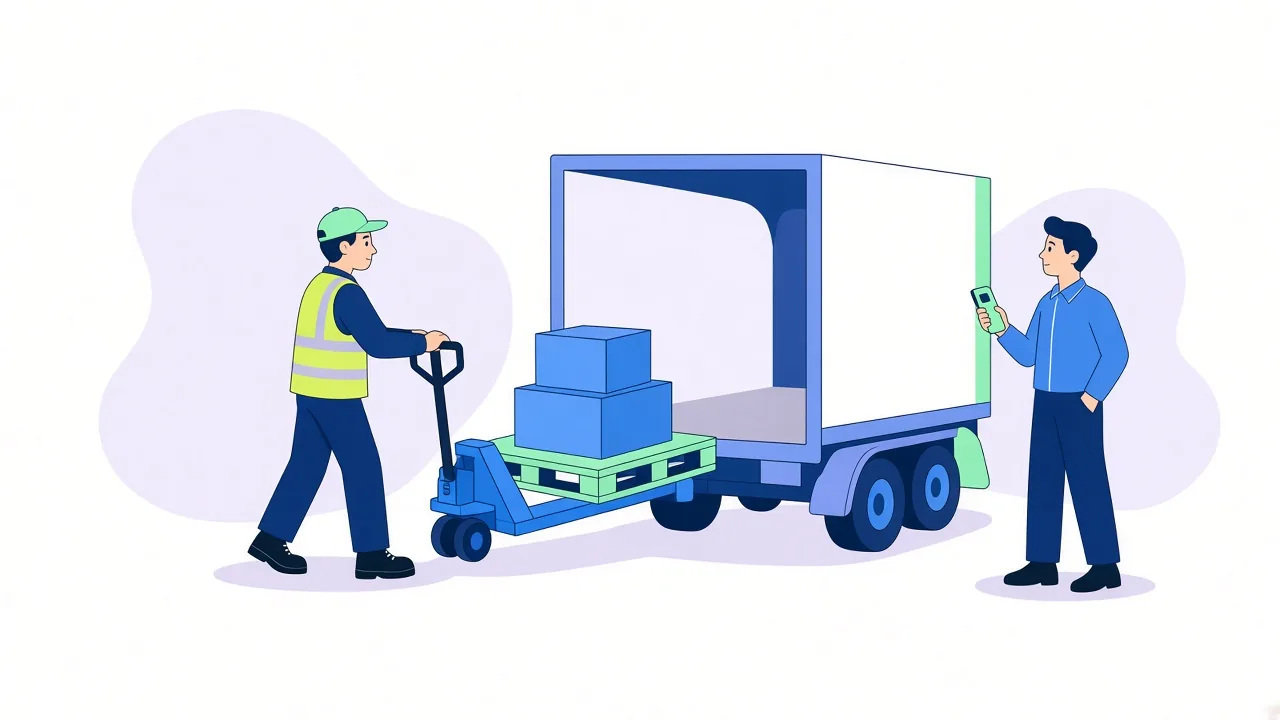
Dock worker interview questions test four things: whether you can load and unload trailers without damage or injury, keep labels and piece counts right, work nights, weekends, heat and cold, and follow dock safety without being told. The 20 questions below draw on what candidates report being asked at freight terminals and warehouses. Each has a sample answer in plain spoken English, with no-experience versions where they matter.
In this article
- The 20 dock worker interview questions at a glance
- What does a dock worker do?
- Dock worker interview questions about you and your experience (1–6)
- Loading and unloading interview questions (7–12)
- Dock safety interview questions (13–16)
- Teamwork, attendance and closing questions (17–20)
- More loading and unloading interview questions
- Loading and unloading skill tests: what to practise
- Forklift and pallet jack training rules by country
- How to answer dock worker interview questions in clear English
- Practice a dock safety question out loud
The 20 dock worker interview questions at a glance
These questions also fit dock loader, freight handler and loading and unloading jobs. Need a PDF? Print this page or save it as a PDF; the table is the one-page version.
| # | Question |
|---|---|
| 1 | Tell me about yourself |
| 2 | Your dock, warehouse or freight handling experience |
| 3 | Why this job, why here |
| 4 | Heavy lifting all shift |
| 5 | Nights, weekends, overtime, heat and cold |
| 6 | Forklift or pallet jack experience and certification |
| 7 | Loading a trailer so freight doesn’t shift |
| 8 | Unloading a trailer safely |
| 9 | Right freight on the right trailer |
| 10 | Damaged, short or extra freight (OS&D) |
| 11 | Fragile, heavy or odd-shaped freight |
| 12 | A deadline you met |
| 13 | Checks before you enter a trailer |
| 14 | A driver pulls away early |
| 15 | A coworker working unsafely |
| 16 | A hazard or near miss you reported |
| 17 | A disagreement with a coworker |
| 18 | Your attendance |
| 19 | Strengths and weaknesses |
| 20 | Your questions for them |
What does a dock worker do?
A dock worker loads and unloads trucks and trailers and moves freight across the dock by hand, pallet jack or forklift. O*NET, the US Department of Labor’s job database, lists tasks such as sorting cargo before loading, installing bracing, padding or strapping to prevent shifting, and recording units moved (O*NET 53-7062.00). Similar jobs get different interviews:
| Job | Interview focus |
|---|---|
| Dock worker, loader, freight handler | Trailer loading, labels and counts, dock safety, shifts (this page) |
| Shipping and receiving clerk | Purchase orders, bills of lading, carriers, records |
| Warehouse associate | Picking, packing, scanners, pick rates |
| Forklift operator | Truck types, capacity, stability |
| Port dockworker (longshore) | A different job: ships and marine terminals, under separate US rules (29 CFR 1917 for terminals, 1918 for longshoring aboard vessels) |
Dock worker interview questions about you and your experience (1–6)
Every name, number and year in the sample answers is an example: swap in your own.
1. “Tell me about yourself.”
For a dock job, this wants 30 to 45 seconds: what you do now, your physical or freight work, and why this dock. Listen, then record your version.
Tell me about yourself (with experience)
B1I’m a freight handler with two years at a cross-dock, mostly nights. I load and unload trailers, scan freight and use an electric pallet jack every day.
Before that I worked in a supermarket stockroom, so I’m used to heavy boxes and checking stock against paperwork.
I’m applying here because you run a busy terminal with steady hours, and I want to get certified on the forklift.
Read it aloud
Listen to a model reading, then record yourself. You get your speaking pace, the share of words that came through clearly, and the words to repeat.
No experience? Same order, other proof: “I’ve worked two years on construction cleanup, so I’m used to lifting and working outside in all weather. I show up early, and I want to learn dock work properly.”
2. “Describe your previous experience working on a dock, in a warehouse or in a freight handling environment.”
This reads like an online application question, so prepare a typed version of three or four sentences and a spoken one: place, freight, equipment, one result.
Sample answer: “I spent 18 months as a loader at a freight terminal. I unloaded floor-loaded trailers by hand, built and wrapped pallets, and loaded outbound trailers by destination with a handheld scanner. I drove a powered pallet jack after the company trained and evaluated me. In my last three months I had no mis-loads.”
No dock experience: “In my delivery job I loaded my own van every morning, heaviest boxes first, in delivery order, and checked every label against the route sheet. I’m used to physical work and early starts, and ready to learn your loading procedures.”
3. “Why do you want to work as a dock worker here?”
Candidates at freight carriers report being asked why that company in particular (Indeed, candidate answers), so learn one fact about the employer first.
You could say: “I like physical work where I can see the result: a trailer goes out full and nothing is damaged. Your terminal runs nights and weekends, which suits me, and your ad says you train new dock workers on forklifts. I want a job I can grow in.”
4. “Are you comfortable with heavy lifting and physical work all shift?”
Say yes and prove you lift safely: hand laborers and material movers have “some of the highest rates of injuries and illnesses of all occupations” (BLS).
A strong answer: “Yes. In my last job I did ten-hour shifts moving boxes of up to about 25 kilos. I lift with my legs, keep the box close and turn with my feet. For anything heavy or awkward I ask for a team lift or use the pallet jack. Safety boots and gloves every shift.” No job history? Use sport or farm work, honestly.
5. “Can you work nights, weekends, overtime, and in heat or cold?”
A freight-carrier dock worker reported being told “you must be able to work in extreme heat and cold” (Indeed), and 58% of workers in this occupation tell O*NET they face very hot or cold temperatures every day. Give exact days and limits now.
Say: “Yes. I can work nights and weekends, and overtime when freight is heavy. I’ve worked in an unheated stockroom in winter and on summer docks over 35 degrees. I dress in layers, drink water all shift and take my breaks.” OSHA advises that workers new to heat get fluids, shorter shifts and frequent breaks in their first few days (OSHA).
6. “Do you have forklift or pallet jack experience? Are you certified?”
Dayton Freight candidates report the direct version on Glassdoor: “Do you have any forklifting experience?” In the US, OSHA’s standard covers forklifts and motorized hand trucks such as electric pallet jacks: the employer must train and evaluate each operator before they drive, certify it, and re-evaluate at least every three years (29 CFR 1910.178). An old card shows training; the new employer still evaluates you. Federal youth rules bar most under-18s from forklifts outside farm work (OSHA).
Sample answer (trained): “Yes. I’m trained on a sit-down forklift and an electric pallet jack, evaluated by my last employer in March. I know you’ll evaluate me on your trucks.” Not yet: “Not yet. I use a manual pallet jack every day, and I’d like your forklift training as soon as you offer it.”
Loading and unloading interview questions (7–12)
These questions check whether freight arrives whole, at the right place, with nobody hurt. Answer them as habits.
7. “How do you load a trailer so the freight doesn’t shift or get damaged?”
HSE, the UK safety regulator, says loads “should be spread as evenly as possible” because uneven loads can make a vehicle unstable (HSE). US rules require cargo secured so it cannot shift enough to affect the truck’s stability (49 CFR 393.100), with dunnage, shoring bars or tiedowns (393.106).
Sample answer: “Heavy pallets go on the floor, spread evenly from the nose to the doors, and nothing heavy sits on boxes that can crush. I load tight, wall to wall, and fill gaps or put up a load bar so nothing slides. Before the doors close, I check the last row is stable.” Fresher version: “I know the idea: heavy low, even weight, no gaps. I’ll follow your loading plan and ask when I’m unsure.”
8. “How do you unload a trailer safely?”
Freight moves in transit. HSE says checks must make sure loads “are not likely to move or fall when restraints are removed”, and OSHA says trailer floors “shall be checked for breaks and weakness” before a forklift drives on (29 CFR 1910.178(m)(7)).
Say: “First I check the trailer is secured at the dock. I open the doors slowly and stand to the side in case freight has fallen against them. I check the load and the floor, switch on the dock light, and release straps or load bars one at a time. A leaning pallet gets reported before I move it.”
9. “How do you make sure the right freight goes on the right trailer?”
This tests your checking habit. A US for-hire carrier’s bill of lading (BOL) must show the consignor and consignee, origin and destination, the number of packages and a description of the freight (49 CFR 373.101).
A strong answer: “I scan every piece and read the label, not only the color code. I check the destination and the PRO number, the carrier’s tracking number, against the load sheet, and count pieces against the bill of lading. If the scanner and the label disagree, I ask my lead before loading. One wrong pallet can travel 500 miles.”
10. “You find freight that is damaged, short or over. What do you do?”
OS&D means over, short and damaged: more pieces than the paperwork shows, fewer, or broken freight. Show that you record it the same shift and never hide it.
Sample answer: “I stop and don’t load it. I take photos, note the PRO number, the piece count and what’s wrong, and tell my lead. Damaged freight goes to the OS&D area, not back into the trailer. With an overage, I don’t guess where it belongs; I tag it and report it so the office can trace it.”
11. “How do you handle fragile, heavy or odd-shaped freight?”
OSHA’s forklift guidance says to center loads and not to carry damaged merchandise unless it is secured by wrapping or banding (OSHA eTool).
You could say: “I read the labels first: fragile, this side up, do not stack. Fragile freight goes on top, never under heavy boxes. For long or heavy pieces I get a second person or the right equipment, and I never carry something I can’t see over. If a pallet’s wrap is loose, I rewrap it before it moves.”
12. “Tell me about a time you had to finish a trailer before a deadline.”
A freight-carrier candidate on Indeed reported being asked about a time they met a deadline. Tell a short story: situation, action, result.
A time you met a deadline
B1–B2Last December, our last outbound trailer had to leave at 4 a.m., and at 2:30 half its freight was still on the dock because an inbound trailer was late.
My lead split us into pairs. I scanned and checked labels while my partner moved pallets, so nobody stood waiting.
We closed the doors at 3:50 with every piece scanned and nothing damaged, and we used that setup for late trailers after that.
Read it aloud
Listen to a model reading, then record yourself. You get your speaking pace, the share of words that came through clearly, and the words to repeat.
Dock safety interview questions (13–16)
OSHA lists forklifts driven off loading docks and lifts falling between the dock and an unsecured trailer among the ways workers get hurt (OSHA), so expect these questions.
13. “What do you check before you go into a trailer?”
Three checks: the trailer cannot move, the dock plate is safe, the floor will hold. OSHA’s dockboard rule calls for measures “such as wheel chocks or sand shoes” to stop the truck or trailer moving while employees are on the dockboard, and portable dockboards must be secured (29 CFR 1910.26). Where FMCSA brake rules cover the truck (commercial trucks in interstate commerce), OSHA says that paragraph does not apply (OSHA, 2016), so learn your dock’s own chock or restraint procedure. Canada’s CCOHS advises engaging a trailer restraint, if available, to help stop the trailer separating from the dock (CCOHS).
Sample answer: “I check the wheels are chocked or the vehicle restraint is locked, so the trailer can’t creep or pull away. The dock plate must sit flat on the trailer floor, and I look for holes or soft boards. Then dock light on and horn as I enter. If anything is wrong, I don’t go in; I call my lead.”
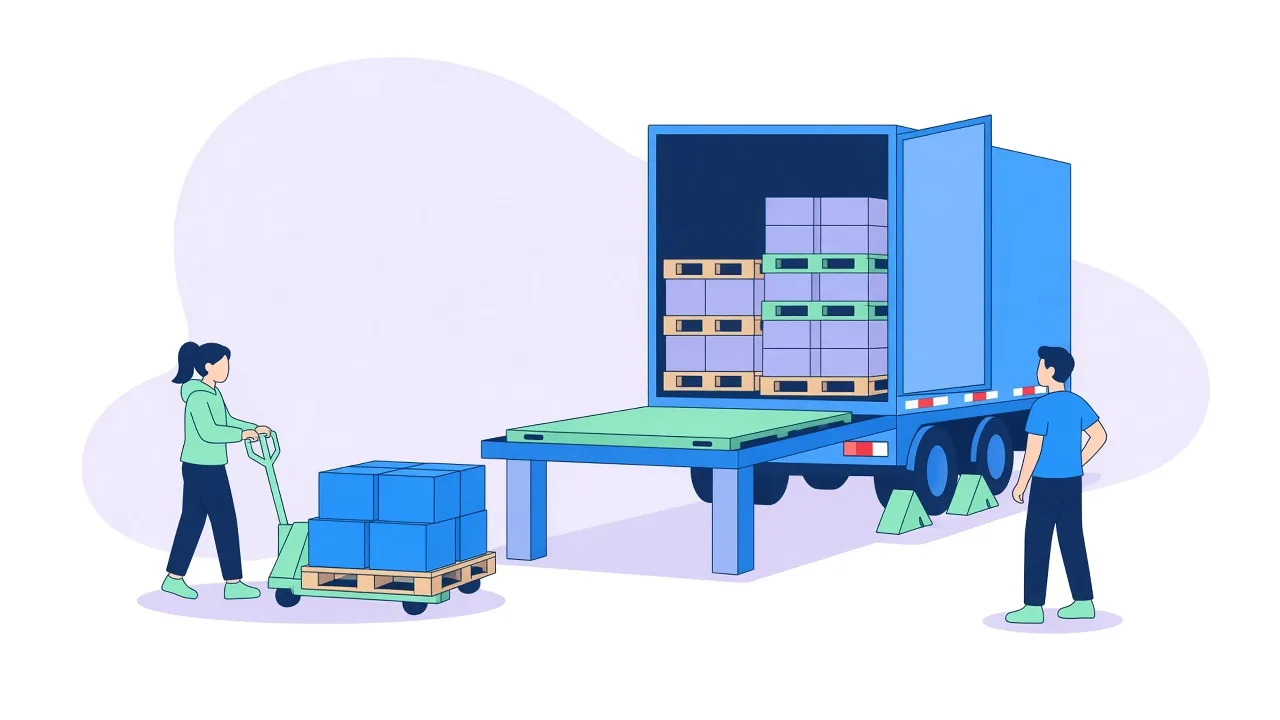
14. “A driver starts to pull away while you’re in the trailer. What do you do?”
HSE says early departure “does happen, and is extremely dangerous”, and lists safeguards such as traffic lights, vehicle or trailer restraints, and holding the driver’s keys or paperwork until it is safe (HSE).
Say: “I stop, shout and signal the driver to stop, and stay away from the gap between the dock and the trailer. Once it’s safe, I report it to my supervisor straight away, even if nobody was hurt, because the chocks, the restraint or the sign-off failed.”
15. “What would you do if a coworker was working unsafely?”
Name a real rule: OSHA says no one may stand or pass under the raised part of a forklift, and unauthorized people may not ride on one (29 CFR 1910.178(m)).
A strong answer: “If it’s dangerous right now, like someone riding on the forks or standing under a raised load, I say stop straight away. Then I talk to them calmly; most people are just rushing. If it happens again, I tell the supervisor. I’d want someone to do the same for me.”
16. “Have you ever reported a safety hazard or a near miss?”
A near miss is an event where nobody was hurt but someone could have been. Under OSHA’s rule, a forklift operator involved in one must get refresher training (29 CFR 1910.178(l)(4)).
Sample answer: “Yes. The dock plate at door 12 kept slipping. Nobody was hurt, but I blocked the door, told my lead and wrote it in the shift log. Maintenance found a broken lip and fixed it the next day. Since then, I check the plate at every door before the first trailer.”
Teamwork, attendance and closing questions (17–20)
17. “Tell me about a time you disagreed with a coworker.”
Tell a short story where you stay calm and never blame the other person. Try: “A coworker kept leaving his pallets in my lane. Instead of arguing in front of everyone, I asked him at break if we could split the dock: his side inbound, mine outbound. He agreed, our lead kept the setup, and we got on better.”
18. “How would you describe your attendance?”
The staffing firm TempStaff calls reliability “one of the most important topics in warehouse interviews” (TempStaff, 2026). Give a fact, not an adjective.
Sample answer: “Strong. Last year I missed one shift, when I was sick, and I called before the start. I live 20 minutes away with my own car, and a bus as backup. If I’m ever going to be late, my lead hears it from me first.”
19. “What are your strengths and weaknesses?”
Give three dock strengths with proof and one real weakness that is not a safety duty. You could say: “Reliability, care with labels and counts, and stamina: I’ve worked ten-hour nights without slowing down. My weakness was rushing the end of a trailer. Now I slow down for the last rows and check every label, because a mistake at the doors is the first thing the customer sees.”
20. “Do you have any questions for us?”
Dayton Freight candidates report this one as “What do you want to know”. Ask about the work:
- “What does a normal shift look like on this dock?”
- “How do you train new dock workers on the forklift and pallet jack?”
- “What freight do you handle most: pallets, floor-loaded boxes or hazmat?”
More loading and unloading interview questions
| Question | What to say |
|---|---|
| “Why should we hire you?” | “I’m on time, I check every label, and I can start nights next week.” |
| “How can your other skills help here?” | Link a skill to the dock: driving, retail stock counts, construction lifting. |
| “How long do you plan to stay?” | “I want to stay and get forklift and lead experience here.” |
| “How do you stay motivated on repetitive work?” | “I count trailers, not hours, and try to beat my own accuracy.” |
| “What pay are you expecting?” | A range from the job ad or local postings, open on shift pay. |
| “Have you ever been hurt at work?” | The truth, briefly, and what changed: “Now I ask for a team lift.” |
| “Have you handled hazardous materials?” | In the US, anyone who loads, unloads or handles hazmat for a hazmat employer is a hazmat employee, trained within 90 days of hire (supervised until then) and at least every three years (49 CFR 172.704). |
| “How do you handle stress on a busy night?” | “I focus on the next pallet and ask my lead to set priorities.” |
| “Have you ever suggested a better way to work?” | One small change with a result: “I suggested a two-person setup for late trailers, and we kept it.” |
Loading and unloading skill tests: what to practise
In the US, forklift training must include “evaluation of the operator’s performance in the workplace” (29 CFR 1910.178(l)(2)). If an employer adds a skill test, practise a safe lift or a short pallet jack drive, sorting boxes by label, counting pieces against a bill of lading, and simple math.
The “loading dock” word problem searched alongside dock tests is a GMAT practice question (GMAT Club): each night-crew worker loaded 3/4 as many boxes as each day-crew worker, and the night crew has 4/5 as many workers. What fraction did the day crew load? Try 5 day workers × 4 boxes = 20 and 4 night workers × 3 boxes = 12: 20 of 32, so 5/8.
Forklift and pallet jack training rules by country
| Where | Rule |
|---|---|
| United States | The employer trains, evaluates and certifies each operator of forklifts and motorized hand trucks, with evaluation at least every 3 years (29 CFR 1910.178(l)). |
| Canada | Trucking that crosses provincial or international borders is federally regulated; there, section 14.23 of the Canada Occupational Health and Safety Regulations requires training for operators of motorized equipment and on-the-job training for manual equipment. Other docks follow provincial rules. |
| United Kingdom | No state training system. Employers have lift truck operators trained to HSE’s L117 code in three stages; a basic course typically lasts 3 to 5 days (HSE). |
| Australia | A high risk work licence, class LF, for forklift trucks, but not for pedestrian-operated trucks or pallet trucks (WorkSafe Queensland). |
| Gulf states, India, elsewhere | Rules vary by country, emirate, state and employer: ask which certificate they accept and whether they train on site. |
How to answer dock worker interview questions in clear English
On a loud dock, use one action per sentence (“I chock the wheels. I check the plate. Then I go in.”) and stress these words as the Cambridge Dictionary does:
| Word | Say it |
|---|---|
| freight | FRAYT (rhymes with “eight”) |
| pallet | PAL-it |
| bill of lading | bill of LAY-ding |
| chock | CHOK (US: CHAHK) |
For phrases that open an answer or buy time, see the English for job interviews guide.
Practice a dock safety question out loud
The trailer that moves
B1–B2- Interviewer
You’re about to unload a trailer. What do you check first?
- Carlos
The wheels are chocked or the restraint is locked, the dock plate is flat and secure, and the floor looks solid.
- Interviewer
The restraint is broken today.
- Carlos
I tell my lead and chock the wheels. I don’t go in until the trailer is secured.
- Interviewer
Halfway through, you feel the trailer move.
- Carlos
I stop, shout to the driver to stop, and stay clear of the gap.
- Interviewer
Nobody was hurt. Do you still report it?
- Carlos
Yes, right away. Something failed, and the next person might not be so lucky.
Practise this dialogue
Listen to the whole exchange, then take one role: your partner’s lines are read aloud, you say yours into the microphone and see which words came through.
For a timed run, the free browser mock interview asks screening and behavioral questions and reports answer length, pace and filler words; it has no dock track and does not check safety content. For a baseline, take the English speaking test.
Say your answers out loud before the interview
Fluently is an AI speaking coach for non-native English speakers on iOS and Android. You answer out loud and get feedback on pronunciation, fluency, vocabulary and grammar. The download is free and starts with a free four-minute speaking assessment; full practice is a subscription after a free trial.


Frequently asked questions
What are the 10 most common warehouse interview questions?
For dock and warehouse jobs, prepare these first: questions 1–6, 12, 16, 18 and 20 above. Picking and packing roles add pick rates and scanners; see the warehouse associate questions.
Is a dock worker interview hard?
Usually not. Glassdoor rates Dayton Freight’s dock worker interviews “Easy” from 12 ratings; one reviewer describes a talk with two managers, then a walk around the warehouse. The harder part is proving reliability and safety habits with real examples.
Do you need forklift certification to get a dock worker job?
Not always. In the US the employer must train and evaluate you on its own trucks before you drive, so new hires can be trained on the job. A previous certificate still shows training and can shorten the process.
Are general laborer interview questions the same as dock worker questions?
The questions about you are the same (1–6 and 17–20 here). Dock jobs add trailer loading, freight paperwork, OS&D and dock safety (7–16).
Can I answer dock worker interview questions well if English is my second language?
Yes. Supervisors need you to understand safety instructions and report problems clearly, not to sound native. To check your level first, take the free English level test.