20 Dairy Interview Questions and Answers for Dairy Plant Workers and Freshers
 Yurii Rebryk · Updated October 29, 2026 · 14 min read
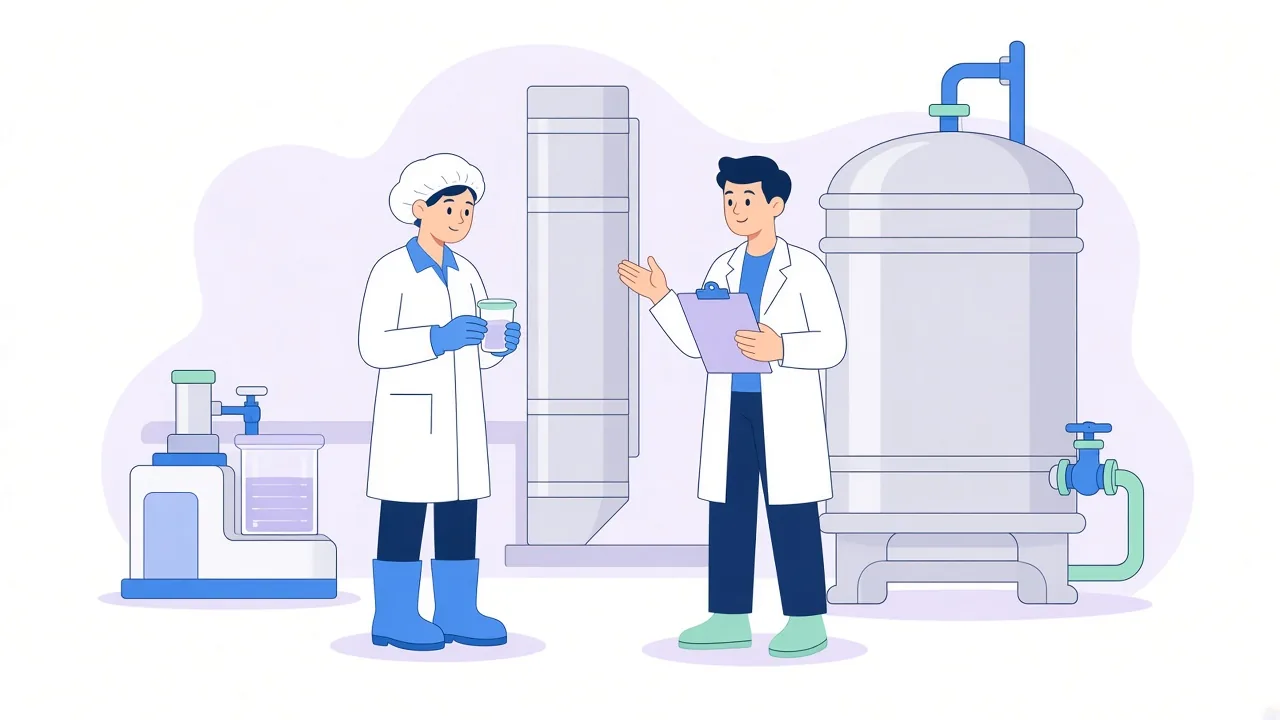
Dairy interview questions for plant workers test three things: whether you know how milk is checked and kept safe, whether you follow hygiene and cleaning rules exactly, and whether you report a problem instead of hiding it. The 20 questions below cover milk reception, fat and SNF, pasteurisation, CIP, packing and chemical safety, plus the general worker classics, each with a sample answer in plain spoken English.
In this article
- Dairy interview questions about you (1–5)
- Milk reception and quality questions (6–9)
- Pasteurisation, CIP and hygiene questions (10–14)
- Packing line and safety questions (15–17)
- Behavioural and closing questions (18–20)
- More dairy and general worker interview questions
- Dairy farm interview questions
- Dairy worker training and food safety rules by country
- Dairy interview questions and answers for freshers
- How to say dairy words clearly in English
- Practice a dairy scenario question out loud
Dairy interview questions about you (1–5)
The first five are the general worker classics, asked for plant, farm and factory jobs alike. Every name and number in the sample answers is an example: swap in your own.
1. “Tell me about yourself.”
“Tell me about yourself” wants 45 seconds: your current work, the part that fits a dairy, and why this job. Listen, then record your own version.
Tell me about yourself (dairy plant)
B1I’m Ravi. For two years I’ve worked as a helper at a milk collection centre. I weigh the milk, take samples and keep the cans clean.
I learned to follow the testing routine exactly, keep clear records and tell the supervisor when milk smells or looks wrong.
Now I want to learn pasteurisation and packing in a processing plant, and your plant trains new workers on each line.
Read it aloud
Listen to a model reading, then record yourself. You get your speaking pace, the share of words that came through clearly, and the words to repeat.
No dairy experience? Use your training or any job with hygiene routines: “I’ve just finished a food processing course and worked weekends in a sweet shop kitchen, so hairnets and cleaning lists are normal for me.”
2. “Why do you want to work at our dairy?”
Give one reason tied to the work and one fact about this employer (its products, a new line, its training) from the website or job notice.
Sample answer: “I like work where routine really matters, and in a dairy one warm tanker or one dirty valve can spoil a whole batch. You make milk, curd and paneer, so I can learn more than one line. I live 20 minutes away, so early shifts are easy for me.”
3. “What experience do you have with milk or dairy products?”
Name the stage of the milk chain you know, two tasks and one thing you checked. O*NET describes plant work as watching temperature and pressure gauges, collecting samples for the lab, logging readings and cleaning tanks and pipes (O*NET 51-9012.00, which includes dairy processing equipment operators).
Say: “I worked a year on the packing line at a milk plant. I loaded pouch film, checked seals and date codes every 30 minutes and recorded rejects, and I helped with the evening CIP.” Fresher: “Not in a plant yet, but I did the milking at home before school, so I know how fast milk spoils in the heat.”
4. “What are your strengths and weaknesses?”
Pair a strength with proof, and a real weakness that is not a core safety duty with what you are doing about it.
You could say: “I follow procedures exactly, even at the end of a night shift; that’s why my supervisor gave me the sampling job. My weakness was the computer system, so I practised data entry at home, and now my readings go in on time.”
5. “Can you work shifts, overtime, weekends and in cold rooms?”
Some interviewers press hard on this: one production worker at a US food plant reported a “high focus on willingness to work overtime” (Indeed, 2024). Cold work comes with milk, which is stored chilled from reception to dispatch.
A strong answer: “Yes, all three shifts and most weekends. I need one Sunday a month for family, and I’d tell you weeks ahead. I’ve worked in a cold store, so I know to wear the thermal jacket and take my breaks.”
Milk reception and quality questions (6–9)
Platform tests screen out poor milk “before the milk leaves its original container and is mixed with bulk milk”, because a small amount can affect the whole batch (Virtual Labs, IIT Kanpur).
6. “What checks are done when milk arrives at the plant?”
Answer in order. FSSAI’s dairy hygiene guidance expects tanker seals to be checked and collection centres to test fat, SNF, smell and appearance (organoleptic evaluation) and adulterants (FSSAI guidance, milk and milk products). Common platform tests add clot-on-boiling (COB) for acidic or abnormal milk and the methylene blue reduction test (MBRT) for bacterial load (Virtual Labs, IIT Kanpur). In the US, every Grade “A” raw milk supply is tested for beta-lactam drug residues before it is mixed or processed (PMO 2025, Appendix N).
Model answer: “First the tanker: seals, cleanliness, paperwork. Then a sample: smell, look and temperature, fat and SNF, COB and the adulterant and antibiotic tests the plant uses. We unload only when the results pass, and every result goes in the register.”
7. “What are fat and SNF, and what are the standards?”
Fat is the milk fat; SNF (solids-not-fat) is the rest of the milk solids. FSSAI’s milk survey calls them “two key quality parameters”, and FSSAI’s standards set minimums for each class of milk at the point of sale (FSSAI dairy standards, May 2025).
| Class of milk (India) | Minimum fat | Minimum SNF |
|---|---|---|
| Cow milk | 3.2% | 8.3% |
| Buffalo milk | 5.0% | 9.0% |
| Toned milk | 3.0% | 8.5% |
| Double toned milk | 1.3% | 9.0% |
| Standardised milk | 4.5% | 8.5% |
| Full cream milk | 6.0% | 9.0% |
Say: “Fat is the cream part, SNF the rest of the solids. Buffalo milk is richer, so its minimums are 5.0% fat and 9.0% SNF, against 3.2% and 8.3% for cow milk. Low readings can come from breed and feed, or from added water.”
8. “How do you check milk for adulteration?”
FSSAI’s 2022 manual of test methods covers added sugar, starch, urea, neutralisers, detergents, hydrogen peroxide and maltodextrin (FSSAI manual, dairy). Keep the problem in proportion: of 6,432 samples in FSSAI’s 2018 national survey, 12 had adulterants that made the milk unsafe, 156 had maltodextrin and 78 had sugar (mostly processed milk), and 1.2% had antibiotic residues above the limit (FSSAI milk survey, 2019).
A strong answer: “I run the tests by the plant’s method, exactly as trained, and never judge by eye. If a test is positive, the milk stays in the tanker, I tell QA at once and record the supplier and result. Rejecting milk is QA’s decision.”
9. “A tanker arrives at 12°C, or a sample fails. What do you do?”
This scenario tests whether you stop the milk before it mixes with good milk. FSSAI’s guidance wants raw milk at the plant or chilling centre within 4 hours of milking and chilled to 5°C or below there; the US ordinance keeps raw milk at 7°C (45°F) or less until processed.
Try: “I don’t unload it. I recheck with a calibrated thermometer, tell my supervisor and QA, and write down the tanker number, time, reading and driver’s name. Then I follow the procedure: hold, test or reject. Mixing it ‘just this once’ could spoil a silo.”
Pasteurisation, CIP and hygiene questions (10–14)
10. “What is pasteurisation? What are the time and temperature?”
Pasteurisation heats every particle of milk to a set temperature and holds it there long enough to cut disease-causing bacteria to a safe level. India’s FSSAI standard and the US Pasteurized Milk Ordinance share the two classic minimums; FSSAI adds a negative phosphatase test and immediate cooling to 4°C or less.
| Method | Minimum temperature | Minimum time |
|---|---|---|
| Batch (vat) | 63°C (145°F) | 30 minutes |
| HTST (continuous flow) | 72°C (161°F) | 15 seconds |
| US: 10%+ fat, 18%+ solids or added sweeteners | Add 3°C (5°F) | Same time |
You could say: “HTST is at least 72 degrees for 15 seconds; a batch vat is 63 degrees for 30 minutes. Then the milk is cooled fast, to 4 degrees or less. Under US rules, cream and sweetened mixes need 3 degrees more.”
11. “The pasteuriser temperature drops below the set point. What happens?”
Question 11 tests whether you trust the safety system. Under the US ordinance, a continuous pasteuriser has a flow diversion device that “automatically causes the diversion of the milk” when the temperature is below the legal minimum (PMO 2025, Item 16p(B)).
Sample answer: “The diversion valve should send the milk back automatically, and the alarm sounds. I never override or bypass it. I call the shift engineer and my supervisor and note the time and temperature. Any milk that may have gone forward is held until QA checks it.”
12. “How does CIP work?”
CIP (cleaning in place) cleans tanks, pipes and pasteurisers by circulating rinses and chemicals without taking them apart. For heated surfaces such as a pasteuriser, FSSAI’s dairy guidance recommends:
- Warm water rinse, about 10 minutes.
- Alkaline detergent (0.5–1%) circulated at 75°C.
- Warm water rinse, about 5 minutes.
- Nitric acid (0.5–1%) circulated at 70°C.
- Cold water rinse, then gradual cooling for about 8 minutes.
Say: “Rinse, caustic, rinse, acid, rinse. The caustic removes milk deposits, the acid removes milk stone. I check temperature and strength on the screen, sign the CIP record and keep chemicals away from product lines.” Fresher: “I haven’t run CIP yet, but I know the order and would follow the SOP.”
13. “What hygiene rules do you follow before entering the processing area?”
FSSAI’s dairy guidance lists the routine: clean work wear, hair fully covered, no jewellery or watches that risk the product, short clean nails, cuts under a waterproof dressing (preferably brightly coloured and metal-detectable), hands washed before work and after breaks, toilets and phones. Handlers report diarrhoea, vomiting, fever or infected cuts.
A strong answer: “Clean uniform, hairnet, boots, no watch or ring, then I wash and dry my hands. If I have diarrhoea, vomiting or a fever, I tell my supervisor before the shift instead of coming onto the line.”
14. “How do you keep milk products cold from the plant to the shop?”
FSSAI’s guidance keeps pasteurised milk below 5°C at the plant and in refrigerated or insulated vehicles, with stock rotated first in, first out (FIFO) or first expired, first out (FEFO).
Sample answer: “I log the cold room reading at the start of the shift. Crates go in fast, doors stay shut, and the oldest date goes out first. If a vehicle reads above the limit before loading, I tell dispatch and we don’t load it.”
Packing line and safety questions (15–17)
15. “What do you check on the packing line?”
The packing line is the last check before milk leaves the plant. FSSAI’s guidance asks for detection of glass, plastic and metal, traceability of any lot “within 24 hours”, and allergen control: milk is itself a major allergen, and products with other allergens (nuts, for example) should preferably run after those without, with a validated clean in between.
Model answer: “At start-up and at set intervals I check the seal, the fill weight, and that the date code and batch number match today’s plan. I test the metal detector with the test pieces. A wrong date code means I stop the machine, label the packs ‘on hold’ and call my supervisor.”
16. “How do you handle cleaning chemicals safely?”
Dairies use strong caustic, acid and sanitising chemicals. US employers must train workers on the hazardous chemicals in their work area and keep safety data sheets (SDS) “readily accessible during each work shift” (29 CFR 1910.1200). Never mix products: chlorine gas can be released when bleach meets cleaners that contain an acid (ATSDR, CDC).
You could say: “I read the label and SDS first and wear the goggles, gloves and apron they ask for. I never mix a chlorine sanitiser with an acid cleaner, and I report spills.” Fresher: “I’ll need training on your chemicals first; until then I won’t handle them alone.”
17. “What would you do if you smelled ammonia?”
Ammonia is widely used as a refrigerant in dairy and ice cream plants (OSHA eTool). OSHA notes the smell is detectable at 5 to 50 ppm and recommends that “if an employee can smell it they ought to back off” and check whether they need respiratory protection (OSHA, properties of ammonia).
Say: “I move away, warn the people near me and call my supervisor or the control room with the location. If the alarm sounds, I leave by the trained route to the assembly point. I don’t go back to close valves; that’s the refrigeration team’s job.”
Behavioural and closing questions (18–20)
18. “Tell me about a time you found a problem and reported it.”
Food safety depends on people who speak up, so this question carries weight. Answer with STAR: Situation, Task, Action, Result (National Careers Service).
Tell me about a time you found a problem and reported it.
B1–B2Last summer, on the curd line, I noticed weak seals on the cups coming out of the sealer. It was late in a night shift, and the line was behind.
I tested five cups and three leaked, so I stopped the sealer, called my supervisor, and we put the last pallet on hold.
Maintenance changed a worn heating element in 20 minutes. We lost 40 cups instead of a pallet, and the supervisor added a seal check after every film change.
Read it aloud
Listen to a model reading, then record yourself. You get your speaking pace, the share of words that came through clearly, and the words to repeat.
19. “What salary do you expect?”
Give a range from the job notice or similar plant jobs in your area, and mention shift allowance if it matters. For a US reference, O*NET lists a median of $24.81 an hour (2025) for the occupation that includes dairy processing equipment operators.
Try: “For plant jobs like this in our area, I’m looking for [your range] a month plus the usual shift allowance. I’m flexible if the job includes training. What is the range for this role?”
20. “Do you have any questions for us?”
Ask two questions about the work. DairyNZ’s interview guide even tells employers to note which questions a candidate asks (DairyNZ, 2020).
- “Which line would I start on, and how long is the training?”
- “How are shifts rotated, and how much notice do you give for overtime?”
- “What food safety training do new workers get?”
More dairy and general worker interview questions
Longer dairy interview lists add these general worker questions; one or two sentences each is enough.
| Question | What to say |
|---|---|
| “Why did you leave your last job?” | One neutral, forward-looking reason (“I want steady plant work with training”). Never criticise the old employer. |
| “Why should we hire you?” | One reason with proof: “In a year on sampling, I never missed a sampling time.” |
| “Tell me about a conflict with a coworker.” | A short STAR story ending in a fix, such as agreeing at handover who cleans which part of the line. |
| “Do you work better alone or in a team?” | Both, with one example each: a solo sampling round, and a shift handover where you passed on clear readings. |
| “How do you work under pressure?” | Safety and hygiene first, then your supervisor’s order; ask when two jobs clash. |
| “Can you do repetitive work and stand all shift?” | Yes, with proof: “I stood eight-hour shifts on a packing line and kept my checks on time.” |
| “A machine breaks down. What do you do?” | Stop it safely, tell your supervisor and maintenance, and never reach into a running machine. |
| “Why do you want to work abroad?” (agency interviews for factories in Taiwan, Korea or the Gulf) | Your honest reason (savings, skills, family), plus that you will follow the contract and plant rules. |
Dairy farm interview questions
Farm jobs (milking, calf rearing, herd work) use a different set. These four come from DairyNZ’s question bank for farm interviews.
| Farm question | What a good answer covers |
|---|---|
| “Tell me about a time milking did not go well.” | What happened, what you did, what you would change; for a breakdown, how you found the fault and who fixed it. |
| “How do you spot mastitis?” | Udder changes (swelling, heat, hardness, redness, pain) and milk changes (watery, flakes, clots), as AHDB lists them; then tell the manager. |
| “What would you do after a thermoduric alert?” | Thermoduric bacteria can survive pasteurisation; Farm Source advises an immediate plant and vat hygiene check. |
| “Teat spray is diluted 9:1. How much concentrate makes 25 litres?” | 2.5 litres: 9 parts water plus 1 part concentrate is 10 parts, and 25 ÷ 10 = 2.5 (with 22.5 litres of water). |
Dairy worker training and food safety rules by country
| Where | What applies |
|---|---|
| India | FSSAI’s FoSTaC programme trains food safety supervisors, who train food handlers on site. FSSAI’s dairy guidance adds a medical examination before joining and every year. |
| United States | Grade “A” plants work under the Pasteurized Milk Ordinance, a model that FDA recommends states adopt; the state regulatory agency issues the plant permit. Chemical hazard training is an OSHA rule (29 CFR 1910.1200). |
| United Kingdom | Food handlers must be “supervised and instructed and/or trained in food hygiene matters” (Regulation 852/2004, Annex II), but a food hygiene certificate is not required (GOV.UK). |
| Nepal, South Africa, Korea, the Gulf, elsewhere | Rules vary: ask the employer or the national food regulator which training you need before your first shift. |
Dairy interview questions and answers for freshers
A fresher gets the same 20 questions. Use proof from farm work at home, a food course, a shop or a kitchen, and say “I would…” for scenarios you have not lived: questions 9, 11, 16 and 17 share one shape (stop, report, record). Never invent plant experience; the follow-up exposes it. For wider factory roles, see the food production worker interview questions.
How to say dairy words clearly in English
The classic slip is “diary” (a notebook) instead of “dairy”. Stress is in capitals; IPA (UK · US) from the Cambridge Dictionary.
| Word | Say it | IPA |
|---|---|---|
| dairy | DAIR-ee | /ˈdeə.ri/ · /ˈder.i/ |
| diary (a different word) | DYE-uh-ree | /ˈdaɪə.ri/ · /ˈdaɪ.ə.ri/ |
| pasteurise | PAS-chuh-rize | /ˈpɑːs.tʃər.aɪz/ · /ˈpæs.tʃə.raɪz/ |
| hygiene | HY-jeen | /ˈhaɪ.dʒiːn/ |
| tanker | TANG-ker | /ˈtæŋ.kər/ · /ˈtæŋ.kɚ/ |
More drills: the English pronunciation practice guide. Phrases that open an answer or buy time: English for job interviews.
Practice a dairy scenario question out loud
Interviewers add pressure to see whether you stay inside the procedure. Say the candidate’s lines out loud.
A tanker that fails the temperature check
B1–B2- Interviewer
A milk tanker arrives. Your thermometer reads 11 degrees. What do you do?
- Priya
I don’t unload. I check again with a second thermometer and tell my supervisor and QA.
- Interviewer
The driver says the milk left the chilling centre two hours ago and it’s fine.
- Priya
I thank him, but I follow the procedure and note the tanker number, the time and both readings.
- Interviewer
Your supervisor is busy, and the line is waiting for milk.
- Priya
Then I call QA directly. Warm milk in the silo could affect the whole batch, so ten minutes of waiting is cheaper.
- Interviewer
The tests pass, but the temperature is still high. What next?
- Priya
That decision belongs to QA. I record what they decide and who decided it.
Practise this dialogue
Listen to the whole exchange, then take one role: your partner’s lines are read aloud, you say yours into the microphone and see which words came through.
For a timed run, the free browser mock interview reports answer length, pace and filler words. It has no dairy track, so choose the screening and behavioral questions; it checks how you speak, not dairy knowledge.
Say your answers out loud before the interview
Fluently is an AI speaking coach for non-native English speakers on iOS and Android. You answer out loud and get feedback on pronunciation, fluency, vocabulary and grammar. The download is free and starts with a free four-minute speaking assessment; full practice is a subscription after a free trial.


Frequently asked questions
Is there a PDF of these dairy interview questions and answers?
There is no separate PDF file. Use your browser’s Print option and choose Save as PDF to keep all 20 questions and answers. Then say each answer out loud at least twice; reading is not rehearsal.
What questions are asked in a Mother Dairy or Amul interview?
Plant jobs at large Indian dairies involve the work covered here, so prepare these 20 questions. Candidate reports on AmbitionBox for Mother Dairy are mostly from sales and executive roles, with questions on markets, sales and expected salary. For quality control posts, see the quality control inspector interview questions.
What are the main dairy products?
FSSAI’s dairy guidance groups them as liquid milk; UHT, condensed, fermented and flavoured milk; ghee, butter and cream; dairy whitener (milk powder); and curd, yoghurt, buttermilk, paneer and cheese. Name the plant’s own products in your answer to question 2.
What are the most common general worker interview questions?
Tell me about yourself, why this job, strengths and weaknesses, shift availability, a problem you found or solved, salary expectations and your questions for them: questions 1, 2, 4, 5, 18, 19 and 20 above.
Can I do a dairy interview in English if it is my second language?
Yes. Interviewers check that you can follow instructions and report a problem clearly, not that you sound native. Use short sentences and repeat numbers back (“11 degrees, tanker 4”). To check your level, take the free English level test.