20 Food Production Interview Questions and Answers for Factory and Production Line Workers
 Yurii Rebryk · Updated October 19, 2026 · 14 min read
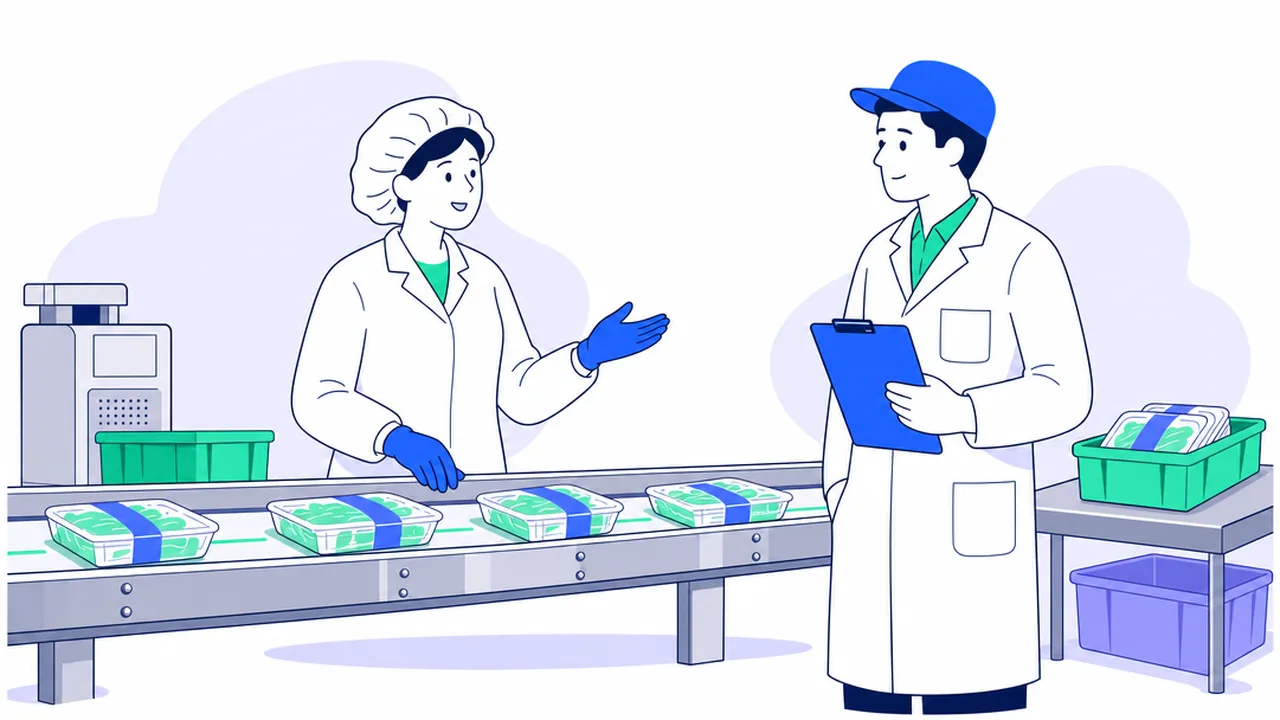
Food production interview questions check three things: that you follow food safety rules when nobody is watching, that you keep up with the line without skipping checks, and that you turn up for every shift. The 20 questions below come with sample answers in plain spoken English. For most scenario questions, the safe answer is the same: stop, tell your supervisor, write it down.
Say your answers out loud before the interview
Download AppIn this article
- The 20 food production interview questions at a glance
- Food production interview questions about you (1–5)
- Food safety interview questions for food production workers (6–11)
- Production line interview questions: speed, machines and shifts (12–17)
- Quality, mistakes and closing questions (18–20)
- More food factory and production worker interview questions
- Food handler training and health rules by country
- Basic food production questions in hotel management
- Practice a food production interview question out loud
The 20 food production interview questions at a glance
These 20 questions fit a first interview for a food production worker, food factory operative or production line worker. Need a PDF? Print this table or save the page as a PDF.
| # | Question |
|---|---|
| 1 | “Tell me about yourself.” |
| 2 | “Why food production, and why here?” |
| 3 | “What factory experience do you have?” |
| 4 | “Why should we hire you?” |
| 5 | “What are your strengths and weaknesses?” |
| 6 | “Have you had any food safety training?” |
| 7 | “What hygiene rules do you follow?” |
| 8 | “What is HACCP, and what is a critical control point?” |
| 9 | “How do you prevent allergen cross-contact?” |
| 10 | “The metal detector rejects a pack. What do you do?” |
| 11 | “How do you fill in a temperature log?” |
| 12 | “How do you keep up with line speed?” |
| 13 | “A machine jams. What do you do?” |
| 14 | “Can you handle repetitive work and standing?” |
| 15 | “Can you work shifts or in a cold room?” |
| 16 | “Tell me about a conflict with a coworker.” |
| 17 | “How do you keep your work area clean?” |
| 18 | “How do you follow the SOP exactly?” |
| 19 | “What if you noticed a mistake in production?” |
| 20 | “Do you have any questions for us?” |
Food production interview questions about you (1–5)
Every production interview opens with these classics. Keep answers under a minute, and swap the sample names and numbers for your own.
1. “Tell me about yourself.”
Say what you do now, what fits a food factory, and why you applied. Listen, then record your version.
Tell me about yourself
B1I’m a production operative with two years’ experience at a bakery plant, mostly on the packing line.
I’m used to hairnets, hand-washing checks and metal detector tests, and I’ve worked days, nights and weekends.
I’m applying here because you make ready meals, and I want to learn more machines and become a line leader one day.
Read it aloud
Listen to a model reading, then record yourself. You get your speaking pace, the share of words that came through clearly, and the words to repeat.
No experience? “I’ve spent two years in a supermarket stockroom, rotating stock by date and lifting all day. I want factory work because I like clear routines and fixed shifts.”
2. “Why do you want to work in food production, and why here?”
One honest reason plus one fact about the company beats “I need a job”.
Say: “I like work where I can see the result at the end of the shift. You make frozen pizzas for supermarkets, and your job ad says you train new staff on every machine. I want a place where I can learn and stay.”
3. “What food production or factory experience do you have?”
Food production experience is any work where food is made, processed or packed. Name the product, your station, the machines and one check. Forms that ask for up to three meat packing or food processing employers want the employer, dates, job title and two tasks.
Sample answer: “For 18 months I worked on the packing line at a poultry plant. I weighed and labeled trays, checked seals and date codes, and ran the metal detector test at the start of each shift. When I wasn’t sure about a label, I asked the line leader before the product moved on.” First job? Use the closest thing: a kitchen, a warehouse, a farm or a food stall.
4. “Why should we hire you?”
Pick one reason that matters on a line (reliability, safe habits, speed with accuracy) and prove it.
A strong answer: “You can rely on me for every shift and every check. In two years I had no unplanned absences and never skipped a line check, even on busy nights. I learn machines quickly, and I ask before I guess.” Fresher version: “I’m new to factories, but I’m always on time, I follow instructions exactly, and I’m used to standing and lifting all day.”
5. “What are your strengths and weaknesses?”
Choose a real weakness that is not a safety rule, and show the fix.
You could say: “My strength is attention to detail: I spot a wrong date code or a weak seal quickly. My weakness was speed on a new machine. I asked the trainer for tips, practiced on quiet shifts, and within a month I was hitting the line target.”
Food safety interview questions for food production workers (6–11)
Food safety questions set a food production interview apart from other factory interviews. The answers below follow the rules.
6. “Have you had any food safety training?”
Say what training you have and when. In the US, every person who makes, processes, packs or holds food, “including temporary and seasonal personnel”, must be trained in food hygiene and food safety (21 CFR 117.4). Other countries: see the rules table.
Sample answer: “Yes. I did a food hygiene course in 2025, and my last employer ran allergen and HACCP training every year. I know the basics: hygiene, temperature control, allergens and foreign bodies, and I can bring my certificate on the first day.” No certificate yet? “Not yet, but I’ve read your hygiene rules, and I’m happy to do any course before I start.”
7. “What hygiene rules do you follow before you go on the line?”
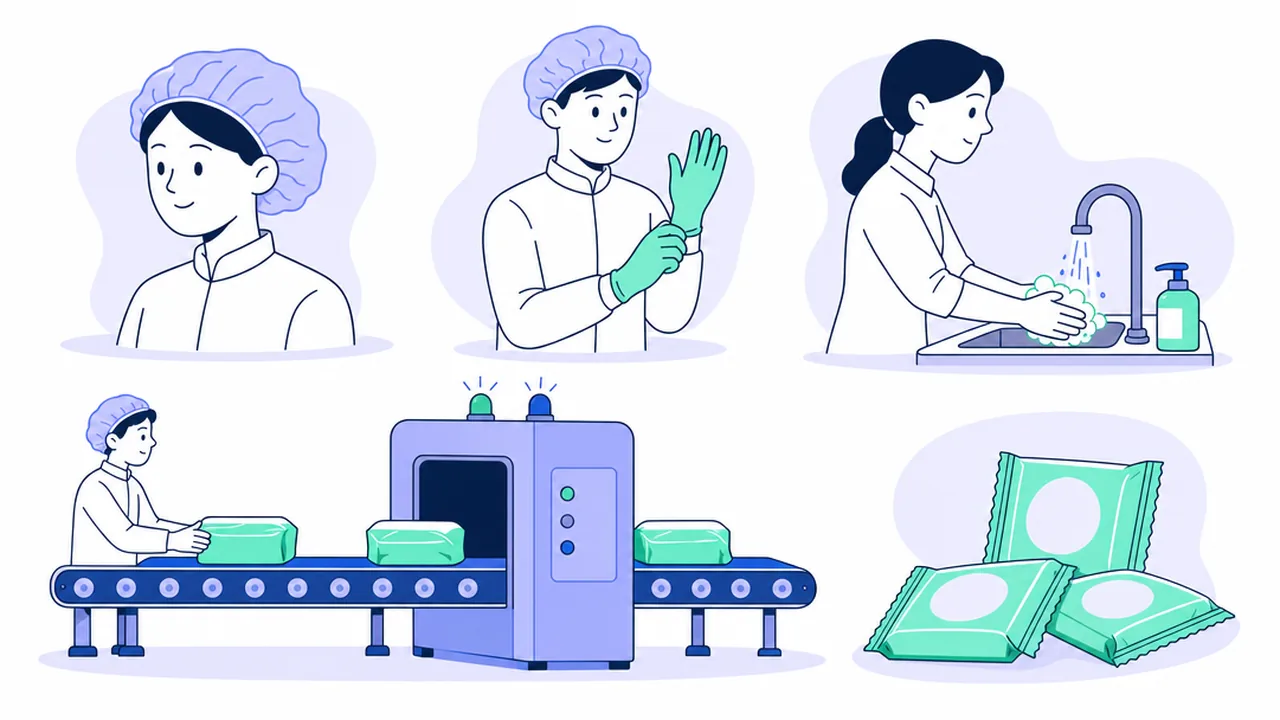
This tests good manufacturing practice (GMP). US law lists hand washing before work and after each absence, hair nets or beard covers, no unsecured jewelry, and no eating or gum where food is exposed (21 CFR 117.10). UK guidance says no watches or jewelry except a plain wedding band (GOV.UK), and the CDC advises scrubbing hands for at least 20 seconds.
Say: “I put on a clean white coat, a hairnet and a beard net, take off my watch and earrings, and wash my hands for 20 seconds, again every time I come back to the line. If I’m ill or have a cut, I tell my supervisor before I start.”
8. “What is HACCP, and what is a critical control point?”
HACCP (Hazard Analysis and Critical Control Point) is a food safety system with seven principles: hazard analysis, CCPs, critical limits, monitoring, corrective actions, verification and records. FDA defines a CCP as “a step at which control can be applied and is essential to prevent or eliminate a food safety hazard or reduce it to an acceptable level”, with heat treatment, chilling and metal testing as examples (FDA HACCP guidelines).
A strong answer: “HACCP means finding the hazards and controlling them at the critical points. On my last line the oven was a CCP: every batch had to reach the core temperature on the spec, and I recorded it. If a batch didn’t, it went on hold and I called the supervisor. That’s the corrective action.”
9. “How do you prevent allergen cross-contact?”
Allergen control keeps allergens out of products that do not list them. US law names nine major allergens: milk, eggs, fish, crustacean shellfish, tree nuts, peanuts, wheat, soybeans and sesame (FDA). UK law lists 14, including celery, mustard and lupin, and staff must be trained on allergens (Food Standards Agency).
Sample answer: “I keep allergen ingredients in labeled containers and use the color-coded tools for that line. At a changeover I follow the cleaning checklist, and the line doesn’t restart until it’s signed off. I also check every label matches the product.”
10. “The metal detector rejects a pack. What do you do?”
Never return a rejected pack to the line. FDA’s HACCP guidance lists glass, stones and metal as physical hazards, and metal detectors, magnets, sifters and screens among product safety devices; hairnets do the same job for hair.
Say: “The rejected pack stays in the reject bin, and I tell my supervisor or quality straight away. If I find plastic or metal myself, I stop, keep the piece and the pack, and note the time and batch so they can check the whole run.”
11. “How do you fill in a temperature log?”
Record real readings and act on bad ones. Bacteria grow fastest between 40°F and 140°F (about 4°C to 60°C), “doubling in number in as little as 20 minutes” (USDA FSIS). Each site sets its own limits.
Try this: “I write the actual reading, the time and my initials, and I never fill in a reading I didn’t take. If the chiller shows 7°C and the limit is 5°C, I tell my supervisor at once and follow the corrective action, usually holding the product.”
Production line interview questions: speed, machines and shifts (12–17)
Questions 12 to 17 double as general production worker interview questions and answers.
12. “How do you keep up with line speed without losing quality?”
This tests whether you cut corners under pressure. Keep every check, and speak up when the line outruns them.
Sample answer: “I set up my station before the line starts, so I’m not looking for labels later. I do my checks in the same rhythm every time. If the line gets too fast to check properly, I tell the line leader instead of skipping checks.”
13. “A machine jams. What do you do?”
Never put your hands into a running machine. In the US, OSHA’s lockout/tagout standard covers clearing a jam whenever you must remove a guard or put part of your body into the point of operation, and lockout “shall be performed only by the authorized employees” doing the work (29 CFR 1910.147).
Say: “I press the stop button and tell the line leader. If clearing the jam means taking off a guard, the machine is locked out first, by me if I’m trained and authorized, or by maintenance. Then I check the product near the jam for damage or metal.”
14. “How do you handle repetitive work and standing all shift?”
Expect the direct version too: “Can you stand for eight hours and lift 50 pounds?” In US data, food processing workers “usually stand during their shifts”, and equipment workers may lift boxes of up to 50 pounds (BLS). Answer honestly, then show how you stay sharp.
A strong answer: “Yes, I stood for full eight-hour shifts in my last job. I stay focused by counting checks, not hours: a seal check every 15 minutes, a weight check every half hour. I wear good safety boots and lift the way I was trained.”
15. “Can you work shifts, nights, weekends or in a cold room?”
In food processing, shift work “may include early mornings, evenings, or nights” (BLS). For chillers around 0°C, the UK regulator HSE says “suitable clothing and normal breaks are usually sufficient” (HSE).
You could say: “Yes, I can do days, nights and rotating shifts, and weekends when the schedule needs it. I’ve packed in a chilled room at about 4°C, so I know to wear thermal layers and take the warm-up breaks. I can start on Monday.”
16. “Tell me about a conflict with a coworker.”
Tell a real story with STAR (Situation, Task, Action, Result). In a food factory, the best stories are about a rule, not a personality clash.
Sample answer: “A new coworker kept going back on the line after break without washing his hands. I told him quietly that it’s a hygiene rule and showed him the sink. When it happened again, I told the line leader, who reminded the whole team at the next briefing.”
17. “How do you keep your work area clean?”
Clean as you go and follow the cleaning schedule, not your own method. Some lines clean tanks and pipes in place (CIP): cleaning and disinfection solutions circulate through a fixed system to reach all interior food contact surfaces (Dubai Municipality Food Code).
A strong answer: “I clean as I go: scraps in the right bin, spills off the floor. At the end of the shift I follow the cleaning card for my station, with the right chemical and dilution, then rinse, sanitize and sign the record.”
Quality, mistakes and closing questions (18–20)
18. “How do you make sure you follow the SOP exactly?”
An SOP (standard operating procedure) is the written method for a task. Show that you read it, ask, and check your first products.
Say: “I read the SOP and the product spec for each run and ask about anything unclear before we start. I check my first packs for weight, seal, label and date code. If someone shows me a shortcut that isn’t in the SOP, I don’t use it.”
19. “What would you do if you noticed a mistake in production?”
The right order is stop, hold, tell, record, whether the mistake is yours or someone else’s. Practice this hard answer as a real event:
A mistake on the line
B1–B2Last year I was labeling ready meals when I noticed the labels said “chicken curry”, but the trays were vegetable curry, with different allergens.
I stopped, put my last trays aside and called the line leader. We went back to the last correct pack, about 40 trays, and quality put them on hold.
The trays were relabeled and nothing left the site. Now I check the first label against the job sheet at every changeover.
Read it aloud
Listen to a model reading, then record yourself. You get your speaking pace, the share of words that came through clearly, and the words to repeat.
20. “Do you have any questions for us?”
Ask two questions about the job itself: “What does a normal shift on this line look like?” and “How long is training before I work a station alone?” On the day, arrive 10 minutes early with your ID, right-to-work documents and certificates.
More food factory and production worker interview questions
| Question | What to say |
|---|---|
| “Why are you leaving your current job?” | Short and positive: more hours, a permanent contract, closer to home. Never criticize your last employer. |
| “Where do you see yourself in five years?” | Here, with more skills: “trained on more machines, maybe a line leader.” |
| “What are your salary expectations?” | Give a range from local job ads. US median for food processing equipment workers: $19.82 an hour, May 2025 (BLS). |
| “Are you dependable? What if you were running late?” | Your attendance record, then the rule: “I call the shift manager before my start time.” |
| “What would you do if you cut yourself at work?” | Stop, cover it with a waterproof dressing, tell the supervisor and say which product you touched. |
| “What if you feel ill before a shift?” | Tell your manager before you start. In the UK, diarrhoea or vomiting means no work with open food, “normally for 48 hours from when symptoms stop naturally” (FSA). |
| “Do you prefer working alone or in a team?” | Both, with one example each: a solo station, and a team changeover. |
| “How do you take feedback from a supervisor?” | “I listen, ask what good looks like, and fix it on the next run.” |
| “What do you do if you finish your work early?” | Clean down, restock, then ask the line leader where to help. |
| “How do you handle a change in the production schedule?” | Ask what changed (product, allergens, labels), then follow the changeover checklist. |
Food handler training and health rules by country
Answers about training and health checks depend on the country; your employer’s site rules come on top.
| Where | Training | Health and hygiene |
|---|---|---|
| United States | Food hygiene and safety training for all staff, with records (21 CFR 117.4) | Ill workers and uncovered wounds kept away from food (21 CFR 117.10) |
| United Kingdom | Training for the role; “food handlers do not have to hold a food hygiene certificate” (GOV.UK) | Off open food, normally for 48 hours after diarrhoea or vomiting stops (FSA) |
| Canada | “The competencies and qualifications” for the duties (Safe Food for Canadians Regulations, s. 75) | Gloves, hairnet, beard net and smock; hands washed on entering the area (s. 76–77) |
| India | A Food Safety Supervisor trained under FSSAI programs supervises and trains food handlers | Yearly medical examination by a registered doctor (FSSAI, Schedule 4) |
| Dubai, UAE | All food handlers formally trained in food safety (Dubai Food Code) | Medical fitness tests and an occupational health card |
| Nigeria | Staff training under NAFDAC good manufacturing practice guidelines | Head and facial hair restraints in all production areas (NAFDAC) |
Elsewhere, including Saudi Arabia and Kenya, rules vary: ask the employer or the food regulator which course or health check you need.
Basic food production questions in hotel management
In Indian hotel management courses, “food production” means the kitchen department, and viva questions on stocks, sauces and cooking methods come from your textbook. The food safety basics are the same as above: the danger zone (40°F to 140°F), hair restraints, 20-second hand washing, the seven HACCP principles and the declared allergens (14 in the UK, 9 in the US). Applying for a hotel or restaurant kitchen? The catering assistant interview questions fit better; for bakery lines, see the baker assistant interview questions.
Practice a food production interview question out loud
Say Amara’s lines out loud; the interviewer adds follow-ups.
A wrong lid on the yogurt line
B1–B2- Interviewer
The lids say “strawberry”, but the pots look like the hazelnut yogurt. What do you do?
- Amara
I stop packing, put the last pots to one side and call the line leader.
- Interviewer
The line leader says, “Just finish the run. We’ll fix it later.”
- Amara
I explain that hazelnut is a tree nut allergen, so a wrong lid could make someone very ill, and I ask quality to check first.
- Interviewer
Why not just change the lids yourself?
- Amara
Because the product has to be checked and recorded. Fixing it quietly hides the problem, and it could happen again on the next shift.
Practise this dialogue
Listen to the whole exchange, then take one role: your partner’s lines are read aloud, you say yours into the microphone and see which words came through.
For a timed run, the free browser mock interview reports answer length, pace and filler words; it has no food production track, so choose Screening classics or Behavioral. It checks how you speak, not food safety facts.
| Word | Say it | Example |
|---|---|---|
| hygiene | HY-jeen | “I follow the hygiene rules after every break.” |
| allergen | AL-er-jen | “Sesame is a major allergen.” |
| contamination | kun-tam-ih-NAY-shun | “Hairnets prevent contamination.” |
Stressed syllables (capitals) follow the Cambridge Dictionary. For more drills, see the English pronunciation practice guide and English for job interviews.
Say your answers out loud before the interview
Fluently is an AI speaking coach for non-native English speakers on iOS and Android. You answer out loud and get feedback on pronunciation, fluency, vocabulary and grammar. The download is free and starts with a free four-minute speaking assessment; full practice is a subscription after a free trial.


Frequently asked questions
Is there a PDF of these food production interview questions and answers?
There is no separate PDF. Use your browser’s Print option and choose Save as PDF to keep the table of 20 questions or the whole page.
What are some common food safety interview questions?
Questions 6 to 11 cover the usual ones. Another is “When should you throw food away?” Say: when it is past its use-by date, damaged, possibly contaminated, or has been out of temperature control too long; USDA advises never leaving food out of refrigeration for more than 2 hours (USDA FSIS).
What are the 5 basic interview questions for a factory job?
Tell me about yourself (1), why this job (2), why should we hire you (4), strengths and weaknesses (5), and questions for us (20). Prepare these first.
Is a food production interview different from a food service interview?
Yes. A food service interview, for a restaurant or canteen, asks about customers and busy service. A food production interview asks about hygiene rules, line checks, machines and shifts, because you make or pack food and rarely meet customers.
Can I do a food production interview in English if it is my second language?
Yes. Interviewers check that you understand safety instructions and can report a problem clearly, not that you sound like a native speaker. Use short sentences. To check your level, take the free English level test.