Where Mexico Speaks English: A State-by-State Map
 Yurii Rebryk · Updated · 6 min read
In Mexico City, one in three Fluently learners speaks English at B2 or above. In Veracruz and Chihuahua, it’s one in four. B2, or upper intermediate, is the fourth of six levels on the A1–C2 scale that language schools and exams use. At B2 you can hold a conversation, argue a point and follow a meeting without a script.
Fluently is an app where people practice speaking English with an AI tutor. From those conversations, it gives each learner a Fluently score: an English level on that same A1–C2 scale. We took the scores of 10,209 learners, matched each one to the state they live in and built a map of spoken English in Mexico. Three things stand out.
Start speaking with confidence today
Fluently is free to start. Take a free AI speaking assessment to see your level, then practice with games that build your vocabulary and pronunciation.


In this article
- Learners measured
- 10,209
- States measured
- 11 of 32
- B2 or above in Mexico City
- 35%
- B2 or above in Veracruz
- 25%
The map
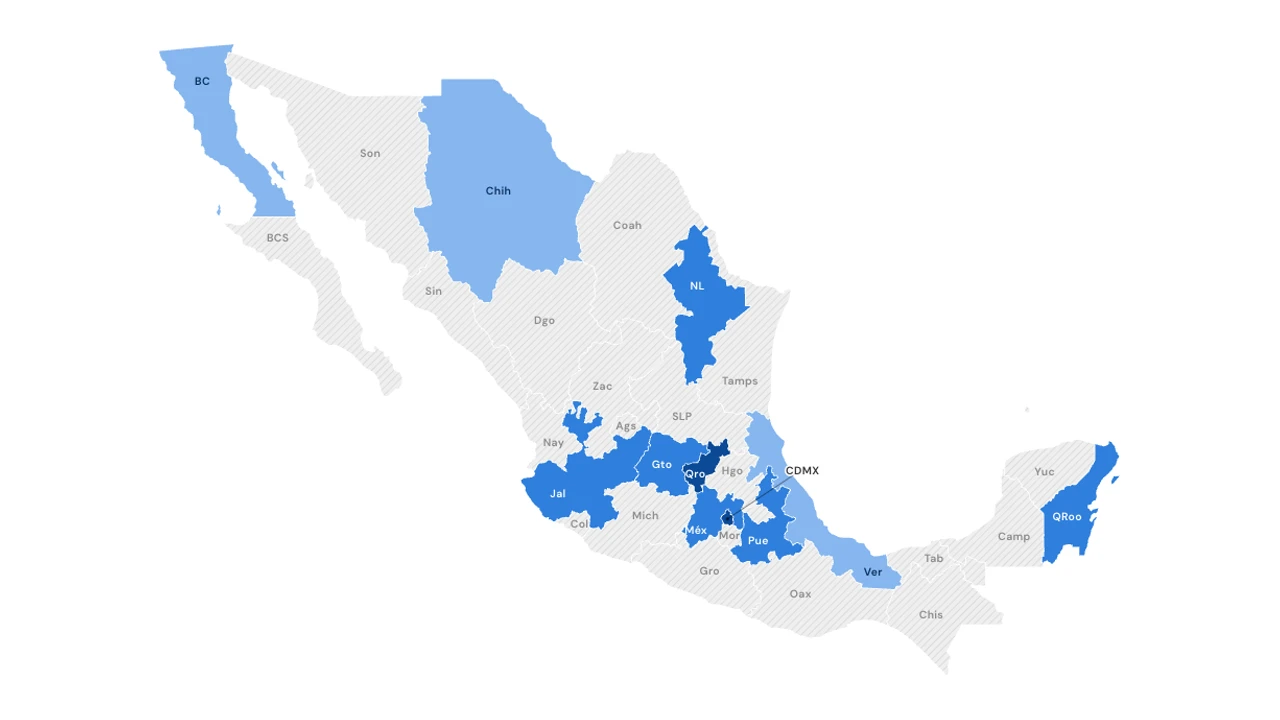
Each state is in one of three groups: top, middle or bottom. Hover over or tap a state to see its share, the margin of error and how many learners the number is based on. Gray states don’t have enough learners yet for a reliable number.
Keep in mind who these learners are: people who study English on Fluently, not the population as a whole. So the map doesn’t show how many Mexicans speak English. It shows how well the Mexicans who are learning it speak.
Interactive map
Hover over or tap a state, or use Tab on a keyboard.
Learners who speak at B2 or above
Learners using the app in Spanish, May 2025 to July 2026.
- 31% or more · top groupMexico City 35% · Querétaro 31%
- 26% to 30% · middle groupGuanajuato 29% · Jalisco 30% · Nuevo León 29% · Puebla 30% · Quintana Roo 29% · State of Mexico 29%
- 25% or less · bottom groupBaja California 25% · Chihuahua 24% · Veracruz 25%
- Not enough learners · 21 statesAguascalientes, Baja California Sur, Campeche, Chiapas, Coahuila, Colima, Durango, Guerrero, Hidalgo, Michoacán, Morelos, Nayarit, Oaxaca, San Luis Potosí, Sinaloa, Sonora, Tabasco, Tamaulipas, Tlaxcala, Yucatán, Zacatecas
Show all the numbers in a table
| State | Region | B2 or above | Margin of error | Learners | Words per minute | New job | Margin of error | Answers |
|---|---|---|---|---|---|---|---|---|
| Aguascalientes | Center and Bajío | — | — | — | — | 24% | 20–28% | 399 |
| Baja California | North | 25% | 21–29% | 439 | 87 | 14% | 12–16% | 1,097 |
| Chihuahua | North | 24% | 20–29% | 329 | 86 | 18% | 15–20% | 771 |
| Coahuila | North | — | — | — | — | 15% | 12–18% | 539 |
| Guanajuato | Center and Bajío | 29% | 26–33% | 651 | 87 | 17% | 14–19% | 1,125 |
| Hidalgo | Center and Bajío | — | — | — | — | 16% | 13–20% | 361 |
| Jalisco | West | 30% | 27–33% | 935 | 87 | 16% | 15–18% | 2,091 |
| Mexico City | Valley of Mexico | 35% | 33–37% | 3,358 | 87 | 18% | 17–19% | 7,174 |
| Michoacán | West | — | — | — | — | 15% | 12–18% | 473 |
| Nuevo León | North | 29% | 26–32% | 827 | 86 | 18% | 16–20% | 1,889 |
| Puebla | Center and Bajío | 30% | 27–34% | 611 | 84 | 16% | 14–18% | 1,092 |
| Querétaro | Center and Bajío | 31% | 27–35% | 502 | 88 | 19% | 17–21% | 1,053 |
| Quintana Roo | South and Southeast | 29% | 25–34% | 351 | 87 | 19% | 16–22% | 681 |
| San Luis Potosí | Center and Bajío | — | — | — | — | 19% | 16–23% | 487 |
| Sinaloa | North | — | — | — | — | 14% | 10–18% | 314 |
| Sonora | North | — | — | — | — | 17% | 14–21% | 481 |
| State of Mexico | Valley of Mexico | 29% | 27–31% | 1,867 | 85 | 19% | 18–21% | 3,243 |
| Tamaulipas | North | — | — | — | — | 18% | 14–22% | 370 |
| Veracruz | South and Southeast | 25% | 21–30% | 339 | 84 | 18% | 15–20% | 708 |
| Yucatán | South and Southeast | — | — | — | — | 19% | 15–22% | 470 |
Not enough learners yet: Baja California Sur, Campeche, Chiapas, Colima, Durango, Guerrero, Morelos, Nayarit, Oaxaca, Tabasco, Tlaxcala, Zacatecas.
Mexico City leads, Veracruz trails
In Mexico City, 35% of learners speak at B2 or above. In Veracruz it’s 25%, and in Chihuahua 24%. By region, the North reaches 27% and the South 23%.
After Mexico City come Querétaro (31%), Puebla and Jalisco (30% each). The State of Mexico is at 29%; together with the capital, the Valley of Mexico comes to about 33%. The margins of error overlap, so we put the states into three groups instead of ranking them from 1 to 11.
Learners who speak at B2 or above
By state. The black lines show the margin of error.
A test is not a conversation
The EF English Proficiency Index (EF EPI) ranks Mexico’s states using an online test of reading and listening. The Fluently score comes from conversation. In the EF EPI 2025, Nuevo León comes first and the State of Mexico second to last. In conversation, 29% of learners in the State of Mexico reach B2, the same share as in Nuevo León, and more than in Chihuahua, Baja California and Veracruz.
Across the 10 states that appear in both rankings, the order barely matches. Understanding English on a test and speaking it in a conversation are different skills.
English for work, and the Mexican “well”
Work is the most common reason to learn English: 44% want to speak with confidence at work. 17% learn English to get a new job, against 11% in Brazil. In Aguascalientes the share is 24%; in the State of Mexico, Querétaro, Quintana Roo and San Luis Potosí, 19% each.
Main goal for learning English
Mexico, share of the 33,321 learners who answered
The giveaway is a filler word. 31% of Mexican learners use “well” as a filler, three times the world average (10%). “Maybe” (21% against 15%) and “try” (14% against 10%) also come up more often than elsewhere.
A possible reason: “well” is a direct translation of “bueno” and “pues,” the words that start so many answers in Spanish. “Well, I think…”
Filler words: Mexico and the world
Share of learners who use the word as a filler
How we did it
- Who we measured. 10,209 Fluently learners in 11 Mexican states, scored between May 2025 and July 2026. Each of them spoke at least 300 words with the tutor. We counted only people who use the app in Spanish, because people who switch the app to English tend to speak better and would skew the comparison.
- What the Fluently score is. Fluently’s AI tutor holds open conversations with learners and rates how they speak on the A1–C2 scale that language schools and exams use. “B2 or above” means a learner was rated B2, C1 or C2.
- Which states are on the map. A state appears if at least 300 of its learners were scored, or at least 300 answered the question about their goal. The other states are gray.
- How we know the state. From where the internet connection was when a learner signed up. For learners who also shared their phone’s location, the two match 69% of the time in Mexico, and many internet providers have their network hubs in the capital. That’s why we treat Mexico City and the State of Mexico together as the Valley of Mexico and don’t compare the two with each other. Location mistakes blur the differences, so the real gaps between regions are probably a little larger.
- Regions. The North includes Baja California, Chihuahua, Coahuila, Nuevo León, Sonora and Tamaulipas. The South includes Chiapas, Guerrero, Oaxaca, Tabasco and Veracruz. The regional averages count all of these states, including those without enough learners to appear on the map on their own.
- Margin of error. Every share comes with a margin of error: the range where the real figure lies 19 times out of 20. States with fewer learners have wider margins. Speed is the typical value for a state and has no margin of error.
- National figures and goals. The filler words and the goals chart cover every Fluently learner in Mexico, whatever language their app is in, compared with Fluently learners worldwide. The goals, on the chart and on the map’s “new job” layer, come from a question every new learner answers: what they want English for.
- Comparison with EF. The EF EPI scores reading and listening in an online test; we score conversation. The states’ places come from the EF EPI 2025. We compared the order of the 10 states that appear in both rankings (Mexico City isn’t one of EF’s states). The two orders barely match: their rank correlation is 0.32, where 1 would mean the same order and 0 no link at all.
- Limits. Everyone we measured had already decided to learn English with Fluently, so the results describe learners, not Mexico’s population. Location data can be wrong, and states with few learners have wide margins of error.
- Privacy. We publish only totals for groups of at least 300 people. No individual data leaves Fluently.
Which group would you be in?
Talk to Fluently’s AI tutor for a few minutes to get your own Fluently score and see which filler words you lean on.
For journalists
You can republish the map and the figures if you credit Fluently and link to this page. To embed the interactive map on your site, copy the code below.
<iframe id="fluently-map" src="https://getfluently.app/blog/english-speaking-map-mexico/embed"
  title="Where Mexico speaks English: Fluently’s interactive map"
  width="100%" height="820" loading="lazy" style="border:0"></iframe>
<script>addEventListener("message",function(e){if(e.origin==="https://getfluently.app"&&e.data&&e.data.fluentlyMapHeight)document.getElementById("fluently-map").style.height=e.data.fluentlyMapHeight+"px"})</script>
The script adjusts the map’s height to fit the space. If your site doesn’t allow scripts, use the iframe on its own, set to 820 px tall on desktop and 1,050 px on mobile.
Contact
For interviews or more data: [email protected]
How to cite: Fluently, “Where Mexico Speaks English: A State-by-State Map,” November 2026.