8 Best Apps to Learn Spanish: Build a Habit of Speaking
 Yurii Rebryk · Updated October 29, 2026 · 13 min read
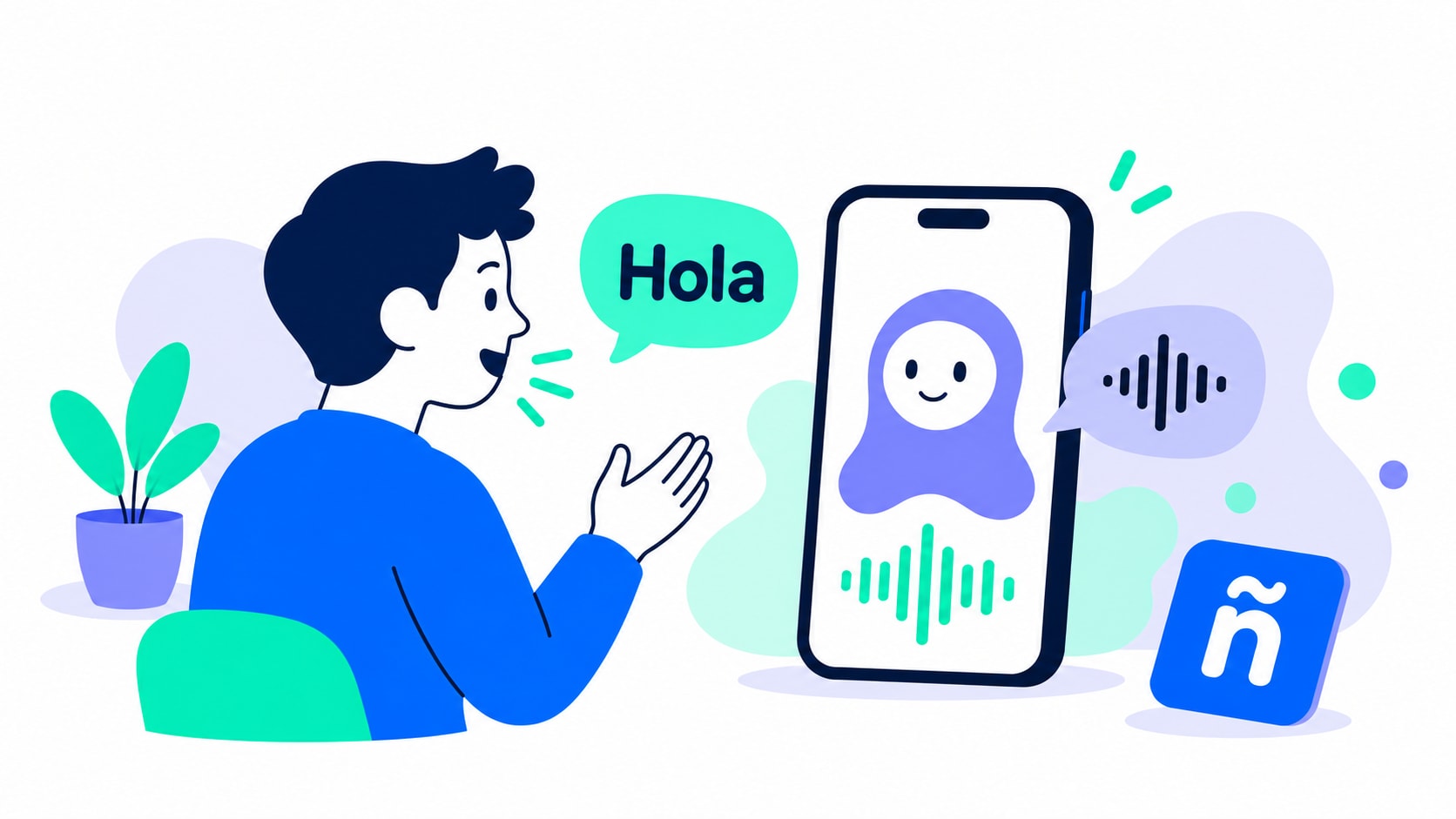
You know the words. You understand the lesson. Then someone asks you a question in Spanish, and you struggle to answer. If that is your problem, Fluently is our first recommendation. You speak with an AI tutor, get grammar and phrasing corrections, and put those corrections into your next answer. The habit you build is using Spanish to say something of your own.
Below, we compare eight tools by what they help you do. Duolingo, Busuu and Babbel offer lesson paths; Dreaming Spanish builds listening practice. Those can support your learning. When your goal is to hold a conversation, make speaking the center of your routine.
In this article
- Which app helps you do the thing you cannot do yet?
- Fluently: our pick when you want to speak, not just study
- Busuu: a clear course with a human feedback layer
- Babbel: explicit explanations and a deliberate dialect choice
- Duolingo vs Fluently: a study habit or a speaking habit?
- Language Transfer: free audio for thinking through sentences
- Dreaming Spanish: listening at a level you can follow
- SpanishDictionary.com: resolve a specific language question
- Preply: choose a teacher for a specific goal
- Check two languages: the Spanish you want and the explanations you need
- A seven-day routine built around speaking
Which app helps you do the thing you cannot do yet?
For speaking practice, we put Fluently first. The other options serve useful roles, from learning foundations to finding a human teacher. “Free” means some usable learning material is available; it does not mean all features are free. Check the price and renewal terms in your country and store.
| Tool | Best use | Practice format | Free and paid access | Main limitation |
|---|---|---|---|---|
| Fluently | Making speaking your daily habit | Voice conversations, correction cards and separate pronunciation practice | Free install and level check; tutor conversations paid | For a full beginner syllabus, add a course |
| Busuu | A course with feedback | Short lessons; community submissions | Free course access; Premium adds tools | Community replies are not a scheduled tutor |
| Babbel | Guided grammar and dialogues | Sequenced lessons and review | Sample lessons; full access paid | Course choice depends on display language |
| Duolingo | A structured study routine | Short lessons; AI Video Calls also available | Free lessons; paid plans and feature availability vary | A lesson streak alone does not show what you can say |
| Language Transfer | Building sentences logically | Pause-and-answer audio | Free; donations optional | English-led; no personal corrections |
| Dreaming Spanish | Understanding spoken Spanish | Videos graded by difficulty | Free videos; Premium library | Watching does not give feedback on your speech |
| SpanishDictionary.com | Verbs, meanings and examples | Reference, drills and lessons | Core tools free; Premium extras | English–Spanish reference, not a live partner |
| Preply | Individual human guidance | Booked one-to-one lessons | Paid trial; recurring lesson subscription | Requires a suitable tutor, budget and schedule |
Fluently: our pick when you want to speak, not just study
Choose Fluently’s Spanish tutor when your knowledge is ahead of your speaking. The tutor responds out loud while you construct your own answers. You can describe a work problem, defend an opinion or rehearse a situation you expect to face. No appointment to book; your practice starts when you have time to talk.
The useful part is the correction loop. Grammar and phrasing cards make feedback visible during the conversation. Read a correction, understand it with the available translation, then use the improved wording in your next answer. Captions can also be translated. This gives you a practical task after an error instead of leaving you wondering what to change.
Illustrative exercise: imagine discussing travel plans and saying Si tendría más tiempo, viajaría más. The standard form for that hypothetical condition is Si tuviera más tiempo, viajaría más. Now change the idea: Si tuviera una semana libre, visitaría Madrid. The aim is to use the correction in a new thought. This is a sample practice task, not a recorded app result.
Give pronunciation its own practice time. In Fluently’s dedicated pronunciation exercises, listen to a reference, record your attempt and inspect feedback on individual sounds. Use that to focus your next attempt. These exercises are separate from the grammar and phrasing cards in conversation; they do not mean every sound is scored during a call. You can also practice words aloud in the Spanish-supported Launchpad game.
This makes Fluently a focused choice for learners moving beyond beginner exercises: you practice explaining, responding and correcting yourself. For exam marking, a specific regional accent or expert guidance, a human teacher can still help. Installation and the initial vocabulary-based level check are free; tutor conversations require a subscription. Any trial is shown in the app.
Make your next Spanish session a conversation


Busuu: a clear course with a human feedback layer
Busuu combines a sequence of lessons with written or spoken exercises that other learners can correct. Choose it if deciding what to study next takes more effort than studying. Its course overview describes reading, writing, listening and speaking activities; that is a different proposition from an app devoted only to conversation.
The current plan comparison includes course access and Community in the free tier. Premium adds review tools and offline access; Premium Plus lists AI features, with language, level and device restrictions. Limit: community feedback depends on other users. For your first check, submit a short introduction and see whether the correction explains something you can reuse. Do not buy a plan solely for an AI feature without checking its Spanish availability on your device.
Babbel: explicit explanations and a deliberate dialect choice
Babbel suits learners who want a lesson to explain how a sentence works, then give them practice and review. Its free introduction offers sample lessons; it is not an unlimited free course. Use a sample to check whether the balance of explanation, listening and exercises feels useful before buying full access.
There is an important distinction in its course catalogue: European Spanish and Mexican Spanish are separate courses, and Mexican Spanish requires the American English display language. Limit: the same course range is not promised for every base language. If Mexico is your destination, check that you selected the intended course, then try explaining your plans without reading the lesson dialogue.
Duolingo vs Fluently: a study habit or a speaking habit?
Duolingo’s lesson path and short exercises are a useful way to begin and keep studying. But recognizing a word, arranging answer tiles and expressing an original thought are different tasks. If you can finish lessons but freeze when someone asks “Why?”, another completed lesson is not the whole answer.
Duolingo also offers AI Video Calls, and its Roleplay feature includes feedback. Check the features in your own course and plan. The useful comparison is the practice you get: in Fluently, voice conversation, visible grammar and phrasing corrections, and trying again are the core routine we recommend.
Our recommendation: keep Duolingo if its lessons help you build foundations. Choose Fluently when your priority is getting words out in a real exchange, handling follow-up questions and improving the way you express yourself. You do not need to wait until you have finished a course to make speaking a daily habit.
Language Transfer: free audio for thinking through sentences
Complete Spanish is a recorded audio course, available on the website and in the Language Transfer app. The method asks you to pause, think and answer aloud. Choose it if you enjoy working out a sentence rather than tapping through an exercise. The project makes its material free; donations are optional.
Limit: the Spanish explanations use English; the official FAQ discusses transcripts for learners who need help following it. A recording cannot hear or correct your answer. This is not a personal tutor or a regional accent course. Try one lesson somewhere you can speak aloud. Pause before the recorded learner answers; if you only play it in the background, you are skipping its central activity.
Dreaming Spanish: listening at a level you can follow
Dreaming Spanish uses videos spoken in Spanish, with visual support in its easiest material. Its video library separates difficulty levels and offers filters such as speaker or country. It is useful when you know words on a page but lose the thread when somebody speaks. Free videos let you check the format; Premium unlocks additional material.
Limit: listening practice does not assess your own speech. The service’s learning philosophy prioritizes input; our recommendation here concerns its graded video library, not a promise that one method is sufficient for everyone. Watch a short, easy video and describe its main event in your own language. If you cannot follow the event, choose easier material rather than chasing a higher level label.
SpanishDictionary.com: resolve a specific language question
Keep SpanishDictionary.com nearby for a verb form, a meaning or examples of a word in context. It also offers drills and a Spanish course. Its most distinct job in this shortlist is reference: when you are unsure about tengo, inspect the conjugation and an example instead of guessing from a translation alone.
Most core resources are free; a free account saves learning progress. Premium adds features such as ad removal and a writing checker, with differences between platforms. Its advertised seven-day trial renews into the chosen paid plan unless canceled. Limit: this is an English–Spanish resource, and looking up a sentence does not mean you can say it. Close the entry and make a new example about your own day.
Preply: choose a teacher for a specific goal
Preply connects you with human Spanish tutors. Check a teacher’s spoken languages, background, availability and lesson focus. For a move to Argentina or work with customers in Spain, ask how they would handle the vocabulary and situations you need. A tutor’s country of birth alone does not establish teaching skill or expertise in your exam.
The trial lesson is paid, with 25- or 50-minute options. Continuing lessons use a subscription that renews every 28 days, tied to one tutor. Limit: cost and scheduling matter, and unscheduled lessons can expire at renewal. During the trial, ask for a short role-play and one explained correction. Judge the teaching you receive, not just the friendliness of the introduction.
Check two languages: the Spanish you want and the explanations you need
An English speaker has many options here, but a learner reading this in translation should check the base language. Babbel lists its display languages; Japanese and Korean are not among them. Busuu lists Japanese, Korean and Portuguese interfaces, while warning that course availability varies. Dreaming Spanish’s learning videos are in Spanish, so they do not require an English explanation track.
For dialect, start with the people you want to understand. Spain, Mexico and Argentina differ in vocabulary, forms of address and pronunciation; “Latin American Spanish” is not one uniform accent. Listen to actual samples. A course selector, a video filter and a tutor’s profile offer different amounts of control. Do not treat an AI voice as a verified regional accent model.
A seven-day routine built around speaking
Pick a realistic topic and a short daily slot. Use your answers to judge the practice: can you explain more without a script, and can you reuse a correction? This is a way to check your routine, not a promise of fluency in a week.
- Day 1: describe your work, plans or a recent experience. Note where you stop or switch languages.
- Days 2–3: hold a short conversation in Fluently. Ask a follow-up question and reuse one grammar or phrasing correction.
- Day 4: explain an opinion and give a reason. Ask the tutor a question that keeps the discussion going.
- Day 5: work on a difficult sound in a dedicated pronunciation exercise, then use the word in a sentence.
- Day 6: return to your topic with different details. Speak from an idea, not from a memorized paragraph.
- Day 7: repeat the first task. Compare the pauses, help you need and corrections you can now apply. Keep the routine you can sustain.
You have studied Spanish. Now use it.
Frequently asked questions
Should I choose Duolingo or Fluently for speaking Spanish?
Choose Fluently if you want speaking and reusable corrections to be the center of your routine. Duolingo offers lessons and AI conversation features, with availability depending on your course and plan. Compare a session by how much you express in your own words and what you can improve in the next answer.
Is Fluently useful beyond beginner Spanish?
Yes: bring a topic that requires you to explain, persuade, tell a story or respond to an unexpected question. Fluently’s voice conversations and grammar and phrasing feedback let you practice using the Spanish you know. For specialist exam preparation or nuanced professional writing, add expert guidance.
Does Fluently help with Spanish pronunciation?
Fluently offers dedicated pronunciation exercises with reference audio, recording and feedback on individual sounds. These are separate from conversation practice, where correction cards focus on grammar and phrasing. Use them to work on specific sounds; they do not promise to remove an accent or score every sound during a conversation.
Can Fluently replace a Spanish tutor?
For regular speaking practice, Fluently gives you an AI conversation partner and corrections without booking a lesson. A human teacher remains useful for specialist goals, detailed explanations and individual judgment. Choose by the job you need: daily spoken exchanges or that teacher’s expertise.
What is the best free app to learn Spanish?
Language Transfer gives you a free audio course if you understand English. Duolingo offers free lessons, and Busuu offers free course access with optional paid tools. Dreaming Spanish has free listening videos; SpanishDictionary.com has free reference resources. Choose according to the activity you need, not just the word “free.”
Which Spanish app should a complete beginner choose?
Start by comparing the first lessons in a structured course such as Busuu or Babbel, in a language you understand. Duolingo is an option for short daily practice. If a conversation tool feels overwhelming, learn a few useful phrases first and then add short speaking sessions.
Which app should I use for Spanish from Spain?
Babbel explicitly offers European Spanish, with course availability depending on the display language. Dreaming Spanish lets you explore different speakers and dialects. A human tutor familiar with Spain can adapt lessons to your destination. Listen to a sample before choosing.