20 Valet Interview Questions and Answers for Valet Parking Drivers and Attendants
 Yurii Rebryk · Updated · 15 min read
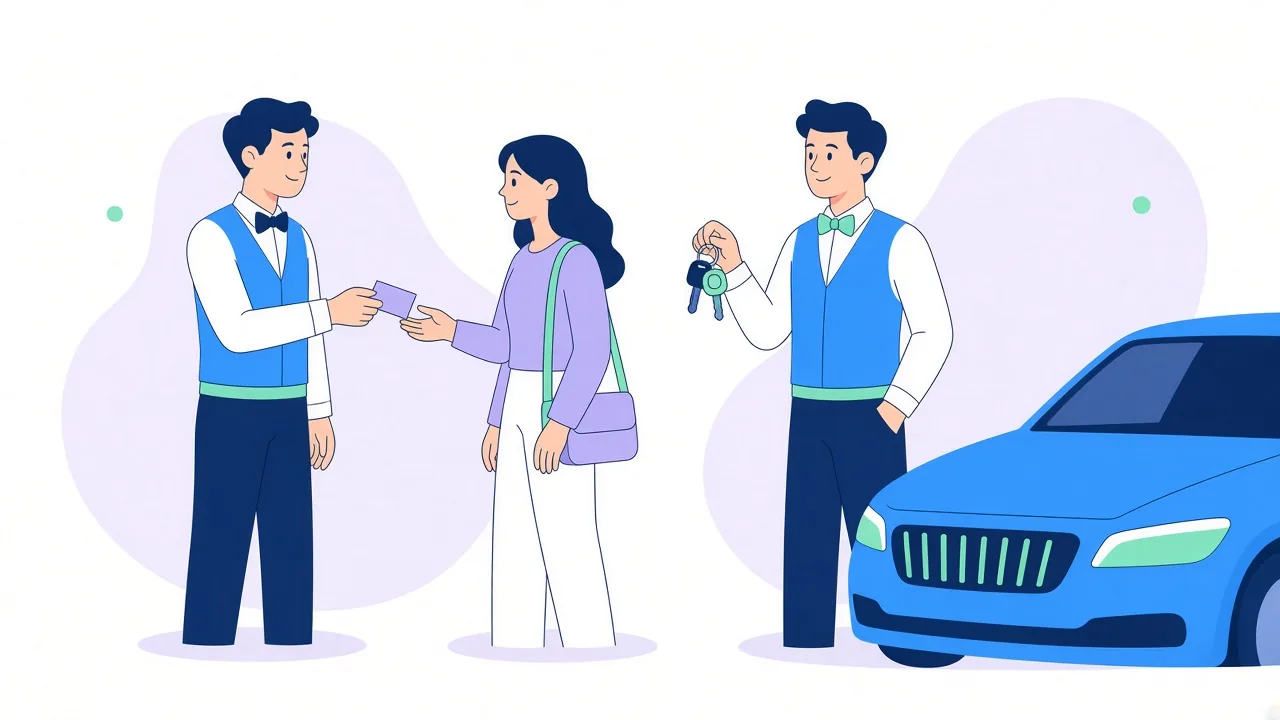
Valet interview questions check four things: that you can legally drive a guest’s car, that you protect it (a damage check before you drive, strict key control), that you stay calm with angry or drunk guests, and that you can work outside all shift. The 20 questions below come with sample answers in plain spoken English. Expect a driving-record check and, at some employers, a short test drive.
Start speaking with confidence today
Fluently is free to start. Take a free AI speaking assessment to see your level, then practice with games that build your vocabulary and pronunciation.


In this article
- What a valet parking driver does, and what the interview checks
- Valet interview questions about you and your driving (1–6)
- Valet parking questions about the car, the keys and the ticket (7–12)
- Situational valet questions: angry, drunk and rushed guests (13–16)
- Valet questions about cash, discretion and you (17–20)
- More valet interview questions to prepare
- Valet driver licence rules by country
- Valet interview questions and answers for freshers
- English phrases valets use with guests
- Practice a valet interview question out loud
What a valet parking driver does, and what the interview checks
A valet parking driver greets guests, takes their keys, parks the car and brings it back. O*NET, the US Department of Labor’s occupational database, files Valet Attendant, Valet Parker and Parking Lot Attendant under one occupation, with tasks such as greeting customers, inspecting vehicles for damage, tagging keys to match the guest’s stub, and handling cash and tips (O*NET 53-6021.00, 2026). In its survey of workers, 60% say they work outdoors in all weather every day.
On Glassdoor, candidates at Valet Park of America rate the interview as easy, “more a screening than anything”, with questions on driving violations, manual cars and why you want the job. Some employers ask you to park a car on the spot.
Valet interview questions about you and your driving (1–6)
Questions 1 to 6 decide whether the employer can put you behind the wheel. Names and numbers in the sample answers are examples: swap in your own.
1. “Tell me about yourself.”
“Tell me about yourself” wants one minute, in order: what you do now, the experience that matters (driving, guests, cash) and why this site. Listen to the model, then record your own version.
Tell me about yourself (with experience)
B1I’m a valet attendant with two years at a busy downtown hotel, mostly evening and weekend shifts.
On Friday nights our team parks more than a hundred cars in a tight garage. I often run the key box, and I have never lost a key.
I’ve held my licence for six years with a clean record, and I’d like to bring that care to your restaurant.
Read it aloud
Listen to a model reading, then record yourself. You get your speaking pace, the share of words that came through clearly, and the words to repeat.
No valet experience? Use the fresher version.
2. “Why do you want to work as a valet?”
The interviewer wants a reason that survives rain and late finishes. If they ask “Have you worked outside before?”, name the job and the weather.
Sample answer: “I like driving and I like people, and this job is both. In my delivery job I worked outside in all weather and enjoyed the pace. Here I also welcome guests, and a valet is the first and last person they see that evening.”
3. “Have you worked as a valet before?”
Name the venue type, how busy it was and one duty beyond parking, such as the key box or helping guests.
Say: “Yes, eighteen months at a hospital car park and then a hotel. At the hospital I helped visitors with wheelchairs and directions. At the hotel I ran the key box on Friday nights and showed new valets the ticket system.”
Fresher version: “Not as a valet, but I greeted guests and took payments in a restaurant for two years, and I drive every day for my family’s shop.”
4. “Do you have a valid driver’s licence and a clean driving record?”
Question 4 is a gate: the employer must know you can legally drive any guest’s car. State the facts, including any ticket, because the record check will show it. In the US, employers “must get your written permission before running a background check with a background reporting company” (FTC). Some cities add a valet permit: see the licence table.
Sample answer: “Yes, a full licence for six years. One speeding ticket three years ago, nothing since, and you’re welcome to check my record.” New driver: “I passed my test eight months ago and drive daily. Because I’m new, I take tight spaces slowly.”
5. “Can you drive a manual (stick shift)?”
The stick-shift question comes up repeatedly in valet candidate reports on Indeed and Glassdoor. In the US, manual transmissions went from almost 35% of new vehicles in model year 1980 to below 1% of production since model year 2021 (2025 EPA Automotive Trends Report). In practice the question is about the occasional manual car, so honesty beats a quick yes. Outside the US, ask how many guest cars are manual.
A strong answer: “Yes, I learned on a manual and drove one for three years, so I’m fine with a clutch on a ramp.” If you can’t: “Not yet. If a manual comes in, I’d hand it to a teammate who drives stick, and I’d like to learn if you train.”
6. “What would you do with a car you have never driven, like an electric or push-button car?”
Unfamiliar controls are a real risk at the curb. NHTSA, the US road safety agency, warns about drivers of keyless (push-button) cars who switch off without selecting Park, so the car can roll away, or who leave the engine running, which raises the risk of carbon monoxide poisoning in a closed space. Its advice: Park, engine off, parking brake (NHTSA). If asked which vehicles you have driven, list them: small cars, large SUVs, vans, any luxury or electric models.
You could say: “I ask the guest for ten seconds at drop-off: how to start it, how to select Park, where the parking brake is. With an electric car I read the dashboard to know it’s on. If I’m still unsure, I ask a senior valet first.”
Valet parking questions about the car, the keys and the ticket (7–12)
Questions 7 to 12 check that each car comes back in the condition it arrived, to the right person.
7. “Walk me through how you take a guest’s car.”
Describe the steps in order, like a routine. Where you stop matters too: Beverly Hills’ valet permit conditions say valets “shall not receive or return vehicles in any traffic lane or any red zone” (permit form, 2023).
Sample answer: “I wave the car into the drop-off zone, open the door and greet the guest. I walk around the car with them and note any damage on the ticket. I give them the stub, tag the keys with the same number and explain how to get the car back. Then I park it.”
8. “What do you check before you drive a car away?”
A damage note written before you drive, with the guest present, shows that a scratch was already there. Some operators use valet apps (O*NET lists valet point-of-sale software for this job); others mark a car diagram on the ticket. Check four things:
| Check | What to note |
|---|---|
| Body | Scratches and dents, by panel: “scratch, rear left door” |
| Wheels | Curb marks on the rims, a flat or low tire |
| Glass and mirrors | Chips, cracks, a broken mirror |
| Inside | Valuables in view (tell the guest), dashboard warning lights |
Say: “I walk around the car with the guest and write any damage by panel. If I see a flat tire or a warning light, I tell the guest before I drive, and I ask them to take any phone or bag off the seat.”
9. “How do you keep keys and tickets under control?”
Lost or swapped keys are hard to fix on a busy night, so describe a system: the tag on the keys matches the stub the guest holds.
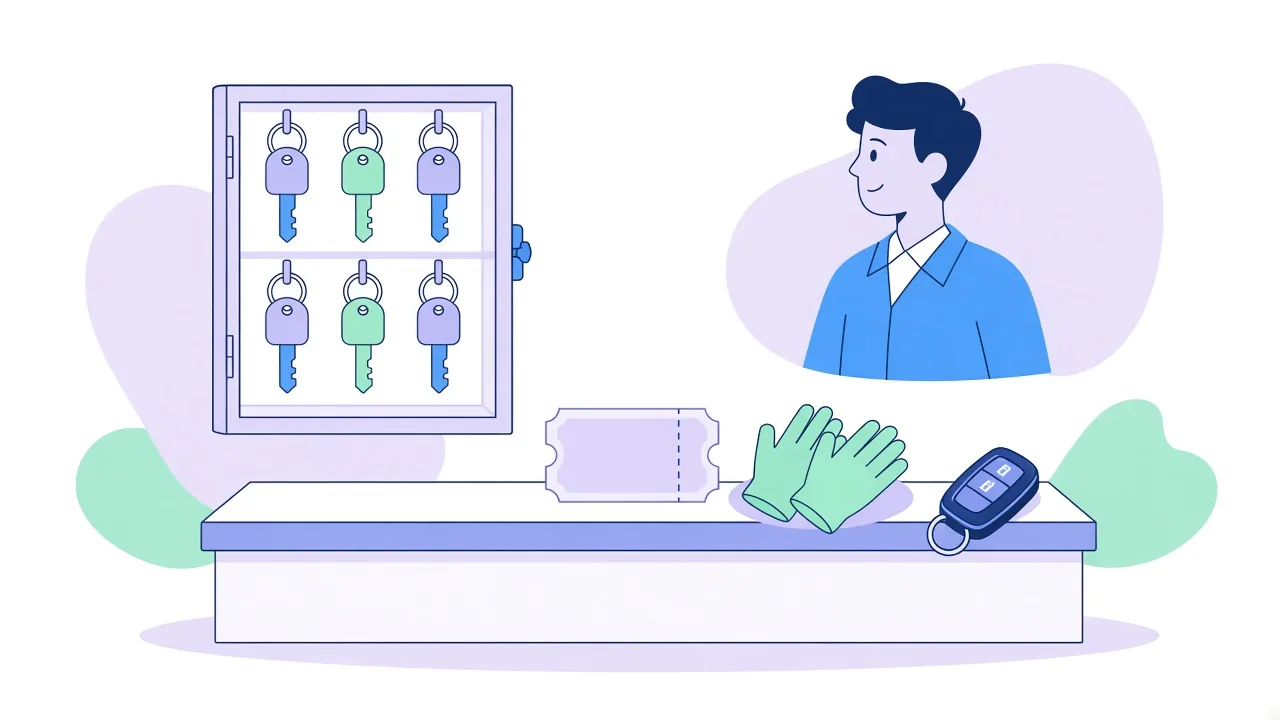
A strong answer: “The key goes from my hand to the key box, never into my pocket. Each tag matches the guest’s stub, and I write the parking spot on the ticket. Before I hand a car back, I check the stub against the tag. If two tickets look mixed up, I stop and call my supervisor.”
10. “How fast do you drive in a parking garage?”
There is one right answer: slowly. Garages have pillars, ramps and people walking between cars.
Sample answer: “At walking pace, or the posted limit if that’s lower. I keep my phone away, use the headlights inside and watch for people between cars. I drive a guest’s car as if my manager were in the passenger seat.”
11. “What would you do if you damaged a guest’s car?”
Question 11 is an honesty test: report it at once, because hidden damage turns an accident into a trust problem.
Answer: “I’d stop, check nobody is hurt and tell my supervisor straight away. I’d take photos, write down what happened and when, and follow the incident process. Hiding even a small scratch makes everything worse.”
12. “A guest says their car was scratched while it was parked. What do you do?”
A damage claim is different from damage you caused: at the curb you neither admit it nor argue.
Sample answer: “I’d say, ‘I’m sorry, let me get my supervisor so we can look at it together.’ We’d compare the damage with the drop-off notes and photos, and the supervisor would start the claim process. I wouldn’t argue or promise anything. If something is missing from the car, I’d do the same: supervisor first, then a written report.”
Situational valet questions: angry, drunk and rushed guests (13–16)
Situational questions start with “What would you do if…”. If you have not lived the situation, say “I would…” and give the steps; never invent a story.
13. “A guest is angry because their car is taking too long. What do you say?”
Interviewers listen for calm words and an honest wait time.
Try this: “I’m sorry for the wait, sir. Your car is on level three and will be at the door in about four minutes. I’ll come back to you if anything changes.” Then radio the runner and thank the guest when the car arrives. Fresher: tell a café or shop story about an upset customer, what you said and how it ended.
14. “A guest who seems drunk asks for their car. What do you do?”
Answer with the venue’s policy and a call to your manager.
A strong answer: “I’d stay friendly and not accuse anyone. I’d offer to call a taxi and say the car can stay with us overnight, if the venue allows it. I’d call my manager at the same time, because this decision shouldn’t sit with one valet. If the guest still insisted on driving, I’d follow the policy, which may mean calling the police.”
15. “Ten cars arrive at once. How do you handle the rush?”
Rush questions test teamwork: say how the team splits the work and which steps you never skip.
Sample answer: “One person greets and writes tickets, the others run cars, and we call out on the radio so two people don’t chase the same car. Guests who are leaving usually come first, because they’re standing and waiting. I keep the line moving, but I never skip the walk-around or the key tag.”
16. “Can you work outside in all weather, on your feet, nights and weekends?”
Say yes only if it is true, and give proof. Candidates on Indeed report being asked whether they can run and when they are available, and O*NET’s survey shows why: 54% of surveyed parking attendants walk or run “continually or almost continually”.
Say: “Yes. I did two winters of bike delivery, so rain and cold don’t stop me, and I’m fine running to the garage all night. I’m free Thursday to Sunday, evenings included, and I can get home by bus after a late finish.”
Valet questions about cash, discretion and you (17–20)
17. “How do you handle cash and tips?”
Cash questions check honesty, because some stands collect parking fees and share tips. In the US, an employee who receives $20 or more in cash tips in a calendar month while working for one employer must report them to the employer in writing by the 10th of the next month (IRS Topic 761).
You could say: “I count change back to the guest, keep the drawer exact and log every payment. Tips follow the team’s rule, and I report them as required. In my retail job I balanced my till every shift.”
18. “Someone asks who just arrived, or a guest’s room number. What do you say?”
Hotels, hospitals and private events expect discretion: who arrives, with whom and in what state is not for sharing.
Sample answer: “I’d say politely that I can’t share guest information and send them to the front desk. I don’t talk about guests or their cars, and I don’t post photos from work. At a hospital, a patient’s visit is private.”
19. “What are your strengths and weaknesses?”
Give a strength with proof, then a real weakness that is not a core duty, with the fix.
Example answer: “I stay calm when the line is long; on busy Saturdays at the restaurant I was the one who talked to waiting guests. My weakness was rushing my notes, so now I finish the damage check before I drive off, every time.”
20. “Do you have any questions for us?”
Ask two practical questions, and leave pay to the recruiter unless they raise it.
- “What cars do you park most, and how many are manual?”
- “How do you train new valets on the key box?”
- “How are tips shared on this team?”
Answers that lose valet jobs: “I’m a fast driver.” “I’d fix a small scratch myself.” “In a rush I keep keys in my pocket.” Hiding a ticket on your record. Complaining about guests or your last boss.
More valet interview questions to prepare
Longer valet lists add these; one or two sentences each is enough.
| Question | What to say |
|---|---|
| “Why should we hire you?” | One reason with proof: “I didn’t miss a weekend shift in a year.” |
| “Why did you leave your last job?” | A short, true, neutral reason (hours, study, a move). Never complain about a boss. |
| “What are your salary expectations?” | A range for your area. The US median for parking attendants was $16.90 an hour in 2025 (O*NET). |
| “Tell me about a conflict with a coworker.” | A small, real disagreement, how you talked it through, and the result. |
| “Tell me about a time you went beyond the job.” | One specific act, such as fetching a wheelchair for a guest. |
| “A guest needs medicine from a parked car right now.” | Ask a teammate to cover the stand, fetch it with the ticket, and log that you opened the car. |
| “You lock the keys inside a guest’s car.” | Tell the supervisor at once and the guest honestly, then follow the company’s process. |
| “A guest wants the car left in a no-parking spot.” | Explain politely that you can only use approved spaces. |
| “Do you know the area?” | Name nearby streets and landmarks; O*NET lists giving directions among the tasks. |
| “What would you do in your first 30, 60 and 90 days?” | Learn the stand and the garage, work at full pace, then help train new valets. |
| “Can you give us references?” | A supervisor and someone who saw your driving or service. |
On the day, arrive 10 minutes early in clean, plain clothes and closed shoes, with your licence and ID.
Valet driver licence rules by country
There is no single valet licence. You need a full car licence, and some cities add a valet permit. Rules change: check the official page and ask the employer.
| Where | Rules for driving guests’ cars |
|---|---|
| Los Angeles, US | A written permit from the Board of Police Commissioners before you work as a valet parking attendant (LAMC 103.203.1), when the valet service moves cars on public streets or property (2013 ordinance); $133, then $133 a year (LA Office of Finance). |
| Beverly Hills, US | Short-term valet permits: every attendant 18+ with a valid California licence on them, open to licence checks by city staff (2023 form). Other US cities: ask about local permits. |
| India | Motor Vehicles Act, 1988: no one under 18 may drive a car in a public place (section 4), and your licence must authorise that vehicle (section 3) (India Code). |
| Philippines | The LTO describes the professional licence as authority to operate a vehicle “for compensation”, so ask the employer whether your valet job needs one. Upgrading a car licence (codes B, B1, B2) requires age 18+, a year with the non-professional licence and no unsettled violations (LTO Citizen’s Charter 2025). |
| United Arab Emirates | Residents get a UAE licence after classes at a private driving institute and tests by the local transport authority; some expatriates can exchange a home-country licence (UAE government portal). |
| Bahrain | General Directorate of Traffic: a private-car learner licence needs age 18+, a vision test and no unsettled fines; foreigners need a valid residence permit (GDT eService). |
| Nepal and elsewhere | In Nepal the Department of Transport Management issues licences. Elsewhere, ask which licence category the employer needs and whether it accepts a foreign licence. |
Answer question 4 in two sentences: licence type and years held, then your record.
Valet interview questions and answers for freshers
A fresher, a candidate with no valet experience, gets the same 20 questions and answers them with proof from other work. O*NET puts the job in Job Zone 1–2, with on-the-job training that “ranges from a few days to one year”.
| If you have done this | Use it for | Say |
|---|---|---|
| Delivery or ride-hailing | 4, 10, 16 | “I drove daily in traffic and all weather, with no accidents.” |
| Restaurant, café or hotel | 1, 7, 13 | “I greeted guests and kept them calm during waits.” |
| Retail or cashier | 17, 19 | “I balanced my till every shift.” |
Tell me about yourself (fresher)
B1I’m twenty, and I’ve had my licence for two years. This past year I’ve worked at a pizza restaurant, first as a server and then on delivery.
I greet customers, take payments and keep people calm when the kitchen is slow. On delivery I drive every evening in all weather, with no accidents.
I want to be a valet because I enjoy driving and meeting people.
Read it aloud
Listen to a model reading, then record yourself. You get your speaking pace, the share of words that came through clearly, and the words to repeat.
Never invent valet experience: follow-up questions expose it. Other driving jobs have their own sets, such as these taxi driver interview questions.
English phrases valets use with guests
O*NET names speaking and active listening as the essential skills for this occupation. These lines work at any valet stand:
| Moment | Say |
|---|---|
| Arrival | “Good evening, welcome. Are you staying with us or dining tonight?” |
| Ticket | “Please keep your ticket; we need it to bring your car.” |
| Damage note | “I’ve noted a small scratch on the rear bumper. Could you take a look?” |
| Waiting | “Your car will be here in about five minutes. Thank you for waiting.” |
For more ways to welcome people, see these common English greetings; for interview phrases, see the English for job interviews guide.
Practice a valet interview question out loud
In a scenario question the interviewer may add complications. Say the candidate’s lines out loud.
A guest who has waited too long
B1–B2- Interviewer
A guest has waited ten minutes. He says, “This is ridiculous. Where is my car?” What do you say?
- Maria
I’m sorry for the wait, sir. May I see your ticket? I’ll check where your car is.
- Interviewer
A delivery truck is blocking the garage ramp.
- Maria
I tell him the truth: his car is coming, but a truck is blocking the ramp, so it will be about four more minutes.
- Interviewer
He wants to speak to your manager.
- Maria
Of course. I call my supervisor on the radio and stay with the guest until the car arrives.
- Interviewer
He says, “Give me the keys. I’ll get it myself.”
- Maria
I stay polite and explain that guests wait at the stand while we bring the car. When it arrives, I open his door, thank him and tell my supervisor about the delay.
Practise this dialogue
Listen to the whole exchange, then take one role: your partner’s lines are read aloud, you say yours into the microphone and see which words came through.
For a timed run, the free browser mock interview measures answer length, pace and filler words; it has no valet track, so choose the screening and behavioral questions. It checks how you speak, not whether your answer is correct. For a baseline, take the English speaking test.
Say your answers out loud before the interview
Fluently is an AI speaking coach for non-native English speakers on iOS and Android. You answer out loud and get feedback on pronunciation, fluency, vocabulary and grammar. It is free to start: take a free AI speaking assessment to see your level, then practice with games that build your vocabulary and pronunciation. Conversations with your AI tutor come with Fluently Premium.
Frequently asked questions
What questions does LAZ Parking ask in a valet interview?
LAZ Parking runs valet services in the US; in 2024 it won the valet contract at Duke University Hospital (LAZ news release). The valet job is the same at any operator, so prepare the core questions: licence and record, manual cars, service, availability, an angry guest and a damaged car. Each job posting lists that location’s requirements.
Are parking attendant interview questions the same as valet questions?
Mostly yes: O*NET files valet attendants and parking lot attendants under one occupation. For booth work, prepare more for cash and complaint questions, since the tasks include collecting fees and responding to customer complaints.
How much does a valet parking driver earn?
In the US, the median wage for parking attendants was $16.90 an hour ($35,150 a year) in 2025, based on BLS data shown on O*NET. Pay and tips vary by city and venue, so ask about both.
Is there a PDF of these valet interview questions and answers?
There is no separate PDF file. Use your browser’s Print option and choose Save as PDF, then say each answer out loud at least twice before the interview.
Can I do a valet interview in English if it is my second language?
Yes. Guests need to understand you; you do not need to sound like a native speaker. Use short sentences and repeat key facts such as the wait time. To check your level, take the free English level test.