22 Common English Greetings for Every Situation (and How to Reply)
 Yurii Rebryk · Updated September 24, 2026 · 16 min read
The 22 common English greetings below run from “How do you do?” to “G’day”, sorted formal to casual, each with the reply people expect and the line that usually comes next. In the US most of them are not real questions: “How are you?” gets “Good, thanks. You?” and the conversation moves on. Screenshot the tables; say the four dialogues at the end out loud.
In this article
- The 22 common English greetings, formal to casual
- How to greet someone: match, name, add one line
- Formal greetings examples
- Friendly greetings examples
- Casual greetings examples
- Casual greeting responses: short, with a detail, or returned
- How to reply to “How are you?”
- Greetings in email and chat: Hi, Hello, Dear, Hey
- How the greetings sound at natural speed
- Five lookalikes that are not greetings
- Practice: four greeting dialogues with a voice trainer
Jump to the full table of 22 greetings, the formal, friendly and casual examples, the reply to “How are you?”, the fast spoken forms or the four dialogues. Every greeting here is a three-turn opener: what they say, what you say back, what you say next.
The 22 common English greetings, formal to casual
This list of greetings runs from the most formal to the most casual, with the regional ones (UK, US South, Australia) labeled at the end. Rows 20 to 22 are heard rather than said unless you live where they come from. If you need 20 greeting words for a class list, take the first 20 rows.
| Greeting | Register | Typical reply | What you say next | Where it works |
|---|---|---|---|---|
| 1. How do you do? | Formal, rare | “How do you do?” (the same words back) | “I’m Ana Costa, from the Lisbon office.” | Formal introductions, mostly UK and older speakers |
| 2. Good morning | Formal to neutral | “Good morning.” | “Thank you for seeing me.” / “How was the drive in?” | Before noon: reception desks, first meetings, calls |
| 3. Good afternoon | Formal to neutral | “Good afternoon.” | “Thanks for coming in.” | Noon to early evening: clients, stores, calls |
| 4. Good evening | Formal to neutral | “Good evening.” | “Thank you for having me.” | Evening: restaurants, events, hosts |
| 5. Pleased to meet you | Formal | “Pleased to meet you too.” / “Likewise.” | “I’ve heard a lot about your team.” | First meeting with a client or a senior person |
| 6. Hello | Neutral | “Hello.” / “Hi.” | “I’m Daniel, we spoke on the phone.” | Any situation, any age, and the phone |
| 7. Nice to meet you | Neutral | “Nice to meet you too.” | “So you’re on the design team?” | First meeting, work or social |
| 8. It’s good to see you (again) | Neutral, warm | “Good to see you too.” | “How was the trip?” | Second meeting and every one after it |
| 9. How are you? | Neutral | “Good, thanks. You?” | “Busy week?” | Anyone you have met before, including cashiers |
| 10. How have you been? | Neutral, warm | “Pretty good. And you?” | “Still at the same company?” | After weeks or months apart |
| 11. Hi | Neutral to casual | “Hi.” / “Hey.” | “Hi, I’m Maya.” / “Hi, do you have a minute?” | Almost everywhere in the US, including work |
| 12. How are you doing? | Neutral to casual | “Good, how about you?” | “Did you get through that report?” | Colleagues, neighbors, store staff |
| 13. Long time no see | Casual, warm | “I know, it’s been ages.” | “What have you been up to?” | Someone you have not seen for a long time |
| 14. How’s it going? | Casual | “Not bad. You?” | “Just heading to lunch, you?” | Colleagues, friends, cashiers |
| 15. How are things? / How’s everything? | Casual | “All good, thanks.” | “Work’s busy. How about you?” | People you know |
| 16. Morning! | Casual | “Morning.” | “Coffee’s fresh if you want some.” | Coworkers and neighbors, before noon |
| 17. Hey | Casual | “Hey.” | “Hey, got a second?” | Friends and coworkers, mainly US |
| 18. What’s new? | Casual | “Not much. You?” | “Well, I started the new project.” | Friends, after a few days apart |
| 19. What’s up? | Casual | “Not much, what’s up with you?” | “Same, just got out of a meeting.” | Friends and younger colleagues; heard as “wassup” |
| 20. Hiya / Alright? | Casual, UK | “Hiya.” / “Alright.” (not a report on your health) | “Alright, mate. Busy?” | UK friends and coworkers |
| 21. Howdy | Casual, US | “Howdy.” / “Hey.” | “How’s the family?” | US, associated with the South; often humorous |
| 22. G’day | Casual, Australia | “G’day.” / “Hi.” | “How are you going?” | Australia; outside it, it sounds put on |
The register labels follow the dictionaries: Cambridge marks how do you do? formal, hey mainly US, g’day Australian and informal, and how are things? / “how’s everything?” / “how’s it going?” as one informal family. Oxford Learner’s has howdy as North American, informal and often humorous, and gives “All right, Bill.” “All right.” as the British “all right” hello.
How to greet someone: match, name, add one line
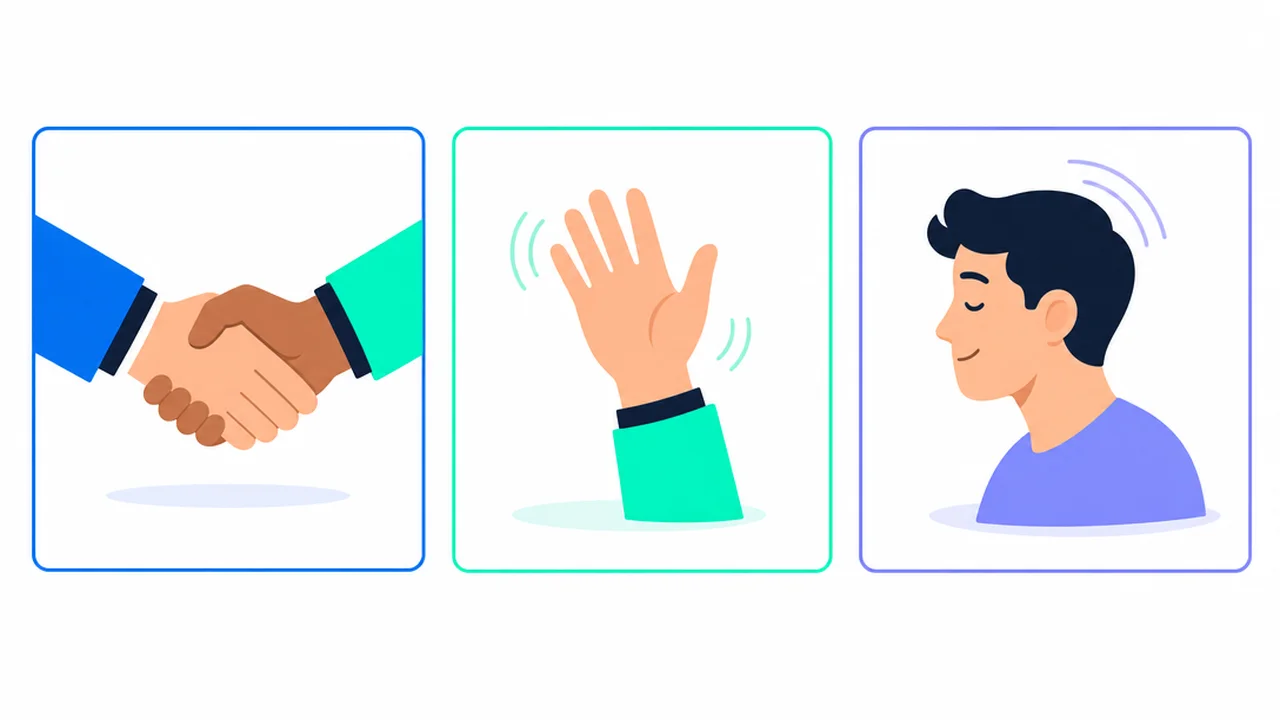
How to greet someone in English comes down to three moves; the greeting word is the least important of them.
- Match the register you hear. “Hey” gets “Hey”, “Good morning” gets “Good morning”. When you speak first to a stranger, go one step more formal than you think you need; the other person will pull the register down if they want to.
- Add the name. “Good morning, Ms. Park” and “Hey, Tom” do more work than the choice of greeting word. If you do not know the name, that is your next line: “Hi, I don’t think we’ve met. I’m Maya.”
- Add one line. A thank-you (“Thanks for making time”), a reason (“I’m here for the 10 o’clock”) or a small-talk question (“How was the trip?”). Without it the exchange stalls after two words; the English conversation topics guide has question sets for that third line.
Formal greetings examples
Formal polite greetings in English are short. In US work settings, “Good morning” plus the name plus a thank-you is as formal as it gets; “How do you do?” is correct but rare. Formal ways to greet someone, with the reply and the next line:
| Formal greeting | Reply | Next line |
|---|---|---|
| “Good morning, Ms. Park.” | “Good morning.” | “Thank you for making time today.” |
| “How do you do?” | “How do you do?” | “I’m Ana Costa. I lead the Lisbon team.” |
| “Pleased to meet you.” | “Pleased to meet you too.” | “I’ve read your report on the Q3 numbers.” |
| “It’s a pleasure to meet you.” | “The pleasure is mine.” | “I’ve heard a lot about your work.” |
| “Hello, Dr. Ortega.” | “Hello, Priya.” | “How was your flight?” |
Use “Mr.”, “Ms.” or “Dr.” with the last name at a first formal meeting; switch to first names as soon as the other person uses yours. For what follows the greeting in an interview, see the interview English guide.
Is “Greetings” a formal polite greeting?
In writing, yes. In speech, no. Cambridge defines the plural greetings as “a message that says you hope someone is well, happy, etc.”, and its formal examples are all written or addressed to a group: “Greetings to you, my friends and colleagues”, “Greetings from Paris!”, “Season’s greetings”. Use “Greetings,” or “Greetings, everyone,” at the top of a notice, a card or a group email. Said aloud to one person (“Greetings, Tom”), it sounds stiff or like a joke.
Time-neutral formal greetings for email and calls
Time-neutral greetings matter when you do not know the reader’s time zone or when the message will be opened hours later; “Good morning” sent to a global team lands at 11 p.m. for someone.
- “Hello [name],” formal enough for a first email, works at any hour.
- “Hi [name],” the default opener for most US work email and chat, also time-neutral.
- “Dear [name],” letters, cover letters, first contact with someone senior, formal requests.
- “Good day” is time-neutral but old-fashioned in both Cambridge and Oxford Learner’s.
Friendly greetings examples
Friendly greetings sit between formal and casual: neighbors, colleagues you like, classmates, the barista who knows your order. Each one carries a small question, so the reply answers it briefly and sends it back.
| Friendly greeting | Reply | Next line |
|---|---|---|
| “Hi, how are you?” | “Good, thanks. You?” | “Busy, but good. Did you have a nice weekend?” |
| “It’s good to see you.” | “Good to see you too.” | “How’s the new place?” |
| “How have you been?” | “Pretty good. And you?” | “Can’t complain. Still running in the mornings?” |
| “Long time no see.” | “I know, it’s been ages.” | “What have you been up to?” |
| “How are things?” | “All good. How about you?” | “Work’s busy. How’s your family?” |
Learners hesitate over “Long time no see” because the grammar looks broken. Cambridge lists long time no see as a normal idiom, “said when you meet someone who you haven’t seen for a long period of time”, and the reply agrees with it: “I know, it’s been ages.”
Casual greetings examples
Casual greetings are for friends, close coworkers and anyone who greeted you casually first. Two of them, “What’s up?” and “What’s new?”, ask what is happening rather than how you are, so “Good, thanks” answers the wrong question.
| Casual greeting | Reply | Next line |
|---|---|---|
| “Hey.” | “Hey.” | “Hey, how’s it going?” |
| “Hey, what’s going on?” | “Not much. You?” | “Just grabbing coffee. Want one?” |
| “What’s up?” | “Not much, what’s up with you?” | “Same. Did you see the game?” |
| “How’s it going?” | “Good, you?” | “Can’t complain. Long day?” |
| “Morning!” | “Morning.” | “Coffee’s fresh.” |
| “What’s new?” | “Nothing much. You?” | “Well, I got the job.” |
| “Hiya.” (UK) | “Hiya.” | “You alright? How’s it going?” |
| “Alright?” (UK) | “Alright.” | “Yeah, not bad. You?” |
| “Howdy.” (US, often playful) | “Howdy.” | “How’s it going, stranger?” |
| “G’day.” (Australia) | “G’day.” | “How are you going?” |
Cambridge gives what’s up? two senses, “used to ask what is wrong” and “used to ask what is happening, often as a way of greeting someone”, and lists “wassup?” and “whassup?” as spellings of the greeting. Oxford Learner’s traces hiya to “how are you?”, which is why the reply is simply “Hiya”.
Casual greeting responses: short, with a detail, or returned
Casual greeting responses come in three sizes: one or two words that close the exchange, a reply with a detail that invites a follow-up, and a returned greeting that hands the turn back.
| Greeting you hear | Shortest reply | Reply with one detail | Returned |
|---|---|---|---|
| “Hey.” | “Hey.” | “Hey, good to see you.” | “Hey, how’s it going?” |
| “What’s up?” | “Not much.” | “Not much, just finished a call.” | “Not much, what’s up with you?” |
| “How’s it going?” | “Good.” | “Good, busy week.” | “Good, you?” |
| “How are you doing?” | “Pretty good.” | “Pretty good, a bit tired.” | “Pretty good. How about you?” |
| “What’s new?” | “Nothing much.” | “Not much, I started a new project.” | “Nothing much. You?” |
| “Long time no see.” | “I know!” | “I know, it’s been what, a year?” | “I know. How have you been?” |
| “Alright?” (UK) | “Alright.” | “Alright, bit tired.” | “Alright, you?” |
The one-word rule: “Not much” answers “What’s up?” and “What’s new?”; “Good” answers “How’s it going?” and “How are you doing?”; the greeting word itself answers “Hey”, “Morning”, “Hiya” and “Howdy”. Swap them and the reply sounds off even when every word is correct.
How to reply to “How are you?”
The “How are you” reply is two or three words plus the question sent back, because in American English it is a greeting, not a request for information. Cambridge’s own example runs “Hi, Lucy, how are you?” “Fine, thanks, how are you?” The whole exchange takes about three seconds.
- “Good, thanks. You?” The default US reply. Cambridge lists “I’m good” as an informal “general reply when someone greets you”, with the example “How are you doing?” “I’m good, thanks.” The textbook “I’m well” is also correct and sounds a little more formal.
- “Not bad, how about you?” Slightly lower energy, still positive. Common with coworkers.
- “Pretty good, busy week.” The reply with one detail; the detail gives the other person a follow-up.
- “Fine, thanks.” Correct and neutral; without “And you?” it signals that the conversation can end, which is sometimes exactly right (a cashier, a passing colleague).
The same four replies work for “How are you doing?”, “How’s it going?” and “How are things?”. With a manager or a client, use the full form (“Very well, thank you. And you?”). With a friend who wants to know, give the real answer after the short one (“Good. Well, honestly, a long week. The move is taking forever.”); the truth alone, to a stranger, surprises people.
Greetings in email and chat: Hi, Hello, Dear, Hey
Written greetings have fewer options and stricter rules than spoken ones, because the reader cannot hear your tone.
| Opener | Use it for | Wrong when |
|---|---|---|
| “Dear Ms. Park,” | Letters, cover letters, first contact with someone senior, formal requests | Chat, and the fifth reply in the same email thread |
| “Hello Ms. Park,” / “Hello Priya,” | A first email to someone you do not know, any time zone | Rarely wrong; slightly distant between people who talk every day |
| “Hi Priya,” | Most US work email, Slack, Teams, follow-ups | A first email to a senior stranger in a formal industry |
| “Hey Priya,” | Chat with people you already talk to | First contact, clients, anyone senior, anything that could be forwarded |
| “Greetings,” / “Greetings, everyone,” | Group notices, newsletters, cards | One-to-one email; it sounds like a form letter |
| “Good morning,” | Messages read the same morning, in the same time zone | Global teams, scheduled sends, anything read later |
After the first exchange in a thread, drop the greeting line or keep a bare “Hi”; “Dear Ms. Park” on every reply reads as if each message were a new letter. For greetings in meetings and calls, the business English conversation guide has the full phrase sets.
How the greetings sound at natural speed
At normal speed the greetings lose syllables, and the fast version is what a cashier or a coworker walking past will say. Recognize the forms in the middle column, keep saying the full forms yourself, and see the pronunciation practice guide for the sounds and stress behind them.
| Written | What you hear | Note |
|---|---|---|
| How are you? | “how are ya” / “how-ya” | The vowel in “you” shrinks; sometimes “are” disappears too |
| How are you doing? | “how ya doin’” | The final “g” of “doing” goes; “ya” for “you” |
| How’s it going? | “how-zit-goin’” | The “s” attaches to “it” |
| What’s up? | “wassup” / “sup” | Cambridge lists “wassup?” and “whassup?” as spellings of the greeting |
| Good morning | “Morning” | Cambridge lists the one-word “morning” as an informal exclamation |
| Nice to meet you | “nice ta meet ya” | “to” and “you” both reduce |
Five lookalikes that are not greetings
- “Good night” is a farewell. Cambridge defines good night as “said when people leave each other in the evening or before going to bed”. The evening greeting is “Good evening”.
- “How do you do?” is not a question. The reply is “How do you do?” again, as in Cambridge’s example; “I’m fine, thanks” reads the words literally.
- “Greetings!” is not spoken. It opens cards, notices and group messages. Said aloud it is a joke or a robot.
- “Good day” is old-fashioned in both Oxford Learner’s and Cambridge. Australians shortened it to “G’day”; Americans mostly dropped it.
- “What’s up?” with a frown means “what is wrong”. Cambridge lists that sense first; said slowly, with eye contact, it wants a real answer.
Practice: four greeting dialogues with a voice trainer
One dialogue per register. Play the partner’s line, say yours before the trainer moves on, then swap roles. Say the third line out loud too; it is the part learners skip. More exchanges with the same trainer are in the English conversation for beginners guide.
1. Meeting a client for the first time (formal)
Meeting a client for the first time
B1- Ana
Good morning. You must be David Park. I’m Ana Costa from Northwind.
- David
Good morning, Ana. Pleased to meet you.
- Ana
Pleased to meet you too. Thank you for making time today.
- David
Of course. How was the drive in?
- Ana
Easy, the traffic was light. And it’s good to finally put a face to the emails.
- David
Likewise. Can I get you a coffee before we start?
- Ana
A coffee would be great, thank you.
- David
Let’s go through to the meeting room.
Practise this dialogue
Listen to the whole exchange, then take one role: your partner’s lines are read aloud, you say yours into the microphone and see which words came through.
2. A colleague in the hallway (neutral)
A colleague in the hallway
A2- Tom
Hey, Maya. How’s it going?
- Maya
Good, thanks. You?
- Tom
Not bad. Busy morning.
- Maya
Same here. Did you get through that report?
- Tom
Almost. I’ll send it after lunch.
- Maya
Perfect. See you at the two o’clock?
- Tom
See you there.
Practise this dialogue
Listen to the whole exchange, then take one role: your partner’s lines are read aloud, you say yours into the microphone and see which words came through.
3. Opening a video call (neutral, with small talk)
Opening a video call
B1- Priya
Hi Daniel, can you hear me OK?
- Daniel
Hi Priya, loud and clear. How are you?
- Priya
Good, thanks. How about you? It must be early there.
- Daniel
It’s eight in the morning here, so I’m on my first coffee. How was your weekend?
- Priya
Nice and quiet. We finally got some sun. Yours?
- Daniel
Same, mostly gardening. Shall we wait for Sam, or get started?
- Priya
Let’s give him two minutes. Did you see the updated slides?
- Daniel
I did, they look good. Oh, here’s Sam.
- Priya
Hi Sam, we were just about to start.
Practise this dialogue
Listen to the whole exchange, then take one role: your partner’s lines are read aloud, you say yours into the microphone and see which words came through.
4. A friend at the weekend (casual)
A friend at the weekend
A2- Jess
Hey! Long time no see.
- Marco
Hey, Jess! I know, it’s been ages. What’s up?
- Jess
Not much. Just grabbing coffee. You?
- Marco
Same. What have you been up to?
- Jess
Working, mostly. I started at the new place in June.
- Marco
Nice. How’s it going there?
- Jess
Pretty good so far. Want to sit for a bit?
- Marco
Sure, I’ve got half an hour.
Practise this dialogue
Listen to the whole exchange, then take one role: your partner’s lines are read aloud, you say yours into the microphone and see which words came through.
Success check: for each dialogue, cover the text and produce the greeting, the reply and the third line from memory. If the third line does not come, that is the one to drill.
Say the reply out loud, not just read it
A greeting takes about two seconds, and the reply has to come before the other person moves on, which is why a table is not enough on its own. Fluently is an AI speaking coach for non-native professionals: you hold voice conversations and role-plays on everyday and work situations, such as meeting a client or opening a call, and after each answer the app shows feedback on pronunciation, fluency, vocabulary and grammar. It is on iOS and Android and opens with a free 4-minute speaking assessment; a trial comes before any subscription.


Frequently asked questions
What are the most common greetings in English?
“Hello”, “Hi”, “Hey”, “Good morning”, “Good afternoon”, “Good evening”, “How are you?”, “How’s it going?” and “Nice to meet you”. In the US, “Hi” covers most spoken situations including work, “Hey” covers friends and close coworkers, and “Hello” is the safe choice for strangers and the phone.
Is “Greetings” a formal polite greeting?
In writing, yes: “Greetings,” or “Greetings, everyone,” is a formal opener for cards, notices and group messages, and Cambridge’s examples (“Greetings to you, my friends and colleagues”, “Season’s greetings”) are all written or addressed to a group. In speech, no: said aloud to one person it sounds stiff or like a joke.
How do you reply to “How are you?”
With two or three words and the question returned: “Good, thanks. You?”, “Not bad, how about you?”, “Pretty good, busy week.” or “Fine, thanks.” “I’m good” is listed by Cambridge as the informal general reply to a greeting, and “I’m well” is the more formal version. A real, longer answer is for a friend who wants one, and even then the short reply comes first.
What is a formal way to greet someone?
“Good morning / Good afternoon / Good evening” plus the title and last name (“Good morning, Ms. Park”), then a thank-you or a reason for the meeting. For a first meeting add “Pleased to meet you” or “It’s a pleasure to meet you”. “How do you do?” is the most formal option, but it is rare in the US and takes “How do you do?” as its reply, not an answer about how you are.
What are 10 different greetings?
Ten different greetings, formal to casual: 1. Good morning, 2. Pleased to meet you, 3. Hello, 4. Nice to meet you, 5. How are you?, 6. Hi, 7. How’s it going?, 8. Long time no see, 9. Hey, 10. What’s up? The table above extends the list to 22.
How do you greet someone you have not seen for a long time?
“Long time no see!”, “It’s so good to see you” or “How have you been?”, followed by the question that keeps it going: “What have you been up to?” or “Are you still at the same company?”. If they say “Long time no see” first, reply “I know, it’s been ages” and ask the same follow-up back.