20 Laundry Supervisor Interview Questions and Answers for Hotel and Hospital Laundries
 Yurii Rebryk · Updated · 15 min read
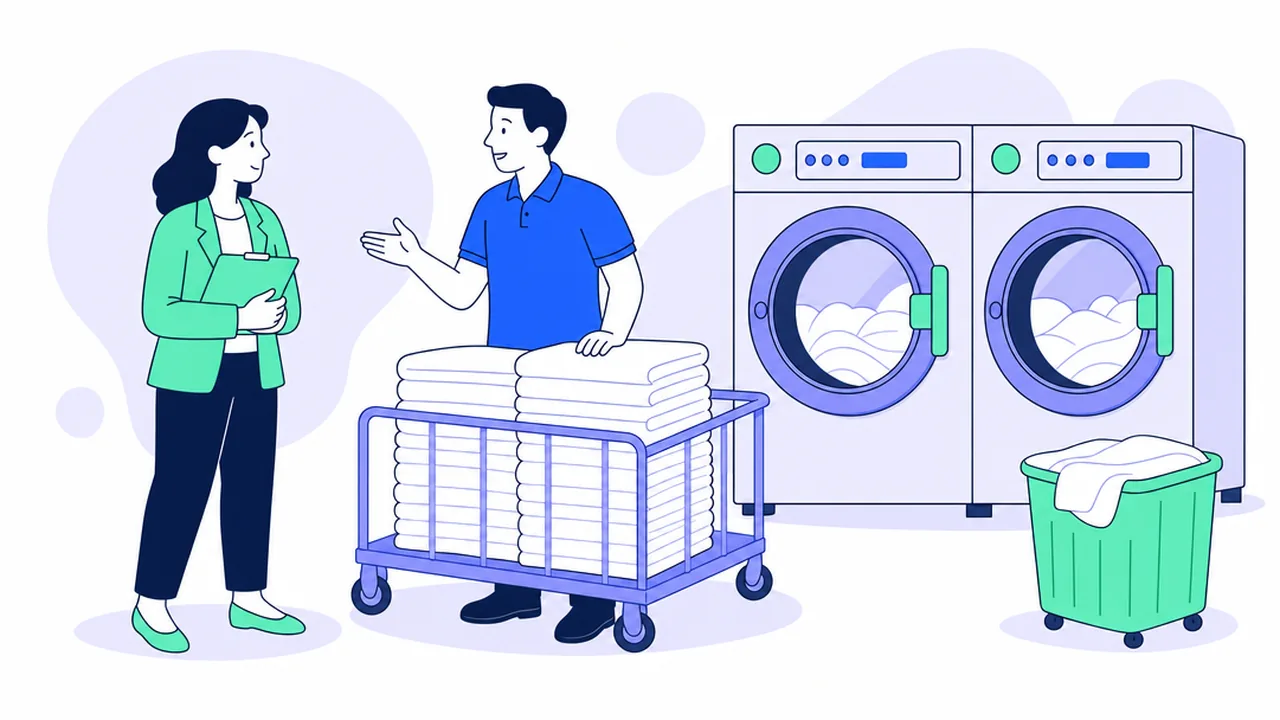
Laundry supervisor interview questions check three things: that you know how linen moves through a laundry, that you keep it clean and safe (stains, chemicals, infected hospital linen), and that you can run a team on a busy shift. Each of the 20 questions below has a short sample answer in plain spoken English. You also get fresher versions, a practice dialogue and official hygiene and chemical rules for seven countries.
Start speaking with confidence today
Fluently is free to start. Take a free AI speaking assessment to see your level, then practice with games that build your vocabulary and pronunciation.


In this article
- What a laundry supervisor does, and the linen flow interviewers ask about
- Laundry supervisor interview questions about you (1–5)
- Technical questions: sorting, care labels, stains and chemicals (6–10)
- Machine, quality and complaint questions (11–15)
- Team, pressure and closing questions (16–20)
- More laundry supervisor interview questions to prepare
- Laundry hygiene and chemical rules by country
- Laundry interview questions and answers for freshers and attendants
- How to say laundry words clearly in English
- Practise a laundry supervisor interview question out loud
What a laundry supervisor does, and the linen flow interviewers ask about
A laundry supervisor runs the laundry shift: the people, the machines, the chemicals and the quality of every item that leaves. O*NET, the US Department of Labor’s job database, lists Laundry Supervisor under first-line housekeeping supervisors, whose tasks include supervising in-house laundries, planning work schedules, inspecting work and keeping stock at the right level (O*NET 37-1011.00, 2026). Attendants load washers, run dryers, and sort, count and fold (O*NET 51-6011.00).
| Linen flow step | What happens | Questions |
|---|---|---|
| 1. Collection | Soiled linen is bagged where it was used and taken to the dirty side | 10 |
| 2. Sorting | By soil level, fabric, colour and item; pockets emptied | 6, 7 |
| 3. Washing | The right program and chemical dose for each load | 8, 9, 10 |
| 4. Drying | Extraction, then the tumble dryer or the flatwork ironer | 11, 12 |
| 5. Finishing | Ironing, folding and the quality check | 14, 15 |
| 6. Storage | Counted and kept apart from soiled linen | 13 |
| 7. Delivery | Back to rooms, wards or the restaurant on time | 16, 19 |
O*NET puts laundry and housekeeping supervisors in the same occupation. For the housekeeping side, see the housekeeping supervisor interview questions.
Laundry supervisor interview questions about you (1–5)
The first five questions are about you. Keep each answer under a minute. Names and numbers in the sample answers are examples: swap in your own.
1. “Tell me about yourself.”
Give three facts: what you do now, your past laundry work, and why this job. Listen, then record your own.
Tell me about yourself (with experience)
B1I’m a laundry shift leader at a 300-room hotel, where I’ve worked for four years. I started as an attendant, then moved to the washers and the chemical dosing.
Now I run the morning shift with six attendants: room linen, restaurant linen, uniforms and guest laundry.
I’m applying for this supervisor job because I already do most of the work, and I want full responsibility for quality, the team and the machines.
Read it aloud
Listen to a model reading, then record yourself. You get your speaking pace, the share of words that came through clearly, and the words to repeat.
Fresher version: “For a year I worked weekends at a laundromat, sorting loads and reading care labels. I’d like to start as an attendant here and grow into supervision.” More in the freshers section.
2. “Why do you want to be a laundry supervisor?”
Link your reason to something you already do; “I like clean things” is not enough.
Sample answer: “I enjoy the planning side of laundry. On my shift, I already decide the order of the loads and teach new attendants. As a supervisor, I can plan the whole day so rooms and wards never wait for linen.”
3. “What laundry equipment have you worked with?”
Name the machines you can run alone (washer-extractors, tunnel washers, tumble dryers, flatwork ironers, presses, folders, dosing pumps) and be honest about the rest.
Say: “I’ve used 60-kilo washer-extractors, gas dryers and a flatwork ironer, and I can change wash programs. I haven’t worked with a tunnel washer yet, so I’d ask for training on yours.” No experience? “Only home and laundromat machines, but I follow manuals carefully.”
4. “Walk me through how linen moves through your laundry.”
The process question checks that you see the whole flow and the rule that keeps it hygienic: soiled and clean linen never meet. The CDC notes that a healthcare laundry is usually split into a “dirty” area for receiving soiled laundry and a “clean” area (CDC, Laundry and Bedding, 2024).
A strong answer: “Soiled linen arrives in bags on the dirty side. We sort it, empty pockets and run the right program, then the dryers or the ironer. On the clean side we fold, check and count, and clean linen leaves on covered trolleys, never through the dirty area.”
5. “What are your strengths and weaknesses?”
Give one strength with proof, then a real weakness that is not a core duty, with your fix. Asked for three? Keep each one small, true and improving.
You could say: “My strength is organisation: in two years, my shift has never sent linen up late. My weakness was paperwork: my reports were often late, so now I fill in the log every hour.”
Technical questions: sorting, care labels, stains and chemicals (6–10)
Technical questions check that you know the reason behind each rule: give the step, then the reason.
6. “How do you sort laundry, and why does it matter?”
A sorting mistake becomes a stain, a shrunken item or a rewash. The CDC adds a safety reason: “Sorting laundry before washing protects both the machinery and fabrics from hard objects.” For hospital linen it notes that sorting after washing reduces workers’ exposure to infective material (CDC).
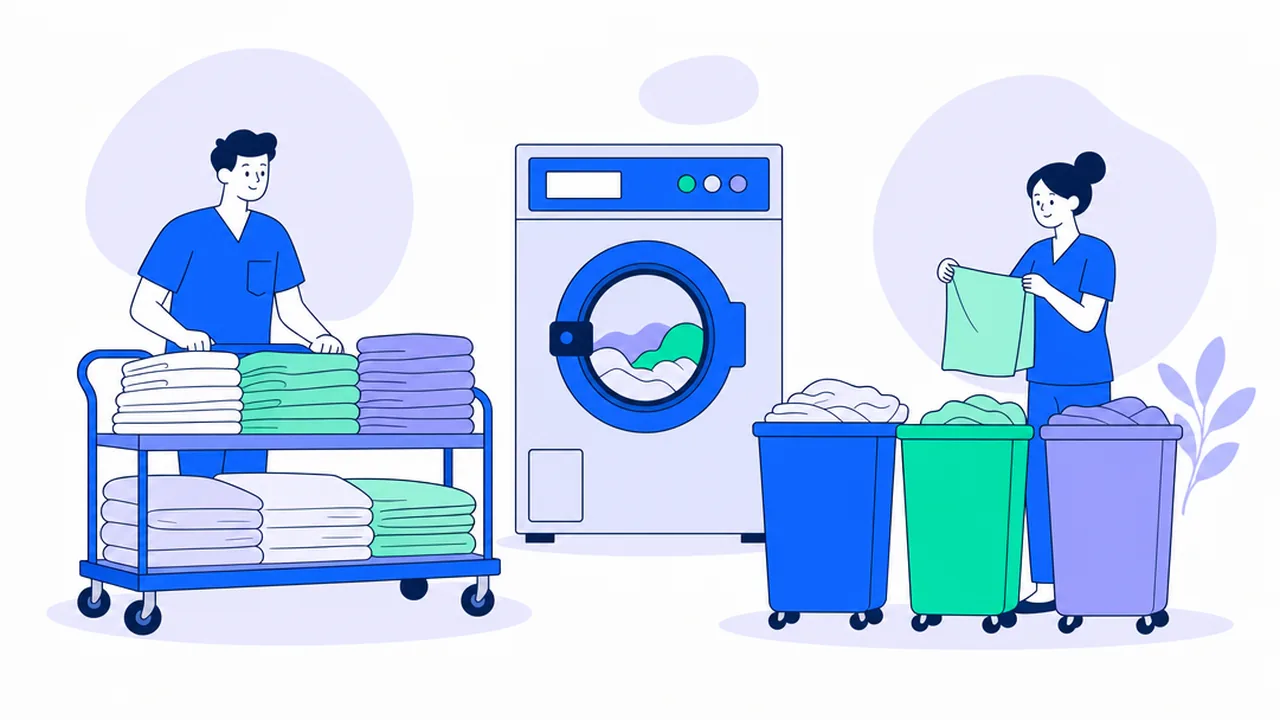
Example answer: “We sort into heavy soil, light soil, whites and colours, and keep towels apart from sheets because they need different programs. Every pocket gets checked, because one pen in a load of white sheets means a full rewash.”
7. “How do you read a care label?”
Care labels use five basic symbols. Under ISO 3758, each one shows the most severe treatment the item can take without irreversible damage (ISO 3758:2023; marks as in the GINETEX table).
| Symbol | Means | Marks |
|---|---|---|
| Washtub | Washing | Number = maximum °C; one bar = mild, two bars = very mild; cross = do not wash |
| Triangle | Bleaching | Empty = any bleach; two lines = oxygen bleach only; cross = no bleach |
| Square | Drying | Circle inside = tumble dry, dots = heat level; crossed out = no tumble dryer |
| Iron | Ironing | One dot = 110°C, two = 150°C, three = 200°C |
| Circle | Professional care | Letter inside = the dry or wet cleaning process; cross = do not dry clean |
A detail that impresses: ISO 3758 does not cover industrial laundering, which has its own symbols in ISO 30023.
Sample answer: “I read the label before guest laundry goes anywhere. A washtub with 40 means 40 degrees maximum, and a crossed-out square with a circle means no tumble dryer. If there’s no label, I don’t guess: I ask the guest or use the gentlest process.”
8. “How do you remove a difficult stain?”
Interviewers want to hear that you treat a stain before heat touches it. The University of Georgia Extension says to rinse fresh blood in cold running water and pretest every product on a hidden area, and warns that “stains set by heat will be difficult to remove” (UGA Extension).
Say: “I check the stain and the fabric, and test the product on a hidden seam. Blood and other protein stains go into cold water, never hot, and a stained item never goes into the dryer. If two treatments fail, I stop and tell the guest.”
9. “How do you control wash chemicals and dosing?”
Chemical answers need the right dose and a safe team. US employers must keep safety data sheets “readily accessible during each work shift” (29 CFR 1910.1200). Dubai Municipality asks for training on automatic dosing pumps and an eyewash in the chemical area (Dubai Municipality, 2026).
Never mix chemicals to make them stronger. Bleach mixed with ammonia creates chloramine gases, and bleach mixed with an acid product releases chlorine gas (New Jersey Department of Health).
A strong answer: “Chemicals go through the automatic dosing system, and the supplier checks the pumps at every visit. New attendants read the safety data sheets with me in week one. We wear gloves and goggles to change drums, and nobody mixes products by hand.”
10. “How do you handle linen from a hospital ward or an infected room?”
This is the core hospital laundry question, and hotels may ask it after an outbreak. Three rules come up again and again in official guidance:
- Bag it where it was used. US law says contaminated laundry “shall not be sorted or rinsed in the location of use” and travels in labelled or colour-coded bags (29 CFR 1910.1030).
- Do not open it. In England, infectious linen goes into a red water-soluble bag, and “the laundry staff should never open any inner water-soluble bags” (HTM 01-04, 2016).
- Disinfect it. HTM 01-04 asks for 71°C for at least 3 minutes or 65°C for at least 10. The CDC cites 160°F (71°C) for 25 minutes, or lower temperatures with carefully controlled chemicals (CDC).
You could say: “Infected linen stays in its sealed bag and goes straight into a washer on the disinfection program; nobody opens it to sort it. Staff wear gloves and an apron, and soiled-linen trolleys are cleaned before they carry clean linen.”
Machine, quality and complaint questions (11–15)
Questions 11 to 15 are about things going wrong. Keep the order: safety, people, priorities, then the record.
11. “A washer breaks down at peak time. What do you do?”
Safety comes before speed: a broken machine is switched off and locked or tagged before anyone repairs it or reaches inside, as OSHA’s lockout/tagout standard requires in the US (29 CFR 1910.147). Practise the follow-ups in the dialogue below.
Sample answer: “I stop the machine, switch it off and tag it ‘do not use’. I call engineering and tell my manager. Then I move the queue to the other washers: room linen first, because rooms must be ready for check-in, then restaurant linen and uniforms. I warn housekeeping early and log the downtime.”
12. “How do you keep the machines running?”
Preventive maintenance means small daily checks. Mention lint: in US homes, failure to clean was the leading factor in clothes dryer fires in 2018–2020, at 31% (US Fire Administration), and a commercial dryer runs all day.
Example answer: “Every shift we clean the lint screens, check door seals and look for leaks. Loads are weighed, so nobody overloads a washer. Once a week I walk round with engineering, and each machine has a log, so we see which one keeps failing.”
13. “How do you control linen stock, par levels and linen loss?”
Par level is the number of full sets you hold for each bed or station: at par 3, picture one set in use, one in the laundry and one on the shelf. Linen goes missing with guests, as rags, into other departments, or into the bin without a record; counting is the fix.
Say: “We work at par 3. I count soiled linen in and clean linen out every day, with a full count each month, and damaged items are written off. When towels went missing faster, I compared counts by floor and found the problem floor.”
14. “How do you check quality and keep rewash low?”
Name a checkpoint and a number. Inspect each item at folding, and track the rewash rate (items rewashed divided by items processed) by cause. One hidden cause is hard water: with it, “more soap or detergent is needed to get things clean” (US Geological Survey).
A strong answer: “Folders check every piece under good light, and anything stained goes to the rewash bin. I record rewash daily. When it rose one week, the cause was overloading on nights, so we added a weighing step and it came back down.”
15. “A guest says the laundry ruined their shirt. What do you do?”
Complaint questions test calm, fair handling: listen, check the facts, follow the hotel’s policy and report it.
Sample answer: “I thank the guest, apologise and ask to see the shirt. I check the laundry list, the care label and the program we used. If we made the mistake, I tell my manager and follow the compensation policy. If the label was wrong, I explain that politely.”
Team, pressure and closing questions (16–20)
Questions 16 to 20 test you as a leader. Tell real examples in STAR order: Situation, Task, Action, Result.
16. “How do you plan staff and shifts for a busy day?”
Plan from the expected volume, not last week’s rota. O*NET describes the task as forecasting “necessary levels of staffing and stock at different times” (O*NET); in a hotel that means occupancy and events, in a hospital beds and operating lists.
Say: “Every afternoon I check tomorrow’s occupancy and banquets. For a full house plus a wedding, I add two people to the morning shift and start the banquet linen the night before. Everyone knows two stations, so one sick call doesn’t stop the ironer.”
17. “How do you train a new laundry attendant?”
Start with safety. South Africa’s Hazardous Chemical Agents Regulations, for example, require training before an employee is exposed to a hazardous chemical (HCA Regulations, 2021).
You could say: “Day one is safety: the chemicals and their data sheets, gloves and goggles, and how to stop each machine. Then I show one station at a time, watch and check. For the first week, they work next to an experienced attendant.” Never trained anyone? “I taught new colleagues to fold to the hotel standard: show, watch, check.”
18. “Two of your staff are in conflict, or one is always late. What do you do?”
People questions check that you act early, in private and fairly, and follow up.
Example answer: “Two attendants argued daily about who got the easier station. I talked to each alone, then together, and we agreed on a rotation board; the arguing stopped within a week. With lateness, I first ask why. If it continues, I follow the warning process and keep notes.”
19. “Tell me about a time the laundry fell behind.”
Pressure questions want a short story with a result and one thing you changed afterwards. First job? Tell a busy day from any work, such as a rush in a shop or a kitchen.
Tell me about a time the laundry fell behind
B1–B2Last December the hotel was full, and a dryer broke on Friday morning. By noon we were two hours behind, with 40 rooms waiting for sheets.
I asked housekeeping which floors were most urgent, and we did those first. I moved two people from towels to the ironer and asked for one hour of overtime.
All rooms were ready by four o’clock. After that, we kept one extra set of sheets per room for busy weekends.
Read it aloud
Listen to a model reading, then record yourself. You get your speaking pace, the share of words that came through clearly, and the words to repeat.
20. “Do you have any questions for us?”
Ask two questions about the work, and leave pay for HR unless the interviewer raises it.
- “How many kilos does the laundry process on a normal day?”
- “Does the laundry also serve the restaurant, uniforms and guest laundry?”
- “What should the new supervisor improve in the first three months?”
More laundry supervisor interview questions to prepare
| Question | What to say |
|---|---|
| “Why should we hire you?” | One reason with proof: “I’ve run a hospital laundry shift, so I know infection control.” |
| “Why our hotel or hospital?” | One fact about them (size, guests, services) linked to your experience. |
| “Why did you leave your last job?” | Short and positive: growth, a closed site or a move; never criticise. |
| “Can you work early mornings, weekends and holidays?” | Your exact availability and limits, now rather than after the offer. |
| “What are your salary expectations?” | A range from local job ads for the same title. |
| “Where do you see yourself in five years?” | Running a larger laundry or a whole housekeeping department. |
| “How do you motivate a team doing repetitive work?” | Rotate stations, share the day’s numbers and thank people by name. |
| “How have you reduced costs?” | One real example: water, energy, chemicals or lost linen. |
| “An attendant finds money in a guest’s pocket. What happens?” | Recorded, handed in under lost and found, returned. Nothing is kept. |
| “How does each guest get back the right items?” | Tag each guest’s items and check them against the laundry list at every step. |
| “What is water hardness?” | Dissolved calcium and magnesium; hard water needs more detergent (USGS). |
| “How do you stay up to date?” | Supplier training, chemical service visits and your country’s hygiene rules (table below). |
Laundry hygiene and chemical rules by country
Rules differ by country. Quoting yours in questions 9 and 10 shows you know the job.
| Where | What the official rule says |
|---|---|
| United States | Safety data sheets accessible every shift (OSHA); contaminated laundry bagged where used, in labelled or colour-coded bags (29 CFR 1910.1030); hot water at 160°F (71°C) for 25 minutes (CDC). |
| England (UK) | COSHH: employers plan, manage and monitor hazardous substances (HSE); infectious linen in red water-soluble bags, 71°C for 3 minutes or 65°C for 10 (HTM 01-04). |
| India | Hospital laundries keep clean and dirty areas apart, monitor wash temperature and duration, and protect staff from sharps (National IPC Guidelines, NCDC, 2020). |
| South Africa | Training before exposure to a hazardous chemical; safety data sheets with 16 standard headings (HCA Regulations, 2021). |
| Kenya | Safety data sheets for every chemical in use, available to employees (OSH Act 2007, sections 84–85). |
| Dubai, UAE | Contaminated textiles kept separate from collection to delivery, washed at 71°C or more for 25 minutes or with approved low-temperature chemicals (Dubai Municipality, 2026). |
| Qatar | Linen from isolation rooms handled as infected linen, in a soluble alginate bag, with minimum agitation (MOPH policy, 2023). |
| Other countries | Rules vary: ask the employer which standard they follow, or check the health or labour ministry. |
Laundry interview questions and answers for freshers and attendants
Freshers usually start as laundry attendants and get simpler versions of the same questions. Answer with proof from any job, from school or from home.
| If you have done this | Use it for questions | What you can say |
|---|---|---|
| Laundromat or dry cleaner job | 3, 6, 7 | “I sorted loads and read care labels every day.” |
| Hotel room attendant | 4, 13, 15 | “I counted linen and handled guest requests.” |
| Restaurant or kitchen work | 9, 19 | “I used cleaning chemicals safely and worked fast at peak times.” |
| Factory or warehouse work | 11, 12, 16 | “I followed machine safety rules and worked to daily targets.” |
Attendant interviews also ask what never goes in a washer (anything with a crossed-out washtub), how you avoid mixing up customers’ loads, and what you would do with money found in a pocket. Never invent experience: one follow-up question exposes it.
How to say laundry words clearly in English
Use short sentences your team and guests understand: “I stop the machine. I call engineering.” Stress these words correctly (capitals = stressed syllable):
| Word | Say it | Example |
|---|---|---|
| linen | LIN-in | “Clean linen never goes through the dirty area.” |
| detergent | dih-TUR-junt | “The pump doses the detergent.” |
| garment | GAR-munt | “I check the label on every guest garment.” |
| disinfection | dis-in-FEK-shun | “Infected linen goes on the disinfection program.” |
Stress follows the Cambridge Dictionary. For drills, see the English pronunciation practice guide; for phrases that open an answer or buy time, see English for job interviews.
Practise a laundry supervisor interview question out loud
Interviewers add problems after your first answer to see if you stay calm. Say Amina’s lines out loud.
The washer breaks down on a busy Saturday
B1–B2- Interviewer
It’s Saturday, the hotel is full, and your biggest washer stops mid-cycle. What do you do first?
- Amina
I make it safe. I switch it off, tag it “do not use” and call engineering. Then I tell my manager.
- Interviewer
Engineering can’t fix it until Monday.
- Amina
Then I move the loads to the other washers: room sheets and towels first, because guests check in at three. Restaurant linen and uniforms come after.
- Interviewer
You still won’t finish in time.
- Amina
I ask for overtime or one extra person, and I warn housekeeping now about the floors that may be late.
- Interviewer
What about the wet load inside the broken machine?
- Amina
When engineering says it’s safe to open, we take it out and rewash it straight away, so it doesn’t sit wet until Monday.
Practise this dialogue
Listen to the whole exchange, then take one role: your partner’s lines are read aloud, you say yours into the microphone and see which words came through.
For a timed run, the free browser mock interview reports answer length, pace and filler words. It has no laundry track, so choose Screening classics or Behavioral; it checks how you speak, not laundry content. For a baseline, take the English speaking test.
Say your answers out loud before the interview
Fluently is an AI speaking coach for non-native English speakers on iOS and Android. You answer out loud and get feedback on pronunciation, fluency, vocabulary and grammar. It is free to start: take a free AI speaking assessment to see your level, then practice with games that build your vocabulary and pronunciation. Conversations with your AI tutor come with Fluently Premium.
Frequently asked questions
How do you pass a laundry supervisor interview?
Prepare three short true stories (a breakdown, a complaint, a team problem), learn your country’s hygiene rule, and bring numbers: team size, daily volume, rewash rate. Say each answer out loud at least twice.
What is the difference between a laundry supervisor and a laundry manager?
A supervisor runs the shift: the team, the machines, quality and daily counts. A manager usually owns the budget, hiring and supplier contracts, so manager interviews add questions on costs and reports.
Is there a PDF of these laundry interview questions and answers?
There is no separate PDF file. Use your browser’s Print option and choose Save as PDF to keep the 20 questions and sample answers.
What do they ask in a hospital laundry interview?
More infection control, including what to do if a needle turns up in the linen (do not pick it up by hand; follow the sharps procedure and report it). In the US, employers must offer the hepatitis B vaccine free to employees with occupational exposure to blood (29 CFR 1910.1030), so you may be asked about it.
Can I do a laundry interview in English if it is my second language?
Yes. Interviewers check that your team and the guests or nurses can understand you, not that you sound native. Use short sentences and the right laundry words. To find your level, take the free English level test.