20 Housekeeping Supervisor Interview Questions and Answers for Hotels and Hospitals
 Yurii Rebryk · Updated November 3, 2026 · 20 min read
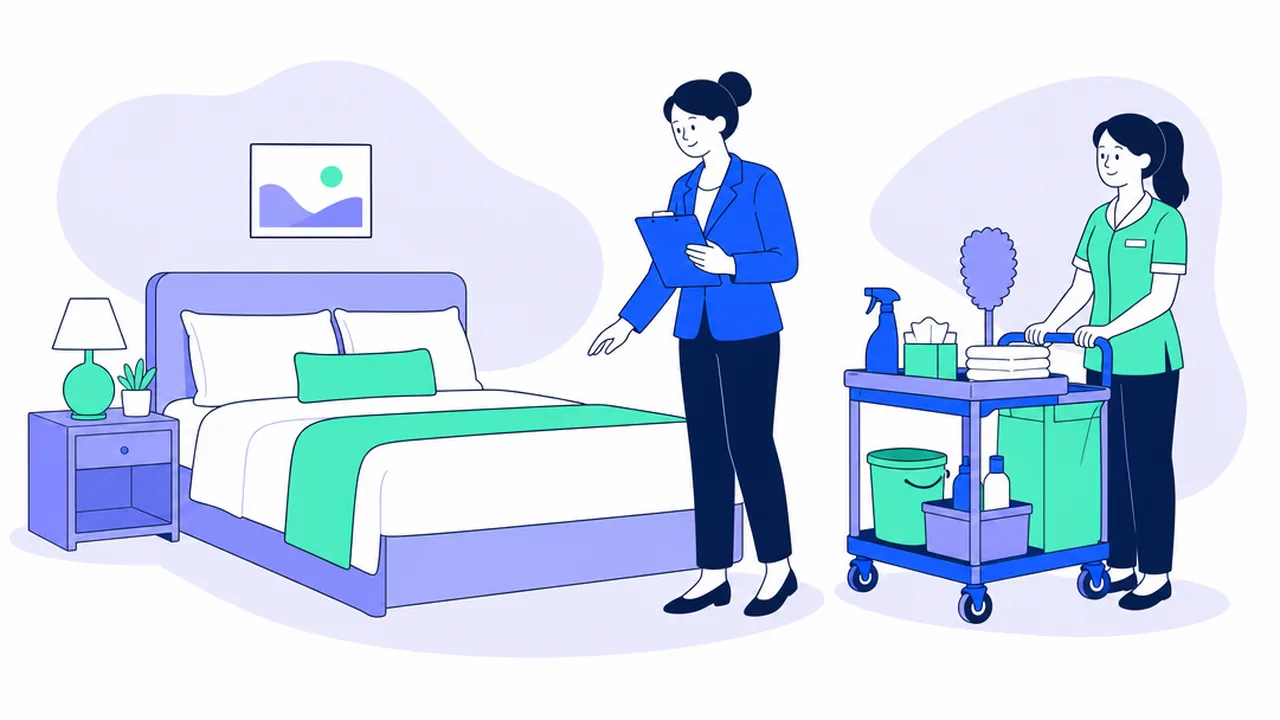
Housekeeping supervisor interview questions test five things: how you inspect rooms, how you plan staff and stock, how you handle guests and their property, how you control chemical and infection risks, and how you lead a team. Below are 20 questions in those five groups, each with what the interviewer wants and a sample answer in plain spoken English, then six more common questions in one table.
Practice your interview answers with feedback
Download AppIn this article
- The 20 housekeeping supervisor interview questions at a glance
- Housekeeping supervisor responsibilities the interview checks
- Background questions: tell me about yourself and why supervision (1–3)
- Room inspection and room status questions (4–7)
- Staffing, par level and cost questions (8–11)
- Chemical safety and hospital infection control questions (12–15)
- Lost property, training and team questions (16–20)
- More housekeeping supervisor interview questions to prepare
- How to say your answers clearly in English
- Practice the 20 answers out loud
The 20 housekeeping supervisor interview questions at a glance
Each question links to its sample answer, and the table doubles as a printable checklist. After the 20 come six more questions, English tips and a practice plan.
Numbers in the sample answers (years, room counts, minutes, savings) are a candidate’s examples, not industry figures. Swap in your own: the interviewer will ask about them.
Housekeeping supervisor responsibilities the interview checks
A housekeeping (HK) supervisor plans, assigns and inspects the work of room attendants or cleaners, and keeps rooms, stock and safety records in order. O*NET, the US Department of Labor’s occupation database, files the role as First-Line Supervisors of Housekeeping and Janitorial Workers (37-1011) with 26 tasks (O*NET OnLine, updated 2026); the main ones map onto the 20 questions.
| O*NET tasks for 37-1011 (shortened) | Questions that test it |
|---|---|
| Inspect work to ensure it meets specifications and established standards | 4, 6, 15 |
| Advise managers or desk clerks of rooms ready for occupancy | 3, 5 |
| Plan work schedules; forecast staffing and stock levels | 3, 8, 9, 10 |
| Inventory and order supplies; manage budgets | 10, 11 |
| Direct infection-control activities in facilities such as hospitals | 13, 14, 15 |
| Investigate complaints and take corrective action | 7, 16 |
| Instruct staff in work policies, procedures and equipment use | 12, 17 |
| Confer with staff to resolve performance and personnel problems | 18, 19 |
Hotel, hospital or facility: what changes in the interview
O*NET’s sample job titles for 37-1011 include Housekeeping Supervisor, Executive Housekeeper, Environmental Services (EVS) Supervisor, Janitorial Supervisor and Custodian Supervisor, and the setting decides which questions get the most time. For cleaning supervisor interview questions, read “client” for “guest” and “area” for “room” below.
| Setting | Topics that get more time |
|---|---|
| Hotel or resort | Room status, VIP rooms and turndown, guest complaints, lost and found, par levels |
| Hospital or clinic (EVS) | Infection control, isolation rooms, blood spills and sharps, cleaning checks |
| Office, school or mall | Night shifts, client complaints, site checklists, floor care equipment |
Background questions: tell me about yourself and why supervision (1–3)
The first three housekeeping supervisor interview questions set the frame: keep each answer under a minute and point it at supervision.
1. “Tell me about yourself.”
The interviewer has your résumé and wants the version of it that fits a supervisor: a path from doing the work to organizing it.
Tell me about yourself (housekeeping supervisor)
B1–B2I’ve worked in hotel housekeeping for six years. I started as a room attendant in a 180-room city hotel, and for the last two years I’ve been a senior attendant on the executive floors.
I train new attendants, I inspect rooms when the supervisor is off, and I run the monthly linen count.
Now I want to own a whole shift: the morning plan, the inspections and the people. Your hotel is bigger than mine, and that’s the step I’m ready for.
Read it aloud
Listen to a model reading, then record yourself. You get your speaking pace, the share of words that came through clearly, and the words to repeat.
Follow-up to expect: “What did you change as a senior attendant?” Have one example ready, such as a checklist you introduced.
2. “Why do you want to be a housekeeping supervisor?”
This question tests whether you want the leadership part of the job, including re-clean orders, schedules and difficult conversations.
Sample answer: “As an attendant I make my own rooms right. As a supervisor I can make forty rooms right, by planning the day and teaching the standard. I already do some of that without the title, and I want the responsibility that comes with it.”
Follow-up to expect: “What part of supervising will be hardest?” Name a real one, such as telling a senior colleague a room failed, and how you would say it.
3. “How do you plan the first hour of your shift?”
Priorities are the point, and a good answer starts from the room status report and the arrivals list.
Sample answer: “First I check the room status report and arrivals with the front desk: departures, stayovers, early arrivals, VIP rooms. I split the rooms into fair sections. At the briefing I give out sections, priority rooms and any change, like a new chemical or a room out of order. Then I check the floor pantries for linen and amenities.”
Likely follow-up: “The front desk needs ten rooms by noon.” Say which rooms jump the queue and how the desk hears that each one is ready.
Room inspection and room status questions (4–7)
Inspection is the core of a housekeeping supervisor’s day; these four questions show whether you have a method.
4. “How do you inspect a room?”
A repeatable method is what the interviewer wants: a route, a checklist and a rule for rooms that fail. “I check everything carefully” is an attitude.
How do you inspect a room?
B1–B2I inspect every room in the same order, so I don’t miss anything. I start at the door: the lock, the chain and the sign. Then I go clockwise around the room, high to low: lights, curtains, furniture, the bed, under the bed, the minibar and the amenities.
The bathroom is last. I look, I touch and I smell: hair on the floor, water spots on the mirror, towels to standard, any smell from the drain.
If a room fails, I don’t fix it myself in silence. I call the attendant back, show them the items and inspect again. Repeated misses go on the inspection sheet, so I can plan training.
Read it aloud
Listen to a model reading, then record yourself. You get your speaking pace, the share of words that came through clearly, and the words to repeat.
Follow-up to expect: “Do you inspect every room?” Give the rule you worked to, such as every departure and VIP room plus a sample of stayovers.
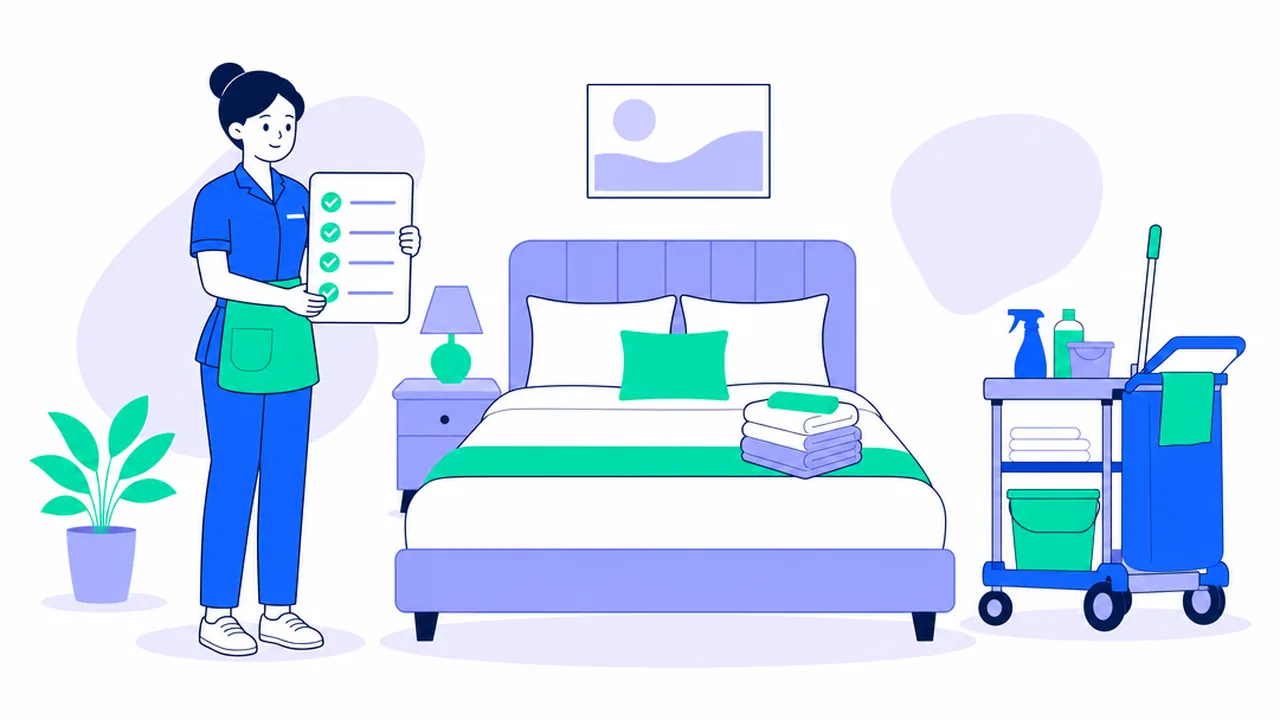
5. “What do the room status codes mean, and how do you keep them accurate?”
Room status questions check that you speak the language of the property management system (PMS): a room the desk wrongly thinks is ready becomes a complaint at check-in.
Front office status says whether a guest is registered; housekeeping status says what state the room is in. Definitions below come from Oracle’s OPERA hotel PMS documentation (room statuses, out of order, out of service, discrepancies) and the help center of Optii, a housekeeping software vendor (room status codes). Your hotel’s codes may differ.
| Status | What it means |
|---|---|
| Vacant / Occupied | Front office status: no guest in the room / a guest is registered in the room |
| Dirty | The room needs cleaning |
| Clean | The room has been cleaned |
| Inspected | Checked and cleared for occupancy by the appointed person; optional, switched on per property |
| Pickup | Optional status for a quick touch-up or a final room check |
| Out of order (OOO) | Unfit for occupancy and deducted from room inventory; no reservation can be assigned to it |
| Out of service (OOS) | Not removed from inventory; the room stays available and can be sold if needed |
| Skip / Sleep | Discrepancies: the desk shows occupied but housekeeping finds the room vacant (skip), or the desk shows vacant but there is luggage in the room (sleep) |
| VD, VC, VI, OD, OC | Two-letter shorthand: vacant dirty, vacant clean, vacant inspected, occupied dirty, occupied clean. In Optii’s definitions, VC means cleaned but still waiting for a supervisor’s inspection |
Sample answer: “I update status as soon as each room changes. A finished room goes to clean, and I move it to inspected only after I’ve checked it, because that’s the status the front desk sells from. Twice a day I compare our list with the desk’s and report any skip or sleep straight away.”
Ask back: “Which status means a room is ready to sell here?” In OPERA the inspected status is optional, so at some properties clean is the last step before sale.
6. “How do you prepare a VIP room or a turndown?”
VIP rooms and turndowns are where a mistake costs the most, so the interviewer listens for a plan.
Say: “VIP rooms go to my most experienced attendant first, and I inspect each one myself before arrival, including booking requests like an extra pillow. Turndown is short and fixed: fresh towels, empty bins, bed turned down, curtains closed, lights set, night amenity. I check a few turndown rooms every evening.”
Follow-up to expect: “The VIP arrives two hours early.” Put two people on the room, give the desk an honest ready time, and offer an inspected room of the same type.
7. “A guest says their room is not clean. What do you do?”
Guest recovery comes first, then the cause, without blaming anyone in public. Try the exchange with the trainer: it reads the interviewer, you answer as the candidate.
A guest complaint question with follow-ups
B1–B2- Interviewer
A guest calls the front desk and says there is hair in the bathroom. What do you do?
- Anita
I go to the room myself, or I send the nearest attendant if I can’t get there in a few minutes. I apologize to the guest and ask if they want it cleaned now or later.
- Interviewer
The guest is angry and wants a different room.
- Anita
Then I ask the front desk for an inspected room of the same type, and we move the guest. I don’t argue about the hair.
- Interviewer
And after that?
- Anita
I check who cleaned and who inspected the room. I talk to them privately, show them what was missed, and write it in the log, so the manager can follow up with the guest.
- Interviewer
What if the same attendant had a complaint last week too?
- Anita
Then it’s a pattern, not a bad day. I would check their workload first, then retrain them on bathrooms and inspect all their rooms for a week.
Practise this dialogue
Listen to the whole exchange, then take one role: your partner’s lines are read aloud, you say yours into the microphone and see which words came through.
Why it works: the guest is helped before anyone looks for the cause, and a second complaint is treated as data. The same shape answers “How do you handle guest complaints?”
Staffing, par level and cost questions (8–11)
Number questions separate a supervisor from a senior attendant. Forecasting staffing and stock is a core O*NET task for the role, so expect at least one calculation.
8. “How many attendants would you schedule for tomorrow?”
The test is a staffing plan said out loud, with your hotel’s numbers; there is no single correct number of rooms per attendant. Count departures and stayovers separately: a departure takes longer.
| Step | Example | Say it like this |
|---|---|---|
| Departures × minutes each | 60 × 40 = 2,400 minutes | “Sixty departures at about forty minutes each…” |
| Stayovers × minutes each | 80 × 25 = 2,000 minutes | “…and eighty stayovers at about twenty-five minutes…” |
| Total workload | 4,400 minutes, about 73 hours | “…that’s about seventy-three hours of cleaning.” |
| Cleaning time per attendant | 420 minutes (7 of 8 hours, after briefing and breaks) | “Each attendant has about seven hours on rooms.” |
| Attendants needed | 4,400 ÷ 420 = 10.5, rounded up to 11 | “So I’d schedule eleven. I round up, not down.” |
How many attendants would you schedule?
B1–B2Tomorrow we have sixty departures and eighty stayovers. At my hotel a departure takes about forty minutes and a stayover about twenty-five, so that’s four thousand four hundred minutes, or about seventy-three hours of cleaning.
Each attendant has about seven hours on rooms after the briefing and breaks. Seventy-three divided by seven is about ten and a half, so I would schedule eleven attendants, and keep one person on call for late check-outs.
Read it aloud
Listen to a model reading, then record yourself. You get your speaking pace, the share of words that came through clearly, and the words to repeat.
Follow-up to expect: “Where do your forty minutes come from?” Say how your hotel measured them, or give the rooms-per-attendant number it planned with.
9. “Two attendants call in sick on a full day. What do you do?”
Calm re-planning wins this one, and so does picking up a cart yourself: O*NET lists “Perform or assist with cleaning duties as necessary” among the role’s core tasks.
Sample answer: “I re-plan the sections around arrivals: early-arrival departures and VIP rooms go first, and stayovers that asked for no service come off the list. I offer overtime and call the on-call attendant on the roster. The desk gets honest ready times for late rooms. And I clean rooms myself; on a short day, that’s part of the job.”
10. “How do you manage linen and amenity par levels?”
Par is the standard stock level for an item, so a strong answer gives a par number, a count and a reorder rule.
Sample answer: “We kept sheets and towels at three par: one set in the room, one in the laundry, one on the shelf. Each floor pantry had a par for amenities. We counted linen monthly with the laundry team, and when the count showed losses, we checked rejects and towels used as rags. I reordered before stock fell below par.”
Likely follow-up: “How many sets do 200 beds need at three par?” Two hundred times three is six hundred sets, plus your hotel’s extra for rejects.
11. “How have you controlled housekeeping costs?”
Budget questions want evidence: one cost, what you changed and what happened, with your own number.
Say: “Our biggest waste was chemicals: attendants mixed them by eye, used too much and damaged some surfaces. I got a dispensing system with fixed doses from our supplier, trained everyone in one briefing and tracked use for three months. Chemical use went down by about a fifth, and now I track amenities the same way.”
Follow-up to expect: “Where would you not cut costs?” Safety equipment, chemical training and the linen standard guests see.
Chemical safety and hospital infection control questions (12–15)
Safety questions have answers set by regulators, so specifics win. Questions 12 and 13 come up in hotels and hospitals; 14 and 15 in hospitals.
12. “How do you make sure your team uses cleaning chemicals safely?”
Chemical safety is a system of safety data sheets (SDS), labels, training and protective equipment, and the interviewer checks that you know each part.
The rules below share one core: an SDS for every product, labels and training before first use. In the US, OSHA’s Hazard Communication standard, 29 CFR 1910.1200, sets a 16-section SDS (identification and hazards through first aid and protective equipment), kept “readily accessible during each work shift”, with training “at the time of their initial assignment, and whenever a new chemical hazard” is introduced (29 CFR 1910.1200, eCFR). In the UK the duties sit under COSHH, the Control of Substances Hazardous to Health regulations (HSE).
| Country | Rule to name |
|---|---|
| South Africa | Regulations for Hazardous Chemical Agents, 2021: the same 16 SDS headings, and training before exposure that covers how to access the SDSs (Department of Employment and Labour) |
| India (hospitals) | NABH standards list “Hazardous materials are identified and used safely” as a core element, with a plan for managing spills (NABH Hospital Standards, 6th edition, 2025) |
| Indian hotels, the Gulf, elsewhere | Rules differ. Name the chemical policy your employer follows, or ask which one applies. |
Sample answer: “Every product has its SDS in the housekeeping office and on the tablet, and every attendant knows where. Every spray bottle is labeled, including refills. New attendants get chemical training before their first room, and a new product means a briefing first. I check gloves and goggles on the carts, and nobody mixes products. A splash means section 4 of the SDS, first aid, and a report.”
13. “An attendant finds a used needle or a blood spill. What happens next?”
A used needle or a blood spill is a bloodborne pathogen risk with a fixed procedure, in a hotel as much as in a hospital.
OSHA’s Bloodborne Pathogens standard, 29 CFR 1910.1030, sets the US baseline. Broken glassware that may be contaminated “shall not be picked up directly with the hands”, and contaminated laundry is “handled as little as possible with a minimum of agitation” and bagged where it was used (29 CFR 1910.1030, eCFR). Outside the US, describe your employer’s sharps and spill procedure.
Sample answer: “The attendant stops, doesn’t touch it, and calls me. I bring gloves, tongs and a sharps container, or a spill kit. The needle goes into the container without hands. Blood is absorbed, the surface cleaned, then disinfected for the contact time on the label. Linen with blood is bagged in the room without shaking. I report it, and anyone stuck by the needle washes the area and gets medical follow-up at once.”
14. “How is cleaning a patient room different from cleaning a hotel room?”
The difference is the cleaning order, which is designed to stop infection spreading from one patient to the next.
The CDC and the Infection Control Africa Network (ICAN) set out the principles in their 2019 guide for healthcare facilities: proceed from cleaner to dirtier areas (patient areas before toilets) and from high to low, with floors last; work in a systematic order such as clockwise; use a fresh cloth for each patient zone in higher-risk areas; never double-dip cloths into solution (CDC and ICAN, Best Practices for Environmental Cleaning in Healthcare Facilities, 2019).
Model answer: “A hotel room has to look and feel clean. A ward also has to stop germs moving from one bed to the next, so the order matters: cleaner areas first, the toilet last, high before low, and a fresh cloth for each patient zone in higher-risk areas. Isolation rooms come last, with the protective equipment on the door sign, and a discharged patient’s room gets a terminal clean.”
15. “How do you check that a ward was really cleaned?”
Good cleaning monitoring goes beyond “it looks clean” and ends with feedback to the cleaner.
The same CDC and ICAN guide lists visual assessments, fluorescent markers and ATP bioluminescence among monitoring methods and prefers objective methods over subjective ones “if resources allow”. On staffing it says there is no definitive benchmark for the ratio of supervisors to cleaners, but “an upper limit of 20 cleaning staff per supervisor might be recommended”.
Sample answer: “I walk every ward on my shift and check high-touch surfaces: bed rails, overbed tables, IV poles and door handles. Once a week I put fluorescent marks on a few of them before cleaning and check with a UV light afterwards. The cleaner gets the result the same day, and I keep scores by ward to plan training.”
Lost property, training and team questions (16–20)
The last five questions are about trust and people: guest property, training, and the conversations many supervisors avoid.
16. “What is your lost and found procedure?”
Lost property tests honesty and records: every item should be traceable from the room to its owner.
Sample answer: “Whoever finds an item hands it in the same shift. We log the date, time, room, finder and description, then bag, tag and lock it away; cash, jewelry, passports and phones go to the safe with a witness. The owner gets an item back after describing it and showing ID, and signs for it. Unclaimed items follow our policy.”
Follow-up to expect: “A guest asks about a ring that is not in the log.” Search the room and cart with the attendant present, involve security and the manager, and give the guest a call-back time.
17. “How do you train a new room attendant?”
A training answer needs steps and a finish line, not “I show them the job”.
Say: “Chemical safety and the SDS come first. Then two days shadowing a senior attendant, and show, do, check: I show one room, they clean the next while I watch, then they clean alone and I inspect with the same checklist. Fewer rooms in week one, more as their results improve.”
18. “What do you do when an attendant keeps failing inspections?”
Fair performance management means facts first, a private conversation, a clear standard and a date to review.
Sample answer: “I start with the inspection sheets, so we talk about facts. In private, I ask what’s going on: training, the section or something at home. We agree what good looks like, I retrain on the missed items and inspect all their rooms for two weeks. If it improves, I say so; if not, I document it and follow the HR process.”
19. “Two attendants are in conflict. How do you handle it?”
Conflict questions check speed, fairness and whether you fix the cause, not only the mood.
Model answer: “I talk to each of them separately first. Once, the cause was that one attendant always got the floor with the most departures, so I rotated sections weekly and posted the plan. Then the three of us agreed in five minutes how they would work, and I checked in a week later.”
20. “Do you have any questions for us?”
Questions about how the department works show interest and judgment; questions the website already answers do not. Ask one or two, then a follow-up about the answer.
- “How many rooms is a normal section, and how does it change on heavy departure days?”
- For a hospital: “Who signs off a terminal clean before the next admission, housekeeping or nursing?”
More housekeeping supervisor interview questions to prepare
Six more questions come up often. Answer each in under a minute, with one example from your own work.
| Question | What to say |
|---|---|
| What do you do in a fire alarm or a medical emergency? | Follow the property’s emergency plan: your role, exits, assembly point. Account for every attendant from the day’s section sheet; in a medical case, call for help as the plan says and stay with the person. |
| How do you work with maintenance? | Report defects the same shift through the work order system, set an unsellable room to out of order, and inspect it before it goes back on sale. |
| How do you plan deep cleaning? | A rotation that deep cleans every room on a fixed cycle (behind furniture, vents, curtains, mattress), on low-occupancy days, recorded per room. |
| What is your leadership style? What is the most important quality in this job? | Hands-on and consistent: one standard, checked the same way, feedback in private, a cart when the team is short. Consistency is the quality; prove it with one example. |
| What are your strengths and weaknesses? | One strength with proof, such as inspection results. One real weakness you are fixing, for example re-cleaning failed rooms yourself instead of calling the attendant back. |
| How do you motivate your team? | Fair, rotating sections, thanks by name at the briefing for rooms that passed, and asking attendants how to fix problems. When a procedure changes, explain why before showing how. |
How to say your answers clearly in English
A supervisor gives instructions all day, so the interview also tests whether staff and guests understand you the first time. Being understood is not the same as sounding native: a study of second-language speech found that “a strong foreign accent does not necessarily reduce the comprehensibility or intelligibility” of what is said (Munro and Derwing, Language Learning, 1995).
Say numbers slowly, with stress. Fifteen is stressed at the end (fif-TEEN) and fifty at the start (FIF-ty); on a busy floor or a phone line, that difference is the whole number. Keep one idea per sentence.
Eight housekeeping words to say correctly
Pronunciations are from the Cambridge Dictionary; each word links to its entry with audio.
| Word | IPA | Say it like | Note |
|---|---|---|---|
| suite | /swiːt/ | sweet | Not “suit”: a suite is a set of rooms. |
| schedule | UK /ˈʃedʒ.uːl/, US /ˈskedʒ.uːl/ | SHED-jool or SKED-jool | Both are correct; pick one and keep it. |
| amenity | UK /əˈmiː.nə.ti/, US /əˈmen.ə.t̬i/ | uh-MEE-nuh-tee or uh-MEN-uh-tee | Stress on the second syllable. |
| inventory | UK /ˈɪn.vən.tər.i/, US /ˈɪn.vən.tɔːr.i/ | IN-vuhn-tuh-ree or IN-vuhn-tor-ee | Stress on the first syllable, not in-VEN-tory. |
| hygiene | /ˈhaɪ.dʒiːn/ | HY-jeen | Two syllables. |
| linen | /ˈlɪn.ɪn/ | LIN-in | Short “i” in both syllables. |
| chemical | /ˈkem.ɪ.kəl/ | KEM-i-kuhl | The “ch” sounds like k. |
| laundry | UK /ˈlɔːn.dri/, US /ˈlɑːn.dri/ | LAWN-dree or LAHN-dree | Two syllables. |
Word-stress drills are in the English pronunciation practice guide, and everyday traps in the list of 40 difficult words to pronounce in English.
Practice the 20 answers out loud
Reading does not train you to find the next sentence while someone watches; speaking does. Start with this page’s trainers (questions 1, 4, 7 and 8), then take three questions a day: notes with your own numbers, a recording, one fix per retake. The free browser mock interview asks questions aloud and reports length, pace and filler words, with no account; choose Screening classics or Behavioral, since housekeeping is not among its job-specific fields. It checks delivery, not content. The guide to English for job interviews covers STAR stories, and the English speaking test shows which skill needs the most work.
Practice your interview answers with feedback
Fluently is an AI speaking coach for iOS and Android. Answer out loud and get feedback on your pronunciation, fluency, vocabulary and grammar. It is free to start: take a free AI speaking assessment to see your level, then practice with games that build your vocabulary and pronunciation. Conversations with your AI tutor come with Fluently Premium.


Frequently asked questions
What kind of questions are asked in a supervisor interview?
Three kinds. Screening questions are about you and the job (“Why do you want this role?”). Behavioral questions ask about a real past event (“Tell me about a time you handled a staff shortage”) and are best answered with a short STAR story: situation, task, action, result. Situational questions ask what you would do (“What if two attendants call in sick?”). For a housekeeping supervisor, the situational questions focus on inspection, staffing, stock, chemical safety and guests. The job interview English guide shows the STAR shape with a worked example.
What are the top 3 skills for a housekeeping supervisor?
Inspecting work against a standard, coordinating people and rooms, and communicating clearly with staff and other departments. Those match the top-rated work activities in O*NET’s profile of the role: communicating with supervisors, peers or subordinates (importance 89), coordinating the work and activities of others (86), and both guiding subordinates and inspecting equipment, structures or materials (84 each) (O*NET OnLine, 2026). In the interview, prove each skill with one example rather than naming it.
Is there a PDF of housekeeping supervisor interview questions and answers?
This page is the current version, and you can turn it into a PDF yourself: open your browser’s Print menu and choose Save as PDF. The table of 20 questions near the top works as a short checklist for the day before the interview. A PDF helps you remember the questions; saying the answers out loud is what prepares you to give them.
What is the difference between a housekeeping supervisor and an executive housekeeper?
O*NET files both titles, along with Environmental Services Supervisor and Janitorial Supervisor, under one occupation: First-Line Supervisors of Housekeeping and Janitorial Workers, 37-1011 (O*NET OnLine). Where a property has both roles, the executive housekeeper heads the department and the supervisors run shifts or floors. Executive housekeeper and housekeeping manager interview questions lean more on the tasks O*NET lists as supplemental for the occupation, such as preparing and managing budgets and screening job applicants.
What questions are asked in a housekeeping interview for a room attendant?
A room attendant interview asks about your own cleaning rather than other people’s: your cleaning order, how many rooms you have done in a shift, what you do with items guests leave behind, and how you use chemicals safely. Questions 4, 7, 12 and 16 on this page come up at both levels. Answer them in the first person as the one doing the work (“I clean the bathroom last”) rather than as the one checking it (“I inspect the bathroom last”).