20 Groundskeeper Interview Questions and Answers, With a Quick Knowledge Test
 Yurii Rebryk · Updated October 14, 2026 · 15 min read

Groundskeeper interview questions test four things: your experience, the machines you can run safely, basic grounds care, and how you handle weather, hazards and the public. The 20 below come with sample answers in plain spoken English. Winning answers are specific: name the machines, describe your pre-start checks, and say you stop and report a hazard instead of working around it.
In this article
- The 20 groundskeeper interview questions at a glance (top 10 marked)
- Groundskeeper interview questions about you (1–6)
- Groundskeeper equipment and safety questions (7–10)
- Grounds care questions: lawns, pests, mulch and irrigation (11–14)
- Weather, problem and people questions (15–20)
- More groundskeeper interview questions to prepare
- Groundskeeper test questions with answers
- Pesticide licence rules for groundskeepers by country
- Practice a groundskeeper scenario question out loud
- How to say groundskeeping words clearly
The 20 groundskeeper interview questions at a glance (top 10 marked)
These groundskeeper interview questions fit jobs at parks, schools, campuses, golf courses and cemeteries, and the same set works for groundsman, grounds maintenance and park maintenance worker roles. Prepare the ten marked ✓ first.
| # | Question | Top 10 |
|---|---|---|
| 1 | “Tell me about yourself.” | ✓ |
| 2 | “Why do you want to work as a groundskeeper here?” | ✓ |
| 3 | “What groundskeeping experience do you have?” | ✓ |
| 4 | “What equipment can you operate?” | ✓ |
| 5 | “What are your strengths and weaknesses?” | |
| 6 | “Can you work early mornings, weekends and through the seasons?” | ✓ |
| 7 | “What do you check before you start a mower?” | ✓ |
| 8 | “What protective equipment do you wear?” | |
| 9 | “How do you mow a steep slope on a ride-on mower?” | ✓ |
| 10 | “You find a hazard or damage on the grounds. What do you do?” | ✓ |
| 11 | “How do you keep a lawn healthy?” | |
| 12 | “How do you deal with weeds and pests? Have you used pesticides?” | ✓ |
| 13 | “What is mulching, and what is aerating?” | |
| 14 | “A sprinkler zone is not working. How do you find the problem?” | |
| 15 | “It starts to rain, or you hear thunder. How do you plan your day?” | ✓ |
| 16 | “How do you work safely in extreme heat or cold?” | |
| 17 | “Tell me about a problem you solved on the job.” | |
| 18 | “A visitor complains about the grounds. What do you do?” | |
| 19 | “Tell me about a disagreement with a coworker or supervisor.” | |
| 20 | “Do you have any questions for us?” |
Groundskeeper interview questions about you (1–6)
Keep each answer under a minute. Names and numbers in the sample answers are examples: swap in your own.
1. “Tell me about yourself.”
“Tell me about yourself” wants three parts: what you do now, the outdoor work behind it, and why this site. Listen, then record your own version.
Tell me about yourself
B1I’ve worked for three years on the grounds team at a community college: mowing, trimming, leaf clean-up and snow clearing.
I run a zero-turn mower and a compact tractor, and I do the daily checks and blade changes myself.
I’m applying here because your park has sports fields, and I want to learn more about turf care.
Read it aloud
Listen to a model reading, then record yourself. You get your speaking pace, the share of words that came through clearly, and the words to repeat.
No experience? Say: “I haven’t worked as a groundskeeper yet, but I spent two summers working on a farm. I’m used to early starts and physical work, and I learn machines quickly.”
2. “Why do you want to work as a groundskeeper here?”
Interviewers want a reason that survives cold mornings and repetitive mowing, plus one fact about this employer.
Sample answer: “I like seeing the result at the end of the day: a clean edge, a field ready for a game. I enjoy being outside and working with machines. Your district keeps its grounds in great shape, and I want to be part of that team.”
3. “What groundskeeping experience do you have?”
Name the type of site, its size and three regular tasks.
You could say: “For two years I looked after an apartment complex with eight buildings: mowing, edging, blowing walkways and spreading mulch. In winter I cleared and salted the paths before 7 a.m., and I kept a short log for the manager.”
Fresher version: “No paid groundskeeping yet. I’ve mown lawns for neighbors for three summers and volunteered at a community garden, and I’m ready to learn your way of working.”
4. “What equipment can you operate?”
List what you can run alone today and admit what you have not used; some interviews include a practical test. Machines are taught on the job: the Bureau of Labor Statistics says grounds workers “typically need 1 month or less of on-the-job training” for mowers, trimmers, blowers and small tractors.
A strong answer: “Push mowers, a 60-inch zero-turn, string trimmers, backpack blowers and hedge trimmers. I’ve used a chainsaw only for small branches, with chaps and a helmet, so I’d need training for felling.” Never used a ride-on? “Only push mowers so far, but I read the manual first and learn fast.”
5. “What are your strengths and weaknesses?”
Pick a strength that matters outdoors (reliability, care with machines) and a real weakness that is not a core duty, with your fix.
Try: “My strength is reliability: in two years I was late once, because of a flat tire. My weakness was rushing the edging late in the day. Now I plan so the detail work isn’t left until 3 p.m.”
6. “Can you work early mornings, weekends and through the seasons?”
Availability is a real filter. A former City of Phoenix parks groundskeeper reported being asked about flexibility and weekend work (Indeed), and some grounds jobs are seasonal, with snow removal in winter (BLS).
Say: “Yes. I can start at 6 a.m., work one weekend in two, and do leaf clean-up in the fall and snow clearing in winter. The only time I can’t work is Tuesday evenings, for a class that ends in December.”
Groundskeeper equipment and safety questions (7–10)
Safety questions decide many groundskeeper interviews. OSHA lists cuts and amputations, eye injury, hearing loss and vehicle accidents among the main hazards of lawn maintenance (OSHA).
7. “What do you check before you start a mower?”
Give a routine, not “I check everything”. OSHA’s riding mower guidance includes checking that “ROPS, guards, seat belts, and shields are securely in place” (OSHA).
Sample answer: “I walk the area first and pick up stones and branches. On the machine I check fuel, oil, tires and blades, and that the guards and safety switches work. If something is broken, I tag the mower, tell my supervisor and don’t use it.”
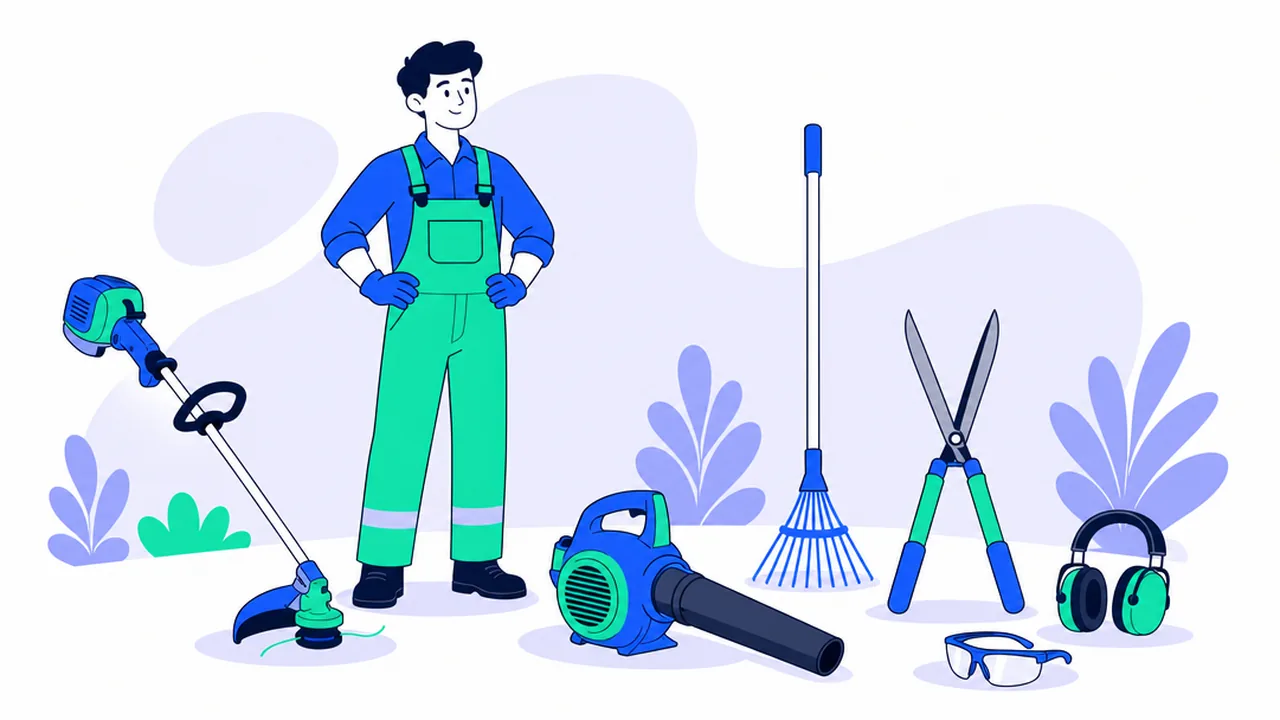
8. “What protective equipment do you wear?”
Protective gear is daily routine: 73% of landscaping and groundskeeping workers told O*NET they wear safety shoes, glasses, gloves, hearing protection or similar “every day” (O*NET). Match each item to a task.
You could say: “Safety boots, gloves and hi-vis all day. Glasses for mowing, trimming and blowing, ear protection for anything with an engine, chaps and a helmet for the chainsaw. For spraying, whatever the label says.”
9. “How do you mow a steep slope on a ride-on mower?”
Slope questions check that you know a ride-on mower can roll over; OSHA’s riding mower page opens with two groundskeepers killed that way. Its rules (OSHA):
- Follow the slope limit on the mower’s label; if there is none, avoid slopes over 15 degrees.
- On a ride-on, mow slopes up and down, not side to side.
- Keep drive wheels 5 feet from walls, ditches and embankments; trim there instead.
- With the rollover bar (ROPS) up, wear the seat belt. No passengers.
A strong answer: “I check the slope limit first. If a slope is too steep or wet, I use a push mower or a trimmer, and I stay well back from walls and ponds.”
10. “You find a hazard or damage on the grounds. What do you do?”
Hazard questions test one habit: make it safe, report it, write it down. Think of a hanging branch, broken glass in a playground or a hole by a path.
Example answer: “I keep people away, with cones or tape if I have them, and call my supervisor with a photo. If it’s vandalism, I touch as little as possible. I note the time and place, and repair it only if that’s in my training.”
Grounds care questions: lawns, pests, mulch and irrigation (11–14)
11. “How do you keep a lawn healthy?”
Mowing height comes first in a lawn answer. The University of California’s lawn guide gives the rule: “No more than one-third of the grass blades should be cut at a time” (UC IPM).
Say: “I mow often enough to cut no more than a third of the blade, with sharp blades. I water deeply in the early morning, not at midday. For a bare or yellow patch, I find the cause, like a broken sprinkler, before adding fertilizer.”
12. “How do you deal with weeds and pests? Have you used pesticides?”
Start with prevention and end with the label. The EPA’s integrated pest management (IPM) has four steps: set action thresholds, monitor and identify pests, prevent, then control (EPA). Pesticide labels are legally enforceable: “the label is the law” (EPA).
Sample answer (licensed): “I identify the weed or pest first and try mowing height, mulch or hand-pulling before I spray. When I spray, I follow the label for the rate, protective equipment and weather. I hold a state applicator license.” No licence yet: “I haven’t sprayed alone. I’d spray only under a licensed person until I’m certified.” Rules by country are in the licence table.
13. “What is mulching, and what is aerating?”
Mulch is a layer of bark, wood chips or compost on the soil that holds moisture and suppresses weeds (UVM Extension). Aerating pulls small plugs of soil out of a lawn to relieve compaction and help water and nutrients move (Iowa State Extension).
You could say: “Around a tree, mulch also keeps mowers away from the bark, so I spread it in a wide ring, never against the trunk. I aerate when the soil is moist, not dry or soaked.”
14. “A sprinkler zone is not working. How do you find the problem?”
Irrigation questions test whether you work step by step, from the controller to the head.
A strong answer: “I check the controller: is the zone programmed, and does it run manually? Then I walk the zone while it runs, looking for broken or tilted heads, clogged nozzles, leaks and low pressure. Heads I fix myself; a valve or a broken pipe I mark and report.”
Weather, problem and people questions (15–20)
Answer the past-event questions with STAR: Situation, Task, Action, Result.
15. “It starts to rain, or you hear thunder. How do you plan your day?”
Put safety first and keep work moving. OSHA and NOAA: “If you hear thunder, even a distant rumble, get to a safe place immediately,” then wait in a building or hard-topped vehicle at least 30 minutes after the last thunder (fact sheet). Wet ground also raises the rollover risk on ride-on mowers.
Say: “I check the forecast and plan: safety problems first, then anything needed that day, like a field before a game, then routine work. In rain, I switch to drains, litter, and cleaning and sharpening equipment. If I hear thunder, I stop, take the key, go inside and radio my supervisor.”
16. “How do you work safely in extreme heat or cold?”
Heat questions matter most for new starters: almost half of heat-related deaths happen on a worker’s first day, and over 70 percent in the first week (OSHA).
Sample answer: “In the heat I drink before I’m thirsty, rest in the shade and do the heavy jobs early. If a coworker seems confused or dizzy, I get them into shade and call for help. In the cold I wear layers and dry gloves and watch for ice.”
17. “Tell me about a problem you solved on the job.”
Tell a real story with a cause, an action and a result, in under a minute. Practice this one out loud.
A problem you solved (STAR)
B1–B2Last summer, a strip of grass along the main path in our park kept turning brown, even though the sprinklers ran every night.
I ran that zone by hand. Two heads had been knocked sideways, probably by a mower, so they were watering the path.
I reset the heads and asked the mowing crew to stay wider from that edge. In three weeks the strip was green again.
Read it aloud
Listen to a model reading, then record yourself. You get your speaking pace, the share of words that came through clearly, and the words to repeat.
New to the work? Use a problem from any job or from school: what went wrong, what you did, what changed.
18. “A visitor complains about the grounds. What do you do?”
Stay polite, help where you can and pass on what you cannot fix.
Sample answer: “I switch off the machine and listen without arguing. If I can fix it now, like blowing grass off a path, I do. If not, I pass it to my supervisor the same day. Once a teacher asked us not to run blowers near classrooms in the morning, so we changed our route.”
19. “Tell me about a disagreement with a coworker or supervisor.”
Show that you raise a concern calmly, with a safety reason, and then follow the decision.
Try this shape: “My lead wanted the soccer field mowed right after heavy rain. I said I was worried about ruts and the wet slope. We agreed I’d do the edges first and mow after lunch, when it had dried. The field was ready, with no damage.”
20. “Do you have any questions for us?”
Ask two questions about the work, and leave pay to the recruiter unless it comes up.
- “What does a normal week look like in summer and in winter?”
- “Which machines will I use, and how do you train new staff?”
- “Is spraying part of the job? Do you support the licence?”
- “How do we report hazards?”
More groundskeeper interview questions to prepare
| Question | What to say |
|---|---|
| “Why should we hire you?” | One reason with proof: “I’m reliable on early starts, I look after machines, and I can start on your date.” |
| “Why are you leaving your job?” | Look forward: “My job is seasonal and ends in October. I want year-round work.” |
| “Do you prefer working alone or in a team?” | Both, with an example of each. Much of the day is solo: 49% of these workers told O*NET they “never” have face-to-face discussions at work. |
| “What are your salary expectations?” | A range from local job ads. The US median for landscaping and groundskeeping workers was $18.82 an hour in May 2025 (BLS). |
| “Do you have a driver’s license?” | Yes or no, plainly. O*NET lists driving trucks to and at work sites as a job activity. |
| “What did you notice about our grounds?” | One honest positive and one polite observation: “The entrance beds look great. I’d check the sprinkler by the dry patch near the parking lot.” |
| “What would you do in your first 30 days?” | Learn the site, the machines and the safety rules, and finish the task list before suggesting changes. |
| “Have you looked after sports fields or artificial turf?” | Mention mowing patterns, line marking or turf repair. Artificial turf is vacuumed and disinfected to stop bacteria growing (BLS). |
| “How do you handle the physical side?” | “I walk and cycle every day, and I lift with my legs.” BLS calls the work “repetitive and physically demanding”. |
| “What new skill have you learned recently?” | One real example: a course, a new machine or a turf problem you read up on. |
Arrive 10 minutes early with your ID, driver’s license and certificates. Public employers may add steps: City of Phoenix parks applicants have reported scenario questions, a fitness exam, a background check and a drug test (Indeed).
Groundskeeper test questions with answers
Some employers add a short knowledge check. Make sure you can answer each of these test questions in one sentence.
| Test question | Correct answer |
|---|---|
| “What do the numbers 10-20-20 on a fertilizer bag mean?” | Percent by weight of nitrogen, phosphate (P2O5) and potash (K2O), in that order (Clemson Extension): a 50 lb bag holds 5 lb of nitrogen. |
| “What is the difference between trimming and edging?” | Trimming cuts grass the mower can’t reach (posts, trees, fences); edging cuts a clean line where grass meets a path or bed. |
| “When would you lay sod instead of sowing seed?” | Sod, rolls of grown turf, gives instant cover, for example on a slope. Seed costs less but takes longer to establish. |
| “How deep should mulch be around a tree?” | 2 to 4 inches, starting at least 3 inches from the root flare; never a “mulch volcano” against the trunk (UVM Extension). |
| “How much water does a lawn need?” | Typically about 1 inch a week, including rain; avoid midday watering (EPA WaterSense). |
| “When do you contact 811 in the US?” | A few business days before any digging, including planting trees, so buried lines get marked (811). |
| “Who may apply restricted use pesticides in the US?” | Anyone who applies or supervises them must be certified by the state, territory or tribe (EPA). |
| “At what noise level must a US employer provide hearing protection?” | An 8-hour average of 85 decibels or more, free of charge (29 CFR 1910.95). |
Pesticide licence rules for groundskeepers by country
Pesticide rules change by country, and in the US and Canada by state or province. If the job includes spraying, check the regulator and say which licence you hold or plan to get.
| Where | Rule for staff who apply pesticides |
|---|---|
| United States | “Most states require licensing for workers who apply pesticides,” usually after a test (BLS); restricted use products need certification (EPA). |
| Canada (Ontario) | An exterminator licence to apply pesticides commercially on property you or your employer don’t own; trainees and technicians aged 16+ may assist under supervision (Ontario). The cosmetic pesticide ban limits lawn use to an Allowable List (Ontario). |
| United Kingdom | Since 26 November 2015, every professional user needs a specified certificate or must train under direct supervision; “grandfather rights” ended (HSE). Hand-held sprayers: usually PA1 plus PA6 (HSE list). |
| South Africa | Act 36 of 1947 provides for registering pest control operators, people who apply agricultural remedies as their trade (Act 36 of 1947). Ask if you’ll spray under a registered operator. |
| Botswana | Only agrochemicals registered under the Agrochemicals Act (Cap. 35:09) may be used (Agrochemicals Act). Ask the employer what training they require. |
Practice a groundskeeper scenario question out loud
Scenario questions come with follow-ups that add pressure. Say the candidate’s lines out loud.
Thunder on the far field
B1–B2- Interviewer
You’re mowing the far field alone. You hear thunder, but the sky above you is blue. What do you do?
- Maria
I stop, take the key and go to the nearest building or my truck. If I can hear thunder, lightning can reach me.
- Interviewer
The football game starts at six, and the field is half done.
- Maria
I radio my supervisor, tell him where I stopped and that I’m waiting out the storm.
- Interviewer
When do you go back out?
- Maria
Thirty minutes after the last thunder. I walk the field first, because the wind may have brought branches down.
- Interviewer
Why not keep mowing? The storm might miss you.
- Maria
A game can start late, but nobody can undo a lightning strike.
Practise this dialogue
Listen to the whole exchange, then take one role: your partner’s lines are read aloud, you say yours into the microphone and see which words came through.
For a timed run, the free browser mock interview measures answer length, pace and filler words. It has no groundskeeper track, so choose Screening classics or Behavioral; it checks how you speak, not your grounds knowledge. For a baseline, take the English speaking test.
How to say groundskeeping words clearly
Radio calls, safety warnings and visitors all need clear English. Stress the syllable in capitals (Cambridge Dictionary):
| Word | Say it | Example |
|---|---|---|
| equipment | ih-KWIP-munt | “I check the equipment every morning.” |
| irrigation | ir-ih-GAY-shun | “I can fix most irrigation heads.” |
| machinery | muh-SHEE-nuh-ree | “I’ve used heavy machinery for years.” |
| herbicide | HER-bih-side | “I read the herbicide label first.” |
More drills: the English pronunciation practice guide. Phrases that open an answer or buy time: English for job interviews. A similar outdoor, machine-heavy role: airport ground crew interview questions.
Say your answers out loud before the interview
Fluently is an AI speaking coach for non-native English speakers on iOS and Android. You answer out loud and get feedback on pronunciation, fluency, vocabulary and grammar. The download is free and starts with a free four-minute speaking assessment; full practice is a subscription after a free trial.


Frequently asked questions
What should I wear to a groundskeeper interview?
Clean, neat clothes you could work in: work trousers, a plain shirt or polo and clean boots. If a practical test on a mower or trimmer is possible, ask the recruiter and bring gloves and safety glasses.
Are groundsman and grounds maintenance worker interview questions the same?
Mostly yes. O*NET files groundskeeper, groundsman, greenskeeper and grounds maintenance worker under one occupation (O*NET 37-3011.00). Sports field and golf jobs add turf questions; a grounds supervisor interview adds crew scheduling and training.
What should employers ask when hiring a groundskeeper?
A balanced set: experience and machines (3, 4), two safety scenarios (9, 10), a grounds care question (11 or 12), weather (15) and a people question (18). Add a practical check if the job needs it, and ask about any pesticide licence the role requires.
Is there a PDF of these groundskeeper interview questions and answers?
There is no separate file. The table of 20 at the top is the one-page version: print it, or choose Save as PDF in your browser’s Print menu. Then say each answer out loud at least twice.
Can I do a groundskeeper interview if English is my second language?
Yes. Interviewers check that you understand instructions, give clear radio messages and talk politely with visitors, not that you sound like a native speaker. To check your level, take the free English level test.