20 Airport Ground Staff Interview Questions and Answers for Check-in, Gate and Ramp Jobs
 Yurii Rebryk · Updated September 29, 2026 · 20 min read
Airport ground staff interview questions test three things: whether you stay calm and polite with passengers under pressure, whether you follow safety and security rules without shortcuts, and whether you can work shifts as part of a team. The 20 questions below come with short sample answers in plain spoken English, split into passenger service (check-in, gate, baggage) and ramp (loading and apron safety), plus a self-introduction for freshers to practice aloud.
In this article
- Passenger service or ramp: which ground staff interview are you preparing for?
- How to answer airport ground staff interview questions
- How to answer “Tell me about yourself” and other opening questions (1–5)
- Check-in, gate and baggage questions for passenger service staff (6–12)
- Ramp and loader interview questions: safety, FOD and physical work (13–15)
- Security, teamwork, pressure and shift questions (16–20)
- More airport ground staff interview questions to prepare
- English for the counter and the gate
- How to prepare for a ground staff interview
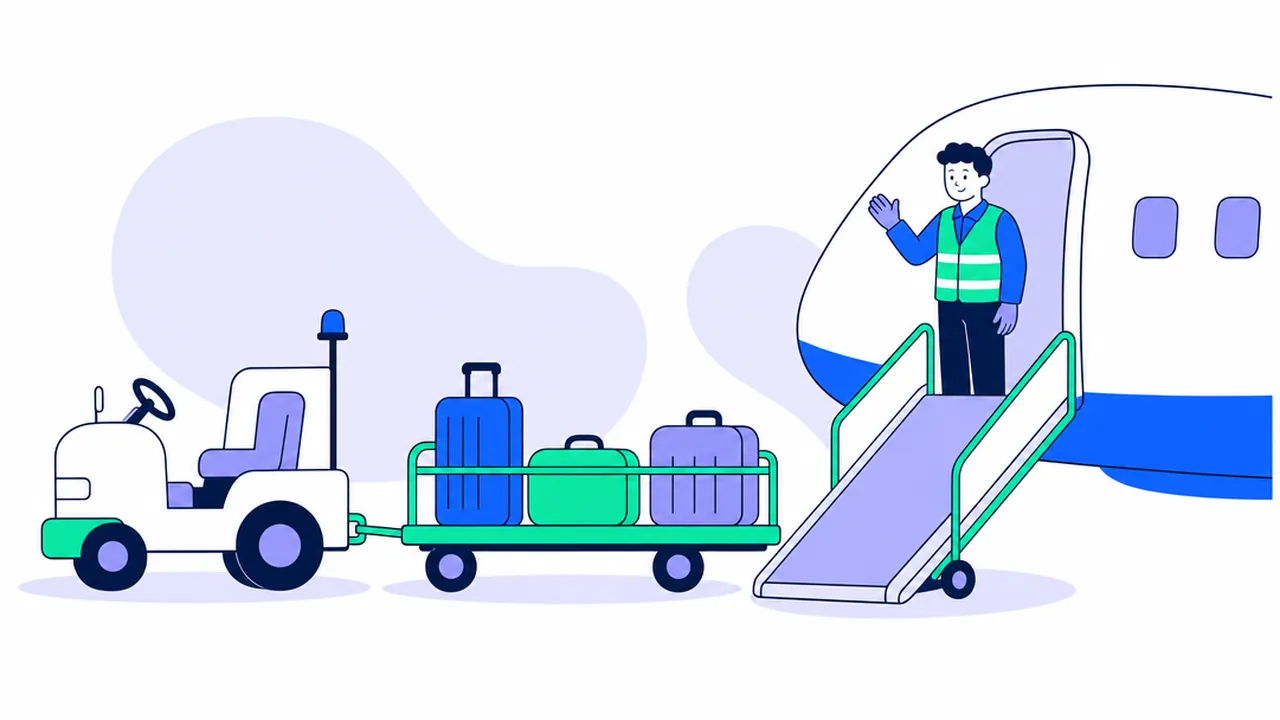
Passenger service or ramp: which ground staff interview are you preparing for?
Airport ground staff is an umbrella term for two jobs, and the interview questions follow the job. Passenger service staff work at check-in, the boarding gate and the baggage desk (O*NET’s ticket agents profile, 43-4181, lists titles such as Baggage Service Agent). Ramp staff load bags and cargo and turn the aircraft around on the apron; O*NET’s aircraft service attendants profile includes guiding aircraft with hand signals. IndiGo’s airport operations hiring page splits the same way: Terminal Service, Security and Ramp.
| What differs | Passenger service | Ramp (ground handling) |
|---|---|---|
| Typical tasks | Check travel documents, tag bags, collect excess baggage fees, board flights, make announcements, handle delays and missing bags | Load and unload bags and cargo, drive tugs and belt loaders, guide aircraft, check the hold, clear debris |
| What the interview checks | Calm English with upset passengers, accuracy with documents and rules, saying no politely | Safety habits, reporting mistakes, teamwork, physical readiness, comfort with shifts and weather |
| Questions to prioritize below | 1–12 and 16–20 | 1–5 and 13–20 |
| English you need most | Explaining rules, apologizing, announcements, spelling names and booking references | Short headset and radio phrases, repeating instructions back, reporting clearly |
Ground staff are not cabin crew, and security is a separate track. In India, airport security is provided by the CISF at 66 airports and by the state police at the rest (Ministry of Civil Aviation, February 2023), under rules set by the Bureau of Civil Aviation Security (BCAS). Ground staff still get security questions (question 16): an alert agent can be the first to notice something wrong.
How to answer airport ground staff interview questions
Most airport ground staff interview questions are situational (“What would you do if…”). A strong answer acknowledges the person or the problem, acts by the rule or procedure, then follows up or reports. “Tell me about a time…” questions want a real past example in STAR order (situation, task, action, result), in about four sentences.
- Acknowledge: “I understand, sir. I’m sorry about the wait.” One sentence, no excuses.
- Act by the rule: name the procedure, not your opinion: “I’ll check the baggage policy,” “I’ll stop and inform my supervisor.”
- Follow up or report: “I’ll update you at 3:30,” “I’ll write it in the report before the end of my shift.”
About the sample answers: names, places, numbers and times are examples; swap in your own. Freshers can use a college event, a part-time job or a family business and say so plainly. A real small example beats an invented airport story, and panels often ask a follow-up to check.
How to answer “Tell me about yourself” and other opening questions (1–5)
The first five ground staff interview questions are about you, not the airport, and apply to both tracks. Prepare them first.
1. “Tell me about yourself.”
The panel wants a one-minute introduction in clear English that links your background to a customer-facing or safety-focused job.
Answer plan: name and where you are from, education or training, current work or your most relevant experience, one skill that fits ground staff work, and why you are here. About 45–60 seconds.
Self-introduction for a ground staff fresher
B1Good morning. My name is Priya Sharma, and I’m from Lucknow. I finished my B.Com last year, and after that I did a six-month course in airport and airline operations.
For the past eight months I have worked part-time at a mobile phone store. I handle customer questions, billing and complaints, and on busy weekends I often manage the counter alone.
I speak English, Hindi and a little Punjabi. I want to start my career as ground staff because I enjoy helping people, and I like work where the day is busy but the rules are clear.
Read it aloud
Listen to a model reading, then record yourself. You get your speaking pace, the share of words that came through clearly, and the words to repeat.
Experienced version: replace the education line with your current role (“two years as a customer service agent at [company], mostly at check-in”) and add one result, such as training new joiners.
2. “Why do you want to work as airport ground staff?”
A good answer shows you understand the job (shifts, pressure, rules). “I love travel” and “free tickets” are weak: ground staff spend the shift at the airport, not on the plane.
Sample answer: “I want a job where I work with people every day and where teamwork matters. At the phone store I enjoyed the busy hours most, when I had to stay calm and fast at the same time. An airport is like that every day, and the work follows clear procedures. Later I would like to grow into a supervisor role.”
3. “What does ground staff do on a normal shift?”
This question checks whether you researched the actual work; “helping passengers” sounds like a guess.
Passenger service answer: “The shift starts with a briefing: which flights, which gates, any delays or passengers who need assistance. Then check-in: documents, seats, bags and excess baggage. Before departure the team moves to the gate for boarding. After the flight closes, there are reports, and help for passengers with missed connections or delayed bags.”
Ramp version: describe the turnaround in order: “briefing, equipment check, unloading, hold check, loading by the loading instruction, closing the doors, pushback.”
4. “What are your strengths and weaknesses?”
Pick one strength the job needs, with proof, and one real weakness you are fixing. Avoid “no weaknesses” and weaknesses at the core of the job, such as impatience or being late.
Say: “My main strength is explaining things simply. At the phone store, older customers often asked for me when they did not understand a bill. My weakness was saying no: I used to promise things before I checked them. Now I say, ‘Let me check that first,’ and I only promise what I know is possible.”
5. “Why should we hire you as ground staff?”
Treat this as a summary: two or three strengths from the job post, each with proof, in under a minute.
Why should we hire you as ground staff?
B1–B2There are three reasons. First, I’m calm with upset customers. At the store I handled complaints every weekend, and my manager asked me to train two new staff members on returns.
Second, I’m careful with rules and details. In eight months I never had a billing mismatch. Third, I’m available for all shifts, including nights and holidays. I think that is what a busy check-in counter needs.
Read it aloud
Listen to a model reading, then record yourself. You get your speaking pace, the share of words that came through clearly, and the words to repeat.
Check-in, gate and baggage questions for passenger service staff (6–12)
Passenger service interview questions are scenarios from a real shift. The panel listens for a calm tone and for rule-awareness: you do not make up policy at the counter.
6. “How would you handle an angry passenger whose flight is delayed?”
This question tests whether you stay calm, own the information and avoid promises you cannot keep.
Sample answer: “First I listen without interrupting. Then I apologize and give the facts I have: the reason, if I know it, and the new time, or when I will update them. I offer what the airline’s policy allows, such as a meal voucher or rebooking. If the passenger stays angry, I call my supervisor instead of arguing.”
Play the dialogue, then take the agent’s part: the trainer reads the passenger, and you answer.
A delayed flight at the boarding gate
B1–B2- Passenger
Excuse me. The screen says delayed again. This is the second time, and I have a meeting in Mumbai at five.
- Agent
I’m sorry, sir. I understand this is frustrating. Let me check the latest information for you.
- Passenger
Every time I ask, nobody knows anything.
- Agent
The aircraft is coming from Chennai, and it left late because of weather there. The new departure time is 2:40.
- Passenger
Then I’ll miss my meeting. Can you put me on an earlier flight?
- Agent
Let me look. There is a 1:15 flight with two seats left. One moment, I’ll check if I can move you at no charge.
- Passenger
Okay. Thank you.
- Agent
Yes, I can move you. Boarding is at 12:45 at gate 9. I’ll ask the baggage team to move your checked bag to the same flight.
- Passenger
Good. Sorry for raising my voice.
- Agent
No problem, sir. Here is your new boarding pass. Have a good meeting.
Practise this dialogue
Listen to the whole exchange, then take one role: your partner’s lines are read aloud, you say yours into the microphone and see which words came through.
Why it works: one apology, a reason and a time, a check before offering the option, no blame on colleagues and no guessed departure time.
7. “A flight is cancelled. What do you tell the passengers?”
Clear communication with a group matters here, and so does knowing that compensation is decided by the rules and the airline’s policy, not by the agent.
A strong answer: “First I get the full information from my supervisor: the reason, the rebooking options and the refund process. Then I explain it the same way to every passenger, in short sentences: you can take the next available flight or a full refund. I help passengers with reduced mobility, families and tight connections first. I don’t promise compensation myself; I tell passengers who will process their claim.”
In India, the minimum is set by DGCA’s CAR Section 3, Series M, Part IV (Revision 4, in force since February 2023), with exceptions for extraordinary circumstances such as weather. Know that these rules exist; nobody expects the numbers by heart.
| Situation | What the airline must offer |
|---|---|
| Delay of 2 h (block time up to 2.5 h), 3 h (2.5–5 h) or 4 h (longer flights) | Free meals and refreshments for passengers who checked in on time |
| Domestic delay of more than 6 h | Alternate flight within 6 hours or full refund |
| Cancellation | Alternate flight or refund acceptable to the passenger |
8. “A passenger’s bag is overweight, and they refuse to pay. What do you do?”
Apply the rule politely and offer options, without arguing and without quietly letting it go.
Sample answer: “I would show the passenger the weight on the scale and the allowance on their ticket, so the problem is clear and not personal. Then I give options: move items to the cabin bag if it is within its limit, or pay the excess. If they still refuse, I stay polite and call my supervisor. I would not waive the fee myself: the same rule applies to every passenger.”
Avoid: “I would let it go this time.” A panel hears lost revenue and unfairness to the passengers who paid.
9. “A passenger arrives after check-in has closed. What do you say?”
Say no clearly and kindly, then move straight to what is possible.
Model answer: “I would say: ‘I’m very sorry, sir. Check-in for this flight closed at 10:15, and I can no longer accept passengers for it.’ No false hope. Then I give options: the next flight, any rebooking fee, and where to change the ticket. If the departure is delayed, I check with my supervisor before I answer.”
10. “A passenger’s bag did not arrive. How do you help?”
Empathy plus the baggage desk procedure: record the case properly, give the passenger a reference, and explain what happens next.
Sample answer: “First I say sorry and ask for the baggage tag and boarding pass. I trace the bag, and if it is not found, I make a missing baggage report, often called a PIR (Property Irregularity Report), with a clear description: color, brand, size. I give the passenger the file reference and contact number, explain how delivery works, and say honestly when to expect an update.”
On international journeys, Article 31 of the Montreal Convention 1999 gives the passenger 21 days from receiving a delayed bag to complain in writing, and 7 days for a damaged one.
11. “What would you do if a passenger has a power bank in a checked bag?”
This dangerous goods question checks that you know the rule and apply it politely at the counter.
Say: “I would ask the passenger to move the power bank from the checked bag to their cabin bag, because spare lithium batteries are not allowed in the hold. I check they have no more than two power banks and remind them not to charge them during the flight. If I’m not sure about an item, I don’t guess; I check the dangerous goods list or ask my supervisor.”
The rule behind the answer: the FAA’s PackSafe guidance on lithium batteries (updated August 2026) keeps spare lithium batteries, including power banks, in carry-on only, and limits most rechargeable lithium-ion batteries to 100 Wh each. Since 27 March 2026, an addendum to the ICAO Technical Instructions also allows two power banks per passenger at most and bans recharging them on board (IATA guidance to operators, March 2026). IATA’s Dangerous Goods Regulations get a new edition every year, so details change.
12. “How would you help a passenger who speaks very little English?”
Patience and practical communication matter here: short sentences, gestures, written information, and help from a colleague who speaks the passenger’s language.
Sample answer: “I slow down and use short, simple sentences, one question at a time. I point at the document or screen and write down the gate, time and seat. If a colleague speaks the passenger’s language, I ask for help. I spell names and booking references with the aviation alphabet, so B and D are not confused. Before the passenger leaves, I check: ‘Gate 12, at 3:40. Okay?’”
The aviation alphabet and counter phrases are in the English for the counter and gate section.
Ramp and loader interview questions: safety, FOD and physical work (13–15)
Ramp interview questions are about habits that prevent accidents: watching for aircraft and vehicles, reporting problems, and following procedure even when the flight is late. The FAA’s FOD management circular (AC 150/5210-24A, 2024) defines the apron, or ramp, as where aircraft park and are serviced: refueled, loaded and boarded.
13. “What do you know about safety on the ramp?”
Know the basic rules before training, and treat them as fixed, not as suggestions for quiet days.
Model answer: “I always wear the high-visibility vest and hearing protection, stay clear of engine intake and exhaust areas, and treat the red rotating beacon as a sign that the engines are running or about to start. I follow the marshaller and the ramp lead, use the marked walkways, and don’t use my phone while moving on the apron. If I’m not sure something is safe, I stop and ask.”
Worth adding: jet blast. The FAA’s FOD circular notes that it can blow loose debris onto people and aircraft.
14. “What is FOD, and what do you do when you see it?”
FOD is a term every ramp applicant should know, and the panel wants a reflex: pick it up and report it.
Sample answer: “FOD means foreign object debris: anything on the apron or runway that should not be there and could hurt people or damage an aircraft, like a bolt, a bag tag or a broken luggage wheel. I pick it up and put it in the FOD bin. If it looks like an aircraft part, I report it immediately, because something may be missing from that aircraft.”
The FAA’s advisory circular on airport FOD management defines FOD as “any object, live or not, located in an inappropriate location in the airport environment that has the capacity to injure airport or air carrier personnel and damage aircraft.” It lists luggage tags and parts as typical apron FOD and warns that bag tags and wheels can collect in an aircraft door sill.
Likely follow-up: “What if you damaged the aircraft or a bag yourself?” Stop, leave the equipment where it is and report to your supervisor at once, even if the flight is about to leave. Unreported damage cannot be inspected before the aircraft flies.
15. “Are you physically ready for ramp work in all weather?”
The job means lifting bags all shift, kneeling in the hold, heat, rain and night work; show that you know it.
Say: “Yes. I’m fit and used to physical work; I helped in my uncle’s warehouse during college holidays. I use the correct lifting technique, ask for help with heavy items, and use the equipment instead of carrying too much at once. In summer I drink water at every break, and I’m ready to work in the rain or at night.”
At AI Airport Services, loading is part of the handyman job: its 2024 walk-in notice names baggage and cargo loading as the main duty and sets a physical endurance test (like weight lifting and running) before the interview. The lifting questions also overlap with the warehouse associate interview questions.
Security, teamwork, pressure and shift questions (16–20)
The last five ground staff interview questions apply to both tracks: security, teamwork, pressure, shifts and grooming.
16. “You see an unattended bag in the terminal. What do you do?”
The panel listens for restraint: notice, don’t touch, report.
Sample answer: “I would not touch or move the bag. I calmly ask people nearby if it is theirs. If nobody claims it, I keep people away and report it right away to CISF or airport security and to my supervisor, with the exact location and time. Then I follow their instructions.”
Related questions: a passenger asks you to carry a bag for someone else (refuse politely, report it), or someone without an ID badge is in a restricted area (ask or report, by procedure). The security guard interview questions go deeper.
17. “How do you work with other teams during a flight turnaround?”
A turnaround is one team job: passenger service, ramp, cleaning, catering, fueling, engineering and cabin crew all work on the same aircraft against the same departure time.
A strong answer: “At the gate, I keep the cabin crew and the ramp informed. If a checked-in passenger doesn’t show up, their bag has to come off, so I tell the ramp lead immediately, in a short message: ‘Seat 14C is a no-show, one bag, tag ending 482.’ If there is a problem, I say it early, not at the last minute.”
Ramp version: “I listen to the ramp lead, repeat instructions back on the headset, and tell the team before I move equipment near the aircraft.”
18. “How do you handle pressure and tight deadlines?”
Show a method, not a feeling: one real example, what you did first, and the result. “I never feel stressed” is hard to believe.
Sample answer: “I slow down my words and speed up my hands. On sale days at the store, the queue went out of the door. I asked my manager to open a second counter, served quick requests first and took long problems to the side. At an airport I would do the same: the flight that closes first goes first.”
19. “Are you comfortable with shift work, nights, weekends and holidays?”
Answer honestly: airports work early mornings, late nights and holidays, and a yes that turns into refused shifts leaves a gap in the roster. Mention a fixed limit, such as an evening class, now.
Say: “Yes. Airports are busiest when other people are on holiday, and flights leave early and late. I live 30 minutes from the airport and have my own scooter, so early starts are not a problem. How is the roster planned, and how much notice do staff get?”
20. “Are you comfortable with our uniform and grooming standards?”
Grooming comes up in airline ground staff interviews because the uniform represents the airline. IndiGo’s airport hiring page, for example, lists grooming standards and no visible tattoos among its eligibility conditions.
Sample answer: “Yes. The uniform is part of the airline’s image, so I would follow the standard every day: neat hair, a clean and ironed uniform, polished shoes, minimal accessories. If anything in the grooming guide affects a religious or medical need, I would ask HR in advance.”
More airport ground staff interview questions to prepare
These shorter questions also come up in ground staff interviews; one or two sentences each is enough.
| Question | What to say |
|---|---|
| “Why do you want to join our airline?” | One fact from your research (routes, a new station) and how you want to grow there. |
| “What does customer service mean to you?” | “Correct information, given quickly and politely, and a follow-up when I promised one.” |
| “What are your salary expectations?” | Fresher: “I’m open to your standard pay for this role.” AIASL’s 2024 notice listed Rs 24,960 a month for a Customer Service Executive. |
| “Are you willing to relocate?” | Yes only if it is true; otherwise name the airports you can work at. |
| “Tell me about a conflict with a coworker.” | A short STAR story: the disagreement, a private talk, the result. Never blame the coworker. |
| “What is a no-show?” | A booked passenger who does not turn up for the flight. |
| “What is overbooking?” | Selling more seats than the aircraft has, because some passengers do not turn up. In India, when seats run short, DGCA’s rules make the airline ask for volunteers first. |
| “What is the difference between a ticket and a boarding pass?” | The ticket proves the journey is paid for; the boarding pass, issued at check-in, lets the passenger board one flight. |
| “Where do you see yourself in five years?” | “As a senior agent or team lead, training new joiners.” |
| “How many languages do you speak?” | List them with your real level. AIASL asks customer service staff for good spoken and written English as well as Hindi. |
| “Do you have any questions for us?” | Ask two: “What does training look like in the first month?” and “How are rosters planned?” |
English for the counter and the gate
English matters most in passenger service, where the interview is a sample of how you will sound at the counter. Three skills cover most of it: polite phrases, spelling, and announcements.
| Situation | What to say |
|---|---|
| Asking for documents | “May I see your passport and ticket, please?” |
| Explaining a rule | “Your ticket includes 15 kg of checked baggage. This bag is 19 kg.” |
| Offering options | “You can move some items to your cabin bag, or pay for the extra 4 kg here.” |
| Saying no | “I’m sorry, I can’t do that. Here is what I can do.” |
| Apologizing for a delay | “I’m sorry for the delay. The new departure time is 2:40.” |
| Not knowing yet | “I don’t have that information yet. I’ll update you by 1:30.” |
| Checking understanding | “So that’s gate 12, boarding at 2:05. Is that clear?” |
| Calling a colleague | “Let me ask my supervisor, so I give you the correct answer.” |
Spell names and booking references with the aviation alphabet
Letters like B, D, P and T sound alike at a noisy counter or on a phone call. The aviation spelling alphabet, the ICAO phonetic alphabet published in the FAA’s Aeronautical Information Manual (paragraph 4-2-7), gives each letter one word. At the counter it sounds like this: “Your booking reference is K-7-P-Q-2-M: Kilo, seven, Papa, Quebec, two, Mike.”
| Letters | Words |
|---|---|
| A to G | Alfa, Bravo, Charlie, Delta, Echo, Foxtrot, Golf |
| H to N | Hotel, India, Juliett, Kilo, Lima, Mike, November |
| O to U | Oscar, Papa, Quebec, Romeo, Sierra, Tango, Uniform |
| V to Z | Victor, Whiskey, X-ray, Yankee, Zulu |
Practice a delay announcement
Gate announcements follow a fixed order: who it is for, what happened, the new time, what to do, and an apology. Stress the numbers.
Gate announcement: a delayed flight
B1–B2Good afternoon, ladies and gentlemen. This is an announcement for passengers traveling on flight 214 to Mumbai.
This flight is delayed because the incoming aircraft arrived late. The new departure time is 2:40 p.m. Boarding will start at gate 12 at around 2:05 p.m.
Refreshments are available at the counter next to gate 12. Please show your boarding pass. We apologize for the delay, and we thank you for your patience.
Read it aloud
Listen to a model reading, then record yourself. You get your speaking pace, the share of words that came through clearly, and the words to repeat.
If the stress in pairs like “fourteen” and “forty” trips you, the English pronunciation practice guide has word stress drills.
How to prepare for a ground staff interview
- Pick your track. Mark the questions you are most likely to get: 6–12 for passenger service, 13–15 for ramp.
- Research the employer. It may be an airline such as IndiGo or a ground handling company such as AI Airport Services or AISATS, which serve several airlines. Use one fact in question 2.
- Ask about the format. Indian drives can add an online assessment, a group discussion, a trade test or a physical test before the interview (see the FAQ).
Then say every answer out loud. The free browser mock interview asks questions aloud and reports length, pace and filler words, no account needed. It has no ground staff track: choose Screening classics for questions like 1, 2 and 5, and Behavioral for “Tell me about a time…” stories. The four-minute English speaking test shows what to work on first; the guide to English for job interviews covers STAR stories.
Practice the English part before the panel hears it
Fluently is an AI speaking coach for iOS and Android. Answer interview questions out loud and get feedback on pronunciation, fluency, vocabulary and grammar after each answer. Start with the free four-minute speaking assessment to see which of the four needs the most work before your interview.


Frequently asked questions
Which ground staff interview questions matter most for freshers?
For freshers, the ground staff interview questions that matter most are about you and your attitude: tell me about yourself, why ground staff, why should we hire you, the angry passenger, shifts and grooming (questions 1, 2, 5, 6, 19 and 20). Nobody expects a fresher to know airline procedures, so use examples from college, a part-time job or volunteering, and say where they come from.
What questions are asked in an airport loader interview?
An airport loader works on the ramp, loading and unloading bags and cargo, so the interview leans on questions 13 to 15 and 17: ramp safety, FOD, reporting damage, physical work and teamwork with the ramp lead. Expect practical follow-ups such as “How do you lift a heavy bag?” or “What if the loading instruction does not match the cart?” For the second, stop and ask the ramp lead; never guess.
Do these questions work for other airport jobs, such as lounge or customer service roles?
Partly. Most airport jobs share three themes: customer service under pressure, security awareness and shift work, so questions 1, 2, 6, 16 and 19 transfer well. A lounge role adds hospitality questions, and a security role adds screening and patrol scenarios, covered in the security guard interview questions.
Is there a written exam for airport ground staff jobs?
Some ground staff employers test candidates before the interview. IndiGo’s airport operations hiring page (October 2026) makes online registration and an assessment mandatory before interview invitations. A 2024 AI Airport Services walk-in notice listed a personal interview for customer service posts (plus a group discussion if the company chooses), a trade test with a driving test for ramp posts, and a physical endurance test for handyman posts. Check the notice for your drive; the free English level test shows where your English stands.
Can I download these airport interview questions and answers as a PDF?
Yes, from your browser. On a computer, open the print menu (Ctrl+P on Windows, Cmd+P on Mac) and choose “Save as PDF”; on a phone, use the browser’s Share or Print option. Keep the PDF for reading on the way to the interview, but practice on this page: the read-aloud and dialogue trainers only work online, and answers you have said out loud are easier to say under stress than answers you have only read.