20 Greenhouse Worker Interview Questions and Answers, From Watering to Pesticide Safety
 Yurii Rebryk · Updated November 3, 2026 · 15 min read

Greenhouse worker interview questions test three things: whether you can do steady physical work, whether you understand basic plant care, and whether you will follow the safety rules for pesticides and heat. Below are 20 questions for greenhouse and nursery jobs, each with a sample answer in plain spoken English. On chemicals, show that you know the key rule: never walk into a sprayed area until the re-entry time is over and the warning signs are down.
Start speaking with confidence today
Fluently is free to start. Take a free AI speaking assessment to see your level, then practice with games that build your vocabulary and pronunciation.


In this article
- Greenhouse worker interview questions about you (1–5)
- Greenhouse plant care questions: watering, potting and propagation (6–10)
- Pest, pesticide and heat safety questions (11–14)
- Questions about orders, cleaning and shifts (15–17)
- Teamwork, pay and closing questions (18–20)
- More greenhouse and nursery interview questions
- Greenhouse work rules and seasonal programs by country
- How to answer greenhouse interview questions in clear English
- Practice a greenhouse safety question out loud
This page covers greenhouse, nursery and horticulture worker jobs. In O*NET, the US Department of Labor’s occupational database, “Greenhouse Worker” and “Nursery Worker” are titles of one occupation (O*NET 45-2092.00). It is not about interviews at Greenhouse, the recruiting software company.
Greenhouse worker interview questions about you (1–5)
The first five greenhouse worker interview questions are about you. Keep each answer under a minute. Every name, year, number and employer detail in the sample answers is an example: swap in your own.
1. “Tell me about yourself.”
“Tell me about yourself” asks for a short summary in order: what you do now, what you have done with plants or physical work, and why you want this job. Listen to the model, then record your own version.
Tell me about yourself (with experience)
B1I’m a nursery worker with two years of experience at a garden center that grows its own bedding plants.
I water, transplant plugs, take cuttings and pull orders for our shops. I’m used to early starts and to working fast when the season is busy.
I’m applying here because you grow for wholesale, and I want to learn production from seed to shipping.
Read it aloud
Listen to a model reading, then record yourself. You get your speaking pace, the share of words that came through clearly, and the words to repeat.
Fresher version: “I’m 19 and just finished school. I grow vegetables with my family every summer, and I worked weekends at a supermarket, so I’m used to standing all day and following a list.”
2. “Why do you want to work in a greenhouse?”
This question checks whether you will stay after the first hot week. Give one real reason and one fact about this grower.
Sample answer: “I like work where I see the result: a cutting in a tray becomes a plant on a truck a few weeks later. You grow herbs and bedding plants for local stores, and I’d like to learn both.”
3. “What experience do you have with plants?”
Name tasks, not feelings: watering, transplanting, cuttings, weeding, picking orders. Interviewers then ask for detail, so only list what you can explain.
Say: “At the nursery I watered by hand and on timers, transplanted plugs on the potting line, took herb cuttings and checked benches for pests every morning.”
No paid experience? Gardening at home counts if you describe it like work: “I grow tomatoes and herbs from seed every year. I start them indoors, transplant them and keep notes on what worked.” A farm background counts too: name the crops and the jobs you did.
4. “What skills does a greenhouse worker need?”
Pick three skills and prove one. O*NET lists speaking as the essential skill and dependability as the work style; one task is to “feel plants’ leaves and note their coloring to detect the presence of insects or disease.”
A strong answer: “Careful hands, sharp eyes and reliability. I transplant quickly without breaking roots. I notice small changes, like one bench drying faster than the others. And I’m on time every day, because watering can’t wait.”
5. “What are your strengths and weaknesses?”
Give one strength with proof and one real weakness that is not a core duty, plus what you now do about it.
You could say: “My strength is speed with care: I keep up on the potting line and my trays are labeled right. My weakness was plant names; once I mixed up two salvias. Now I check every label against the order sheet.”
Greenhouse plant care questions: watering, potting and propagation (6–10)
Plant care questions check that you know the reason behind each step. Short, correct answers beat long ones.
6. “How do you know when a plant needs water?”
Interviewers want to hear that you check first. Iowa State University Extension (2025) lists the signs: a dull grayish cast to the leaves, a lighter pot and the moisture of the mix. Most plants dry down to level 2 on a five-level scale and are watered to level 4; plants at the edge of a group often dry first. Overwatered plants often wilt too.
Sample answer: “I check first: the color of the mix, the weight of a few pots, the edge of the bench. If a plant wilts but the pot is heavy, I don’t water; I tell the grower, because it could be the roots.”
7. “How do you transplant seedlings or pot up plugs?”
Transplanting is core work (O*NET lists “transplant or pot and label them”). A UC Agriculture and Natural Resources 4-H seed-starting guide (2020) gives the basics: transplant at one or two pairs of true leaves, hold a seedling by its leaves, not the stem, plant it at the same height or slightly deeper, don’t pack the soil, and water gently.
Say: “I fill the pots evenly, lift each plug by the root ball or a leaf, never the stem, and set it at the same depth. Then I firm it lightly, label the tray, water it in and space it as the crop plan says.”
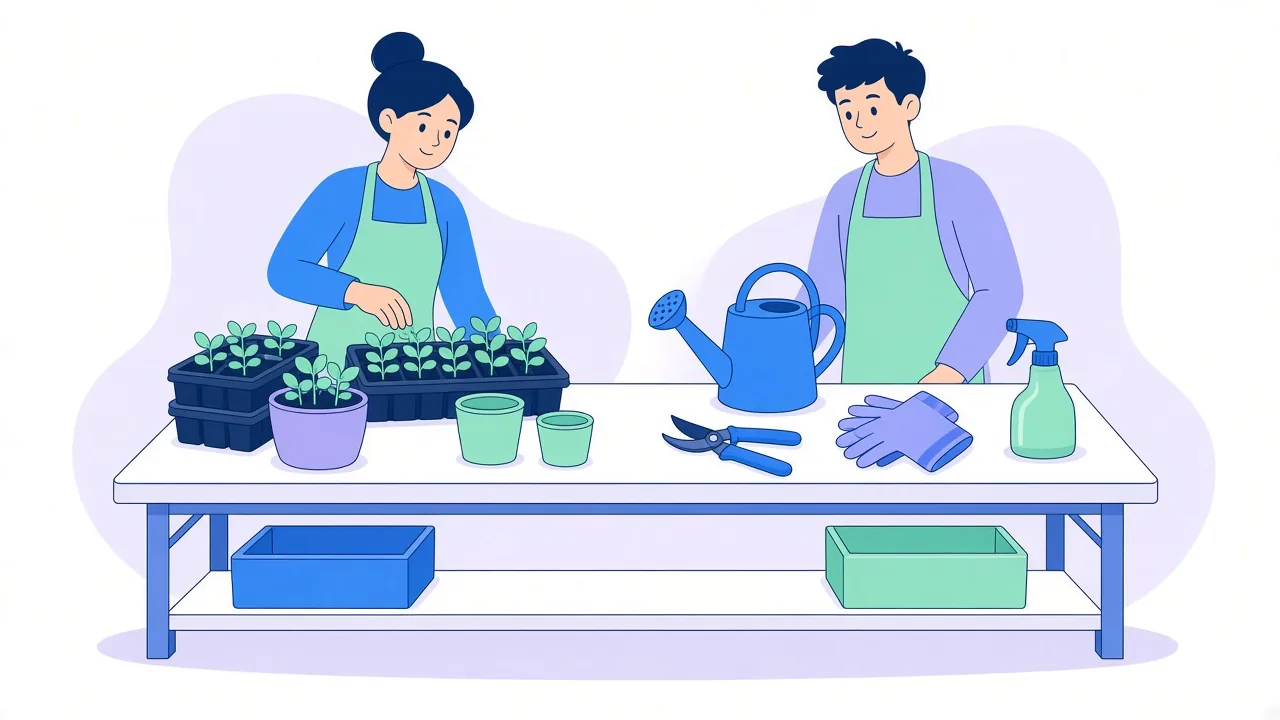
8. “How do you propagate plants from cuttings and seeds?”
Clean work is the point of propagation questions. For soft stem cuttings, Iowa State University Extension (2025) describes a 2 to 4-inch stem tip cut with a clean, sharp knife, lower leaves removed, rooting hormone if available, and moist perlite; most root in 4 to 6 weeks. For seed trays, one risk is damping-off, when seedlings suddenly collapse; Pythium, one cause, is “strongly favored by abundant moisture” (PNW Plant Disease Handbook, 2026).
A strong answer: “I take healthy tips with a clean knife, strip the lower leaves, use rooting hormone if the grower wants it and stick them in moist media. For seeds, I use clean trays and don’t overwater, because damping-off can spread fast.”
Never done it at work? “Not at work, but I’ve rooted mint and basil at home, and I know to keep everything clean.”
9. “A plant is wilting and its leaves are turning yellow. What do you check?”
The best answer starts with the roots. With Pythium root rot, roots look brown or water-soaked, and plants can be stunted or yellow and “may wilt even when enough water is available” (PNW Handbook). Purdue Extension (2011) adds that overwatering, poorly draining mix and pots standing in water raise the risk. Too much fertilizer salt can also cause wilting (Purdue HO-237).
A wilting plant: answer out loud
B1–B2First I check the pot. If the mix is dry and light, the plant probably needs water.
If the mix is wet and the plant is still wilting, I slide it out of the pot and look at the roots. Brown, soft roots that pull apart easily can mean root rot.
I don’t guess or spray anything. I set the plant aside and tell the grower which bench it came from.
Read it aloud
Listen to a model reading, then record yourself. You get your speaking pace, the share of words that came through clearly, and the words to repeat.
10. “Have you worked with irrigation, fertigation or fertilizer?”
Fertigation means feeding plants through the irrigation water. Purdue Extension (2009) recommends monitoring two numbers: EC (dissolved fertilizer salts in the mix) and pH, noting that all nutrients are readily available at a pH of 5.4 to 6.2. Its PourThru test: water as usual, let pots drain 30 to 60 minutes, pour distilled water on top and measure what runs out.
Sample answer: “I’ve run drip lines on timers and checked the emitters for blocks every morning. I helped with weekly PourThru tests, writing down EC and pH so the grower could adjust the feed.” Fresher: “I haven’t used an EC meter yet, but I know it measures fertilizer salts, and I’d like to learn your routine.”
Pest, pesticide and heat safety questions (11–14)
Safety questions have right and wrong answers. The right one is usually: notice early, report it, and follow the label and the site rules.
11. “How do you spot pests early?”
Interviewers want to hear about scouting, the regular checking behind integrated pest management (IPM). The US EPA describes four IPM steps: set action thresholds, monitor and identify pests, prevent them, then control them, less risky methods first. A UMass and UConn Extension scouting guide (2000) for poinsettia growers uses numbered yellow sticky cards (at least one per 1,000 square feet, changed weekly), checks new plants on arrival and uses a 10x hand lens.
Say: “I check the sticky cards and the undersides of leaves on my benches, and I look closely at plants that just arrived. If I see more thrips or whiteflies than last week, I flag the spot and tell the grower. I never spray on my own.”
12. “What do you know about pesticide safety and re-entry times?”
Pesticide safety is a key technical test. The US EPA Worker Protection Standard, which covers nursery and greenhouse workers, defines the restricted-entry interval (REI) as “the time after the end of a pesticide application during which entry into the treated area is restricted” (40 CFR part 170). In a greenhouse, the employer must not let workers in until the label’s REI has expired and all warning signs are removed or covered, apart from permitted early entry (§170.407); signs are required when the REI is longer than four hours (§170.409). Mixing, loading or applying is handler work that needs handler training (§170.401), and handlers must be at least 18 (§170.309).
Sample answer: “I never enter a sprayed area until the re-entry time is over and the sign is gone, not even for one tray. I wash my hands before I eat, drink or use the toilet, and I don’t mix or spray unless I’m trained as a handler.” Outside the US, the label and local rules set the re-entry time; see the country table.
13. “How do you handle the heat in a greenhouse?”
A hot greenhouse is a real risk, so name the warning signs. OSHA lists agriculture among the industries where workers have suffered heat-related illness and encourages water, rest and shade. New workers need time to build tolerance: in the first few days, employers should encourage them to drink enough, work shorter shifts and take frequent breaks. Confusion, slurred speech or passing out can mean heat stroke, which needs emergency help at once.
You could say: “I drink water at every break, wear light clothes and a hat, and take it slower in my first hot week. If a coworker seems confused or starts talking strangely, I get them into the shade, tell the supervisor and call for emergency help.”
14. “Can you handle lifting, bending and repetitive work all day?”
Answer yes only if it is true, then show how you protect your body. In O*NET survey answers, 51% of these workers make repetitive motions continually or almost continually, and 49% bend or twist that often. NIOSH reports that farm workers get backaches and pains in the shoulders, arms and hands more than any other health problem, and suggests a table that holds trays just above waist height instead of weeding on the ground.
Sample answer: “Yes. I did eight-hour shifts on a packing line. I lift with my legs, keep the load close, use a cart for heavy pots and switch hands on repetitive jobs.” Fresher proof: sports, gym training, kitchen or warehouse shifts, or harvest work with family.
Questions about orders, cleaning and shifts (15–17)
These questions cover the daily routine: accurate orders, a clean greenhouse and reliable shifts.
15. “How do you sort, grade and pack plants for an order?”
Order questions test accuracy: O*NET lists grading and sorting crops and packing plants “into boxes to fill orders” among the tasks.
Say: “I read the order sheet first: variety, pot size, quantity and grade. I pull only plants that match the grade, take off yellow leaves, check for pests and make sure every pot has the right label. Then I count twice and mark the sheet before the cart goes out.”
16. “How do you keep the greenhouse clean, and why does it matter?”
Sanitation stops disease. Pythium can survive in dust, planting media and soil particles on greenhouse floors, flats and pots (PNW Handbook). Purdue Extension advises disinfecting benches, tools, trays and containers that touch the potting mix and removing plants with symptoms at once. Against tobacco mosaic virus and related viruses, the University of Kentucky (2020) advises sanitizing pruning tools between plants, for example soaking them for at least one minute in 10% bleach; a quick dip will not work.
Sample answer: “I clear plant waste from under the benches at the end of each shift, keep the potting mix covered and clean trays before we reuse them. When the grower pulls sick plants, I bag them straight away and clean my hands and tools before I touch the next bench.”
17. “Can you work early starts, weekends and the busy season?”
Give exact days and limits now, not after the offer. Long weeks are common: in O*NET’s survey, 56% of these workers reported a typical week of more than 40 hours, and 49% face time pressure every day. Ask when the busy season is, because it differs by grower and crop.
A strong answer: “Yes. I can start at 6 a.m., work Saturdays and do overtime in the busy weeks. My only limit is Sunday mornings, and I can swap if there’s a big order. When is your busiest season?”
Teamwork, pay and closing questions (18–20)
18. “Tell me about a time you disagreed with a coworker.”
Greenhouse work is teamwork: 74% of these workers report face-to-face discussions every day (O*NET). Answer with STAR (Situation, Task, Action, Result) and end with the work, not the argument.
Sample answer: “A coworker kept watering my bench before I checked it, so some pots stayed too wet. I asked to talk at the break, showed him the heavy pots, and we agreed that whoever has the bench does the check. The grower liked it and put it on the board.”
19. “What are your salary expectations?”
Check the ad and local pay, then give a range. In the US, the median wage for crop, nursery and greenhouse farmworkers was $17.15 an hour, based on Bureau of Labor Statistics 2025 wage data (O*NET). In South Africa, farm workers are entitled to at least R30.23 an hour from 1 March 2026 (Government Gazette 54075).
Say: “The ad says $16 to $18 an hour, and that fits what I expect. With my propagation experience, I’d hope to start near the middle. Is overtime paid in the busy season?”
20. “Do you have any questions for us?”
Ask two or three questions about the work itself, and keep pay for later unless they raise it:
- “What does a normal day look like in the busy season?”
- “Will I get pesticide safety training before I start?”
- “Which crops would I work with first?”
- “How do you measure good work on the potting line or in shipping?”
More greenhouse and nursery interview questions
Other greenhouse and nursery question lists add these; one or two sentences each is enough.
| Question | What to say |
|---|---|
| “Do you smoke?” | One likely reason is plant disease: cigarette tobacco often tests positive for tobacco mosaic virus, and the University of Kentucky advises washing hands thoroughly after using tobacco. “Yes, and I always wash my hands before I touch plants.” |
| “What equipment have you used?” | What you can use on day one (shears, watering wands, carts, irrigation timers) and what needs training. |
| “What is the difference between annuals, perennials and biennials?” | An annual completes its life cycle in one year, a biennial needs all or part of two years, and a perennial lives more than two years (Oregon State University Extension). |
| “How do you stay organized when you are interrupted?” | Finish or mark the tray you are on, note where you stopped and go back to the order sheet. |
| “How would you help a customer in a retail nursery?” | Ask where the plant will go (sun or shade), give one care tip, and fetch a colleague if unsure. |
| “Tell me about a time a plant died.” | One real case: what you checked and what you now do differently. |
| “What is your ideal working environment?” | Describe this job: hands-on work with plants, a clear task list and a crew that shares information. |
| “Where do you see yourself in five years?” | Growing inside the operation: a section lead, propagation, or a pesticide applicator certificate. |
Greenhouse work rules and seasonal programs by country
Rules for pesticide training, pay and seasonal work differ by country, and in the US and Canada by state or province. Check the official page before the interview: rates and rules change.
| Where | Rule | What it means for you |
|---|---|---|
| United States | EPA Worker Protection Standard (40 CFR part 170) | Pesticide safety training within 12 months before working where a pesticide was used in the last 30 days (§170.401); handlers and early-entry workers 18+. |
| United States | H-2A temporary agricultural workers | Temporary or seasonal farm jobs. The employer (or its agent), not the worker, files the petition, generally with a Department of Labor temporary labor certification. |
| Canada | Seasonal Agricultural Worker Program | Citizens of Mexico and participating Caribbean countries; up to 8 months between 1 January and 15 December; flowers and nursery-grown trees (including greenhouses/nurseries) are on the commodity list. Home governments recruit workers aged 18+ with farm experience. |
| Canada | Pesticide certification | Each province runs its own applicator certification. Ask which certificate, if any, the job needs. |
| South Africa | National Minimum Wage (2026) | Farm workers: at least R30.23 per hour from 1 March 2026. |
| United Kingdom | Seasonal Worker visa | Horticulture work for up to 6 months; you need a sponsor, and the application fee is £340. |
| Other countries | Rules vary | Ask the employer which training, permits and safety rules apply, or check the labour or agriculture ministry. |
How to answer greenhouse interview questions in clear English
Use short sentences with one action each (“I check the pot. I look at the roots. I tell the grower.”) and stress job words correctly. Capitals show the stressed syllable, per the Cambridge Dictionary:
| Word | Say it |
|---|---|
| horticulture | HOR-tih-kul-cher |
| propagation | prop-uh-GAY-shun |
| fertilizer | FUR-tuh-lie-zer |
| pesticide | PES-tuh-side |
| irrigation | ir-ih-GAY-shun |
More drills: the English pronunciation practice guide and English for job interviews. Outdoor plant jobs have their own set: the groundskeeper interview questions.
Practice a greenhouse safety question out loud
In a safety question, the interviewer may add pressure to see whether you stay inside the rules. Say the candidate’s lines out loud.
An urgent order from a sprayed house
B1–B2- Interviewer
House 3 was sprayed this morning. A customer order needs 40 pots from there by noon. What do you do?
- Maria
I check the sign and the re-entry time. If the time isn’t over, I don’t go in.
- Interviewer
The truck is waiting. It’s only five minutes inside.
- Maria
Five minutes is still exposure. I tell my supervisor at once, so they can change the order or the delivery time.
- Interviewer
Your supervisor says, “Just grab them quickly.”
- Maria
I stay polite, but I don’t go in. I’m not trained for early entry and don’t have the protective equipment the label requires.
- Interviewer
So what can you do to help?
- Maria
I can pull the same plants from another house if the order allows, prepare the labels and cart, and load as soon as the house opens.
Practise this dialogue
Listen to the whole exchange, then take one role: your partner’s lines are read aloud, you say yours into the microphone and see which words came through.
For a timed run, the free browser mock interview reports answer length, pace and filler words; it has no greenhouse track, so choose the screening and behavioral questions. It checks how you speak, not your plant knowledge.
Say your answers out loud before the interview
Fluently is an AI speaking coach for non-native English speakers on iOS and Android. You answer out loud and get feedback on pronunciation, fluency, vocabulary and grammar. It is free to start: take a free AI speaking assessment to see your level, then practice with games that build your vocabulary and pronunciation. Conversations with your AI tutor come with Fluently Premium.
Frequently asked questions
What do greenhouse employers actually ask in interviews?
Candidates who report greenhouse worker interviews on Glassdoor list questions such as why they want to work there, the best and hardest parts of their last job, the equipment they have used, whether they can do long outdoor physical work with repetitive motion, and whether they smoke.
Are nursery worker and greenhouse worker interview questions the same?
Mostly yes: O*NET lists both as titles of one occupation. A retail nursery adds customer questions; a production greenhouse asks more about potting lines, orders and pesticide rules.
What is different in a greenhouse manager interview?
Manager question lists, such as The Knowledge Academy’s, move from tasks to planning: climate control, crop planning and scheduling, pest and disease strategy, and resolving team conflicts.
Is there a PDF of these greenhouse worker interview questions?
There is no separate PDF file. To keep this page, use your browser’s Print option and choose Save as PDF. Then say each answer out loud at least twice.
Do I need good English for a greenhouse job?
You need enough English to follow safety instructions and talk with your crew. In the US, pesticide safety training must be presented in a way workers can understand, such as through a translator (40 CFR 170.401). To check your level, take the free English level test.