20 Bricklayer Interview Questions and Answers for Assistants, Labourers and Trade Tests
 Yurii Rebryk · Updated October 28, 2026 · 15 min read
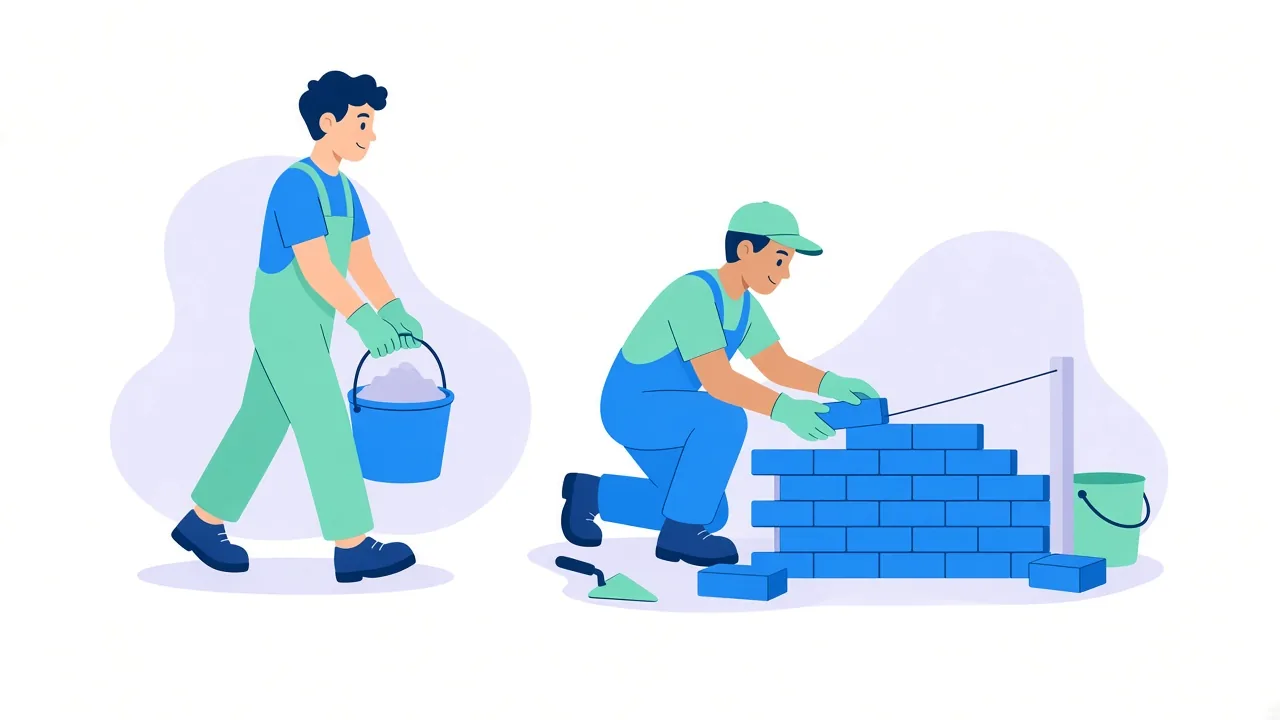
Bricklayer interview questions for an assistant, labourer or hod carrier check three things: that you can keep the bricklayers supplied with mortar and bricks, that you work safely with heavy loads, dust and height, and that you know the basics of the trade (bonds, level and plumb, joints). Below are 20 questions with sample answers in plain spoken English, then 12 bricklaying test questions with the correct answers.
In this article
- Bricklayer interview questions about you (1–5)
- Mortar, supply and technique questions (6–12)
- Bricklaying safety interview questions (13–17)
- Teamwork, pay and closing questions (18–20)
- More bricklayer interview questions to prepare
- Bricklaying test questions and answers
- Site cards, training and rules by country
- Bricklaying words to say clearly
- Practise a bricklayer’s assistant interview out loud
Bricklayer interview questions about you (1–5)
O*NET, the US job database, files Hod Carrier, Mason Tender and Bricklayer Helper under one job: helpers who supply materials and tools to masons and clean up (O*NET 47-3011.00, 2026). Every name and number in the sample answers is an example: swap in your own.
1. “Tell me about yourself.”
The interviewer wants a short summary in order: what you do now, the site work behind it, and why this job. Listen to the model, then record your version.
Tell me about yourself (bricklayer’s assistant)
B1I’m a bricklayer’s labourer with two years on housing sites. I mix mortar, load out the scaffold and keep three bricklayers supplied.
Before that I worked in a builders’ merchant yard, so I know the materials and I’m used to early starts.
I have my site safety card, and I want to start a bricklaying apprenticeship in the next two years.
Read it aloud
Listen to a model reading, then record yourself. You get your speaking pace, the share of words that came through clearly, and the words to repeat.
2. “Why do you want to work as a bricklayer’s assistant?”
A career reason is believable here: England’s National Careers Service says you could start “as a construction site labourer or hod carrier, with a bricklaying team or ‘gang’” and train on the job to become a bricklayer (National Careers Service).
Sample answer (works with no experience): “I like physical work I can see at the end of the day. A wall that wasn’t there in the morning is a good feeling. I also want a trade. If I keep a gang supplied well, I learn how good bricklayers work, and I hope to train as one.”
3. “What construction work have you done?”
Give details a reference could confirm: the sites, the tasks and the size of the gang.
You could say: “Two years with a housebuilder on two-storey homes, serving a gang of three bricklayers: mixing in a drum mixer, loading out bricks and blocks, setting up spot boards and cleaning down at night. My foreman there will give you a reference.” No site experience? “Not on a site yet, but two years in a warehouse: lifting all day, working to deadlines and never late.”
4. “Do you have a site card or safety training?”
Question 4 checks that you can start on site. In the UK a CSCS card is not a legal requirement, but most principal contractors and major housebuilders ask for one (CSCS FAQ); the Labourer card needs the CITB health, safety and environment test plus a Level 1 health and safety award or an approved alternative (CSCS). In Australia, general construction induction training “is required by anyone carrying out construction work” (training.gov.au). Other countries are in the rules table.
Sample answer: “Yes, I do. I have a CSCS Labourer card, valid until next June, and a manual handling certificate from my last job. I have photos of both on my phone, and I can bring the originals to site on my first day.” Fresher: “Not yet. I’ve booked the health and safety test for next week, and I know most sites won’t let me start without the card.”
5. “Are you okay with heights, heavy lifting and bad weather?”
Say yes only if it is true. In O*NET’s survey of this job, 43 % of workers said they spend time climbing ladders, scaffolds or poles “continually or almost continually”.
Example answer: “Yes. I’ve worked on scaffold at second-floor height, and I’m fine up there with guard rails and toe boards in place. I lift all day, but I use a barrow or a pallet truck where I can, and I’ve worked two winters outdoors.”
Mortar, supply and technique questions (6–12)
Questions 6 to 12 check the trade basics. Give the correct content first, then one example from your own work.
6. “How do you mix mortar? What mix do you use?”
Say “the mix in the spec, measured by volume”. UK designation (iii) mortar is 1 part cement, 1 part lime and 5 to 6 parts sand, class M4 (MPA Mortar Data Sheet 01, 2023); in the US, Type N mortar “is recommended for normal use” (BIA Technical Note 8B, 2020). The Brick Industry Association says “measurement of sand by shovel should not be permitted”: use a bucket or box of known volume (BIA Technical Note 7B, 2017).
Say: “I mix to the spec the bricklayer gives me; on my last site it was 1:1:6. I gauge with a bucket, not the shovel, so every batch has the same strength and colour, and I only mix what the gang will use in the next hour or so.”
7. “How do you keep the bricklayers supplied?”
Supply is the core of the job. HSE, Britain’s safety regulator, advises getting blocks delivered as close as possible to where they are laid (HSE, 2024), and the Brick Industry Association says to mix bricks from different packs around the wall so colours blend (BIA TN 7B).
A strong answer: “I watch the boards, not the clock. Before a bricklayer runs low, there’s fresh mortar on the spot board and bricks within reach, mixed from different packs. I load out the scaffold before the gang starts and spread the weight along the lift.”
8. “How do you check that a wall is level, plumb and straight?”
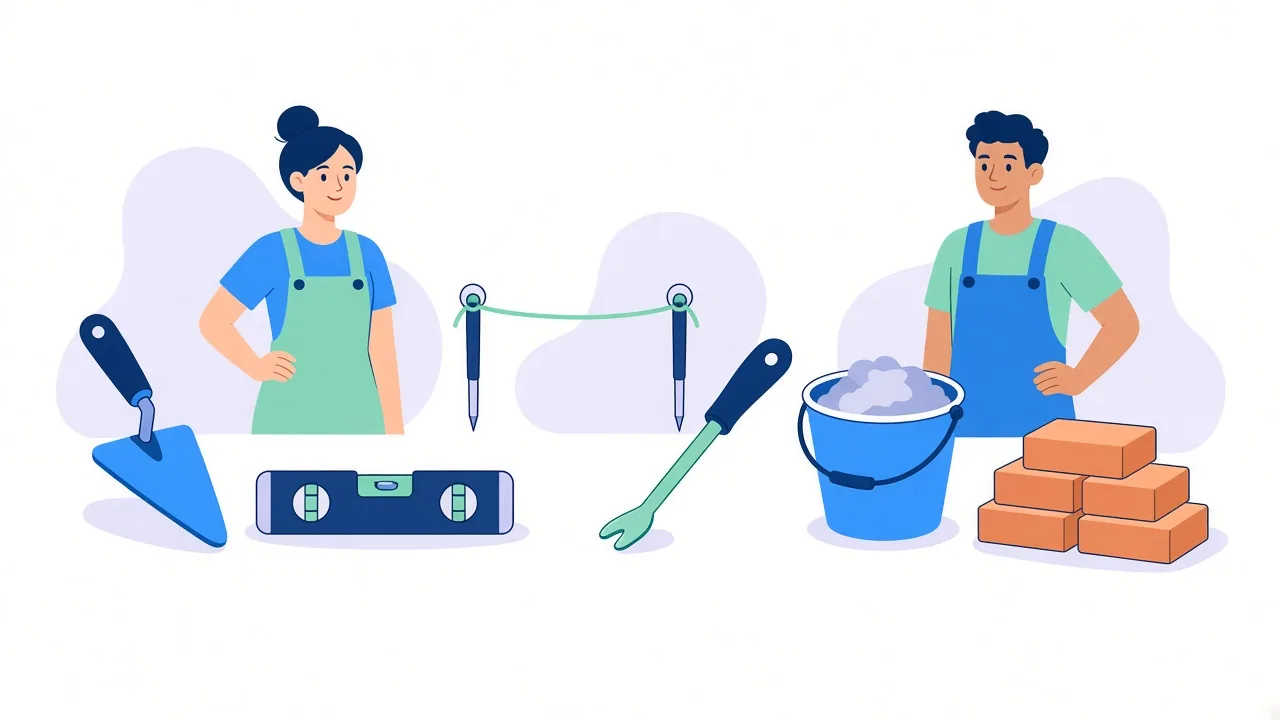
Name the tools and their jobs: the line keeps courses straight, the spirit level checks level and plumb, a gauge rod keeps course heights even. Standard UK bricks (215 × 102.5 × 65 mm) with 10 mm joints rise 75 mm a course (Designing Buildings); three courses of US modular brick equal 8 inches (BIA TN 10).
Sample answer: “The corners go up first, plumbed and levelled. Then the line goes between them on pins or corner blocks, pulled tight, and the bricklayer lays to it. I help check the gauge every few courses. For a square corner I use 3-4-5: 3 metres one way, 4 the other, and the diagonal must be 5.”
9. “Which brick bonds do you know?”
The Brick Industry Association names five basic bonds: running bond (all stretchers; UK sites call it stretcher bond), common or American bond, Flemish bond, English bond and stack bond (BIA Technical Note 30). Know these four by sight:
| Bond | Pattern |
|---|---|
| Stretcher (running) bond | All stretchers; used mostly in cavity and veneer walls, with metal ties |
| English bond | A course of headers, then a course of stretchers |
| Flemish bond | Headers and stretchers alternate in every course |
| Stack bond | All vertical joints in line, no overlap; a pattern bond only |
Test trap: the bond that alternates headers and stretchers in every course is Flemish. At least one practice exam shared online marks English bond as correct, which is wrong by the Brick Industry Association’s definitions.
Say: “Most of my work has been stretcher bond on cavity walls, tied into the blockwork. I know English bond, a course of headers then a course of stretchers, and Flemish bond, where they alternate in the same course. Stack bond needs ties, because nothing overlaps.”
10. “How do you finish the joints and keep the brickwork clean?”
Timing is the answer: joints are tooled when the mortar is “thumbprint” hard: a thumb leaves a mark but picks up no mortar. For exterior walls, the Brick Industry Association recommends concave, “V” or grapevine joints (BIA TN 7B); on any site, the specification sets the finish.
Sample answer: “I cut off the mortar squeezed out of the joints so the bricklayer can tool them on time, and I brush down only when it won’t smear. At the end of the day I wash the mixer, the spot boards and the tools, and cover the top of the new wall against rain.”
11. “Can you read a drawing?”
Claim only what you can do. A plan is a horizontal cut seen from above, an elevation shows one face of the building, and a section shows it “as though it had been sliced in half” (Designing Buildings).
You could say: “I can read a tape in millimetres and inches, and find wall lengths, openings and floor levels on a plan. Before I cut or set anything out from a drawing, I check with the bricklayer, because one wrong number costs a day.”
12. “How many bricks can you lay, or serve, in a day?”
The Home Builders Federation’s sample interview asks bricklayers: “Based on your previous performance how many bricks can you lay in a day?” and “What is more important quality or speed?” (HBF). Give a real figure with its conditions; you may have to show it on a trial day.
Sample answer (assistant): “On straight runs of facing brick I kept two bricklayers going all day without them waiting for me. Corners and openings are slower. Quality comes first, though: a wall that has to come down is the slowest wall of all.” Fresher: “I haven’t served a gang yet, so I won’t give you a number I can’t prove. I’m happy to do a trial day.”
Bricklaying safety interview questions (13–17)
Bricklaying safety questions cover five hazards: heavy loads, height, dust, wet cement and weather.
13. “How do you lift and carry bricks and blocks safely?”
HSE says the risk rises with block weight and when laying above shoulder or below knee height. Its advice: use pallet or sack trucks, carry blocks close to the body and never up ladders (HSE). For blocks over 20 kg, using two workers “is no longer recommended” (HSE FAQ).
Say: “I get the pallets dropped as close to the wall as possible and use the pallet truck or a barrow. I keep loads close and bend my knees. If the blocks are over 20 kilos, I ask for lighter blocks or a lifting aid, and I never carry blocks up a ladder.”
14. “How do you work safely on a scaffold?”
An assistant loads the scaffold but never alters it: HSE says scaffolds are altered “only by competent people” and, unless the provider says otherwise, should be treated as general purpose, with a maximum load of 200 kg/m² (HSE scaffolding). In the US, where materials are piled above the toe board, OSHA lists screening up to the guard rail as one way to protect workers below (29 CFR 1926.451(h)). More in the scaffolder interview questions.
A strong answer: “Before I load a scaffold, I check it has been inspected. I spread bricks along the lift instead of one big stack, and keep stacks below the toe board unless brick guards are fitted. If a guard rail or a board is missing, I don’t touch it: I tell the supervisor.”
15. “How do you cut bricks and blocks safely?”
HSE says over 500 construction workers are believed to die from silica dust every year (HSE, 2026). For cutting blocks with a cut-off saw, it lists water suppression plus a mask, and suggests block splitters (HSE CIS36). Under the US Table 1 option, a handheld power saw needs water fed continuously to the blade, plus a respirator indoors or for more than 4 hours a shift outdoors (OSHA Table 1).
Sample answer: “Hand cuts with a bolster and club hammer, in goggles and gloves. I use the saw only if I’m trained and the water is connected, with a fit-tested mask, away from the gang. Where I can, I use the block splitter, because it makes far less dust.”
16. “What PPE do you wear, and why gloves with mortar?”
Show you know the hidden hazard: wet cement. HSE warns that wet cement can burn, and that cement trapped against the skin, “by kneeling in it or if cement falls into a boot or glove”, can quickly cause a serious burn or ulcer (HSE CIS26).
Example answer: “Hard hat, boots, hi-vis, gloves and glasses every day, plus a mask and ear defenders when cutting. With mortar I wear waterproof gloves and kneel on a board, never in wet mix. If cement gets in my boot, I stop and wash it off straight away.”
17. “Can you lay bricks in the rain or the cold?”
UK mortar maker Holcim says to stop laying when the air falls below 3 °C unless the mortar is kept at 4 °C or more, and not to lay saturated bricks (Holcim, 2025). In the US, Brick Industry Association guidance applies cold-weather rules below 40 °F (4.4 °C) (BIA TN 1, 2018).
You could say: “In light rain we keep going only if the bricks and the new work stay covered. In heavy rain or frost the bricklayer stops, and I cover the walls, the bricks and the mortar tubs. In winter I check the temperature first, and I never use mortar with ice in it.”
Teamwork, pay and closing questions (18–20)
18. “What would you do if a coworker wasn’t working safely?”
The HBF sample interview asks this too. Stop the danger, speak to the person, then report it; tell the story with STAR (Situation, Task, Action, Result).
A coworker cutting blocks without water or a mask
B1–B2On my last site, a labourer was cutting blocks with no water and no mask, right next to the mixer.
I waved at him to stop, waited for the blade to stop, and told him calmly that the dust was getting into all of us.
I helped him connect the water and found him a mask. Later I told the supervisor, who talked about dust at the next morning briefing.
Read it aloud
Listen to a model reading, then record yourself. You get your speaking pace, the share of words that came through clearly, and the words to repeat.
19. “What pay do you expect, and can you work early starts?”
Check local rates first. England’s National Careers Service gives £23,000 to £35,000 a year for construction labourers, on 40 to 44 hours a week (National Careers Service); US helpers to brick, block and stone masons and tile setters earned a median of $47,550 in May 2025 (BLS).
Sample answer: “From the ads I’ve seen for this area, I’m looking for around [your figure] an hour, and I’m flexible if there’s overtime or a route into an apprenticeship. Early starts are fine: I live 20 minutes away and have my own transport.”
20. “Do you have any questions for us?”
Ask about the work itself; it shows you plan to stay.
- “How many bricklayers would I be serving, and on what kind of work?”
- “Is the mortar mixed on site or delivered ready to use?”
- “Is there a chance to start a bricklaying apprenticeship later?”
More bricklayer interview questions to prepare
| Question | What to say |
|---|---|
| “What do you know about our company?” | Two facts from their website and why that work suits you; reported at UK builders (Glassdoor). |
| “What are your strengths and weaknesses?” | A strength with proof, then a real weakness with the fix: “I used to mix too much at once; now I mix to the gang’s pace.” |
| “Why did you leave your last job?” | One neutral fact: the contract ended or the site finished. Never criticise the old gang. |
| “A piece of safety gear slows you down. What do you do?” | Never take it off. Ask for a better fit or another way to do the task (an HBF sample question). |
| “How do you stop fire spreading in cavities?” | For bricklayer posts (HBF): fit cavity barriers and closers where the drawings show them; report missing ones. |
| “When can you start? Do you drive?” | Your start date; a licence helps on sites outside town. |
Bricklaying test questions and answers
Trade tests use short multiple-choice questions: the City & Guilds Level 2 bricklaying theory exam of June 2018 has 60, each with four options (City & Guilds past paper). Here are 12 common types, answered.
| Question | Answer | Why |
|---|---|---|
| Standard UK bricks per m² of half-brick wall in stretcher bond? | 60 | 1 ÷ (0.225 × 0.075 m) ≈ 59.3 (Designing Buildings) |
| Height of one course of UK brickwork? | 75 mm | 65 mm brick + 10 mm joint |
| Height of 26 block courses at 200 mm gauge? | 5.2 m | 26 × 0.2 m |
| A room is 12 m × 9 m. Diagonal if square? | 15 m | √(12² + 9²) = 15 |
| Bond with headers and stretchers alternating in every course? | Flemish | English alternates whole courses (BIA TN 30) |
| Bond with all vertical joints in line? | Stack | No overlap (BIA TN 30) |
| UK mortar designation (iii) by volume? | 1:1:5–6 cement:lime:sand | Class M4 (MPA) |
| US mortar type for normal use? | Type N | BIA TN 8B |
| How soon should mortar be used? | Within 2½ hours (2 hours when hot) | BIA TN 7B; MPA gives cement:lime:sand mortar 1 to 2 hours |
| When is a joint tooled? | When thumbprint hard | BIA TN 7B |
| Why gauge with a box, not a shovel? | More consistent batches | Shovel measuring should not be permitted (BIA TN 7B) |
| UK maker guidance: stop laying below what air temperature? | 3 °C | Unless mortar is kept at 4 °C or more (Holcim) |
Site cards, training and rules by country
Site rules change, and in Australia and the US they differ by state. Check with the employer or the regulator before the interview.
| Where | To start on site | Route to bricklayer |
|---|---|---|
| United Kingdom | Most sites ask for a CSCS Labourer card: CITB health, safety and environment test plus a Level 1 health and safety award or an approved alternative | Apprenticeship or college; a Blue Skilled Worker card after an NVQ/SVQ Level 2 or apprenticeship |
| Australia | General construction induction training, required for all construction work | CPC33020 Certificate III in Bricklaying and Blocklaying; licensing varies by state |
| United States | The OSHA 10-hour Outreach class covers common hazards and ends with a course completion card | Registered Apprenticeship: paid work, a mentor and classroom training |
| Saudi Arabia | Professional Verification: practical and theoretical exams for skilled workers | For targeted jobs, the work visa is being linked, in stages, to passing it in your home country |
| United Arab Emirates | No work in direct sun from 12:30 to 3 pm, 15 June to 15 September (u.ae) | Ask the employer which trade test the job needs |
| Ghana, Bangladesh, Brazil and others | Rules vary: ask the employer or the national labour or training authority | For Gulf jobs, ask the recruiter which trade test applies |
Bricklaying words to say clearly
Stressed syllables are in capitals; meanings follow the Cambridge Dictionary. Two test terms: a perp (perpend) is a vertical joint, a bed joint a horizontal one (Designing Buildings).
| Word | Say it | Meaning on site |
|---|---|---|
| mortar | MOR-ter | Sand, water and cement or lime that fixes bricks together |
| trowel | TROW-ul (rhymes with “towel”) | Flat-bladed tool for spreading mortar |
| lintel | LIN-tul | The beam over a door or window that holds up the wall |
| hod | HOD | An open box on a pole, carried on the shoulder, for bricks |
For drills, see the English pronunciation practice guide; for phrases that open an answer or buy time, the English for job interviews guide.
Practise a bricklayer’s assistant interview out loud
Here the interviewer adds a problem after each answer. Say Kwame’s lines out loud.
Mortar and heavy blocks
B1–B2- Interviewer
It’s 7:30 and three bricklayers start at eight. What do you do first?
- Kwame
I check the scaffold has been inspected, mix the first batch to the spec, and load out enough bricks and mortar for the first hour.
- Interviewer
At eleven, mortar you mixed at seven has gone stiff. Do you add water and use it?
- Kwame
No. Four hours is too long; mortar should be used within about two and a half hours. I throw it out and mix a smaller batch.
- Interviewer
The next pallet is dense blocks, about 25 kilos each. The bricklayer wants them up now.
- Kwame
I won’t carry them up the ladder. I ask for the forklift or the hoist, and I tell the supervisor they’re over 20 kilos.
- Interviewer
Why should we hire you?
- Kwame
Because your bricklayers won’t wait for me, and I won’t cut corners on safety to keep up.
Practise this dialogue
Listen to the whole exchange, then take one role: your partner’s lines are read aloud, you say yours into the microphone and see which words came through.
For a timed run, the free browser mock interview measures answer length, pace and filler words. It has no bricklaying track, so choose the screening and behavioral questions. Related roles have their own sets: construction laborer interview questions and carpenter assistant interview questions.
Say your answers out loud before the interview
Fluently is an AI speaking coach for non-native English speakers on iOS and Android. You answer out loud and get feedback on pronunciation, fluency, vocabulary and grammar. The download is free and starts with a free four-minute speaking assessment; full practice is a subscription after a free trial.


Frequently asked questions
What does a bricklayer’s assistant do?
A bricklayer’s assistant (also called a hod carrier, mason tender or bricklayer helper) does the less skilled work around the bricklayers: mixing mortar, supplying bricks, blocks and tools, cutting materials to size and cleaning the work area and equipment (O*NET 47-3011.00).
Can a bricklayer lay 1,000 bricks a day?
There is no official standard for daily output. The number depends on the wall (long plain runs or corners and openings), the bond, the brick, the weather and how well the labourers keep up. In an interview, give a figure you can repeat on a trial day and say what kind of work it came from.
What is slang for a bricklayer?
In British English, a bricklayer is informally a “brickie” (Cambridge Dictionary), and a bricklaying team is a “gang”.
Is there a PDF or an online mock test for bricklayer questions?
There is no separate PDF: use your browser’s Print or Save as PDF on this page. For the trade side, the 12 test answers above and the City & Guilds past paper are free practice. The Fluently mock interview is spoken interview practice, not a trade test.