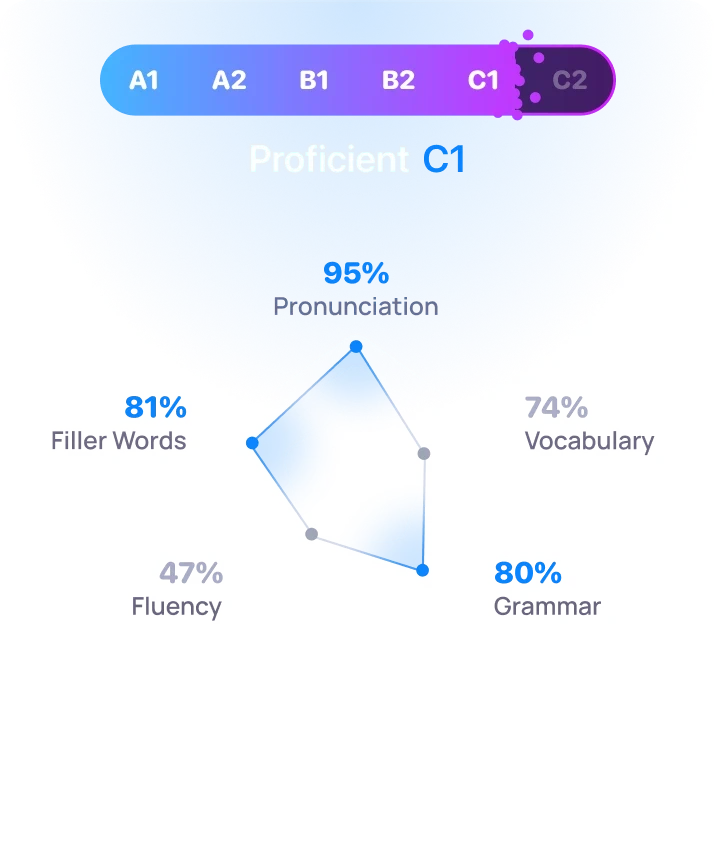
There's a specific kind of English that sounds correct but somehow still foreign. Grammatically fine. Vocabulary solid. But something is slightly off - too formal, too careful, too word-by-word. Native speakers understand it, but they also notice it.
This is the gap between accurate English and natural English. And closing it is a different problem from improving your grammar or expanding your vocabulary. It requires paying attention to things most learners never study at all.
Here are seven habits that actually separate natural-sounding English from technically correct English.
Why "Correct" and "Natural" Are Not the Same Thing
Grammar rules tell you what's right and wrong. Naturalness is about something else entirely - the rhythm, the shortcuts, the filler patterns, the way words blur together in real speech.
Native speakers break grammar rules constantly. They use sentence fragments. They start sentences with "and" or "but." They use "like" as a filler every third sentence. None of this makes them sound bad. In fact, these "mistakes" are part of what makes their speech sound human rather than textbook.
Meanwhile, many non-native speakers produce English that is technically more correct - and that sounds more robotic because of it. The goal isn't to make more errors. It's to understand which patterns mark natural speech and start using them deliberately.
The 7 Habits
1. Use contractions like you mean it
This is the most common and easiest thing to fix, and it makes a noticeable difference almost immediately.
"I do not think that is a good idea" - correct, slightly stiff.
"I don't think that's a good idea" - correct, and how an actual person sounds.
Most learners know contractions exist. They just don't use them automatically when speaking, especially when they're concentrating hard on what to say. The trick is to make it a deliberate habit until it becomes reflex.
Every time you catch yourself saying "I am," "it is," "we will," "they are," "I have" - swap it. No exceptions. After a few weeks, contractions stop being a thing you have to think about.
2. Learn discourse markers and use them
Discourse markers are the little words and phrases that native speakers use to manage conversation - to signal they're thinking, to soften something, to change direction, to add a point. Things like:
"Well..." / "I mean..." / "You know..." / "Honestly..." / "Actually..." / "To be fair..." / "Right, so..." / "Basically..." / "The thing is..."
These aren't filler in the meaningless sense. They do real communicative work. "Actually" signals a gentle correction. "To be fair" signals you're about to add nuance. "The thing is" signals a complication is coming. Native speakers use these dozens of times a day without thinking about it.
Most learners either avoid them (because they feel imprecise) or overuse one or two ("basically" said every sentence). Study them systematically - what they signal, when they're used, what register they fit. The AI English Speaking Practice: The Complete Guide for 2026 goes into how conversation-based practice helps internalize these naturally.
3. Get comfortable with vague language
This surprises a lot of learners: native speakers are intentionally vague, constantly. It's not laziness - it's a linguistic convention.
"I'll be there around seven or so." / "It's kind of complicated." / "She's pretty good at that sort of thing." / "There were like fifteen people there, maybe more." / "We talked for a while."
Hedges like "kind of," "sort of," "pretty," "roughly," "more or less," "a bit," "quite" - these soften statements and make them sound more natural. Approximators like "around," "about," "roughly," "a couple of," "loads of" do the same. Vague category words like "stuff," "things," "whatever," "and so on" replace exhaustive lists.
When learners try to be precise about everything, the speech pattern starts to sound unnatural. Some vagueness signals fluency, not imprecision.
4. Master connected speech - or at least understand it
In natural English, words don't sound the way they do when you read them out loud one by one. They connect, reduce, and blend.
"Want to" becomes "wanna." "Going to" becomes "gonna." "Do you" sounds like "d'ya." "Did you" becomes "didja." "I don't know" becomes "I dunno." "Let me" becomes "lemme." "Give me" becomes "gimme."
You don't necessarily need to use all of these - some are very informal. But you absolutely need to recognize them, because native speakers will use them and you need to understand what you're hearing. And using a few of the milder ones in casual speech ("gonna," "wanna," "dunno") immediately makes your English sound more relaxed and natural.
Practice with How to Improve English Pronunciation: A Practical Guide helps here - the connected speech section specifically covers how words blend in natural conversation.
5. Use the right informal vocabulary for the right register
There's a vocabulary layer that most English courses skip entirely: informal conversational words that native speakers use in everyday speech but would never write in a formal email.
"Grab" instead of "take." "Check out" instead of "examine." "Figure out" instead of "determine." "Run into" instead of "encounter." "Sort out" instead of "resolve." "Get rid of" instead of "eliminate."
These phrasal verbs and informal alternatives are what natural English conversation is built on. Learners who were taught from formal textbooks often know the formal version of a word and not the conversational one - which makes them sound either very educated or slightly stiff, depending on the situation.
One simple habit: when you learn a formal word, also look up how native speakers say the same thing in casual conversation. The informal version is usually a phrasal verb and it's usually the one you'll need.
6. Vary your intonation and don't be afraid to sound expressive
Flat, even-toned English sounds unnatural regardless of how correct the words are. Native speakers use intonation to convey attitude, emphasis, humor, doubt, excitement, sarcasm, and warmth - often more than the actual words do.
Try recording yourself and listening back. If it sounds monotone, that's the problem. Some targeted intonation work fixes this faster than most people expect. Shadowing - repeating along with native speakers and trying to match their pitch and rhythm - is the most direct way to work on this. Same method that helps with accent also helps with expressiveness.
Check out English Speaking Practice: 7 Ways to Practice Every Day (Without Extra Time) for specific daily habits that include intonation practice without needing to set aside extra time.
7. Stop translating common situations - start retrieving them
When you translate into English in real time, the result is usually grammatically fine but carries the logic and structure of your first language. The phrasing is slightly off in ways that are hard to pin down but easy to notice.
The fix is phrase-level learning for your most common situations. Think about the conversations you have most - at work, with friends, about your life, about plans. Learn the specific English phrases for those exact situations rather than translating each time.
"I'll get back to you on that." / "Let me think about it." / "Can we circle back to this later?" / "I was wondering if..." / "I meant to ask you..." / "That reminds me..."
These don't come from grammar rules. They come from exposure and memorization. Using Fluently daily for conversation practice is one of the fastest ways to absorb these - because you encounter them in real dialogue, in context, rather than on a vocabulary list.
How Fluently Helps You Sound More Natural
Accuracy is table stakes. What Fluently targets beyond accuracy is naturalness - the AI tutor doesn't just flag grammatical errors, it flags phrasing that would sound unusual to a native speaker even when it's technically correct.
That's a different kind of feedback from what most apps offer, and it's the kind that actually moves you from "correct English" to "natural English." After a session, you'll see specific notes like "you said X, but a more natural way to say this is Y" - which is exactly the comparison most learners never get unless they're working with a native-speaking tutor.


A Few Quick Wins to Start Today
You don't need to work on all seven habits at once. Pick one and focus on it for two weeks before adding another.
If you're not sure where to start: contractions first. It's the easiest change, and the effect is immediate and noticeable. Then move to discourse markers. Those two alone will shift how your speech sounds to a native listener.
After that, work on connected speech and vague language - both of which take longer to feel comfortable but make a significant difference once they're internalized.
Frequently Asked Questions (FAQ)
Do I need to sound like a native speaker to be fluent?
No. The goal is to sound natural and be easy to understand - not to erase your accent or pretend you grew up speaking English. Many highly fluent non-native speakers have a noticeable accent and still communicate naturally and effortlessly. Naturalness is about patterns and rhythm, not origin.
How long does it take to start sounding more natural in English?
Some things - like contractions and basic discourse markers - shift how you sound within a few weeks of deliberate practice. Connected speech and intonation take longer, usually a few months of consistent shadowing and conversation practice. Using Fluently daily accelerates this because you get real-time feedback on naturalness, not just correctness.
What's the single biggest thing making my English sound unnatural?
For most learners it's one of two things: either speaking word-by-word without connected speech, or using formal vocabulary in casual contexts. Both are fixable with targeted practice. Recording yourself and listening back is the fastest way to identify which one applies to you.
Should I use informal English in professional settings?
Register awareness is important. Contractions, discourse markers, and many phrasal verbs are fine in professional spoken English - in fact, avoiding them often makes you sound overly formal and stiff in meetings or calls. Full slang and very casual language is a different story. The line is between conversational professional and casual social.
Is it okay to use fillers like "um" and "you know"?
Yes - native speakers use them constantly. The problem is when they're excessive or used only as hesitation markers. Discourse markers like "well" and "I mean" are more functional than pure fillers - they signal what's coming next rather than just buying time. A mix of both is completely normal.
How do I practice sounding natural when I don't have people to speak with?
Shadowing is the most effective solo method - repeating along with native speakers, matching their rhythm and intonation exactly. Daily AI conversation practice is the next best thing, because you produce language in real dialogue rather than in isolation. Both are detailed in the AI English Speaking Practice: The Complete Guide for 2026.
Conclusion
Sounding natural in English isn't about being more casual or making more mistakes. It's about learning the specific patterns that mark fluent speech - the contractions, the discourse markers, the connected sounds, the appropriate informality - and building them into your automatic output.
Pick one habit. Work on it until it's reflex. Then add another. That's the whole system.