There's a specific kind of stress that comes with speaking English in a professional setting. You know your subject matter. You're good at your job. But the moment a meeting switches to English, or a client calls unexpectedly, something shifts. You speak more slowly, choose safer words, say less than you wanted to.
This isn't an English problem. It's a high-stakes speaking problem - and it's fixable with the right kind of preparation.
Here's what actually helps, broken down by the specific situations that come up most at work.
Why Professional English Feels Harder Than Casual English
Casual conversations have low stakes. If you say something slightly wrong, the other person just adjusts their interpretation and moves on. But in a meeting with a client, or when presenting to your team, or when you need to push back on a decision - the social and professional stakes are real. That pressure makes everything harder.
Add to this that professional English has its own vocabulary, its own conventions, and its own unwritten rules about when to speak, how to interrupt, and how to disagree politely. These things don't come from studying grammar. They come from being exposed to professional English contexts over time - which most learners haven't had enough of.
The good news: professional English is more learnable than general fluency. The situations repeat themselves. The vocabulary clusters around specific topics. And you can prepare for the conversations you know are coming. That's a much more tractable problem than "speak fluently in any situation."
The Situations That Matter Most
Meetings and calls
Meetings are where most of the stress concentrates. They're unpredictable, they move fast, and there's an audience.
A few things that help:
Know how to buy yourself time. Native speakers do this constantly - "That's a good question, let me think about that for a second." / "Can I come back to you on that?" / "Let me make sure I understood correctly - you're saying..." These phrases aren't stalling. They're normal professional communication. Use them freely.
Know how to jump in. Interrupting in English has a specific vocabulary: "Sorry to jump in here, but..." / "Can I just add something to that?" / "If I can interrupt for a second..." Without these, it's very hard to enter a fast-moving conversation without either waiting forever or talking over someone.
Know how to ask for clarification without sounding lost. "Could you say a bit more about that?" / "I want to make sure I understood - are you saying X?" / "What do you mean by [term]?" These are professional and completely normal. Most people never ask for clarification because they're embarrassed, then spend the rest of the meeting confused.
If you're specifically preparing for job interviews or high-stakes professional conversations, the AI Mock Interview: Prepare for Your English Job Interview with AI guide covers spoken preparation in detail.
Presentations and updates
The biggest mistake non-native speakers make in presentations is writing out everything they want to say and then reading it - which kills eye contact, kills energy, and kills trust.
The goal is to know your content well enough that you can say it in different words each time. Not memorize a script. Internalize the points.
Practice out loud. Multiple times. Before the actual presentation. Not in your head, not in writing - out loud, in English, at speaking speed. Notice the moments where sentences fall apart and work on those specifically. This sounds obvious and is almost never done systematically.
Key phrases for presentations:
"So what this means in practice is..."
"The key takeaway here is..."
"I'll come back to that in a moment."
"Does anyone have questions before I move on?"
"To give you a quick example..."
"What this comes down to is..."
Giving and receiving feedback
This is one of the most culturally variable parts of professional communication, and it trips up a lot of non-native speakers in both directions.
Giving feedback in English - especially critical feedback - tends to be more indirect than in many other professional cultures. Direct criticism with no softening often lands as rude or aggressive, even if that wasn't the intent.
"I wonder if we might want to reconsider..." / "One thing I noticed..." / "Have you thought about..." / "I think there might be a way to make this stronger by..." - these are normal ways to deliver feedback professionally in English-speaking environments.
Receiving feedback is often harder. The instinct to defend or explain immediately is strong. "That's a fair point." / "Good to know - I'll factor that in." / "I hadn't thought about it that way." - these buy you time and signal receptiveness without committing to agreement.
Disagreeing without damaging the relationship
Disagreement is inevitable in professional settings. The phrasing matters a lot.
"I see it a bit differently." / "I take your point, though I'd push back slightly on..." / "I'm not sure that's quite right - my understanding was..." / "I wonder if we're missing something here." - these let you hold your position without being combative.
The worst version is silence. Many non-native speakers disagree internally but say nothing because they can't find the right words in the moment. The result is decisions they didn't agree with and didn't flag.
Preparing specific disagreement phrases ahead of time - and practicing them until they feel automatic - is one of the most useful things you can do for your professional effectiveness in English.
How to Prepare Before High-Stakes Moments
Preparation is the main variable separating non-native speakers who communicate confidently at work from those who don't. Not native-level fluency. Preparation.
Before a meeting: Think through the key points you'll need to make and say them out loud. Anticipate likely questions and practice your answers. Look up any vocabulary specific to the topic. If you know there's a difficult conversation coming, run it through your head in English, not your native language.
Before a presentation: Practice aloud from start to finish at least twice. Record yourself once and listen for the moments where you hesitate or where phrasing falls apart. Fix those specifically. Know your opening and closing by heart - those are the highest-pressure moments.
Before a difficult call: Write down the two or three things you need to convey. Say them out loud before you dial. Have your key phrases written down where you can see them if you need a reference.
This is the approach outlined in detail for interview contexts in English for Job Interviews: Complete Preparation Guide for Non-Native Speakers - the same preparation logic applies to any high-stakes professional conversation.
For startup founders and entrepreneurs communicating with investors or customers in English, English for Startup Founders: Communicate Confidently with Investors and Customers covers the specific language of pitches, negotiations, and client communication.
The Vocabulary That Actually Matters
Instead of learning broad business vocabulary, focus on the phrases that solve the specific friction points non-native speakers face:
Buying time:
"Let me think about that." / "Good question - I want to give you a proper answer." / "Can I get back to you on that?"
Entering conversations:
"If I can jump in here..." / "Sorry to interrupt, but..." / "Can I add something to this?"
Asking for clarification:
"Just to make sure I'm following..." / "Could you elaborate on that?" / "What do you mean by [X]?"
Signaling you didn't hear:
"Sorry, could you repeat that?" / "I missed that last part - could you say it again?" (Never pretend you understood when you didn't. It causes bigger problems later.)
Transitioning topics:
"Moving on to..." / "On a related note..." / "Separately..." / "Before we leave this topic..."
Closing or wrapping up:
"So just to recap what we agreed..." / "The next step from here is..." / "I'll follow up with you on this."
How Fluently Helps With Professional English Specifically
A big part of what makes professional speaking hard is that you can't always predict what's coming. Someone asks an unexpected question. A client pushes back. A colleague introduces a topic you weren't prepared for.
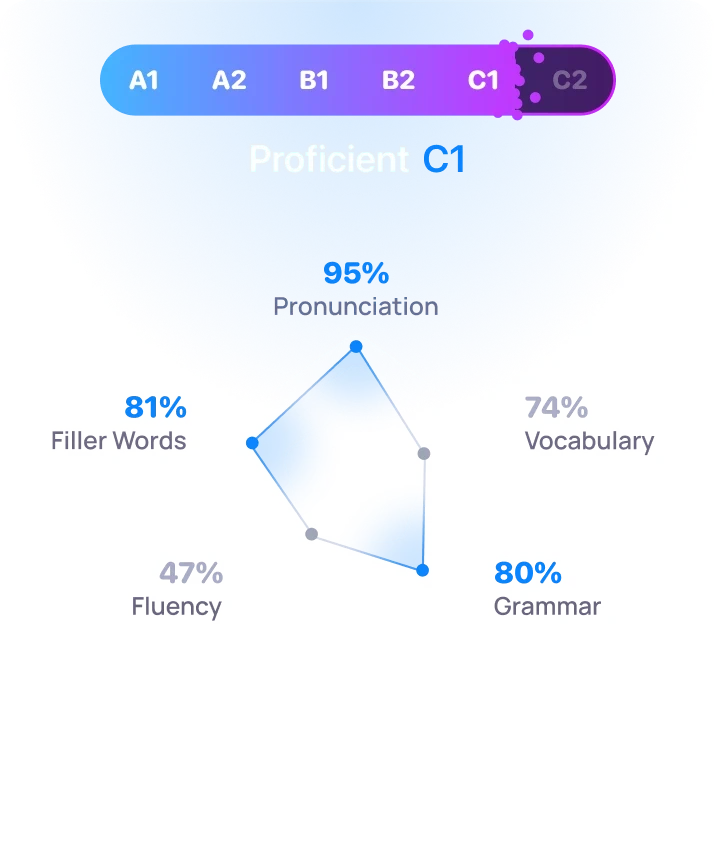
Fluently lets you practice exactly that - unscripted conversation in professional contexts, where you have to respond in real time to things you didn't anticipate. You can set up scenarios: a challenging client call, a performance review, a tricky meeting. The AI responds the way a person would, and you get feedback afterward on your grammar, your phrasing, and how natural your responses sounded.


For learners preparing for more English at work, this kind of scenario-based practice - combined with the preparation strategies above - tends to produce noticeable confidence improvements within a few weeks.
Frequently Asked Questions (FAQ)
How do I stop freezing up when someone asks me an unexpected question in English?
Buying-time phrases are the immediate fix - "That's a good question, let me think for a second" is not a sign of weakness, it's professional. The longer-term fix is more unscripted speaking practice, so your brain gets faster at forming responses under pressure. Fluently's conversation sessions are useful for this specifically because the exchanges are unpredictable.
Is it okay to ask someone to repeat themselves in a professional setting?
Always. Every time, without hesitation. Pretending to understand when you didn't leads to bigger problems - missed information, wrong actions, damaged trust. "Sorry, could you say that again?" is a normal professional request. No one thinks less of you for it.
What's the best way to improve business English speaking quickly?
Preparation before your actual work situations combined with daily unscripted speaking practice. The preparation handles known conversations - you go in ready. The daily practice builds the retrieval speed for unknown ones. Using Fluently for workplace conversation scenarios covers both: you're practicing the kinds of exchanges that come up at work, with feedback on how you sound.
Should I use formal English or casual English at work?
Most professional spoken English is somewhere in the middle - conversational but not slangy. Contractions are fine. Phrasal verbs are fine. Very casual language, strong slang, or very stiff formal language all stand out. Match the register of the people around you, which varies by company culture.
How do I disagree professionally in English without seeming rude?
Softening language is key - "I see it a bit differently," "I'd push back slightly on that," "I'm not sure that's the full picture." Never lead with a flat "no" or "that's wrong." The goal is to hold your position clearly while leaving the other person's face intact. This feels indirect if it's not your cultural norm, but it's standard professional English.
How do I sound more confident even when I'm not?
Speak at a steady pace rather than rushing. Rushing signals anxiety. Slowing down slightly - even when it feels unnatural - is perceived as confidence. Prepare your key points so you're not searching for words in real time. And use complete sentences rather than trailing off or hedging excessively.
Conclusion
Business English speaking isn't about memorizing professional vocabulary. It's about having the right phrases for the moments of friction - the unexpected question, the disagreement, the need to jump in, the request you didn't catch. These are all learnable, and they're more learnable than general fluency because the situations repeat.
Prepare for the conversations you know are coming. Practice out loud, not in your head. Build daily speaking habits that make unscripted English feel less foreign. The confidence comes from the reps, not from waiting until you're ready.