Let's get something out of the way first: most grammar mistakes don't actually matter. Native speakers make grammar errors all the time - in emails, in meetings, in interviews - and the world keeps turning. The mistakes worth caring about are the ones that confuse people, the ones that make your English sound noticeably learner-level in contexts where that costs you something, and the ones so deeply ingrained they'll take deliberate effort to fix.
That's what this article is about. Not a list of 50 errors to panic over. The specific patterns that come up constantly, across almost every language background, and what you actually do about them.
One thing before we start: reading grammar rules doesn't fix grammar mistakes. You already know this if you've ever read a rule, understood it completely, and then made the same error ten minutes later when you were actually speaking. What changes habits is catching yourself in real speech, getting immediate feedback, and practicing the correct version enough times that it replaces the old one. Keep that in mind as you go through this - the goal isn't to memorize the list. It's to recognize your patterns.
Articles - the one that trips up most learners
"I had meeting with client today." "She's best teacher I've ever had." "Can you pass me salt?"
If your first language doesn't have articles - and that includes Russian, Chinese, Japanese, Korean, Arabic, Turkish, and several others - this is probably your biggest source of errors, and honestly the hardest one on this list to fully fix.
Here's the short version of how articles work:
"The" is for something both you and the listener already know exists. "Can you pass the salt?" means the salt that's right here on this table. "The meeting went well" means the specific meeting we were both at.
"A" or "an" is for introducing something new, or referring to one of many. "I had a meeting this morning." "She's a teacher." Not the teacher. Just - one of the many people who teaches.
No article at all is for categories and general statements. "Dogs are friendly" means dogs in general. "Water is important" means water as a concept.
The painful truth: even with a clear understanding of these rules, article errors take a long time to disappear. They require thousands of corrections in context before the intuition builds. Real-time feedback - having someone flag "a meeting, not meeting" in the moment - speeds this up more than rereading rules does. The English Grammar Rules: The Complete Guide for Non-Native Speakers has a much deeper breakdown of the logic if you want it.
Tense consistency - drifting mid-story
"I was walking to work and suddenly it starts raining and I have to run."
You started in past, slipped into present somewhere in the middle. Happens constantly, barely anyone notices in casual conversation. In a professional or test context, though, it registers.
The fix isn't knowing more tenses. It's committing to a tense frame and staying in it. If you're narrating something that happened, past simple, all the way through. If you're describing something ongoing right now, present. The slip usually happens not because you don't know the rule - it's that you're concentrating on what to say and lose track of how you're saying it.
When it happens mid-sentence: finish the sentence, correct at the start of the next one. Don't backtrack. Restarting a sentence every time you catch a tense error is more disruptive than the error itself.
English Verb Tenses: Complete Guide for Non-Native Speakers breaks down when to use each tense - worth a read if you're genuinely unsure of the underlying logic rather than just drifting accidentally.
Prepositions - there's no logic, just memory
"I'm interested on this topic." "We arrived to the airport." "She's been working here since two years."
Preposition errors are nearly universal. And the reason is simple: English prepositions are inconsistent enough that deriving them from rules mostly doesn't work. "Interested in" but "good at." "Arrive at the airport" but "arrive in the city." "On Monday" but "in March" but "at noon." You can't logic your way to these. You just have to know them.
The practical move: stop learning prepositions as standalone words and start learning the whole chunk. "Interested in." "Responsible for." "Depend on." "Good at." "Arrive at." One vocabulary item, not two.
When you're genuinely not sure what preposition follows something, searching the full phrase ("interested ___ English") in a reliable source is faster and more reliable than guessing based on what feels right from your native language.
Present perfect vs. simple past - the one with actual stakes
"I have seen that movie last year." / "Did you ever try sushi?"
This one causes more communication confusion than most of the others. The logic:
Simple past = specific, finished moment in time. "I saw that movie last year." The year pins it to a specific time.
Present perfect = experience or situation that connects to the present somehow. "I've seen that movie" - no specific time mentioned, the experience is what matters. "Have you ever tried sushi?" - you're asking about their whole life up to now, not a specific past moment.
The classic error: using "have" with a specific time marker. "I have seen it last year" is wrong because "last year" puts it in specific past time - which needs simple past. The moment you say "yesterday," "last week," "in 2019," "when I was a student" - switch to simple past.
Present Perfect Tense: How to Use It Correctly (with Examples) covers this distinction with examples that make it much clearer than a short paragraph can.
Make vs. do - just memorize the pairs
"I have to do a decision." "Can you make me a favor?"
There's a rough principle - "make" tends toward producing or creating something, "do" tends toward tasks and actions - but the exceptions are too frequent to rely on it. "Make a mistake" but "do damage." "Make progress" but "do homework." "Make a phone call" but "do business."
The honest approach: learn the most common pairs as fixed chunks and stop trying to apply the rule.
Make: a decision, a mistake, an effort, progress, a phone call, a suggestion, a difference, friends.
Do: homework, business, damage, a favor, the dishes, your best, research, harm.
When you're unsure, it's faster to look it up than to guess and build a wrong habit.
The ones that go wrong because of your first language
"I enjoy to swim." (Should be: I enjoy swimming.) "He suggested me to go." (Should be: He suggested I go.) "She said me she was tired." (Should be: She told me...)
These come from directly applying your native language's grammar structure to English. "Enjoy," "avoid," "consider," "suggest," "recommend," "keep," "finish" - all followed by -ing, not an infinitive. "Say" doesn't take an indirect object the way "tell" does. "Suggest" doesn't either.
These need to be learned individually - there's no formula that covers them all. When you notice one that keeps coming up in your speech, write it down, find three examples of the correct version, and practice saying it correctly until the right form starts to sound natural. Targeting one at a time works. Trying to fix all of them simultaneously doesn't.
How Fluently Helps With This
The reason grammar errors are hard to fix through reading is that reading gives you abstract knowledge, not corrected habits. What changes habits is catching the error when it happens in real speech and getting the right version immediately - so the correct form is associated with the same communicative moment as the error.


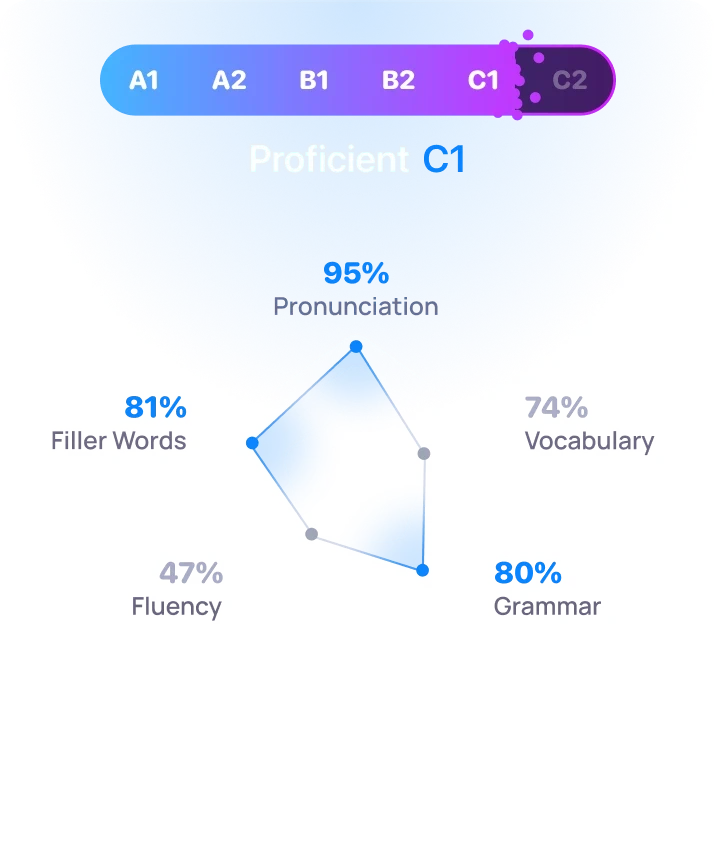
Fluently does this in conversation sessions - your grammar errors get flagged in context, tied to something you actually said, with the correct version right there. Over multiple sessions, it also tracks which errors repeat, so you can see your patterns rather than just getting random corrections.
Where to Actually Start
Not all at once. Genuinely, pick one thing from this list and work on it specifically for two to three weeks before adding another. Trying to monitor everything simultaneously usually means you end up monitoring nothing.
Articles first if that's your main background - it's the hardest and takes the longest, so the earlier you start, the better. Present perfect vs. simple past if you're regularly misusing time markers with "have." Prepositions if you know you're guessing and often guessing wrong.
One at a time. Long enough to actually see a shift.
Frequently Asked Questions (FAQ)
Do grammar mistakes actually matter in real conversations?
Most of the time, not that much. In casual conversation, people adjust and understand. The situations where they matter more: job interviews, client-facing work, language tests like IELTS, any setting where how you present yourself affects how you're assessed. Even then, it's the high-frequency errors that signal learner-level English - not the occasional slip.
Which error takes the longest to fix?
Articles, for most learners from non-article languages. It's not a rule problem - most people understand the rule - it's an automaticity problem. The habit of adding or omitting articles correctly has to be built through thousands of corrected examples. Using Fluently to get article corrections in context every day speeds this up compared to studying the rule on paper.
Should I focus more on grammar study or speaking practice?
Speaking practice with feedback, by a significant margin. Grammar study helps you understand what you're aiming for. But the only thing that actually replaces an old habit with a new one is practicing the correct form in real speech, repeatedly, until it becomes automatic.
How do I find out which grammar errors I make most often?
Record yourself speaking for 2-3 minutes on any topic, then listen back. You'll catch things you can't notice in real time. Or use Fluently, which tracks your specific error patterns across sessions - so instead of guessing what you're getting wrong, you can see the actual data.
Is there a quick fix for prepositions?
No - but learning common verb-preposition and adjective-preposition pairs as chunks (rather than as individual words) is the most efficient approach. And when you're genuinely unsure, looking it up takes ten seconds and prevents reinforcing the wrong version.
Can I fix grammar mistakes without a tutor?
Yes. What you actually need isn't a tutor - it's feedback on what you specifically say. A tutor provides that, but so does Fluently's real-time correction during conversation sessions. What doesn't work well is reading about grammar rules without ever producing the correct forms in your own speech.
Conclusion
Grammar errors that matter are the ones that confuse people or that mark your English as learner-level in places where that has consequences. There aren't that many of them, and they respond to specific, targeted practice - not to reviewing every grammar rule you've ever learned.
Find your pattern. Work on one thing at a time. Get corrections in real speech, not just on paper. That's actually how it changes.