The present perfect is one of the most commonly used tenses in everyday English, especially when talking about experiences, recent actions, or results that still matter. Many learners are confused about when to use it and how it differs from the simple past. In this article, you will learn how to use the present perfect tense correctly with clear rules and simple examples. Structure, general usage, signal words, and common mistakes are explained. We will also introduce you to practical example sentences you can use in daily conversation, writing, and exams. If you walk through this guide, you will better understand this tense and use it with confidence.
What Is the Present Perfect Tense?
The present perfect tense is among the most practical tenses in English. It is used in almost all day-to-day conversations, sentences, and examinations. Once you are completely aware of these tenses, you can speak and write English more naturally.
Definition of the Present Perfect Tense
The present perfect tense is used to describe actions that started in the past and still have a connection to the present moment. In simple terms, I will talk about something that happened before now, and I’ll also show why its results still matter today.
Construction Review:
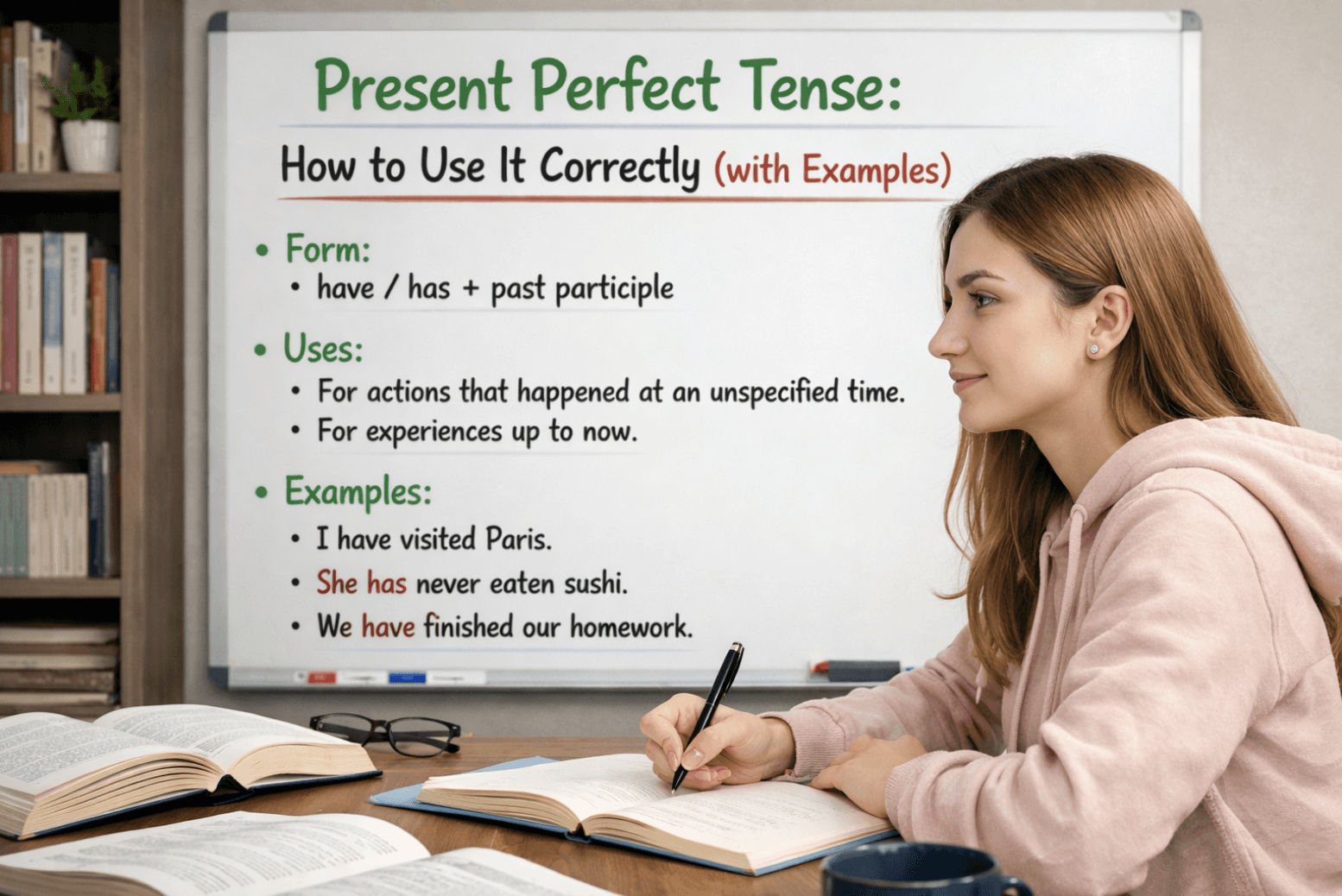
Subject + has/have + past participle (V3)
Example sentences:
I have finished my homework.
She has lost her keys.
They have completed the project.
In these statements, behaviour has occurred in the past, but has affected the present.
Example:
She has lost her keys.
(She doesn't have a key now.)
I finished my homework.
(I am free now.)
The exact time of action is not important. What matters is the current results.
Why This Tense Is Important in Daily English
People always use the present completion form in daily conversation. Native speakers are preferred when:
When talking about experiences
When sharing the latest information
When sharing recent news
When describing the situation affecting the present
Example:
I have seen that film.
We just arrived.
He's already finished eating.
Is work done
If you do not understand this tense, you may misuse the simple past tense. It may sound unnatural in English.
Why We Use the Present Perfect
Now, let us look at the main reasons we use this tense.
1. To Connect the Past With the Present
The present perfect tense connects past actions to the present. Even if something did not happen recently, it can still be important now.
Example:
I broke my phone.
(My phone is broken now.)
She moved to Karachi.
(She now lives in Karachi.)
We finished our work.
(Work is done now.)
In each example sentence, past behaviour r changes the current situation. This connection is the main concept of the completed form.
2. To Talk About Life Experience
Use the present completion form when talking about life experiences, when the exact time is not important.
Example:
I have visited Dubai.
She has traveled to Turkey.
They have tried Chinese food.
Have you ever ridden a horse?
I don't say when these events happened. Just talk about the experience itself. Common words related to life experience:
ever (ever)
never (once)
before (previously)
Example:
I have never seen snow. (I have never seen snow)
Have you ever met a famous person
She has done this before. (She has done this before)
3. To Talk About Recent Actions
Use the present perfect tense when talking about recent actions.
Frequently used words:
just (just)
already (already)
yet (still)
Example:
He just went out.
I've already finished my job.
Isn't that work done yet
She hasn't called yet.
These actions have occurred very recently and are still important.
4. To Talk About Unfinished Time
If the period is not finished, use the present perfect tense.
Example sentences:
I met him twice this week.
She called me today.
Three meetings were held this month.
They studied a lot this year.
The week, day, month, and year are still going on. So now use the present perfect tense.
Compare:
I met him last week. (Finished time → simple past)
I have met him twice this week. (This week is not finished → present perfect)
Structure and Formula of the Present Perfect Tense
The past simple tense is the only tense in which you can apply the present form of the tense. The basic form of this tense is a simple one. If you proceed step by step along the basic form, you can make an affirmative, negative, questionable, and even passive sentence without confusion.
Basic Formula
Subject + has/have + past participle (V3)
This is the basic structure of the present perfect tense.
Use have with: I, You, We, They
Use has with: He, She, It
The third form of the verb (V3) is very important. You must not use V3 and V1 or V2.
Let's take a basic example:
I have eaten lunch.
She has gone home.
They have finished the project.
We have completed the task.
You can see that each sentence follows the formula correctly.
Positive Sentences
Structure: Subject + has/have + V3
The affirmative states that something happened.
Example:
I finished my job.
She visited Lahore.
We cleaned the room.
They submitted a report.
He called a friend.
The rain stopped.
Step-by-Step Example
Sentence: She has visited Lahore.
Subject → She
Helping verb → has
Past participle → visited
Keep this order. Do not change the order of words.
More examples:
I have learned English.
You have improved your skills.
He has completed his assignment.
The teacher has explained the lesson.
Negative Sentences (How to Form Negatives)
To create a denial sentence, add not after has/have.
Structure: Subject + has/have + not + verb past partial form
Example:
They have not finished their work.
She has not finished her homework.
I have never seen this film.
We have not started a project.
He didn't call me.
You have not answered the question.
Short Forms (Contractions)
In spoken words, shortening forms are often used:
have not = haven’t
has not = hasn’t
Examples:
I haven’t finished my work.
She hasn’t visited Lahore.
They haven’t completed the task.
Both complete and shortened forms are correct. Use a shortened form in daily conversation. Use the full form in formal sentences if necessary.
Questions (How to Form Questions)
Change the order of words to make a question statement.
Structure: Has/Have + subject + V3?
Place “has” or “have” at the beginning of the sentence.
Example:
Have you seen this movie
Did she finish her homework
Did they arrive
Did he finish the job
Did we submit a report
The question form of the present perfect tense is made by starting the sentence with “has” or “have,” followed by the subject and the past participle of the verb.
The following questions are also available:
What (What)
Where
Why (Why)
How (How)
When (When)
Who (Who)
Structure:
Wh-word + has/have + subject + V3?
Example:
Where did you go
Why did she return early
What did they do
How did you solve this problem
Who had my pen
Passive Voice in Present Perfect
If you want to focus on the action itself rather than the person who performed it, use the passive form.
Structure: Subject + has/have + been + V3
Example:
Work completed.
The report was submitted.
The room was cleaned.
The project has ended.
Email sent.
Compare Active and Passive
Active:
She finished her job.
Passive:
Work completed.
In passive voice:
Use been after has/have.
Use the third form (V3) of the verb.
Focus is placed on the result.
How to Use the Present Perfect Tense (Complete Uses Explained)
The present perfect tense clearly shows how a past action is connected to the present moment. With these usages, you can take the right tense only when you know these usages. This tense is always the one that links the past and the present. We will consider each of the usages more closely.
Actions Started in the Past and Continuing Now
The present perfect tense is applied to those activities that began to be performed in the past and are still alive to date. It is not something that has been done. The present is also the truth, beginning with the past. Use “for” to show the duration of time, and use “since” to show the starting point of an action. The long-term situation can be elaborated on this usage.
Example:
I have been in this place for five years.
Since 2021, she has worked at this company.
We are long-term acquaintances.
When the Time Period Has Not FINISHED
In case the period still persists, apply the present completion form. Terms like Today, This Week, This Month, and This Year show an incomplete period. The action is related to the present as the period has not yet passed. The rule assists you in the selection of the right tense, not the basic past tense. Always remember to check whether the period is over.
Example:
I met him twice this week.
She called me today.
Completed three tasks this month.
Life Experiences (Time Not Important)
Use the present perfect tense when talking about life experiences where the exact time isn’t important. The only thing that matters is whether it has happened or not in someone’s life. We tend to apply such words as ever (ever), never (once), and before (before) in this case. Do not mention a specific year or exact date. It is widely used in everyday English.
Example:
She has traveled to Dubai.
I have never eaten sushi.
Have you been to Lahore?
Repeated Actions in an Unspecified Time
When explaining actions that have occurred many times in the past, use the present completion form without explaining the exact time. The focus is on "repetition," not "time." This structure suggests that the action could happen again in the future. It’s useful for describing habits or repeated actions without mentioning specific dates.
Example:
We watched the show many times.
I visited Lahore several times.
She repeated the question many times.
Recently Completed Actions (+ just, already, yet)
When speaking about things that have happened quite recently, the present perfect tense is applied. Words like just, already, and yet are commonly used with this tense.
Example:
He just went out.
I've already finished my job.
Isn't that work done yet
When Exact Time Is Unknown or Not Important
If you do not know the exact time or if time is not important, use the current completion form. Results are more important than time. This usage is common when something affects the current situation. Focus on what happened, not when.
Example:
Someone stole my book.
I lost my wallet.
She broke the glasses.
Present Perfect Tense Examples (Real-Life Sentences)
In this part, we shall observe the real-life uses of the present perfect tense. One can use these examples in everyday language, school, and business writing. Each group shows how the tense functions naturally in different situations.
Daily Conversation Examples
People use the present completion form when talking about recent actions, experiences, and incomplete times in their daily lives. This tense helps to communicate the latest information and share information connected to the present.
Example:
End your homework.
She just got home.
I've seen that film before.
He lost his mobile phone.
Are you ready to eat
They have already left.
Academic Examples
The present perfect tense has been introduced to academic writing and speech by students and teachers. This tense is used to explain the outcomes of research, a task done, a discovery, etc, and not to pay attention to the right time. It can be commonly found in the case of essays, reports, and presentations. It is applied when the outcome is significant in the present case.
Example:
Researchers found new evidence.
Scientists conducted several experiments.
The teacher explained the topic clearly.
Students have completed their assignments.
Many studies have shown good results.
The university introduced a new course this year.
Business Examples
In the business scene, experts use the present perfect tense to share the latest information, report progress, and discuss results. This tense helps convey completed actions that remain important today. Managers, employees, and companies are frequently used in emails, conferences, and reports.
Example:
The company has launched a new product.
Signed the contract.
The manager approved the proposal.
Sales increased this year.
The team completed the project.
The client requested additional details.
Improve Your Present Perfect Skills Faster with Fluently
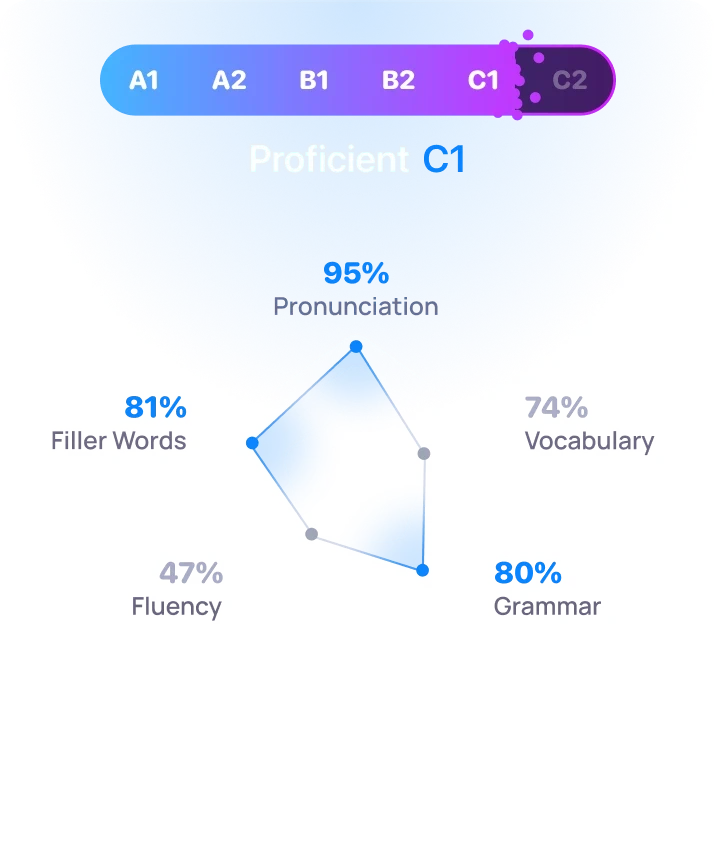
If you want to use the present perfect tense correctly in a real conversation, you need regular speaking practice and clear feedback. Fluently helps you understand your English accurately. Check pronunciation, grammar, vocabulary, and fluency to clearly show the current level. When you practice sentences such as "I have finished my work" and "She has visited Lahore," Fluently points out mistakes and supports corrections. In addition, Fluently creates a personal learning plan based on your level and goals. The app provides unlimited speech practice so you can build confidence step by step.


Key Features:
Real English Level Tracking: Evaluating pronunciation, grammar, vocabulary, and fluency to visualize true abilities
Personal AI Learning Plan: AI tutors analyze errors and adjust lessons according to goals and progress
Unlimited Speaking Practice: Practice English for interviews, meetings, sales, and presentations without limitation.
Practical Conversation Training: Learn grammar not only through theory, but also through actual conversation scenarios, such as the present completion form.
FAQs
How do you use the present perfect tense?
It is used with has/have + past partial form (V3) to explain the behavior related to the present. By practicing regular speaking with services like Fluently, you can use it naturally.
What does the present perfect look like?
Take the structure of the subject + has/have + V3. Examples: "She finished her job" and "I visited Dubai." Fluently allows you to practice these sentences in conversation.
What is a perfect tense sentence?
The completion form statement indicates a completed behavior with results and relevance to the present. Example: "I finished my homework." "They have already left."
Can we use the present perfect with a specific time?
No, the present perfect tense is not used together with the definite time in the past, such as yesterday or last year. It is applied when time is not explicitly given,n or it is still ongoing.
What is the difference between the present perfect and past simple?
While the present completion tense connects past actions with the present, the past tense focuses on actions completed at a specific time. Example: "I've seen that movie" vs. "I saw it yesterday."
Conclusion
The present perfect tense helps to connect past actions with the present. Remember the syntax: subject + has/have + past minutes (V3). It is used for life experiences, recently completed actions, repeated actions, and incomplete time expressions. Avoid accurate past tense expressions and identify situations where simple past forms should be used. If you practice these rules regularly, you will be able to speak English more naturally and confidently. Fluently is a great tool to speed up your progress. AI tutors analyze pronunciation, grammar, and fluency to provide unlimited speaking exercises. With Fluently, you can use the present perfect tense correctly in daily conversations, interviews, and presentations.