Here's the problem nobody warns you about: even when you're motivated to practice speaking, the logistics don't cooperate. Your tutor is busy. Your language exchange partner goes quiet for a week. And the idea of talking to yourself in the mirror sounds fine in theory and feels completely unsustainable after about 90 seconds.
Most learners aren't stuck because they lack motivation. They're stuck because they haven't built the infrastructure for daily speaking practice. This article is about building that infrastructure - specifically, methods that work at home, mostly alone, without depending on someone else's schedule.
All eight of these require actual output. Not passive consumption. Because that's the only thing that builds speaking fluency.
Before the Methods: Why Output Is the Only Thing That Matters Here
Quick version: you can understand English perfectly and still not be able to speak it. Millions of people do. They've watched years of English content and their comprehension is solid - but when they have to produce language under pressure, something seizes up.
Input (listening, watching, reading) and output (speaking) train different systems. They don't automatically cross over. You can't listen your way to fluency.
If you want a deeper explanation of why this disconnect happens - and it's more specific than just "practice more" - Why You Understand English But Can't Speak: The Real Reasons (And Fixes) is the right read.
The 8 Methods
1. Daily AI conversation with actual feedback
This goes first because it's the most effective thing on this list.
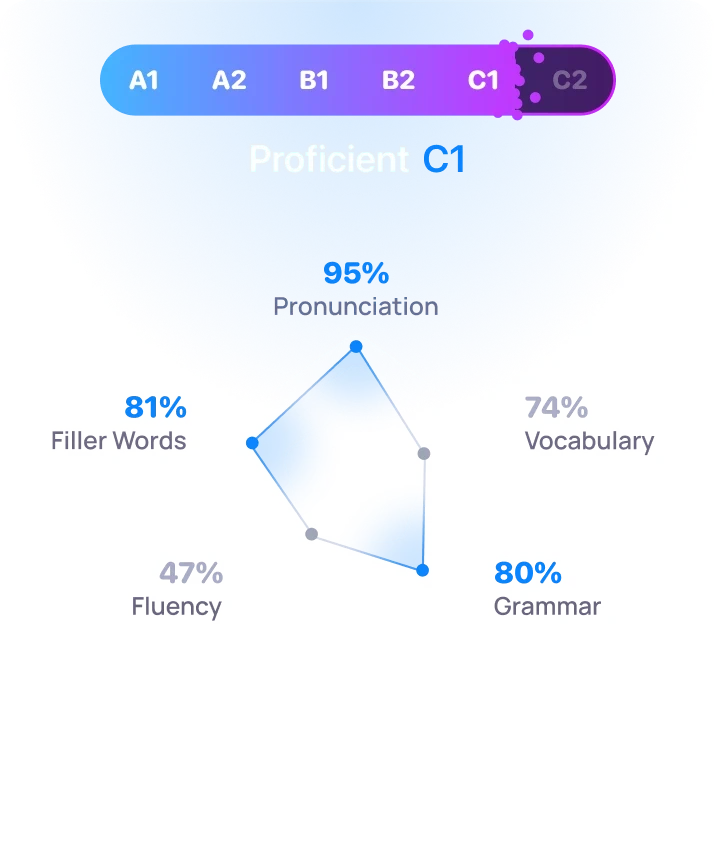
Fluently lets you have a real, unscripted conversation with an AI tutor - on your schedule, with no booking required. You pick the topic, speak freely, and the AI responds the way a person would. After each session, you get a breakdown of specific corrections: grammar errors, vocabulary choices that would sound more natural, patterns in your mistakes over time.
The feedback is what separates this from just talking to yourself. Solo speaking builds some fluency. Feedback-driven practice builds accurate fluency. There's a meaningful difference between those two things.
One more thing: no social pressure. You can get something completely wrong and the only consequence is that you learn it. For learners who feel anxious practicing with real people, that removal of judgment is actually a pretty big deal.
Practical tip: same time every day, even just 10 minutes. Morning tends to stick better than evening. Evenings have more ways to cancel themselves.
2. Narrate your day out loud
Yeah, this sounds like a lot. Bear with me.
While making breakfast: "I need to put the water on. I should've gone to the grocery store yesterday, I'm almost out of everything." On the way to work: "The train is crowded today. There must be something happening." Nothing profound. Just a running commentary on what you're doing and thinking.
What it actually builds: retrieval for everyday language - not the vocabulary you carefully studied, but the words for random ordinary things that come up constantly in actual conversations. And it keeps your brain in English mode rather than switching back to your native language every time you're not actively studying.
Do this for a month and see what changes in your spoken fluency. Most people who actually try it - not halfheartedly, but consistently - are genuinely surprised.
3. Shadow the speakers you want to sound like
Shadowing is speaking along with a recording simultaneously, not after - at the same time. Matching speed, rhythm, intonation. You're trying to inhabit how the speaker talks, not just copy the words.
Most non-native speakers have the rhythm of their first language sitting underneath their English. Individual words might sound fine, but at the sentence level, the pacing and emphasis pattern gives it away. Shadowing is the most direct way to fix that, because you're training your mouth and breath on the exact patterns you want to replicate.
Listen to a clip once. Then play it again and speak along. Same clip four or five times before you move on. It's a motor habit - repetition is the mechanism, not variety. Pairs well with everything in How to Improve English Pronunciation: A Practical Guide if pronunciation is a specific focus for you.
4. Record yourself and actually listen back
Nobody likes this. The sound of your own recorded voice is almost universally uncomfortable. Do it anyway.
Talk about something - anything - for two or three minutes without stopping. Record it on your phone. Then listen. All of it, not just the first 20 seconds before you cringe and turn it off.
What you hear won't be what you expected. Filler words you over-rely on. A sound you consistently mispronounce. Sentences that start strongly and trail off. Pauses that feel much longer in the recording than they did in the moment. This is what your conversation partners actually hear.
The version that works well: pick a recurring topic (your job, a project you're working on), record yourself on it once a week, and compare recordings from a month apart. Progress is often clearer than expected when you have reference points.
5. Talk yourself through things you already know well
Set a timer for five minutes. Pick a subject you know inside and out - your work, a hobby, a place you've lived - and explain it in English. Out loud. To no one.
The key rule: don't stop. When you can't find a word, describe around it. When a sentence comes out wrong, don't restart it - keep going and finish the thought. Fluency needs momentum, and stopping to self-correct every few words actively trains the opposite of what you want.
This exercise is particularly good for people who can handle casual English conversation fine but fall apart when explaining anything technical or detailed. Taking the content knowledge off the table - you already know what you're talking about - isolates the language challenge in a useful way.
Progress version: start with topics you know deeply, then gradually introduce things where the vocabulary is harder.
6. Read aloud, then paraphrase
Not a replacement for free speaking. A complement.
Read a paragraph from an article or book aloud. Then close the text - or look away - and say what you just read in your own words. Don't reproduce it exactly. Rephrase it.
That gap, between reading aloud and having to reconstruct the meaning in your own language, is where real output practice happens. Reading aloud on its own builds some pronunciation awareness and comfort with hearing yourself. Adding the paraphrase step turns it into active production.
Choose material that overlaps with English you actually use: business writing if you work in an English-speaking environment, tech writing if that's your field, whatever is relevant. Vocabulary lands deeper when it's connected to context you actually care about.
7. Prepare in advance for real English conversations
This one seems obvious and almost no one does it properly.
If you have a meeting in English on Friday, a job interview next week, or a presentation coming up - prepare for it the way an athlete would prepare for a game. Not just thinking about what to say. Actually saying it. Out loud. Multiple times. Until the key points feel smooth.
Notice the moments where you hesitate or where sentences fall apart. Work on those specific moments. Then go into the real thing noticeably more prepared.
The difference between thinking through what you'll say (in your head, in your native language) and actually saying it in English beforehand is enormous. Most people skip the second step entirely and wonder why they still freeze up.
For specific high-stakes contexts: English for Job Interviews: Complete Preparation Guide for Non-Native Speakers and AI Mock Interview: Prepare for Your English Job Interview with AI are both practical if interviews are what you're preparing for.
8. Debrief your English calls after they happen
If you already have meetings or calls in English, you're already practicing. The question is whether you're paying attention.
Right after a call, spend two minutes on it: What did you struggle to express? What did you want to say but couldn't find the words for? What did you avoid saying entirely because the English felt too hard?
Write those down or just note them mentally. Then look up the phrases and practice saying them. Come to the next call slightly more equipped for those specific moments.


Fluently integrates with your meeting workflow and surfaces these gaps automatically, so you don't have to rely on your own post-call memory to figure out what to work on.
A Starter Schedule
Start with two or three methods. Not eight:
| Day | Activity | Time |
|-----|----------|------|
| Monday | AI conversation | 15 min |
| Tuesday | Shadowing (same clip, repeat) | 15 min |
| Wednesday | Talk yourself through a topic | 10 min |
| Thursday | Read aloud + paraphrase | 15 min |
| Friday | Record + listen back | 20 min |
| Weekend | Self-narration, no fixed time | Ongoing |
Consistency beats intensity every time.
Frequently Asked Questions (FAQ)
Can you actually get better at speaking without a conversation partner?
More than most people expect. Speaking is a production skill - you can train it alone. What solo practice doesn't give you is unpredictable input and external feedback. Fluently covers both, which is why AI conversation tools have changed what "practicing alone" actually means.
How often should I be doing this?
Daily, even for just 10 to 15 minutes. Frequency is the key variable - not how long each session is. Daily short practice keeps the pathways active in a way that occasional long sessions don't. If you can't do daily, three times a week is the minimum to see consistent progress.
Is talking to yourself in English actually worth anything?
Yes, genuinely. The narration and think-out-loud methods work because they create real-time production - the same cognitive demand as an actual conversation. The only thing they don't provide is feedback, which is why pairing them with Fluently (or similar tools) fills that gap.
When will I actually notice a difference?
Most learners feel the change after three or four weeks of consistent daily practice - things feel less effortful, you hesitate less. Visible improvement that other people notice tends to come around six to eight weeks in. It's not instant, but it's also not as slow as most people fear.
What should I do if I only have 10 minutes a day?
AI conversation practice with feedback. It covers the most ground in the shortest time - real production plus correction in one session.
Do I need a language exchange partner?
It's a nice supplement if you can find a reliable one. But building a practice routine that doesn't depend on another person's availability is more sustainable for most people.
Conclusion
You don't need a tutor on speed dial or an English-speaking country to build real fluency at home. You need consistent output, a feedback mechanism, and a schedule that's actually achievable.
Pick one or two methods from this list. Do them every day for a month. Then see what's shifted. For more ideas on fitting speaking practice into a busy week, English Speaking Practice: 7 Ways to Practice Every Day (Without Extra Time) goes into the time management side of it.