You probably already know more English than you think. Seriously. Most people who come to this article can read it without a dictionary, understand it without straining, and yet - if someone called them right now and asked them to explain their job in English, they'd stumble.
That gap between understanding and speaking is the real problem. Not vocabulary. Not grammar. The fact that when the pressure is on, nothing comes out the way it does in your head.
So let's talk about what actually fixes that.
Fluency Is Not What You Think It Is
People treat fluency like it's just "a lot of English knowledge." Like if you study long enough, one day it'll click and you'll magically speak fast and naturally.
That's not how it works.
Fluency is a performance skill. Think of a pianist who knows every piece of music theory there is but only plays scales alone in a quiet room once a week. Put them on stage in front of an audience and ask them to improvise - good luck. The knowledge is there. The performance isn't.
Speaking English under pressure is the same thing. Every time you pull a word or phrase out in a real conversation, that mental pathway gets a bit stronger. Keep doing it and it starts feeling automatic. That's fluency. Not more knowledge - faster access to the knowledge you already have.
Here's the part most courses skip: input and output train different systems. Reading, listening, watching shows - all of this builds comprehension. It does almost nothing for speaking. The two skills don't automatically cross over. You can't listen your way to fluency. You have to talk your way there.
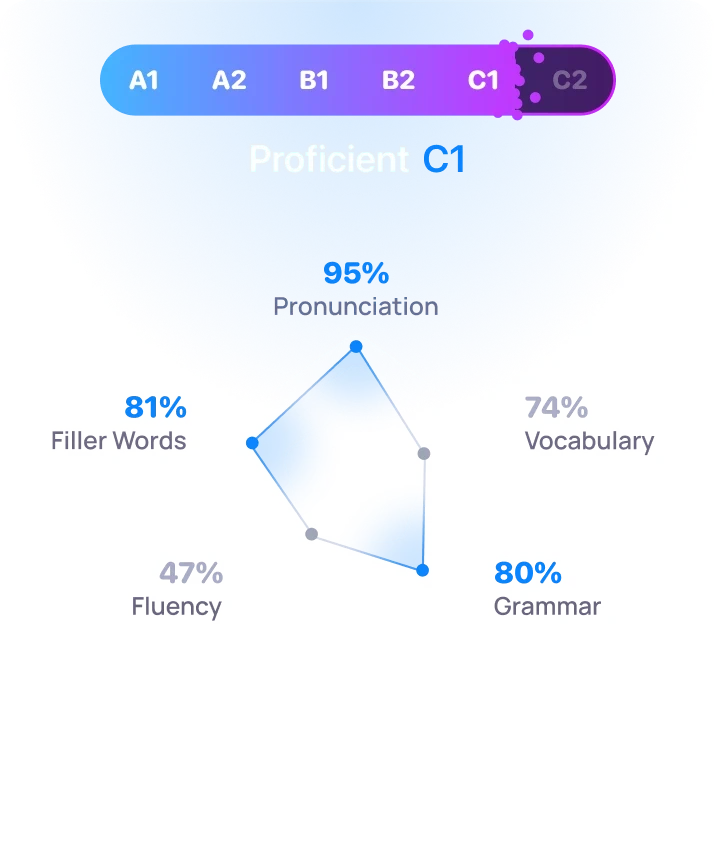
Not sure where you actually stand right now? The English Fluency Test is a useful place to start before you build a plan.
The Disconnect Most Learners Experience
You know the feeling. You understand everything someone says. You even know exactly what you want to say back. But by the time you've put the sentence together, the conversation has moved on, or the moment felt awkward, or what came out was a rough draft of the thought you actually had.
There's a whole breakdown of why this happens in Why You Understand English But Can't Speak: The Real Reasons (And Fixes), but the short answer is: comprehension and production are genuinely different cognitive processes. One doesn't train the other. You can be excellent at understanding English and genuinely bad at speaking it - and no amount of additional listening fixes that.
What fixes it is output. Speaking. Regularly. With feedback.
What to Actually Do
Speak something every single day
Ten minutes every day. That's it to start.
Consistency matters way more than duration here. If you go five or six days between speaking sessions, the neural pathways you're trying to build weaken in the gap. You're partially starting over each time. Short daily sessions keep those circuits active in a way that two-hour weekend marathons just don't.
The logistics problem is real though. Finding someone to speak with every single day - someone patient, available, not charging you by the hour - is genuinely hard. Tutors are expensive. Language exchange partners have their own schedules and honestly aren't always reliable. This is exactly why tools like Fluently exist: you get a real conversation partner on demand, at any hour, with feedback on what you actually said. Not gold stars. Actual corrections.
Set a time slot and protect it. Morning works better for most people - there's nothing to cancel it yet.
Learn phrases, not just words
Native speakers don't build sentences word by word. They retrieve chunks of language whole - fixed phrases and collocations that function as single units. "That makes sense." "It depends on the situation." "I'm not sure I follow." These don't get constructed each time. They get pulled out already formed.
When you study individual words in isolation, you're training yourself to build slowly. So instead of just learning "problem" - also learn: "run into a problem," "get to the root of the problem," "address the problem," "there's a problem with this." Same study time, completely different payoff when you actually need to speak.
Get corrected on what you actually say, not just on exercises
Grammar drills test how you perform under controlled, artificial conditions. Real conversations are neither controlled nor artificial.
The correction that actually changes your habits is the one that happens when you're trying to communicate something real and you immediately learn a better way to say it. That contextual feedback sticks - emotionally, neurologically - in a way that textbook corrections don't.
If you want a deeper look at how to build real speaking practice into your week, English Speaking Practice: 7 Ways to Practice Every Day (Without Extra Time) gets into the specifics.
Shrink the translation loop
Here's the hidden slowdown most intermediate speakers have: you think in your native language, translate, then speak. Every step takes time. The English you produce this way can be grammatically okay but feels slightly off - because you're expressing your native language's logic in English words.
Getting rid of this loop doesn't happen overnight. But it shrinks if you work on it deliberately:
Attach new vocabulary to images and situations, not to their translation. When you can't find a word, describe around it in English rather than switching to your first language in your head. Narrate small everyday moments out loud - what you're making for lunch, what you're thinking about on your commute. Sounds a bit odd. Works really well.
Over months - realistic expectation, not weeks - the translation step gets shorter. Eventually it barely registers.
Shadow speakers you actually want to sound like
Shadowing is speaking along with an audio clip almost simultaneously - not after, but during - trying to match the rhythm, speed, and intonation of the original speaker.
Most non-native English speakers carry the rhythm of their first language underneath their English. You can have clear pronunciation on individual words and still sound distinctly foreign because the sentence-level rhythm is off. Shadowing gradually breaks that pattern.
Pick a clip. Listen once. Then play it again and speak along, chasing the speaker. Do the same clip four or five times before moving on. You're building a motor habit - variety doesn't help here, repetition does.
What Actually Keeps People Stuck
Waiting to feel ready. Confidence doesn't arrive before practice - it arrives because of practice. There's no version of this where you feel comfortable before you've done enough reps to be comfortable.
Stopping to self-correct mid-sentence. Every time you backtrack to fix a grammar error, you're training yourself to pause. Fluency needs momentum. Finish the thought even if it's wrong, then notice what to fix. Flow first.
Only practicing in safe, controlled conditions. If you only speak English when you're prepared and the stakes are low, you'll only be fluent in those situations. Real conversation is unpredictable. That has to be part of the practice sometimes.
How Fluently Helps
Fluently cuts straight to the gap this article describes. Not quizzes. Not fill-in-the-blank. Real conversations on topics you care about, followed by specific feedback on what you said - what would be more natural, what grammar errors came up, what patterns to watch for across sessions.


The difference is that you're practicing with a mirror, not in a void. Every session shows you what to fix based on what you actually said that day.
A Rough Weekly Plan
Day | Activity | Time |
|---|---|---|
Monday | AI conversation session | 15 min |
Tuesday | Shadowing (same clip, multiple times) | 15 min |
Wednesday | Free conversation or exchange | 20–30 min |
Thursday | Chunk and phrase review | 15 min |
Friday | Record yourself, listen back | 20 min |
Weekend | English content, passive | Whenever |
Pick what you'll actually do. That beats a perfect schedule you abandon in week two.
Frequently Asked Questions (FAQ)
How long does it take to actually improve English fluency?
It varies a lot depending on how much you're speaking rather than just studying. Most intermediate learners start noticing a real difference - words coming faster, less effort - within about 4 to 6 weeks of daily practice. The bigger shift, where you stop translating in your head and just respond, tends to take 3 to 6 months. Want to know where you are right now? The English Fluency Test on Fluently gives you a clear starting point.
Is just listening to English enough to become fluent?
No. Listening builds comprehension, which matters - but comprehension and speaking are different skills that train different systems. You can't shortcut the speaking part by doing more listening. You have to produce language to get better at producing language.
Can I improve fluency without a tutor?
Yes. The important thing is feedback - knowing what you're getting wrong and specifically why. Fluently's AI tutor gives real-time corrections on your actual speech, which covers most of what a dedicated speaking tutor would address. The feedback step is non-negotiable; the human part is optional.
Why does my English get worse when I'm nervous?
Stress pulls cognitive resources away from working memory - the same system you need to retrieve vocabulary and structure sentences. It's not a language problem. It's a pressure problem. The solution is more low-stakes reps, so that speaking English stops feeling like a high-threat activity.
What single change makes the biggest difference?
Speaking every day instead of just studying every day. The gap between where most learners spend their time (input) and where fluency actually gets built (output) is enormous. Daily speaking, even for 10 minutes, changes this faster than anything else.
How do I stop thinking in my native language first?
You shrink the loop gradually, not eliminate it overnight. Connect vocabulary to concepts and images instead of translations. Describe around words you can't find instead of switching languages mentally. Narrate your day in English in your head. Over a few months, the translation step gets fast enough that it stops being a bottleneck.
Conclusion
Fluency comes from speaking, not from studying. The method is boring and the timeline isn't instant - but it's also not complicated. Daily output, feedback on what you actually say, phrases over isolated words, and enough patience to let it compound.
Start today, even for ten minutes. That's where it begins.