The vocabulary problem most learners have is not that they don't know enough words. It's that the words they know don't show up when they actually need them - in a meeting, mid-conversation, when they're searching for something more specific than "good" or "problem" and coming up empty.
That gap is the difference between passive vocabulary and active vocabulary. Passive is recognition - you see a word and you know what it means. Active is retrieval - you can produce the word spontaneously when you're speaking, without stopping to think about it. Most vocabulary study builds passive vocabulary and stops there. Which is why someone can have thousands of words somewhere in their head and still reach for basic words every time they open their mouth.
This is the thing worth actually fixing.
Why flashcard apps aren't the problem - and also aren't enough
Spaced repetition apps like Anki and Quizlet are genuinely good tools. The issue isn't that they're bad; it's that what they build - recognition - is only half the picture.
Recognizing a word when you see it does not mean you'll produce it spontaneously at conversational speed. That requires a completely different cognitive process: retrieval under time pressure, in a context you didn't predict. For that, the word needs to have been used in output - in speech or writing, multiple times, until retrieval becomes automatic.
So flashcards as one piece of a larger system: fine. Flashcards as the whole vocabulary strategy: not enough.
Learning words in chunks instead of in isolation
This is the biggest shift you can make in how you approach vocabulary, and it's underused almost universally.
Native speakers don't think in single words - they retrieve chunks, collocations, phrases. "Interested in," not just "interested." "Responsible for," "depend on," "make a decision," "raise concerns," "take ownership." These come out as complete units, not as individual words assembled on the fly.
When you learn a new word in isolation, you have one item. When you learn it with the words around it - the verbs it pairs with, the prepositions that follow it, the collocations it appears in - you have several usable phrases instead of one abstract entry.
"Problem" is a useful example because it feels basic but has a lot of range. "Run into a problem," "address a problem," "the root of the problem," "a recurring problem," "pose a problem," "this is problematic." That's not five separate vocabulary items. It's one word learned in a way that actually makes it productive.
When you encounter a new word, spend a minute finding what lives around it. What verbs does it pair with? What prepositions follow it? What common phrases use it? That minute is almost always worth it.
Use new words in speaking before the day is out
This is the most consistently underused technique, and there's a practical reason behind it.
Research on vocabulary acquisition is fairly clear that a new word needs to be used in production within 24 to 48 hours of first encounter to have a significantly better chance of entering active vocabulary. Reading it, highlighting it, adding it to a list - none of that activates it. Using it in a sentence, spoken out loud, in a context where it means something you actually want to say - that starts the process.
The first time you use a new word in speaking, it'll feel slightly awkward. That's what entering active use feels like. It means it's working.
Daily conversation practice creates these opportunities naturally - which is one reason using something like Fluently for regular speaking sessions supports vocabulary development beyond what studying alone does. You're producing language, not just reviewing it.
Read in areas that actually matter to you
Reading builds vocabulary more efficiently than most people realize - with two conditions.
First, the material needs to be at the right level. Slightly challenging, mostly comprehensible. Too easy and nothing new is entering the system. Too hard and you're spending so much effort decoding that retention drops.
Second, and more importantly: read in areas relevant to the English you actually use. If you work in finance, reading English finance writing exposes you to the vocabulary you'll need in your actual work. If you want to sound more natural in conversation, reading material written in a conversational voice - good essays, quality journalism, writers with a distinct personal style - is more useful than reading academic papers.
The vocabulary you encounter in relevant material is vocabulary you're more likely to retain, because it's connected to contexts and concepts you already care about. English Vocabulary for Daily Life: 500 Essential Words and Phrases is a practical starting point for everyday vocabulary - though the activation step still matters regardless of where you start.
Building vocabulary by theme instead of randomly
Word-of-the-day studying produces random vocabulary. Thematic vocabulary study produces clusters of related words that show up together when you need them.
If you're building work vocabulary, a week on performance language ("exceed expectations," "deliver results," "take ownership," "flag an issue"), then a week on collaboration language ("align on," "loop in," "circle back," "push back"), then situational workplace vocabulary. When you're actually in a work conversation, those clusters are available together - not scattered across months of random study.
The method works for any topic. How to Talk About Your Hobbies in English: Vocabulary and Examples applies this approach to one specific theme - the logic transfers to anything you want to build vocabulary around.
What order to build vocabulary in
Not all vocabulary is worth equal investment, and where most learners go wrong is spending time on the interesting or unusual words before they have solid command of the most frequent ones.
The most efficient investment: first, make sure the 2,000-3,000 most frequent English words are solidly active - meaning you can produce them automatically, not just recognize them. These cover the vast majority of everyday conversation. If any are still passive, they're worth prioritizing over learning new obscure words.
Second, build vocabulary specific to your domains - your field, your interests, the contexts where you actually use English.
Third, gradually expand into lower-frequency but more expressive vocabulary - synonyms that add precision, phrasal verbs, more nuanced academic language if that's relevant.
Spending time on obscure vocabulary before the high-frequency core is active is a poor return on time. Most people do it anyway because the obscure stuff feels more interesting. Worth resisting.
Words have register, not just meaning
"Furious" and "annoyed" both mean angry. They're not interchangeable. "Consequently" and "so" both signal result - using "consequently" in casual conversation sounds stiff in a way that's hard to explain but immediately noticeable. "Kids" and "children" mean the same thing but carry different warmth and register.
Learning what a word means is necessary but not sufficient. You also need to know when it's used, by whom, in what contexts, and what tone it carries. This is what makes vocabulary sound natural instead of technically correct but slightly off.
Building this intuition requires exposure in context - listening and reading in authentic English - combined with feedback on register and phrasing when you produce language yourself. Fluently flags phrasing that sounds unusual to a native speaker even when the vocabulary is technically right, which builds register awareness faster than passive exposure alone.


The one habit worth building
Not a tool or a course. A daily habit.
Before you speak English each day - in a conversation, a meeting, a practice session - deliberately try to use one or two words or phrases you've been building. One or two. Not every sentence. Just intentional activation of something you've been studying.
Over a month: 30 to 60 words moved from passive to active. Over a year: hundreds. The compounding is significant. And the habit is light enough to actually maintain, which is the part that usually breaks down with more elaborate systems.
Frequently Asked Questions (FAQ)
How many new words should I learn per day?
Five words learned in depth - with collocations, context, and same-day use in speech - is more valuable than twenty words recognized in isolation. Most learners overestimate how many new words they need and underestimate how many words they already know passively but can't produce. Activating existing passive vocabulary is usually the better investment than adding new items.
Does watching English TV or listening to podcasts build vocabulary?
It builds passive vocabulary - recognition and comprehension. Moving words into active use requires producing them. Pairing listening with speaking practice that deliberately uses vocabulary you've recently encountered is the more complete approach. Using Fluently's conversation sessions creates a natural opportunity for this - words you've been studying can be tested in actual dialogue.
What's the fastest way to make new words stick?
Use them in speech within 24 hours of learning them, in a context that's meaningful to you. Connect them to something you already know - a word you recognize, a specific situation. Learn them in chunks rather than isolation. Pure memorization doesn't stick nearly as well as meaning-based, contextual learning.
Should I learn synonyms to sound more sophisticated?
Only if you'll actually use them. Learning synonyms that get slotted in mechanically tends to sound unnatural - native speakers don't consciously vary vocabulary for effect, they use the word that fits the context. Learn synonyms to add precision or to understand what you're reading, not to perform vocabulary range.
How do I know if my vocabulary is strong enough for professional English?
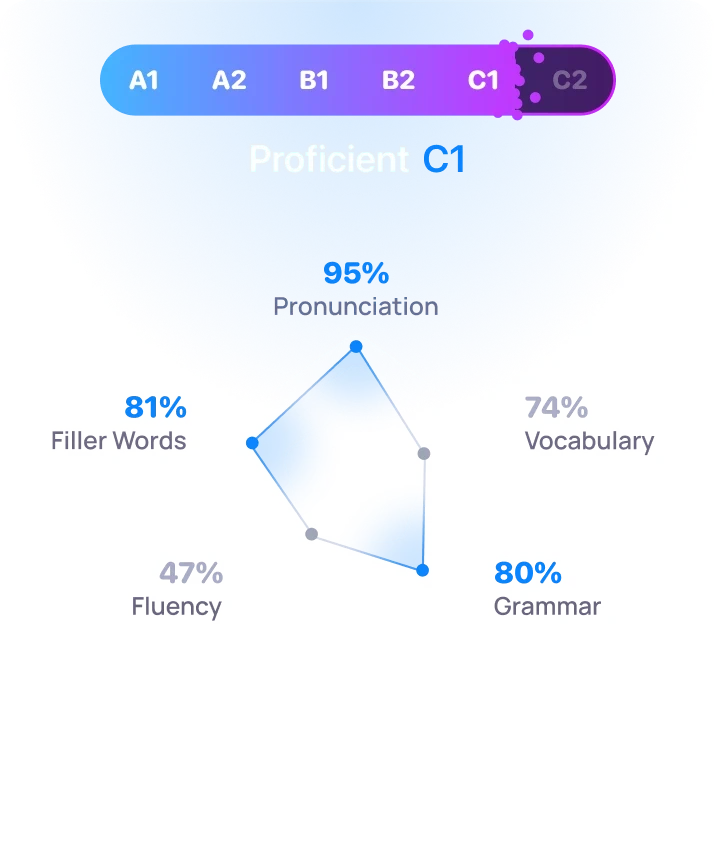
Test it through output rather than recognition. Can you discuss topics in your field without reaching for words or falling back on simpler alternatives? Can you express your ideas precisely rather than approximately? If specific contexts feel thin, build thematically there. The English Fluency Test also gives you a useful benchmark for where your speaking currently sits.
Are phrasal verbs worth learning?
Yes - and they're worth prioritizing over obscure idioms because they're used constantly in spoken English and often have no clean single-word equivalent. "Figure out," "come across," "give up," "run into," "sort out" - these are high-frequency enough that not knowing them creates noticeable gaps.
Conclusion
Building active vocabulary - words that show up automatically when you're speaking - requires more than reviewing lists or recognizing words in reading. It requires using words in production, in context, repeatedly, until retrieval stops feeling effortful.
Learn in chunks. Use new words in speech the same day you encounter them. Read in relevant areas. Build thematically around the situations where you actually need English. That combination, sustained over months, is what produces a vocabulary that's available when you need it.