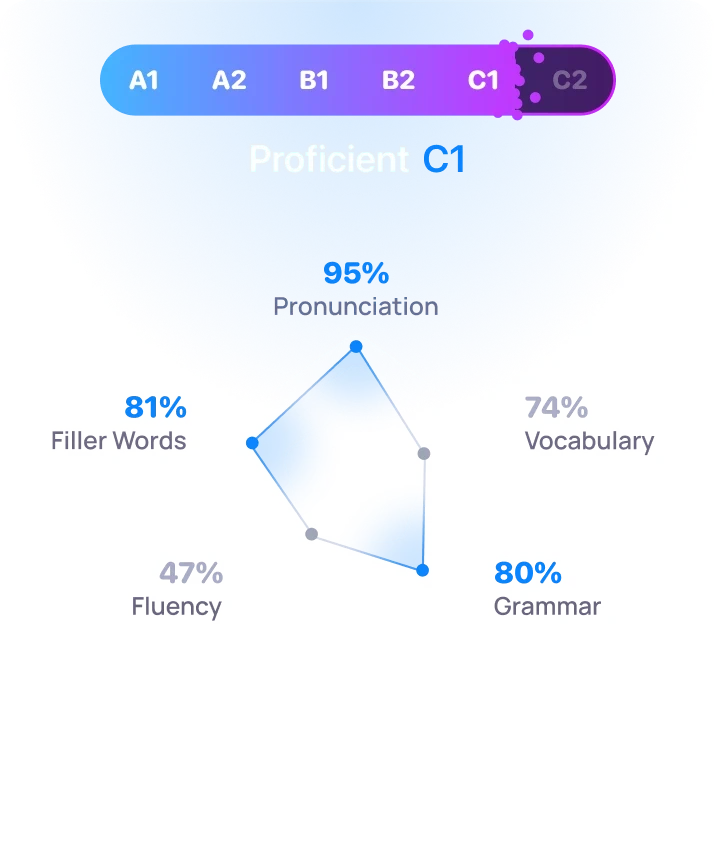
Meta Description: Discover simple steps to test your English speaking level, understand your proficiency, and improve fluency with AI tools, online tests, and expert tips.
English Fluency Test: How to Assess Your Speaking Level
English-speaking ability is important for work, school, and personal growth. When you understand your level, you can focus on areas that need improvement and communicate confidently. Modern tools, including AI-based platforms, make testing easier, faster, and more accurate. This guide covers all methods for assessing your English-speaking skills, from official exams to self-assessments, and provides practical improvement tips. Whether you are a beginner or an advanced learner, these steps will help you track progress and achieve fluency. By following this guide, you can plan your learning effectively and reach your goals.
Why Testing Your English Speaking Level Matters
Test your English speaking level to understand your strengths and weaknesses. Save time and effort by focusing on areas that need improvement. In education, you can participate in appropriate courses by knowing your level. In the workplace, it helps with clear communication and career advancement. You can also build confidence by feeling real progress. The accurate assessment clearly shows current skills and specifically identifies areas for improvement. Without testing, learners tend to waste time practising in the wrong area or overestimate their abilities.
Understanding English Speaking Levels
Being aware of your level of English speaking, it is possible to pay attention to the right learning activities and track your progress. From simple discussions to high proficiency, different models and stages characterize the existing abilities. The knowledge of these levels allows us to set the goals realistically and effectively track the progress.
The Global Language Level Framework
The European Language Common Reference Framework (CEFR) has six levels of learning (A1, A2, B1, B2, C1, C2). These levels are between the beginner and advanced levels and offer a universal guideline through which oratory skills may be unified across the global arena. With the help of CEFR, learners will be capable of determining the level properly and structure their learning.
Beginner, Intermediate, and Advanced Levels
Key features of each level:
Levels of beginner (A1-A2): Simple words, short sentences, and difficulty in pronunciation.
Intermediate (B1-B2): Opinion, description, and sometimes grammar can be incorrect.
Advanced (C1-C2): fluency, extensive vocabulary, and good articulation of thoughts.
Common challenges and expectations:
Novices are not quick to speak or prone to memorizing words. Intermediate students should usually practice more complex sentences. Sophisticated individuals perfect pronunciation, phrases, and colloquialisms in an effort to be clear and fluent.
Modern Methods to Test Your English Speaking Level
In particular, English-speaking skills can be measured more easily using modern tools and methods. With AI-based assessment, online testing, standardized assessment, and field practice, learners can now test their levels through a variety of methods. With the appropriate method, one can monitor progress and improve effectiveness more efficiently.
AI-Powered Speaking Assessments
AI studies pronunciation, grammar, vocabulary, and fluency. Provide comprehensive feedback and suggest ways to become better. The AI adjusts the learning process according to the individual learner and his/her pace, which makes the practice more effective. The use of AI must be regular to track the process and correct the mistakes as soon as possible.
Online English Speaking Tests
Many websites offer free or paid English-speaking tests. Free testing is easy to use, but the accuracy may be low. Paid platforms such as SmallTalk2Me and English Radar provide more accurate grading and feedback. Online testing is convenient, and you can practice at any time.
Official Standardized Exams
The speaking skills will be formally assessed with exams like the Cambridge English Test, the TOEFL, and the IELTS. We have stringent criteria of grading, i.e., pronunciation, grammar, vocabulary, and consistency. All positive features of English can be enhanced by these exams, and allow you to receive internationally acclaimed certificates.
Conversational Practice
By speaking to native speakers, fluency and confidence are enhanced. You are able to simulate real-life discussions and rehearse conversations, meetings, and presentations. The mobile application is also provided with pronunciation practice and immediate feedback. The practice makes one lose hesitations and become habitual in speaking.
Self-Assessment Techniques
Tape yourself and criticize yourself. Evaluate pronunciation, grammar, vocabulary, and fluency through checklists and evaluation criteria. Identify the strengths and weaknesses, and practice well. Self-assessment assists in self-study and self-knowledge.
Key Criteria to Evaluate Speaking Proficiency
Being familiar with the words and grammar is not as easy as speaking skills, which are evaluated in English speaking. To determine real proficiency, there are several areas that are to be measured. All the requirements imply your effectiveness in terms of communication, not only in formal exams but also in real-life scenarios. Having these in mind, you can know what you are good at and what you should improve on.
Pronunciation and intonation: These are to be clear in order to ensure the soundness of a listener. Intonation provides a sentence with emotion and meaning.
Grammar and syntax: With correct grammar and sentence structure, ensure accuracy and professionalism. The slightest mistakes may distort the meaning.
Richness and suitability of vocabulary: This means that you can have a rich vocabulary to express your idea. This is because of the use of appropriate words (formal/informal) depending on the context, and therefore, effective communication.
Fluency and consistency: Fluency is a measure of fluency that is unnecessarily smooth and unnecessary. Consistency makes sentences logically related and makes thoughts easier to comprehend.
Skills in situational communication: To be able to talk, it is necessary to realize the circumstances and the audience.
Common Mistakes When Assessing English Speaking Level
The majority of learners commit errors during the evaluation of their English speaking. Through these errors, you will be in a better position to outline your talents and not waste time doing what is not right. The most common mistakes that are to be mentioned are:
Reliant on grammar tests alone: A few learners will only rely on written grammar tests to learn about their speaking skills.
Exaggeration of abilities based on passive skills: There are learners who feel that they are good speakers just because they have good reading and understanding abilities in English.
Do not worry about the effects of pronunciation and accent: You cannot have inappropriate intonation and incoherent pronunciation when you want the opposite party to comprehend you.
Reality-based tasks: Tasks that are based on reality have higher chances of failure when they are practiced in scripted conversations.
These pitfalls are the major ones that should be avoided since then you can judge how much you have achieved in speaking. Combine grammar, vocabulary, pronunciation, fluency and real life application to have a complete picture of your skills. By doing proper evaluations, you are in a position to plan on the process of learning and move faster.
Tips to Prepare for an Accurate English Speaking Test
Adequate preparation has a significant impact on the findings in the English-speaking test. With an emphasis on key strategies, you will be able to demonstrate your competence with confidence. These aspects will ensure skillful and mindset assessment.
Tension: tension is not bad yet; it influences performance. Test after rehearsing deep breathing, and picture yourself speaking confidently.
Practice and mock test: practice makes perfect. Talk each day, engage in the dialogue, and recapture the test setting.
Learning about assessment criteria: Learn what the examiner will be assessing, such as pronunciation, grammar, vocabulary, and fluency.
Take advantage of objective feedback: Feedback shows what is good and what is better. Have teachers, tutors, and native speakers analyze what you say.
How to Interpret Your Results
It is necessary to interpret the results of the English speaking test after it has been conducted so they can be effectively used for improvement. The outcome reflects the existing level, strengths,s and weaknesses, and it is a guideline for the study plan. With the appropriate interpretation of the score, it is possible to focus on the relevant areas, define realistic goals, and monitor progress.
Understanding CEFR Levels
The CEFR model has six levels of English proficiency that include A1 (beginner), B1, B2, C1, and C2 (advanced). Indications of your speaking, listening, reading, and writing skills are present at every stage. Knowing your level in CEFR will also assist you in evaluating your positioning in the international world and selecting the right learning tasks. The level also enables you to focus on the aspects that need the most attention and not waste time on those aspects that are not mandatory.
Practical Meaning of Each Level
A1-A2: Pay attention to simple sentences, pronunciation, and basics.
B1-B2: Improvement in grammar, vocabulary, and fluency.
C1-C2: Level of sophistication in expression, idiom, and excellence in mastering the stylistic forms of advanced writing.
A clear value of expectation is defined on each level. Novices are the first to establish the basis, intermediates to devise autonomy in dialogue, and the advanced learners to evolve subtlety and fluent speech. The knowledge of your own level allows you to set realistic goals and measure your progress.
Mapping Results to Learning Goals
At this point, after defining your level, we are going to modify your learning activities to your objectives. As an illustration, at the B1 level, one can work on the conversation with complete sentences, on the development of vocabulary, and on discussing. The existence of developmental management is based on CEFR-level results, which facilitate sound development in all practices. Short and long-term goals will be helpful to keep one motivated. Demonstrate great effectiveness, ensure fluency and correctness, and increase long-term confidence.
How to Improve Your English Speaking Proficiency
One must strive to achieve his English speaking skills by employing an intensive strategy and working. Practice: Practice will be an everyday activity that will develop vocabulary, involve real-life English information, and provide feedback. A mixture of various techniques is ensured to achieve fluency, accuracy, and confidence. The practice will enable you to train and achieve noticeable progress in the long term.
Daily Practice Techniques
The speaking habit is reinforced by daily practice, and hesitation is reduced. It is possible to train your brain by merely thinking in English rather than necessarily seeking to translate something in your own language such that you can form sentences in English. Discussions, lectures, and interviews will assist you in easy communication.
Expanding Vocabulary and Grammar
The language can be used naturally by acquiring new vocabulary and grammar in context. Words are learned in meaningful contexts by way of context learning, reading articles, and watching videos. Memory and active reminiscing (e.g., flashcards and self-quizzes) help them to remember more words and find them easier during speaking.
Engaging with Authentic Material
Viewing podcasts, videos, and conversations: You can touch natural speech, accents, and idiomatic expressions.
Join the English community: Practice real conversations in forums, discussion groups, and social clubs.
You can learn how to speak English in various situations by regularly engaging with authentic teaching materials. It also improves listening, pronunciation, and natural response.
Getting Feedback
Feedback helps you correct errors and improve your skills. AI-based correction tools like Fluently evaluate pronunciation, grammar, and fluency in real time. Instructors and conversation partners provide individual feedback and teach improvement points. Continuous application of this feedback will quickly fix errors and make your speech more accurate and confident over time.
Master Your English Speaking with Fluently – The AI-Powered Personal Tutor
Fluently is an intelligent application, a smart mobile app that will assist you in keeping track and improving your speaking ability in English. Assess pronunciation, grammar, vocabulary, and fluency to demonstrate the appropriate level. The AI tutors develop customized learning plans, modify lessons based on strengths and weaknesses, and support unlimited speaking practice in real-life contexts. You can practice with confidence in an interview, a conference, a sales telephone call, a presentation, etc. Fluently helps you learn your favorite topics, fix mistakes instantly, and gradually build fluency and natural expressiveness faster than traditional methods.


Key Features of Fluently:
Evaluate pronunciation, grammar, vocabulary, and fluency in real time to clearly understand the current level of English.
Faster progress with a personalized learning plan that dynamically adapts to mistakes, strengths, and learning goals.
Unlimited speaking practice in practical situations such as interviews, conferences, presentations, and daily conversations.
Learn about topics of interest. Continue attractive practice according to daily life and business needs.
Instant feedback and error correction to instantly correct mistakes and naturally build confidence.
FAQs
How do I test my English speaking level for free?
There are free online artificial intelligence tools, mobile applications, and self-checklists. On record and check, you can see the errors and track progress without charge.
What is the fastest way to know my proficiency?
Artificial Intelligence testing provides instant feedback. Tools like Fluently can instantly analyze pronunciation, grammar, vocabulary, and fluency and provide an accurate level assessment within a few minutes.
Can AI really assess fluency accurately?
Yes. AI is a technology that analyzes pronunciation, grammar, vocabulary, and logic in real time. Fluently also gives you accurate feedback and improvement tips so that you can actually and surely improve your speaking fluency.
How often should I test my English level?
You can grasp progress every 4-6 weeks, adjust your learning plan, and focus on areas that need improvement. Frequent testing ensures continuous growth and more accurate evaluation.
Conclusion
The measurement of English proficiency levels must be accurate so that learners can learn and build confidence. The integration of AI technologies can make official tests and face-to-face discussions complete and effective in the learning process. Fluency, pronunciation, and vocabulary can be enhanced with practice and consistent feedback over time. An AI tutor, such as Fluently, allows you to monitor your progress, learn how to learn, and correct your mistakes. In real-life scenarios like interviews, meetings, and presentations, among others. With passion and practice, it becomes possible to make long-term change, improve communication skills, plan career growth, succeed, and study abroad.