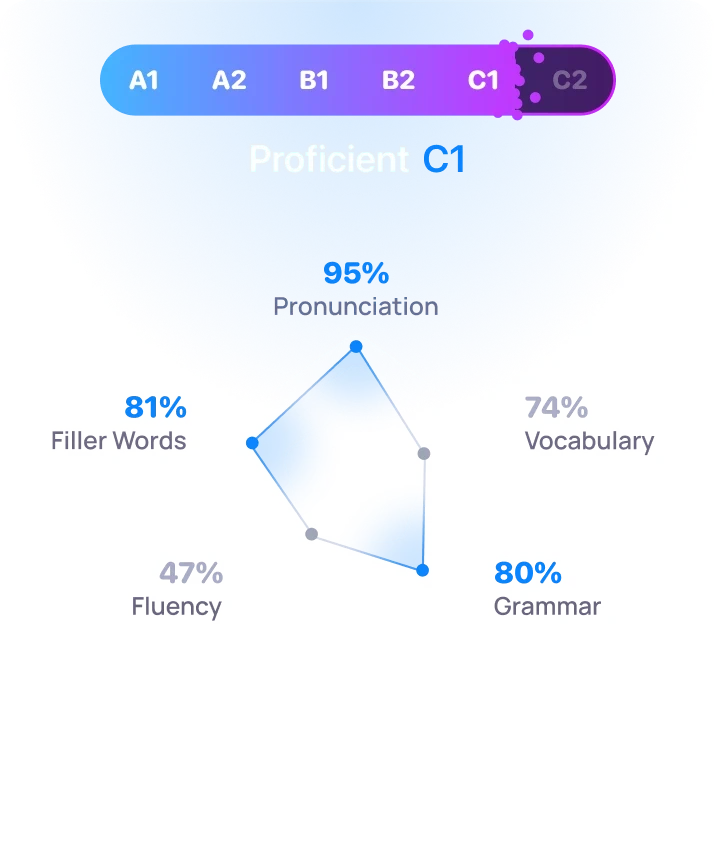
There's a specific kind of frustration that hits somewhere in the intermediate stage. You've been studying for months, maybe years. You understand most of what you read. You can hold conversations. And yet something feels stuck - like the gap between where you are and where you want to be has stopped closing.
This is the plateau. It's real, it's common, and it has specific causes. The fix depends entirely on which cause you're dealing with - which is why the generic "immerse yourself more" advice rarely works.
Why plateaus happen in the first place
The early stages of language learning produce fast visible progress. You go from zero to understanding basic sentences. Then to having simple conversations. The improvement is obvious and motivating.
At intermediate level, progress is still happening - but it's less visible. You're refining, not adding wholesale. The gaps between where you are and where you want to be are subtler: not "I don't know the word" but "I know the word but can't retrieve it fast enough" or "I'm grammatically correct but I sound stiff."
And here's the other thing: intermediate learners typically understand enough English to get through most situations without being pushed. Which means comfort kicks in. You stop encountering the friction that produces learning. The brain, being efficient, stops allocating resources to improvement.
That's the core of most plateaus: not lack of effort, but lack of the right kind of difficulty.
The four types of plateaus - and how to tell which one you're in
The fluency ceiling
Signs: you can speak English, but you slow down noticeably when the topic gets complex or unfamiliar. Simple conversations are fine. Anything requiring real-time thinking in English feels effortful.
What's happening: you haven't fully developed the ability to process and produce language simultaneously at speed. You're still translating, at least partly.
What actually helps: daily unscripted speaking practice - not studying, speaking. Conversations on topics that stretch your thinking, where you can't fall back on memorized phrases. The English Fluency Test is useful here for getting an honest baseline before you start.
The vocabulary plateau
Signs: you have plenty of words, but they feel flat. You reach for the same safe vocabulary repeatedly. You understand more sophisticated language when you hear it but don't produce it yourself.
What's happening: your passive vocabulary is large, but your active vocabulary - what you can retrieve in real time - is much smaller. And it's not growing because you're not activating new words in production.
What actually helps: thematic vocabulary study combined with same-day use. Not more flashcards - more deliberate output. Pick two new words or phrases each day and find a way to use them in actual speech before the day ends. That habit is surprisingly powerful over months.
The grammar accuracy ceiling
Signs: you know the rules. You even know when you've made an error after the fact. But the errors keep coming in real speech because you're focused on what you're saying rather than how.
What's happening: grammatical accuracy in speech is a different skill than knowing grammar rules. It's about automaticity - the correct form needs to feel natural, not just sound right when you're analyzing it carefully.
What actually helps: targeted correction in context. When you make a specific grammar error in speech and immediately hear the correct version, you're building a direct association that passive rule review doesn't create. This is one reason feedback during actual conversation - from a tutor, a language partner, or a tool like Fluently that flags errors in context - accelerates grammar accuracy more than rereading rules does.
The pronunciation ceiling
Signs: your vocabulary and grammar are solid, but people sometimes ask you to repeat yourself. Or you feel like your accent is making you sound less confident or professional than you actually are.
What's happening: pronunciation issues are often deeply ingrained habits formed early in language learning. They require targeted, conscious practice on the specific sounds that cause you problems - not just general speaking practice.
What actually helps: identifying the two or three specific sounds or patterns causing problems, then drilling those deliberately. This is different from general speaking practice. It requires feedback on individual sounds, not just overall comprehension. The Fluently Accent Guru is one tool for getting that kind of specific pronunciation feedback.
The "comfortable input" trap
One pattern that sustains plateaus is consuming English content that's too easy.
If you're watching English TV you already understand, reading articles on familiar topics, and having conversations with people who know your speaking patterns well - you're getting exposure to English without the productive friction that drives improvement.
The research on this is fairly consistent: language acquisition happens at the edges of comprehension, not in the comfortable middle. "i+1" is how linguists often frame it - you need input that's one level above where you currently are, not well within it.
The fix: deliberately seek out slightly difficult English. Articles on topics you're not already an expert in. Conversations with new people who don't know to simplify for you. Podcasts where you catch maybe 80-85% and have to work for the rest.
The speaking-without-feedback loop
Another plateau sustainer: practicing output without any correction.
Speaking English every day is better than not speaking it. But speaking the same errors every day, without anyone flagging them, is how those errors become permanent. At some point they stop feeling wrong because they've been repeated so many times.
Fluency and accuracy are different things. Lots of practice builds fluency. Lots of practice with feedback builds fluency and accuracy. The second is harder to arrange, but it's the only thing that clears up persistent error patterns.
The "study more" mistake
When learners hit a plateau, the default response is often to study harder: more grammar review, more vocabulary lists, more time on learning apps.
This rarely helps, because most intermediate plateaus aren't knowledge gaps. You already know enough English. What's missing is the activation of what you know - in real speech, under real-time conditions, with feedback.
More studying adds to passive knowledge. More practice with feedback converts that knowledge into performance. These are different activities, and the plateau is almost always telling you to do the second one.
Building a plateau-breaking routine
The structure that works: less passive study, more active production with feedback. Concretely:
20-30 minutes of unscripted speaking practice per day (AI conversation tools work well here for consistency - Fluently is built exactly for this)
One focused area at a time - vocabulary, grammar accuracy, or pronunciation. Not all three simultaneously
Slightly challenging input that you're actively processing, not comfortable background English
Periodic self-recording to hear your own patterns rather than just feeling them
The most common reason plateau-breaking routines fail is trying to fix everything at once. Pick one thing. Work on it for three to four weeks. Notice whether it moves. Then add the next.
How Fluently Helps With Plateaus
The reason plateaus are hard to break through self-study is that you need feedback - in real time, tied to what you specifically said - to build new habits. Reading about grammar errors doesn't fix them. Hearing the correct version in the moment you made the error is what builds the association.


Fluently's conversation sessions create exactly that feedback loop: your errors get flagged in context, with the correction right there. And because it tracks patterns across sessions, you can see which errors are repeating rather than guessing.
Frequently Asked Questions (FAQ)
How long does an English plateau usually last?
There's no fixed timeline - it depends on what's causing it and whether you're actively addressing it. Plateaus caused by lack of productive friction can last years if nothing changes. With deliberate practice targeting the right gap, most learners see movement within 4-8 weeks.
Is it normal to plateau even if I'm practicing every day?
Yes - if the practice isn't the right kind. Daily speaking without feedback, daily reading of comfortable material, daily vocabulary review without production - all of these are practice, and none of them are particularly effective at breaking an intermediate plateau. What matters is the quality and type of practice, not just the volume.
I understand English well but can't speak it fluently. Is that a plateau?
It's a specific type: the gap between passive and active skills. You've developed strong comprehension without developing the speaking mechanism. The fix is output - lots of speaking practice, with feedback - not more input. Tools like Fluently are useful here because they give you a low-pressure environment to build speaking volume without waiting for the right conversation partner.
Can I break a plateau without a tutor?
Yes. What you need isn't a tutor specifically - it's feedback on your actual output. A good tutor provides that, but so does any system that flags your specific errors in real time. What doesn't work is practicing in isolation with no correction loop.
How do I know which type of plateau I'm in?
Record yourself speaking for 3-4 minutes on a topic. Listen back. Are the sentences clear but slow? Fluency ceiling. Are you using the same limited vocabulary repeatedly? Vocabulary plateau. Are there consistent grammar patterns you notice? Grammar accuracy ceiling. Do you misplace stress or vowel sounds? Pronunciation ceiling. Usually one of these stands out clearly.
Does watching a lot of English content help break a plateau?
It helps with passive vocabulary and comprehension, but not much with speaking fluency or accuracy. Watching is input. Plateaus are usually output problems - they require production, not more consumption.
Conclusion
Plateaus feel like stagnation, but they're usually a signal: the kind of practice you've been doing has reached its ceiling, and you need to shift to something that creates productive friction again.
Identify which type of plateau you're in. Work on that specific gap with the right kind of practice. The improvement resumes - it just requires being deliberate about what you're doing and why.