Learning English verb tenses is essential for non-native speakers. Tenses indicate the time of occurrence of something in past, present and future. Proper application of tense renders your sentences simple, comprehensible and natural. Using right tenses will make your sentences sound well, clear and understandable. The English language has a basic 12 verb tenses; these tenses are used to demonstrate what is happening, what is already done and what is going to happen. Here, all the English tense will be elaborated with examples and thus, you will then be in a position to understand how they are used in the real life situations. Having such a guide, students will manage to enhance their fluency, feel confident, and prevent typical errors in writing and interacting with others.
What is a Verb Tense?
A verb tense shows when an action happens in the past, present, or future. Verb tenses give a clear time frame for your sentences.
For example:
I eat breakfast every morning. (present)
I ate breakfast yesterday. (past)
I will eat breakfast tomorrow. (future)
The right use of tenses makes your message straightforward and comprehensible.
English Verb Tenses Overview
The English language has 12 great verb tenses that can be classified into past, present, and future. Each of the tenses tells us not only when something is done, but also whether it is done or being done or is repeated.
Quick Verb Tense Chart:
Time Frame | Simple | Continuous | Perfect | Perfect Continuous |
Past | I ate | I was eating | I had eaten | I had been eating |
Present | I eat | I am eating | I have eaten | I have been eating |
Future | I will eat | I will be eating | I will have eaten | I will have been eating |
It is a quick guide to all tenses.
Detailed English Tenses with Examples
There are 12 principal verb tenses in English, which are grouped into past, present, and future. There is a combination of tense usage, structure, and meaning. It is because you can comprehend tenses and convey time. Each tense has been explained with examples below.
Past Tenses
Past tenses help us explain events that occurred in the past. They indicate that an action was completed, was ongoing, or extended over a period in the past. Knowledge of past tenses would be critical for narrating events, presenting experiences, and clearly stating events in both oratory and writing.
Simple Past
Structure: Subject + past form of the verb (+ object)
An action that occurred and was completed is illustrated in the simple past tense. We employ it in events with a definite time like yesterday, last week or 2010. It helps express accomplished tasks and prior practices.
Regular verbs form their past tense and past participle by simply adding "-ed." In contrast, irregular verbs use unique, distinct forms for their past tense and past participle.
Examples:
Yesterday I came to my grandmother.
She studied French last year.
They watched a movie last night.
On Sunday, we swept the house.
Past Continuous
Structure: Subject + was/were + verb-ing (+ object)
Past continuous tense is used to describe an activity, which was in course at a certain time in the past. It may be used with such words as: while or when to indicate that a certain activity was preceded by another. This tension releases the continuation of a previous action.
Examples:
He called in the middle of me reading a book.
It was five PM, and they were playing football.
It was evening and she was cooking when I was putting the table.
We were sitting at the TV where the lights were switched off.
Past Perfect
Structure: Subject + had + past participle (+ object)
The past perfect tense may be understood as a past action which must precede another past action. It illustrates the sequence of events. The tense may be employed to expound on cause and effect, or to give background details of a story. It is focused on achievement at some point in the past.
Examples:
I finished my homework way before dinner.
I came late and she had melted away.
They had spent their
Past Perfect Continuous
Structure: Subject + had been + verb-ing (+ object)
Past perfect continuous tense is the one through which one expresses that a certain action began in the past, up to a certain point in the past. It emphasises length rather than mere accomplishment. We commonly use it to describe the length of time that something had been going on before another thing took place.
Examples:
Before she came, I had two hours of studying.
They had been on a shift all day when the power went out.
She had already been waiting for an hour for the bus.
He had been fleeing because of an early rain.
Present Tenses
Present tenses refer to things that are done at a given period of time, or often, or repeatedly. They help us articulate the habits, facts, activities, and experiences that connect the past and the present. Understanding the present tenses would help you speak and write most of the time correctly.
Simple Present
Structure: Subject + base verb (+ s/es for he/she/it)
The simple present tense is used for speaking about normal things, routines, and everyday facts. It introduces universal or universal truths. We also apply it to the events that will take place. The base form is maintained in the vast majority of verbs, in that the verb is not subject-inflexed, but in the case of he, she, or it we appeal s or es. It is a very much used tense of both everyday spoken language and literature.
Examples:
I have my breakfast in the afternoons.
She plays tennis on weekends.
The sun rises in the east.
We walk to school every day.
Present Continuous
Structure: Subject + am/is/are + verb-ing (+ object)
Present continuous tense is employed in describing something continuous or something which is one time, but which is almost close to present. The tense is usually used with words such as 'current', ' at the moment', 'now', etc. It helps learners show their progress and avoid repetitive or habitual practices.
Examples:
I am reading a book now.
This week she is preparing for her exam.
They are also playing football in the park.
We are making supper at this very moment.
Present Perfect
Structure: Subject + have/has + past participle (+ object)
The present perfect tense introduces an action that is done at an uncertain date, or which supposes the present. The present tense is used when discussing an act that has been committed in the past but is not known at any time, or when discussing an act that applies to the present day. It comes in handy when time is not a very big factor or when time is unknown. These tenses are usually composed of words like already, yet, just or ever. It can also be applied to explaining experiences and changes in experience.
Examples:
I have finished my homework.
She has visited London twice.
They have already seen such a movie.
We are the fifth-year residents.
Present Perfect Continuous
Structure: Subject + have/has been + verb-ing (+ object)
The present perfect continuous tense, where an action began in the past and continues to the present, is used. It emphasises duration. We tend to use the terms' for' or 'since' to define the duration of an action.
Examples:
I have revised three hours in English.
She has been employed in this location since 2019.
A football game in the afternoon they have been playing.
We are waiting half an hour to have a bus.
Future Tenses
Future tenses refer to activities that will or are likely to take place in the future. They assist in laying out plans, forecasting events, and outlining how events will proceed until a given future is achieved.
Simple Future
Structure: Subject + will + base verb (+ object)
The basic future tense refers to the action that will occur later. It may also convey the predictions, promises, or decisions in the moment. This tense is mostly applied with references to time, such as tomorrow, next week, or soon. With the simple future, what you intend and what you plan is easily understood by the listener or reader.
Examples:
Tomorrow I will visit my friend.
She begins her new employment the following week.
They will go to Paris in the summer.
We will call you later today.
Future Continuous
Structure: Subject + will be + verb-ing (+ object)
The future continuous tense is used to refer to an action that will occur at a given time in the future. It tends to indicate a planned or expected future activity. The tense is often used with words such as ' at this time tomorrow', 'by then', and 'next week'. It helps learners articulate future actions that are in progress.
Examples:
I will study at 8 PM.
The meeting will take place when she is working.
They will be on their way within a month.
You see, we are waitingfor you at the station.
Future Perfect
Structure: Subject + will have + past participle (+ object)
The future perfect tense refers to an action which is impossible to perform by the time a given future comes. It is oriented towards future completion. By tomorrow, by next week and by 5 PM are all ordinary phrases. Tense indicates the chronology of events or dates.
Examples:
I will finish the homework at 8 PM.
Next Monday, she will be out of the project.
We will discover them disappearing before us.
On Saturday, we are to have the room painted.
Future Perfect Continuous
Structure: Subject + will have been + verb-ing (+ object)
The future perfect continuous tense describes an activity or action that will continue up to a given time in the future. It is a time-based, not a completion-based one. In response to the question of how long it has been happening, we are likely to say either 'for' or 'by'.
Examples:
By the following month, I will complete my studies in English.
In 2026, she will graduate at the age of ten and be employed in this company.
Noon will see us three hours waiting.
Master English Verb Tenses Faster with Fluently: Your AI-Powered English Tutor
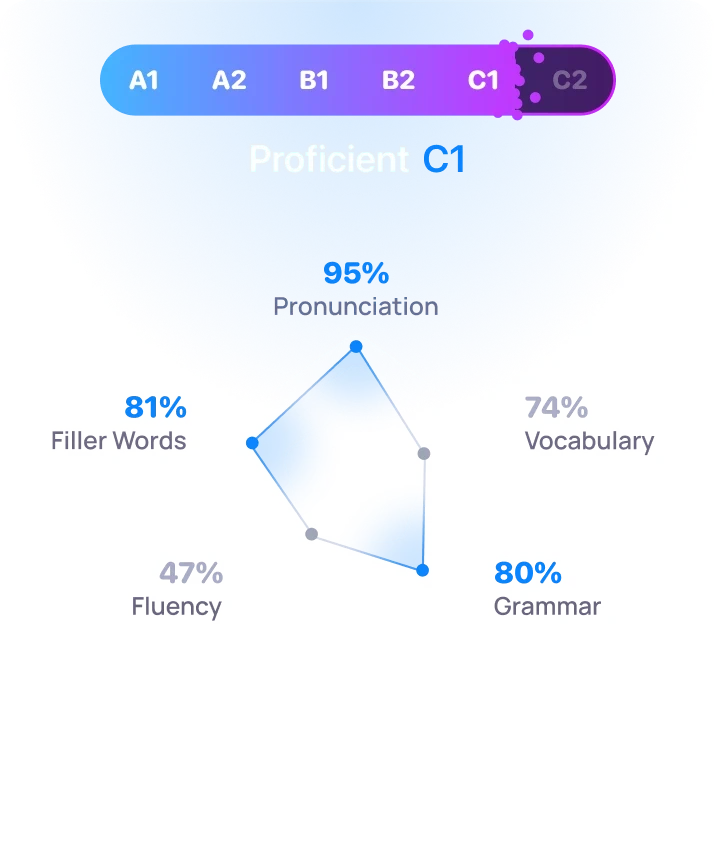
English verb tenses are not easy to master, especially by the non-native speakers. In the case of the AI-based system by Fluenlty, it is easier. It checks pronunciation, grammar, vocabulary and general fluency and you are well aware of where you are actually at in terms of the English language. The AI tutor creates lessons tailored to your capabilities and also identifies areas that require improvement. You will be capable of talking freely, get instant feedback, and strengthen your belief in the ability to use all the tenses of English. Fluently is also an interactive, personalized, and structured learning experience that enables you to be a better learner in a shorter time.


Key Features of Fluently:
Real-Time Assessment: Primes your pronunciation, grammar, and vocabulary in real-time to become familiar with them in a few seconds.
Personalised Lessons: Instantly adapts to your learning level and goals.
Unlimited Speaking Practice: This one lets you speak and speak, and is more effective for fluency.
Interactive Feedback: It should be interactive, showing errors and tips to improve the efficient use of tenses.
Progress Tracking: Checks on how you are improving over time to view actual results and determine whether you are on track.
English Verb Tenses FAQs
What are verb tenses?
Verb tenses are also useful in ascertaining the time of occurrence of the action- past, present, and future. They help you to write or speak more easily, to correct your mistakes and make your sentences more intelligible.
How many tenses are there in English?
English has 12 great tenses: four past, four present, and four future. All tenses used refer to past, present, and future actions.
How do English verb forms work?
Depending on the tense, subject and type of action, verbs assume various forms. Writing and communication require correct sentence structure in both written and spoken language.
How can I practice verb tenses in real-life situations?
You can speak with AI feedback, have a conversation with AI, and write short sentences daily, train to use better tenses in a real-life scenario with the assistance of Fluently.
Can Fluently help me track my English tense usage?
Yes! Fluently also reads out your pronunciation, corrects grammar and tenses, provides instant feedback, and messes with exercises depending on your areas of weakness and overall fluency.
Conclusion
The communication cannot be achieved without English verb tenses. You are quite confident in your speech and writing, as you know past-present-future tenses. Development of fluency may be achieved with the help of routine practice, the list of frequent errors, and the application of tenses in a real-life situation over time. One can study more efficiently and quickly with the assistance of AI-powered applications, including Fluently. Grammar, pronunciation, vocabulary, and using tenses with the necessary evaluation, immediate feedback, and personal lessons. Teaching yourself daily with the assistance of Fluently, you can not only reinforce your vocabulary in English but also correct fast and, during a conversation or a composition, use any form of a verb without any issues.