One has to have English grammar to be able to speak and write correctly. The non-native speakers tend to have issues with the tense of the verbs, sentence structures and vocabularies. Mastering the principles of grammar will make you capable of preventing mistakes and speaking in a confident tone. This is a presentation providing a description of the grammar, common mistakes and learning suggestions. It contains the structure of sentences, verbs, nouns, pronouns, punctuations and more complex facts like conditional sentences and reported speech. In each section, you will have different illustrations to practice by. With this guide, you are likely to be even more fluent, make less errors, and learn to speak or write English in real life or in a work-related scenario.
1. Understanding English Grammar
The system that controls the language is called grammar. Grammar knowledge will assist you to speak and write properly, prevent errors and perfect your speaking abilities.
What is Grammar and Why Does it Matter?
Grammar refers to rules that implicate the way in which sentences and words must be put together. Having grammar knowledge, you can properly organize the sentence and express yourself. Lack of grammar may cause the listeners and readers to fail to understand you. Grammar knowledge may also enable you to know what has been right and avoid serious mistakes. It is only through cleaning up your grammar that you can write and talk easier and properly.
Rules, Patterns, and Exceptions
There are exceptions just as numerous as there are rules and patterns in English. An example of this is that a rule verb will have an -ed ending on past tense form whereas an irregular verb, say go will have the ending went. The nouns, including child, are changed to children. The learners are able to use grammar with these rules and exceptions in place. Some common mistakes can be avoided and not only can one write better but also speak better by remembering patterns and exceptions. Exception knowledge will make him/her sure when communicating in English.
Grammar’s Role in Communication
Make sentences clear and easy to understand
Reduce mistakes in spoken or written language
Helps convey ideas logically
Build confidence in conversation
Correct grammar helps others understand your thoughts without confusion and improves overall communication.
2. The Building Blocks of Sentences
The sentences lack meaning without the presence of a subject, verb, and purpose. Sentence construction can help one enhance fluency and clarity.
Sentence Components: Subject, Verb, Object
The topic refers to whom or what the sentence is discussing. Verbs are a behavior and a condition. The purpose of the word is to obtain its behavior. With such elements appropriately used, one can understand what the authors are talking about, such as when she is reading a book and they play football every day. Knowledge of this structure involves the initial step to making complex sentences. Develop speaking and writing skills through practice to spot these parts of the sentence.
Sentence Types
There are four main sentences in English: plaintext, question, command, and exclamation. The plaintext conveys information such as "I like music (I like music)." The question is "Do you like music?" The order is given like "Open the door." The expression conveys strong emotion, like "What a beautiful song!" By knowing these kinds, you will be able to write and speak appropriately according to various circumstances.
Importance of Punctuation
Period (.) ends the sentence
Question mark () I'll finish the question
Exclamation Mark () is a strong emotion
3. Essential English Grammar Rules
In English, there are rules for making correct sentences. These rules are important for understanding correct sentences and discussions. The next is a simple grammar rule that non-native speakers should be aware of.
Subject-Verb Agreement
The manner in which the subject and the verb were to be related would imply that there was an equal number of subject and verb. The single verbs are taken with the single subject and multiple verbs with the multiple subjects.
Singular: She reads Japan every time.
Plural: They read Japan every time.
The fixed nouns might be difficult to deal with. Other groups like the team and the family are normally one-sided: The team is winning. You can, but it is better to emphasize on individual members, in that case, plural is applicable: The team is bickering over one another. Right subject verb agreement eliminates pronoun confusion in a sentence and makes English sound natural.
Verb Tenses
Tense of the verb will indicate the time of action: past, present and future. It also shows whether the operation is done, is being done or has been repeated.
Simple tense: represents facts and customs - I eat breakfast at 7 am.
Progression: represents the movement in progress - I am now eating breakfast.
Finish shape: Represents completed behavior - I finished eating breakfast.
Progress complete form: represents behavior that has been ongoing in the past - I have been eating breakfast for 20 minutes.
The correct tense makes it easier for listeners to understand the timing of your actions and prevent misunderstandings.
Articles – a, an, the
The verb indicates whether the noun refers to a specific or a general one:
A: Before words starting with consonants: a cat, a book
An: Before a word starting with a vowel: an apple, an hour
The book on the table, the sun
Even a small coronation is noteworthy. Wrong correlative conjunctions may alter the meaning or cause the sentence to sound unnatural. Use it in many different sentences, and thus you will know how to use it.
Pronouns
The repetition of nouns is avoided through the use of pronouns. The right text would be simpler and more understandable to use.
Personality pronouns: I, you, he, she, we, and they - a person or something- my, your, his, her, our, their- something possessive.
Recursive pronouns: myself, yourself, yourself - indicates the fact that the subject is the agent of the subject. And, there are relationships with pronouns who, which permit a little.
Further details: This man who called me was my uncle. The correct use of pronouns eradicates the repetitions and confusion of the sentences.
Nouns – singular/plural, countable/uncountable, proper/common
Some nouns refer to individuals, places, items, or ideas.
Singular and plural: book/books, child/children.
Countable nouns and invalid nouns: apple/milk.
Nouns and general nouns: London/city.
These differences will ensure that you can properly apply verbs, coronals, and quantities in a sentence.
Adjectives & Adverbs
Adjectives modify nouns, adverbs modify verbs, or other adverbs.
Adjective: The tall man
Adverbs: He runs fast
The comparison class and the top level represent the difference in degree:
Comparative class: taller, faster
Superior: Tallest, fastest
Word order is important. Adjectives and adverbs are mostly preposed and postposed, respectively. The right arrangement of words is important to make the sentence readable and meaningful.
Be Verbs and Action Verbs
Be verbs: is, am, are, was, were - representing states and situations - she's happy.
Action verbs: run, write, eat - represent behavior - he runs fast.
A be verb describes a state or situation, and an action verb represents a physical or mental behavior. Using the wrong type makes the sentence inaccurate or difficult to understand.
Irregular Verbs
Irregular verbs do not follow standard past-tense rules. Examples include:
go → went
eat → ate
see → saw
buy → bought
Irregular verbs are often used in everyday English, so learning them is essential. By practicing and memorizing regularly, you can prevent mistakes in using past forms.
Conjunctions
Conjunctions connect words, phrases, or sentences.
Coordinating: and, but, or – join equal ideas: I like tea and coffee.
Subordinating: because, although, since – join dependent clauses: I stayed home because it rained.
Correlative: either…or, neither…nor – used in pairs: Either you start now, or you finish later.
Correct use of conjunctions improves sentence flow and prevents fragmented ideas.
Prepositions
Prepositions represent the relationship between nouns and pronouns and other words:
Time: 5 pm on Monday
Location: In the room, on the table
Direction: To the park, inside the room
Common mistakes include using incorrect prepositions in conjunction with verbs: depend on (depending on ~), wait for (wait ~). By learning the correct prepositions, you can create accurate and natural sentences.
Imperative Sentences
The order represents instructions, advice, or requests. Usually starting with a verb, "please" may be included to express politeness.
Open the door.
Please do not hesitate to contact us.
Think slowly when answering.
Orders are often used in daily life, instruction, and communication in the business scene. By using it correctly, you can communicate the request clearly and carefully.
4. Common Grammar Mistakes to Avoid
It is as well that there are common mistakes that are likely to happen in the process of learning English. Those are the typical grammatical mistakes which make the sentence and discussion disorganized and unconfident. After having learned the causes of such mistakes and how to rectify them, we will be able to communicate better and talk more naturally, and act more confidently in our daily life and at work.
Homophones and Confusions
Other learners will feel puzzled by the various meanings of the same word, despite them being pronounced in the same manner. Their/their there/they are/yours/you are/your are. These errors can be prevented on the basis of context and spelling. Knowledge of these differences will make writing and speaking more accurate.
Sentence Fragments and Run-On Sentences
Relating multiple incomplete thoughts either in the form of a sentence or a period mark will give the reader the wrong idea. Breaking up sentences into simple parts improves comprehension and reading.
Misplaced Modifiers
Ethos Place description words close to the word being described.
False: She nearly drove her children to school on a daily basis.
True: She used to take her kids to school nearly every day.
The modifier should be placed in the right position to ensure that the meaning is not confused.
5. Tips for Non-Native Speakers to Improve Grammar
Practice and techniques are used to enhance English grammar. The chances of repeating them are high among the non-native speakers, but they will have a chance to work on it, and it should be based on systematic learning. Through observing the sentence structure, the verb usage, and frequent mistakes, students will be in a position to develop confidence in the long run. Grammar may be easily learnt with practice and tips and used in life.
Focus on Sentence Structure
I would begin with the simplest sentence structure: subject + verb + object. This is what it is based on: writing and speaking. The simplicity of the sentences practiced will help one comprehend more complex grammar rules in the future. With an evident structure, the sentence has a meaning, and you can always convey the intended message.
Learn Collocations and Word Partnerships
Collocation refers to a word combination made up of words that go together, e.g. make a decision. Through learning these combinations, learners will be at a point of speaking more naturally and not translating directly their native languages. Collocation identification improves fluency in writing and speaking.
Practice Linking Words for Fluency
Use the words and, but therefore, etc.
Relating ideas to more fluent sentences.
Enhance writing and speech fluency.
Connectors assist in linking coherent sentences and the logical expression of ideas.
Use Modal Verbs for Politeness and Nuance
Other verbs such as can, could, should and would provide a meaning to the sentence. One can see how it can happen when a person tells you, You should try this. He will be wary of his suggestions. The auxiliary verbs are used to show the possibility, ability, requirement, and a recommendation, and these are applied in the cases of courtesy request and recommendation.
6. Resources for Continuous Improvement
Constant practice is the most valuable factor in improving fluency and English grammar. With the assistance of the appropriate resources, you will succeed in obtaining the learning guidelines, resolving practice issues, and tracking long-term progress. Apps and websites, books and online courses, or the possibility to choose the right tools, you will be able to practice every day to identify the errors and improve your speaking, writing, and reading skills slowly but surely.
Apps and Online Tools
Applications such as Fluently, Grammarly, and Duolingo assist learners in improving grammar, vocabulary, and fluency. These include correction, example sentences, and practice issues. Every-day practice will enable you to develop your learning and identify frequent errors.
Books and Exercises
Easy-to-understand commentary and exercises can be found in such books as the English Grammar in Use by Raymond Murphy. Quizzes and writing exercises will enhance your knowledge by practicing. Another way to learn to use real English is by reading, which also enhances reading comprehension and grammar.
Courses and Tutoring
Online courses offer systematic lessons
Instructors provide personalized feedback
Combining self-learning with individual instruction improves results
Courses and individual instruction help learners receive instruction and focus efficiently on weaknesses.
8. Fluently: Track, Improve, and Speak English Confidently
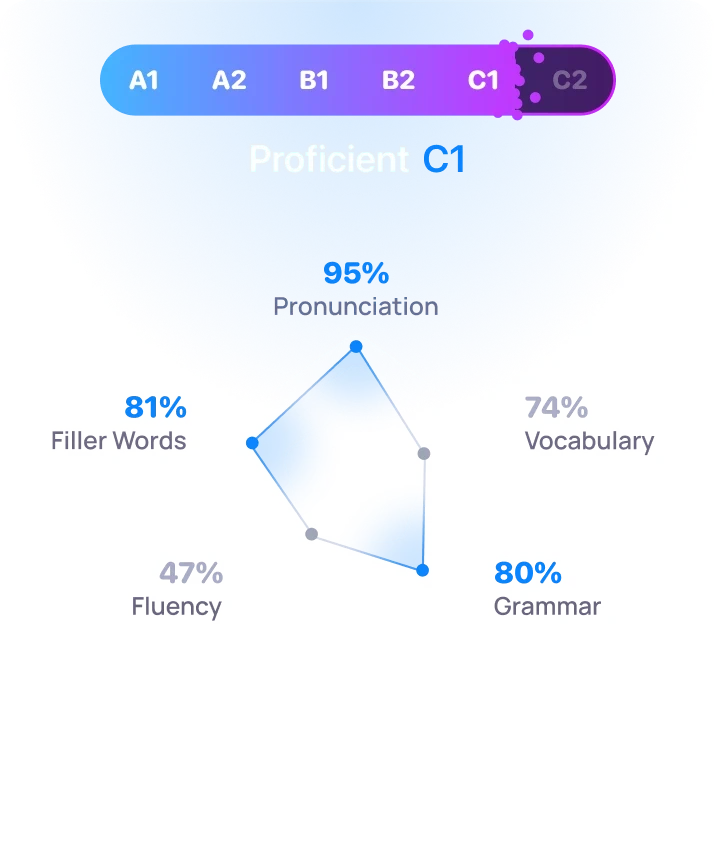
Fluently is an AI program, which is aimed at assisting non-native speakers of English to achieve a high level of proficiency in a short period of time. It checks your grammar, vocabulary, pronunciation, and your general fluency, providing you with a clear understanding of your current state. The platform develops customized lessons in accordance with your abilities, targets and strengths that require work. Fluently makes you aware of mistakes to make as well as correct them right away, and monitor your progress with time. Constantly applying this tool helps you to establish the power of your grammar, speak better, and minimize writing mistakes. Fluency renders learning a practical, interactive and goal-oriented experience to any learner.


Key Features of Fluently:
Track grammar, vocabulary, pronunciation, and fluency to comprehensively evaluate your English proficiency.
Create personalized learning plans that adapt lessons to your level, goals, and areas for improvement.
Provides immediate feedback on mistakes, fixes errors, and helps ensure correct usage.
Provides daily exercises and practice sessions to steadily improve speaking, writing, and overall fluency.
Maintain motivation to continue learning by monitoring long-term progress, checking progress, and measuring growth.
Conclusion
Mastering English grammar improves communication, confidence, and clarity. Focus on sentence structure, verb tenses, pronouns, and punctuation while avoiding common mistakes. Practice daily with reading, writing, and speaking exercises. Use tools like Fluently to track progress and correct errors efficiently. Understanding grammar helps learners speak naturally and write accurately in both casual and professional settings. Consistent effort, patience, and proper guidance ensure steady improvement. This guide covers essential rules, tips, and advanced techniques to help non-native speakers gain confidence. With regular practice, grammar will support clear, effective, and fluent English communication.
FAQs
Q1. How can I improve my English grammar quickly?
It can be helpful to concentrate on sentence structure, practice verb tenses, and read and listen to English every day. With the help of regular writing and speaking, you will know the grammar and can use it properly.
Q2. What are common mistakes non-native speakers make?
Common mistakes include confusion of homophones like their/there/they’re, misuse of prepositions, and subject-verb mismatch. Mistakes can be gradually minimized as learners practice and review them.
Q3. Can I speak English fluently without perfect grammar?
Yes, it is true that fluency results from practice. Grammar ensures clarity, whereas daily conversation, listening, and writing cause confidence. Over time, grammatical mistakes and natural mistakes decrease.
Q4. How does Fluently help improve English skills?
Fluently evaluates grammar, vocabulary, pronunciation, and fluency, giving a clear level assessment. Its AI-driven lessons adapt to your needs, helping you correct mistakes, practice daily, and build confidence efficiently.
Q5. Is Fluently suitable for exam preparation, like IELTS or TOEFL?
Yes, Fluently personalized learning plans focus on frequent grammar patterns, vocabulary, and speaking exercises. Helps improve your daily communication skills and fluency while enhancing the skills required for your exams.