Public speaking is an essential skill for career growth, academic success, and personal confidence. Speaking clearly and confidently allows you to share ideas, influence others, and leave a lasting impression. I tested several strategies and found that even small, daily improvements make a huge difference in confidence, clarity, and audience engagement. This article shares 15 actionable tips to help you manage anxiety, organize your speech, use gestures and voice effectively, and connect with your audience. Following these tips consistently can help beginners and experienced speakers improve their abilities and feel more comfortable on stage.
Why Public Speaking Skills Are Essential
Not just speaking on stage, but talking in front of people. Tremendous talents will be useful in the workplace, school, and personal life. As a confident speaker, there might be opportunities, promotions, and evaluations that may prove him or her to be a leader at the workplace. Presentation skills may be applied to present the ideas and impress teachers and other students in the academic practice. Individual benefits are the communication skills in real life, the ability to persuade better and more confidence. The speech is impressive because of the storytelling, listener interaction, and control of the voice. Listening to the audience and practicing make the message effective and clear.
15 Actionable Tips to Improve Your Public Speaking Skills
Giving presentations is not easy, but with the right strategy an individual can do better. These 15 tips may be viewed as the tips that can be followed in order to cope with tension management, speech organization, appropriate use of gestures and voices, and attraction of the audience's attention. These are the ones that you will be practicing and you will be in a position to talk clearly.
Tip 1: Accept Your Nervousness and Manage Anxiety
Of course, one becomes nervous before talking. Beating their breasts with the tension is only possible to notable speakers. Adrenaline is a body reaction to stress and it is released, when the reaction is controlled, it can also be beneficial to concentration. Instead of being anxious, we will accept the reality that it is a sign that the mind is preparing to perform. The majority of professional speakers use simple techniques of getting down before going on the stage. With this habit you will be able to feel anxiety and not fear.
Try these steps:
Take a deep breath: It is important to breathe slowly through your nose, hold your breath, and then breathe out slowly.
Practice image training: Talk with confidence and envision receiving positive feedback.
Speak in front of a small audience before addressing a large one.
Make yourself repeat words that put your mind at ease, for example, the thought, preparation is all you need.
By accepting tension as the norm and using mind-calming strategies, you will be able to set aside fear and put your heart on your side rather than on your enemy.
Tip 2: Know Your Audience
Ahead of what you are about to prepare, find out who you are addressing. The audience of the professionals should be approached with a difference as compared to that of a group of beginners. Knowing the background of the audience, you will be capable of manipulating words, illustrations, and tones; you will be more understanding of the message. The loudspeakers which change the content according to the audience influence the attention to the listeners and facilitate the positive feedback as the listeners are listening most eagerly when they feel that they are understood.
Focus on:
Audience age group, occupation, and experience level.
What do the audience expect to learn from your speech?
Words and examples that match the level of knowledge of the audience.
Ask a few questions or conduct simple research before your speech.
If you understand the audience well, the message becomes clearer, more relevant, and more effective.
Tip 3: Choose the Right Topic
The confidence and clarity of the speaker will be based on the topic that is chosen. The attitude of eagerness is demonstrated through the way we talk when we are discussing what we know and are interested in. In addition, the relationship with the audience will be enhanced provided that the topic is valuable or has relevance to the lives of the audience. A good topic is not an interesting one but useful, timely and empathetic. Any successful speech must be built upon an interesting choice of topic.
Notes:
• Choose what is relevant to the needs of the audience.
• Choose a topic that you understand or have experience with.
• Incorporate real cases and episodes to enhance your message.
• Avoid topics that are too professional or have a wide range of focus.
Properly selected topics make the creation and presentation of speeches much easier and help attract the audience's attention.
Tip 4: Start Preparing Early
If you wait until the last minute, stress increases, and the speech comes across as rushed. If you start preparing early, you can gather materials, clarify messages, and secure time to strengthen the content's weak points. By taking the time to prepare, it is possible to slowly rethink the idea rather than correct the mistake under pressure. Professional speakers often start preparing weeks or days in advance to improve both content and composition.
Good preparation includes:
Examine facts and reliable information on the subject.
Organize points in logical order.
Create drafts and elaborate as needed.
Practice many times before production.
Starting preparations early makes the content clearer and more confident, leading to smoother, more convincing speeches.
Tip 5: Organize Your Speech Effectively
A properly constructed speech makes it easy to be followed by the people who are listening. The ideal speech will have a basic format; introduction, body, and conclusion. In the introduction, the audiences will be informed of what is in store of this theory; we will highlight the points in the introduction, and give an overview in the conclusion. Through accumulation of this speech, focus is given to the message, which is simple to digest and memorise.
The composition of the speech is as follows:
Powerful opening to capture the audience's attention.
Three to five main points (each with specific examples and episodes).
Smooth connections between sections.
Clear conclusions summarizing important ideas.
If the speech is well structured, the audience will remain focused and listen to the message until the end.
Tip 6: Craft a Compelling Opening and Closing
The most memorable parts to the audience are the first and the last moments. A strong start will capture the audience's attention, and a good ending will reinforce the message and leave the audience thinking long after the speech is over. The idea is to attract the audience at once, and to conclude in such a manner that represents the key points.
An example of audience interest at the beginning:
Thought-provoking questions
Short personal episodes
Unexpected facts and statistics
Related Quotes
Example of closing:
Summarize key messages.
Connect with the idea at the beginning.
Leave clear learning and next steps to the audience.
An excellent opening and closing imprint the speech into the audience's memory.
Tip 7: Practice Regularly
Practice is one of the most important factors in improving in-person speaking skills. By practicing many times in a voice, you will be able to settle important points into memory and speak naturally without the unnatural feeling of memorization. In addition, by practicing repeatedly, you can notice your habits, such as your speech tempo, and modify them before the performance.
Practice Tricks:
Record and confirm your speech.
Practice in front of mirrors or trusted friends.
Join clubs such as Toastmasters and receive regular practice and feedback.
Measure time and improve tempo and flow.
The more you practice, the more confident and sophisticated your speech is.
Tip 8: Use Your Voice and Hands Effectively
The use of voices and gestures will aid in conveying the message that is not possible to communicate through words. The monotonous and flat voice makes it hard to grasp the information, yet it has the power to keep the audience more interested, changing the feeling of elation, speed, and volume. Though handiwork contributes to highlighting the essential messages, there is always a need to ensure that handiwork is not a distraction to speech contents. Body language and voice should get in line with the message to make communication more potent.
Try the following tips:
Change the tone and speed of the voice when you want to emphasize.
Use an open hand gesture to highlight important points.
Stretch your back and correct your posture.
Make eye contact to connect with the audience.
Confident gestures and expressive voices make the message clearer and more interesting.
Tip 9: Avoid Reading from Notes
When you add punctuation to the speech, the speech becomes unnatural, and the eye contact with the audience becomes less. Rather, we can get ready to take brief notes and bullet points so that it does not seem like we are reading off a paper, but we are still talking. It is not aimed at addressing the audience unilaterally, but rather at communicating with the audience. The lowest note is a guideline, but it should be there to signal its presence and to maintain contact with the audience.
Take advantage of the following tips:
Write down important keywords, not complete sentences.
Remember the order of the story.
Raise your face and take eye contact frequently.
Talk to your friends in conversation.
By not relying on written notes, speech becomes more natural and lively.
Tip 10: Improve Pronunciation and Fluency
Direct, understandable speech would be useful for keeping the audience interested and simplifying the message. More significant than speed is pronunciation. It will either create confusion and lose interest if it is too early or fail to hold attention as it is too late. To increase clarity and confidence, practice pronunciation, rhythm, and breathing.
Practical Practice:
Practice early words to enhance clarity.
Listen to excellent speakers and imitate their pronunciation.
Read the text aloud every day.
Take control of your breath so that you don't have a quick mouth.
By improving pronunciation and fluency, speech becomes smoother and more sophisticated.
Tip 11: Engage Through Storytelling
Stories make messages memorable by connecting information to human experiences. Through real cases and personal experiences, the audience can get a better understanding of the idea. Stories are more convincing when spoken vividly through concrete cases and personal experiences. A good story will help you highlight your point in a way that facts alone cannot, following the simple structure of "introduction, conflict, and resolution."
Take advantage of the following approaches:
Talk about short personal episodes related to topics.
Use descriptive words that evoke clear images.
Connect stories directly with your main claims.
Avoid detailed, long, and unrelated explanations.
The story creates emotional connections and helps the audience remember your message.
Tip 12: Observe Feedback and Adapt
An excellent orator is a good watcher. Now we will see what the audience will do. Smiles, nods, indifferent expressions or restlessness all say something. In the moment of speaking, you could change what you have to say depending on the reaction of the audience e.g. slow down on the point, restate the point or provide an illustration. This form of consciousness makes the speech more alluring to the audience.
Notable feedback signs:
Eye contact and concentration
Expressions such as confusion and consent
Posture and audience reaction
Feedback after the speech
By adjusting your speech based on feedback, you can deepen your connection with the audience and maintain their interest.
Tip 13: Master Your Environment
With time you get used to the venue and chances are that you will not have to deal with any technical issues, you can simply focus on the speech. Audit sound system, lighting, seat layout, equipment, etc. In case you have been used to switching visual aids or slides previously, you might become used to switching between teaching material and visual aids. Another way of doing it is to plan your movement on the stage so that you are sure that you are in it with purpose.
What to prepare:
Test microphones, projectors, and slides.
Check the layout and acoustics of the venue.
Check the lighting brightness and seating arrangement.
Decide where to stand and how to move.
By grasping the environment, speech flows more smoothly, and stress is reduced.
Tip 14: Handle Pauses and Silence Confidently
Silence in speech does not mean failure. If used correctly, it can be a powerful tool. It is also an expression of confidence that the audience is in no hurry to absorb ideas and fill the void. Instead of being afraid of silence, let's use it to separate key points, to penetrate messages, and to organize our thoughts towards the next line.
How to use (pose):
Emphasize the important ideas in between.
Avoid connecting words such as "eto" and "anone."
Breathe slowly and stay calm.
Use silence before asking questions.
The deliberate pose makes the speech clear and helps the audience understand the message.
Tip 15: Keep Improving with Practice and Feedback
Good orators are not made in a day. Consistent practice and feedback lead to improvement. In both speeches, we shall see what was successful and what was unsuccessful. Read the speeches of renowned oratory speakers and study their methods. The advice of mentors and colleagues will provide you with a raw view of the situation that results in development. The more we are willing to receive feedback, the more sophisticated and assertive our manner of talking is.
Steps for continuous improvement:
Record and reflect on speech.
Watch the lectures of experienced speakers and write down their techniques.
Ask for specific feedback from others.
Set small improvement goals for each speech.
Continuous learning turns skills into strengths and makes them better than previous speeches.
Quick Tips to Overcome Stage Fright
One of the most widespread obstacles facing speakers in the public is stage phobia which is managed by the use of simple and practical methods. Working on it a bit before, or in the middle of a speech, you may decrease anxiety, be concentrated in front of any audience, and be sure and relaxed. The following are some of the tips that you can actually practice immediately:
Breathing In: Breathe in four times, out four times, breathe slowly, hold, and sigh, relax the nerves, and stabilize voice.
Image Training: Visualize yourself speaking with a positive reaction from the listeners.
Find familiar faces: You can reduce anxiety by focusing your mind on familiar faces in the audience and those who might be helpful to you.
Never think about yourself: Don’t think about your tension, but think about the needs of the message or audience you are communicating to.
Positive self-indication: Repetition of positive words like I am ready, I can, and confidence is generated instantly.
Boost Your Speaking Skills with Fluently AI Speaking Tool
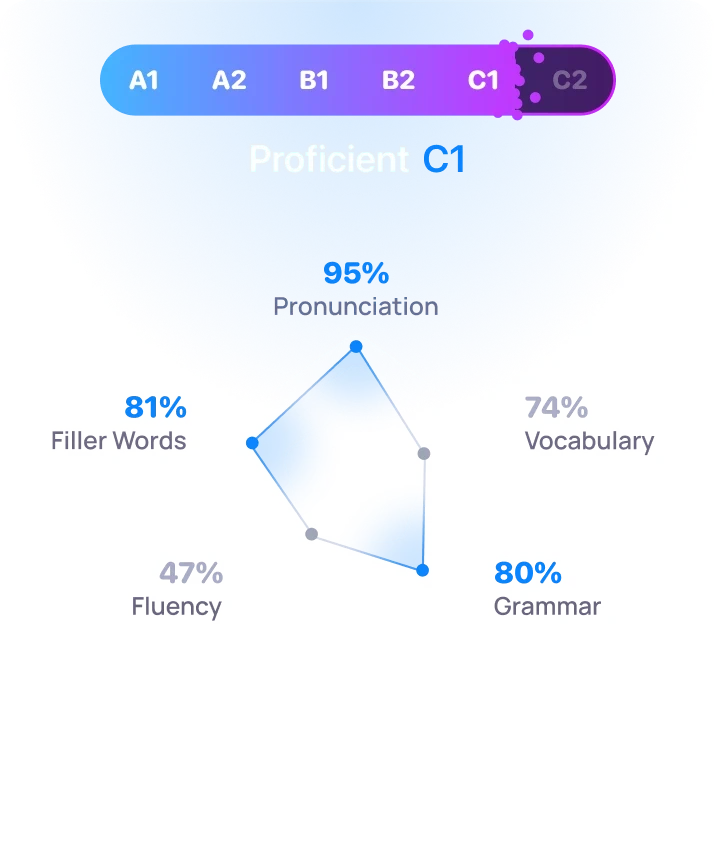
Improving your speaking skills takes consistent practice, honest feedback, and real-world application. Fluently is an AI-powered speaking coach designed to help you improve English fluency, pronunciation, grammar, and vocabulary based on real speech and conversation patterns. It works in the background of your calls and practice sessions to give instant, personalized feedback you can act on right away. Whether you want to prepare for presentations, interviews, meetings, or daily conversations, Fluently offers structured support that adapts to your level and goals.


Key Features:
Real-time feedback: Fluently analyzes your speech as you speak and offers real-time feedback about what you are saying, and makes corrections to your pronunciation, grammar, and vocabulary usage.
Customized learning process: AI adapts your lessons and practice materials based on your strengths and mistakes.
Talking any time: Speak to an AI tutor anytime you wish, and you do not need a schedule or arrangement with a tutor.
Cross-platform support: Key conference tools can be supported and integrated into calls to provide real-time assistance.
Progress Management: Understand how to progress in fluency, vocabulary, and pronunciation.
Frequently Asked Questions
1. How can I improve my public speaking skills quickly?
It is better to practice before the mirror or in front of some friends, note and test your voice. Pay attention to speech, gesture,e and arrangement. Confidence is acquired through day-by-day practice and through slow progress.
2. What is the most important tip for public speaking?
The key is the understanding of the audience. Modify the content, specific examples, and tone to suit the audience's interests and knowledge. The message is delivered with confidence, and concentration is maintained throughout the speech, as the audience remains attentive.
3. How can Fluently help me improve my speaking skills?
Fluently offers pronunciation, grammar, and vocabulary real-time feedback. You can practice English naturally by designing a study plan that fits you and adapts to your level, so you can acquire fluency and confidence over time.
4. Can I use Fluently for professional presentations?
Yes, Fluently helps you get ready for meetings, interviews, and presentations. By monitoring your progress, perfecting your speech, and training your fluency, you will speak assertively and with clarity in business and daily life.
Final Thoughts
Mastering public speaking requires consistent effort, practice, and attention to your audience. Applying these 15 tips helps you improve confidence, clarity, and audience engagement. Daily exercises, feedback, and tools like Fluently enhance your learning experience. Strong speaking skills improve career opportunities, personal confidence, and influence. Start small, practice regularly, and track your progress. Over time, you will feel more comfortable speaking in any setting and delivering messages effectively.