10 Things Every English Learner Should Do in 2026
Millions of people worldwide are learning English in 2026. English has become essential for work, travel, and communication with people from different countries. Today, learning English is easier than ever thanks to technology and AI. We no longer rely only on textbooks and traditional classrooms. Now, learners can practice English through apps, videos, podcasts, and interactive AI tools. This article shares practical steps you can take to improve your English every day. By following these tips, you can speak, read, and write better naturally and confidently.
Why 2026 Is the Best Time to Learn English
In 2026, learning the English language has become significantly closer and more practical. Global communication, online platforms, and AI tools provide learners with a chance to learn faster and in a more natural way. English is no longer taught in schools, but is an element of everyday life, working, and entertainment everywhere on the planet.
The Biggest Change — English Is Everywhere
English has become an almost ubiquitous language in life. People are able to use English in their everyday life on social media, on streaming sites, and in the workplace of the world. Natural learning is performed by viewing videos, reading internet sources, and communicating with foreign friends. Exposure of learners to English in their real-life situations makes them feel assured that they can learn words faster and use language naturally.
Key examples of English in daily life:
Instagram, Tik Tok, and Twitter are the social media platforms.
Email and conference business communication around the world.
Netflix and YouTube streaming sites.
Technology Has Changed Language Learning
Technology has transformed the mode of learning English. An AI tutor will automatically give feedback in terms of the pronunciation, grammar, and syntax. The application allows managing the learning process, vocabulary training, and interactive activities. Learners are also able to design their learning plans individually, such that they concentrate on the areas of improvement. This is a flexible, attractive, and effective tool for learning English as opposed to traditional methods.
The New Learning Rule for 2026
The learning process of English changed to a long-term formal approach to the practical day-to-day application. Learning is not merely traditional grammar-based learning. More practical practice is required for learners, such as speaking, listening, reading, and writing in daily life. Learners may obtain English through active use of English in conversations, within social media, and related work activities.
10 Things Every English Learner Should Do in 2026
By 2026, it will have never been easier to learn English as students do it daily with the help of AI and online tools and resources. It makes little steps throughout the day that are practical in a bid to improve your speaking, listening, reading, and writing. This is what every English learner has to begin doing today to make real progress.
1. Make English Part of Your Everyday Life
You may have natural learning through the use in your daily life. Pay short attention, not long, intermittent attention to everyday life. Think in English, make notes in English, and read easy articles and posts on SNSs when planning a day. Such minor actions produce habits and fluency, and make the process of learning a life, not a duty.
Tricks of daily practice:
5-10 minutes of thinking daily in English.
Write short diaries and simple sentences.
Read short materials and texts in English.
2. Switch Your Phone and Devices to English
The adaptive voice of smartphones, computers, and applications will help you get acquainted with the vocabulary of the digital space and communication as you do in real life. It is easier to memorize words when reading them in context. This small practice allows for continued contact and makes the brain get to know the English language without the need to spend additional time learning.
3. Watch English YouTubers and Movies
An effective and pleasant technique of learning is watching English videos. The first step is to memorise the content with the help of subtitles; after every step, clear the subtitles. You can hear genuine expressions, phrases, and accents, which make you speak naturally. Choose a field of interest and get inspired, and learning should become a part of entertainment.
4. Listen to English Podcasts
The podcasts also improve the level of listening and a natural speech is developed. Listening takes place on a daily commuting and exercise. Fluency and pronunciation is also enhanced by the repetition of words and sentences in podcasts. Stop, say the phrase again and know how to speak like a native.
Ways to practice with podcasts:
Recite the sentence aloud
Write new words and phrases.
Learn to listen several times and learn to hear.
5. Read Everything You Can in English
Reading provides an occasion to learn new words, grammar, and syntax. Read Blogs, News articles, books, social media posts, etc. Reading every day is a natural way to understand and expand vocabulary. Educate on what you like doing, and in this way, learning is not forced but an enjoyment. Let us underline some words we are not familiar with and keep in mind.
6. Actively Learn and Record New Vocabulary
The technique of recording vocabulary notes and preparing electronic lists is a good one for memorising new words. Learn in context, not in words. Of course, you can be able to create sentences and write them with vocabulary by reading them every day. Context-based learning is better than memorization.
Vocabulary tips:
Spell new words in sentences.
Review the list daily.
Read and speak in conversation.
7. Speak English Every Day
The quickest way to gain fluency is through everyday speech. Converse with friends, lecturers, and language partners. Dwelling on perfection is redundant. There is nothing to fear about making a mistake - that is one way of learning. When you practice for at least a few minutes a day, you become more confident, and your pronunciation will improve.
8. Join English Communities Online
One can use valuable English in an online community. Attend language exchange and discussion groups and social media learning communities. Talk to the learners everywhere in the world to have a feel of their various accents and phrases. The process of learning can be accelerated and encouraged through the sharing of questions, tricks, and experiences.
9. Use Technology and AI Tools for Learning
When applied wisely, technology makes learning quicker. It is possible to work on language apps, AI-conversation programs, and pronunciation software at any time. AI tutors correct instantly and provide learning at your level. The use of apps with speaking and listening exercises will help balance skill development.
How to use tech effectively:
Use language applications in vocabulary and grammar.
Conversation with AIs Practice.
Enhance enunciation using special means.
10. Set Goals and Stay Consistent
Maintaining motivation in an organization occurs because of goal-setting in the organization. Use SMART (concrete, measurable, achievable, realistic, deadlines) objectives. Examples: 10 new words a day, 15 minutes of speaking English a day, etc. Practicing every single day is more efficient compared to having knowledge, though not uniform, over a long period.
SMART Goals Example:
Specific: Learn 10 new words each day.
Measure: Improvement noted.
Realistic: Small and achievable tasks are supposed to be initiated with.
Specific: Choose a goal that can be followed on a daily basis.
Time limit: create a routine and have a schedule for every day or week.
How to Learn English Quickly in 2026 (Expert Tips)
Not only must one spend a long time to learn English, but one must also have strategies when learning English to learn it quickly. Technology and daily exposure to the English language would help you sharpen your skills more easily in 2026. Since the practice and personal goals are oriented, and the focus is on the practice of language, it is possible to develop learners' fluency faster than it was previously. Some of the professional tips to learn to master the English language proficiently and confidently include the following.
Focus on Real-Life English
To be able to speak fast in English, it is more appropriate to emphasize the common phrases and sentences. It is better to understand how to meet them, go shopping, work, or travel, but not only the rules of grammar. Live streams of events on podcasts, video, and apps. These phrases are expected to be repeated until natural. It is easy to know the language you use in the real world; you can respond fast when talking, and it is also easy to learn. The secret is to have a good vocabulary and phrases that fit your lifestyle and your life.
Work Smarter, Not Just Harder
No one can be fluent through hard work. One should avoid passive learning (reading and watching videos). Instead, speak, write, record tape, and rehearse. Self-test and discuss the new words and phrases. The tendency to concentrate on a short day is productive compared to the long and fragmented learning sessions.
Ask Questions and Learn From Mistakes
Mistakes are considered to be an ingredient of learning English. Instead of attempting to escape mistakes, we need to make use of it as a means of improving. You can also ask any questions at any point of time on how to use grammar, pronunciation, or words. Train with other people, teachers and robots which provide instant feedback. Record common mistakes and read them. The errors involved in the process will make the process easier in terms of making less fear and gaining confidence and learning. The less you practice the less mistakes you will have in the long run.
Start With What You Really Need
Focus on Learning on actual English. This makes practice more practical and efficient. Example:
Business terms used in emails, conferences, and presentations
Travel terms used at airports, hotels and directions
Phrases used in daily conversations with friends and colleagues
We can make more effective and quicker communication with each other because you concentrate on the most relevant words and phrases. Knowing the most significant things helps to keep you in the motivational state, save time and enhance your English in the real life.
A Simple English Learning Plan for 2026
Routine assists in the facilitation of continuous learning of English. You will become fluent in the long-run with a few hours of intensive practice every day. You need to listen, speak, read, and write without excessive work by dividing the learning process into small and frequent morning, afternoon, and evening sessions and weekly activities.
Morning Routine (10 Minutes)
First, start using your head in English for a day. Read and memorize a new vocabulary and edit the already known words within 10 minutes. Then read an English short article, news, and a blog. It is natural that the brain would remember new words and grammar by reading in the morning. Just the repetition of these little habits in our daily lives makes us learn to know and prepare to have more complex discussions during the day.
Afternoon Practice (10 Minutes)
Listening and comprehension in the afternoon. Watch 10-minute podcasts, short audio, and English videos. Pay attention to the most important information, accents, and phrases. Pronunciation and confidence are improved by repeating words and phrases. Through further listening of a few minutes daily, you would eventually be exposed to natural conversations and different accents. Therefore, you would find it easier to know real English speakers in real-life settings.
Evening Practice (10 Minutes)
Active speaking practice is best at night. Discuss with your friends, instructors, and artificial intelligence conversation-aid devices for 10 minutes. Use the new words and phrases that you learned that day. In communication, do not focus on perfection; communicate the idea. Continuous speaking exercises at night help improve memory, enhance pronunciation, and build confidence in real conversation.
Weekly Practice
Add in more activities of at least an hour a week to build your skills.
Watching an English movie or an episode of a series.
Write a brief journal of what happened during the week.
The practice will give you a chance to use English in real life, enhance your knowledge, and use words and grammar intuitively. The weekly review consolidates what has been learned in the week and makes using English in everyday life easier.
Improve Your English Faster With Fluently — Your Personal AI Speaking Coach
Fluently aims to design a real English systematically and practically. Compared to the traditional grammar-based approach to learning, Fluently places a strong focus on the skill of speaking confidently in real-life scenarios. We can provide practice at your level and learning objectives through interviews, conferences, presentations, and simple talks. Using Fluently in the process of everyday life, you will be able to improve your pronunciation, widen your vocabulary, and get the confidence to speak the English language naturally and efficiently.


Key Features of Fluently:
Use AI to recreate real-life scenarios and practice natural speaking
Instant feedback on pronunciation, grammar, and vocabulary selection to quickly fix mistakes
Accelerate progress with personalized lessons tailored to levels and learning goals
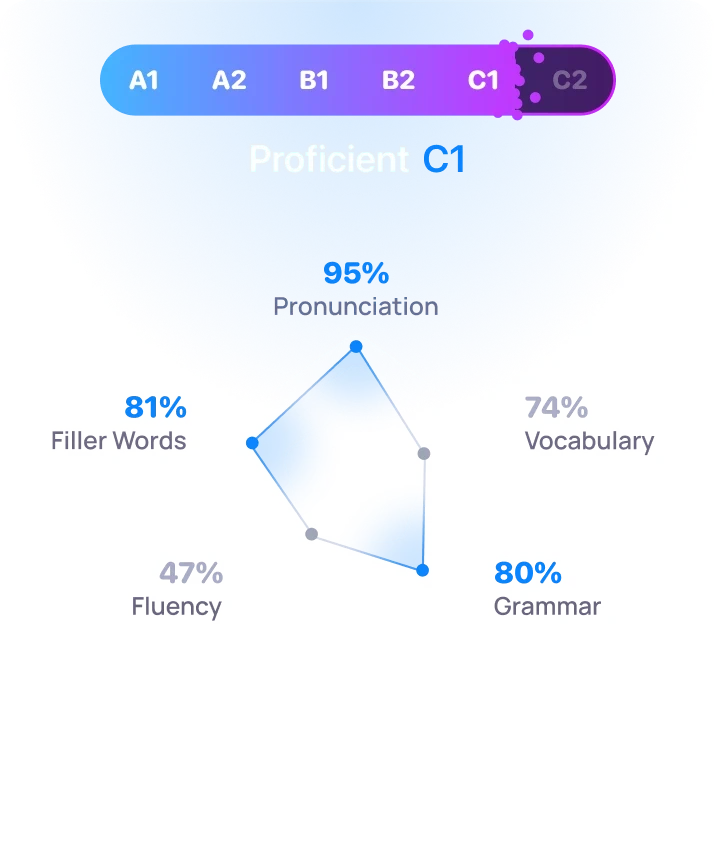
Track progress and visualize areas of expertise and focus.
Includes interactive exercises that comprehensively enhance speech, listening, and vocabulary.
Frequently Asked Questions
How long does it take to learn English fluently?
It is relative to the practice, the chance of being touched by English, and continuity. By adopting the daily practice of speaking, listening, reading, and writing, you can learn fluency more quickly, and you are also able to plan your learning material.
What is the fastest way to improve English speaking?
Communicate in English with friends and instructors or AI-based applications such as Fluently daily. The quickest improvement method involves trying to use newly acquired vocabulary in a sentence and looking at simpler expressions that are not perfect but more understandable.
Can I learn English without living abroad?
Yes. Practice anywhere with apps, online communities, podcasts, videos and AI tutors. Through regular contact and conversation practice, you can learn effectively without going outside the country.
How many minutes should I practice English daily?
Practice at least 20-30 minutes daily, including listening, reading, and speaking. It is more effective to do it continuously, even in a short period of time every day, than to practice for a long time occasionally, and it is easier to solidify memory.
Are language apps enough to learn English?
Apps are useful for vocabulary, grammar, and pronunciation, but practice issues are also important. Regular speaking and listening with people and AI tutors are essential for acquiring real communication skills.
Conclusion
Thanks to technology, AI tools, and online resources, learning English in 2026 has never been easier. The key to success is the opportunity to experience daily English, regular speaking practices, and to utilize technology wisely and pragmatically. Start with small, achievable steps and continue practising. Gradually increase your time spent listening, reading, speaking, and writing in English. With tools like Fluently, you can practice practical English with confidence in everything from everyday conversation to work and travel. By practising these tips, you will be able to steadily improve your skills, achieve your goals, and speak natural and effective English.