20 Warehouse Team Leader and Warehouse Lead Interview Questions, With Sample Answers
 Yurii Rebryk · Updated October 19, 2026 · 14 min read
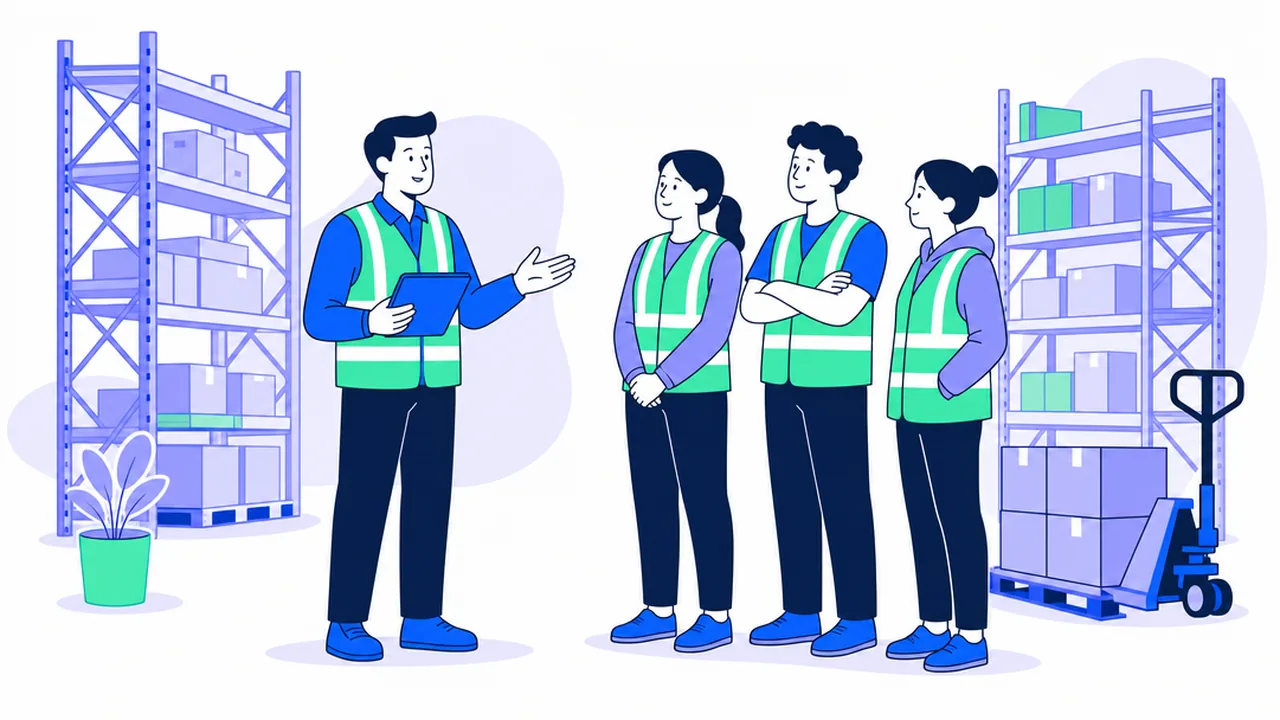
Warehouse team leader interview questions test one thing: whether you can run a safe, accurate shift through other people. Below are the 20 most common, from briefings, targets and low performers to safety and peak season, each with a sample answer in plain spoken English. After them come the safety rules a lead should know in the US, UK, Canada and India, and answers for associates stepping up.
In this article
- The 20 warehouse team leader interview questions at a glance
- Warehouse team leader interview questions about you (1–5)
- Warehouse lead interview questions about running a shift (6–10)
- Warehouse team leader questions about leading people (11–15)
- Safety, accuracy and WMS questions for warehouse leads (16–19)
- Questions to ask at the end of a warehouse team leader interview (20)
- More warehouse lead interview questions to prepare
- Warehouse team leader safety rules by country
- Warehouse lead interview answers when you have no lead title yet
- How to give clear instructions in English as a team leader
- Practice a warehouse lead scenario question out loud
The 20 warehouse team leader interview questions at a glance
The same questions come up whether the job ad says warehouse team leader (UK), warehouse lead (US) or lead hand (Canada). Need a PDF? Print this page or save it as a PDF.
| # | Question |
|---|---|
| 1 | Tell me about yourself. |
| 2 | Why do you want to be a warehouse team leader? |
| 3 | What does a warehouse team leader do? |
| 4 | What are your strengths and weaknesses? |
| 5 | How would you describe your leadership style? |
| 6 | How do you run a start-of-shift briefing? |
| 7 | How do you set and track targets like pick rate and accuracy? |
| 8 | Two people call in sick an hour before the shift. What do you do? |
| 9 | How do you decide what to delegate? |
| 10 | How do you handle peak season or a sudden spike in orders? |
| 11 | How do you keep your team motivated? |
| 12 | Tell me about a time you dealt with a low performer. |
| 13 | Two team members are arguing on the floor. What do you do? |
| 14 | How will you lead people who used to be your coworkers? |
| 15 | How do you train a new starter? |
| 16 | How do you build a safety culture on your shift? |
| 17 | Which warehouse management systems have you used? |
| 18 | How do you find and fix inventory or picking errors? |
| 19 | Tell me about a time you improved a process. |
| 20 | Do you have any questions for us? |
Warehouse team leader interview questions about you (1–5)
Questions 1 to 5 are about you. Keep each answer under a minute; every name and number in the samples is an example, so swap in your own.
1. “Tell me about yourself.”
Give the short version: your warehouse experience, when you started leading, and why this role is next. Listen to the model, then record yours.
Tell me about yourself (associate stepping up)
B1I’ve worked in warehouses for four years, first as a picker, then on receiving and putaway.
For the last year I’ve covered for my team leader on Fridays: I run the briefing, move people between zones and train new starters on the scanner.
Now I’d like to lead full time, on a site like yours where accuracy really matters.
Read it aloud
Listen to a model reading, then record yourself. You get your speaking pace, the share of words that came through clearly, and the words to repeat.
No lead experience? Use the times you were trusted with more; the step-up section shows how.
2. “Why do you want to be a warehouse team leader?”
Give a reason about the team, not the title or the money.
Sample answer: “I like helping the whole shift finish on time. When someone I trained reaches the rate in week two, that feels better than reaching it myself. I also want to learn shift planning, and your leads do that.”
3. “What does a warehouse team leader do?”
The job is mostly planning, checking and talking. O*NET, the US Department of Labor’s occupation database, lists tasks for first-line supervisors of material movers such as keeping a safe workplace, explaining work orders and planning schedules for “fluctuating workloads” (O*NET 53-1042.00).
You could say: “A team leader keeps the shift safe and gets the orders out right and on time: a clear briefing, the right people in the right zones, checks during the shift, and a proper handover.”
4. “What are your strengths and weaknesses?”
Prove a strength the shift needs, then give a real weakness that is not a safety duty, with your fix.
Say: “I stay calm when the plan changes. When a trailer came three hours late, I re-planned the dock and we still made the cutoff. My weakness was fixing problems myself instead of asking others. Now I ask first.”
5. “How would you describe your leadership style?”
Name your style in one line, then prove it.
Example answer: “Clear and hands-on. Everyone knows the plan and their target at the start, and I’m on the floor, so I see problems early. I praise in public and correct in private.”
First lead role? Say how you act when you cover: “When I cover for my lead, I start with safety and check on new people first.”
Warehouse lead interview questions about running a shift (6–10)
Questions 6 to 10 cover the shift itself: the briefing, the numbers, missing people and busy weeks.
6. “How do you run a start-of-shift briefing?”
Show a short routine. A five-minute briefing covers:
- Safety: one hazard or near miss, and what changes.
- The plan: volume, priority orders and carrier cutoffs.
- Who does what: zones, equipment and breaks.
- One change and one question: “Is anything stopping you from starting?”
Try: “Five minutes at the shift board: safety, the plan, the zones. I end with a question, because people mention a broken scanner at the start only if you ask.”
7. “How do you set and track targets like pick rate and accuracy?”
Targets usually come from the site; the question is how you use them.
| Measure | What a lead does when it drops |
|---|---|
| Pick rate (units or lines per hour) | Finds the cause first: walking, empty pick faces, scanners or training |
| Order accuracy | Checks the error type and the location labels, then re-trains |
| On-time dispatch | Moves people to packing and loading earlier |
| Inventory accuracy | Runs cycle counts and fixes the cause of each gap |
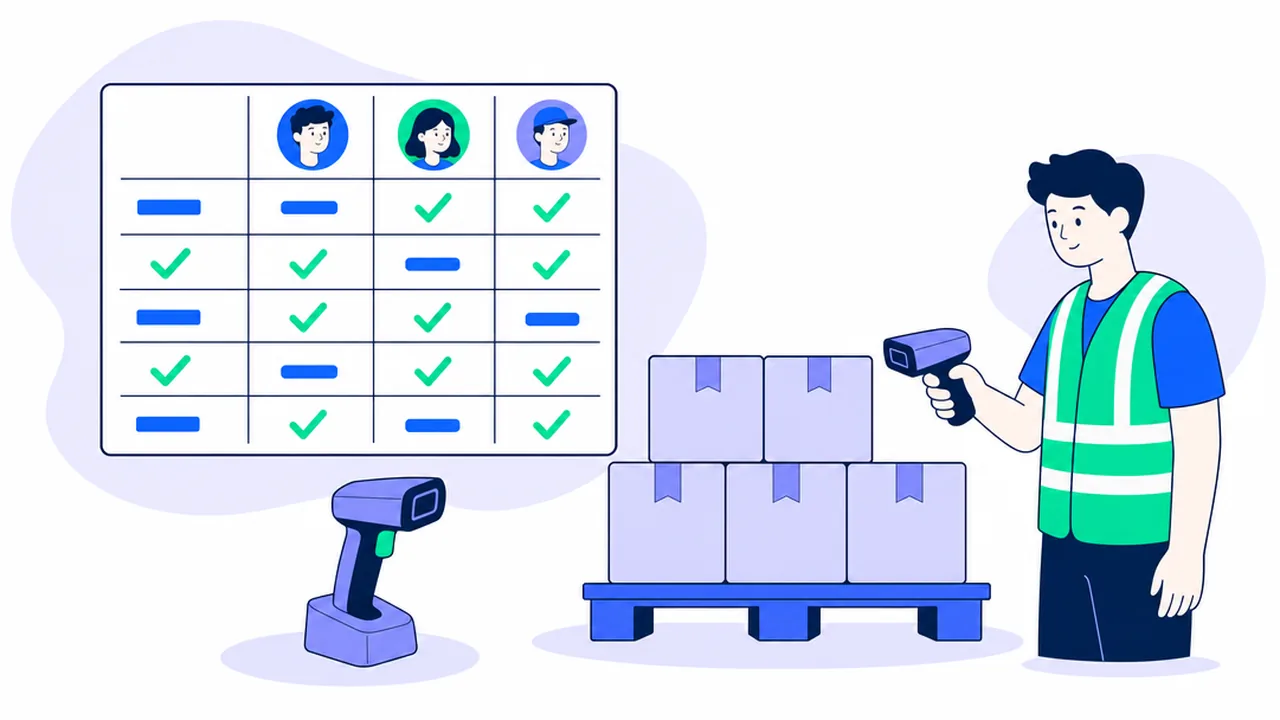
At large California warehouses, a quota cannot prevent “meal or rest periods, use of bathroom facilities” or compliance with health and safety laws, and an undisclosed quota cannot be used for discipline (Labor Code 2102). New York’s Warehouse Worker Protection Act gives similar protection.
A strong answer: “I check the targets every two hours. If a zone is behind, I go and look before I say anything; once the cause was empty pick faces, so I asked for replenishment first. I discuss personal numbers one to one, never in front of the team.”
8. “Two people call in sick an hour before the shift. What do you do?”
Protect safety and the earliest deadlines, then tell people the new plan.
Sample answer: “I check which orders have the earliest cutoffs and move cross-trained people there. Work that can wait, like re-slotting, waits. I ask my supervisor about help from another team or overtime. Nobody drives a forklift they aren’t trained and authorized for. Then I brief the team on the new plan.”
9. “How do you decide what to delegate?”
Delegation shows trust and frees you to watch the whole floor.
You could say: “I delegate tasks someone can learn from, with a clear result and a time: ‘Can you run returns today and tell me at two how many are left?’ Safety decisions and difficult conversations stay with me. I explain why and thank the person by name.”
10. “How do you handle peak season or a sudden spike in orders?”
Show that you plan before the rush and stay safe during it.
Say: “Before peak, I cross-train people in two areas and train new starters before the busy weeks. During a spike, I sort work by cutoff, move people to the bottleneck and keep breaks on time, because tired people make mistakes. Afterwards, I write down what went wrong.”
Warehouse team leader questions about leading people (11–15)
People questions decide most lead interviews. Use real events where you can; STAR (Situation, Task, Action, Result) keeps a story under two minutes.
11. “How do you keep your team motivated?”
Strong answers are specific and cost nothing.
Example answer: “I praise good work by name, the same day. I rotate the hard jobs, like the freezer, so nobody feels punished. And I fix small complaints fast, like a broken scanner, so people keep telling me about problems.”
12. “Tell me about a time you dealt with a low performer.”
Interviewers listen for a private talk, a cause, support and a fair follow-up before any formal step.
A low performer (STAR answer)
B1–B2Situation: a picker on my team was well below the rate for three weeks.
Task: I had to find out why and help him improve, fairly.
Action: I spoke to him in private. He had moved from packing and was walking the long way round the aisles, so I showed him the pick path, paired him with an experienced picker for two shifts, and we checked his numbers every Friday.
Result: within a month he was at the rate, with no drop in accuracy. If that hadn’t worked, the next step was the formal process with my supervisor.
Read it aloud
Listen to a model reading, then record yourself. You get your speaking pace, the share of words that came through clearly, and the words to repeat.
13. “Two team members are arguing on the floor. What do you do?”
Stop it fast, stay neutral and fix the cause.
Sample answer: “I separate them and give each a task in a different zone. Later I listen to each one alone. It’s usually about work, like who gets the easy aisles, so I fix the rule for everyone, for example by rotating zones. A threat or a push goes to my supervisor and HR.”
14. “How will you lead people who used to be your coworkers?”
The friendship stays; the rules apply to everyone.
Say: “In the first week I’d tell each person one to one: ‘My job has changed, and I want to be fair to everyone.’ Friends won’t get the easy aisles. I’ll ask for their ideas, because they know the problems. If a friend breaks a safety rule, I deal with it as I would for anyone.”
15. “How do you train a new starter?”
Describe a method: show, practice, check, and safety before speed.
Try: “A safety walk first: walkways, forklift areas, how to report a near miss. Then I show the task, watch them do it, and check their work. They get a buddy for week one, and I don’t push the rate until they’re accurate.”
Safety, accuracy and WMS questions for warehouse leads (16–19)
OSHA lists forklifts, ergonomics, material handling, hazardous chemicals and slips, trips and falls among warehouse hazards (OSHA warehousing overview). A lead’s safety answers carry extra weight, because the lead sets the tone.
16. “How do you build a safety culture on your shift?”
Interviewers want reporting, follow-up and the courage to stop unsafe work. OSHA recommends a way for workers to report “close calls/near misses” and prompt follow-up (OSHA); the UK regulator HSE defines a near miss as an event that, “while not causing harm, has the potential to cause injury or ill health” (HSE HSG245).
A strong answer: “Safety opens every briefing, and I thank people for reporting near misses, because a near miss is a free warning. I fix small things at once, like a pallet in a walkway, and I stop unsafe work even when we’re behind. A missed cutoff is a bad day; an injury is much worse.”
17. “Which warehouse management systems have you used?”
Name the system and what you did in it; O*NET lists the warehouse management system (WMS) as in-demand software for this job.
Sample answer: “I’ve used SAP for receiving and putaway, and scanners for picking and cycle counts. Covering for my lead, I pulled the daily productivity report and checked open orders against the cutoff. I haven’t used Manhattan, but the flow is the same, so I’d learn it quickly.”
Only used a scanner? Say so, then describe the errors you saw on it and how you fixed them.
18. “How do you find and fix inventory or picking errors?”
Look for the cause, not for someone to blame.
Say: “I look for the pattern: same item, location, person or time of day. Then I go and look. Often it’s a bad label, two similar items side by side, or a step people skip when rushed. I fix the cause and use cycle counts on those locations to check it worked.”
19. “Tell me about a time you improved a process.”
Use STAR and give the team the credit. One example:
| Step | What you say |
|---|---|
| Situation | “Pickers walked to the back of the warehouse for the same ten fast movers all day.” |
| Task | “My supervisor asked me to cut walking time without new equipment.” |
| Action | “I took the top movers from the WMS report, and we moved them next to packing on a quiet Sunday, with a count before and after.” |
| Result | “Picks per hour on those orders went up. We now review the top movers monthly.” |
No exact numbers? “It went up” is better than an invented figure.
Questions to ask at the end of a warehouse team leader interview (20)
20. “Do you have any questions for us?”
Ask about the operation and the team, and leave pay to the recruiter unless they raise it.
- “How many people would I lead, and on which shift?”
- “Which targets is the team measured on, and how is it doing now?”
- “What are the biggest problems on this shift at the moment?”
- “How do leads and supervisors split decisions like overtime and discipline?”
More warehouse lead interview questions to prepare
| Question | What to say |
|---|---|
| “Why should we hire you?” | One reason with proof, said calmly; “I” for your actions, “we” for the team’s results. |
| “Why are you leaving your job?” | “There’s no lead role at my site, and I’m ready for one.” |
| “Can you work nights, weekends and overtime?” | Exact days, limits and your start date, now rather than after the offer. |
| “What are your salary expectations?” | A range from local job ads. US reference: a 2025 median of $30.23 an hour for first-line supervisors of transportation and material moving workers (O*NET). |
| “A carrier misses the last pickup. What do you do?” | Tell your supervisor and customer service, ask about a late pickup, and ship priority orders first next time. |
| “A forklift breaks down mid-shift. What do you do?” | Take it out of use, report it, and move people to other work. |
| “What certifications do you have?” | Forklift, first aid, site safety. In the US, the OSHA 10-hour course is voluntary and not a certification (OSHA). |
| “Have you worked for a 3PL?” | If not, show you know a third-party logistics site works to each client’s rules and deadlines. |
| “Tell me about a mistake you made.” | A real one, what you changed, and no blaming the team. |
| “How do you handle stock loss or theft?” | Follow the site’s security rules and report facts; never accuse anyone without them. |
Warehouse team leader safety rules by country
A lead is the first person the shift turns to after an accident, so know the local reporting rules. Check with the employer, because rules differ by state and province too.
| Where | Rule a lead should know | In the interview |
|---|---|---|
| United States | Reporting must not be discouraged or punished (29 CFR 1904.35); forklift operators are evaluated at least once every three years (1910.178); inspections under OSHA’s updated warehousing emphasis program began July 31, 2026. | Say you check forklift authorization before assigning a truck. |
| United Kingdom | An injury that keeps a worker off normal duties for more than 7 consecutive days is reported under RIDDOR within 15 days (HSE). Sector guide: HSG76. | Say you report incidents to your manager the same day. |
| Canada (Ontario) | A lead hand with “charge of a workplace or authority over a worker” is a supervisor under the OHSA (guide) and must complete awareness training within one week (O. Reg. 297/13). | Ask whether the role counts as a supervisor. |
| India | The Occupational Safety, Health and Working Conditions Code, 2020 took effect on 21 November 2025 (PIB). The Logistics Sector Skill Council lists a Warehouse Supervisor qualification, LSC/Q0102, at NSQF level 5 (LSC). | Ask which site and state rules apply. |
| Other countries | Rules vary. | Ask the employer or the labor regulator. |
Warehouse lead interview answers when you have no lead title yet
Many leads are promoted from the floor, and interviewers expect it. Use proof from associate work, sport or volunteering:
| If you have done this | Use it for | What you can say |
|---|---|---|
| Trained new starters | 5, 15 | “I trained six new pickers on the scanner and the pick path.” |
| Covered for your lead | 1, 6, 8 | “On Fridays I ran the briefing and moved people between zones.” |
| Been the go-to person for the scanner | 17, 18 | “People came to me when a location showed the wrong stock.” |
| Reported a hazard | 16 | “I reported a damaged rack, and it was fixed that week.” |
| Captained a team or organized volunteers | 11, 13 | “I organized 15 volunteers and sorted out an argument about shifts.” |
Never invent a title or numbers: the follow-up question will show it. For associate questions, see the warehouse associate interview questions; for stock roles, the inventory control specialist and warehouse inventory clerk questions.
How to give clear instructions in English as a team leader
A lead’s English reaches the whole shift, so interviewers listen to how you give instructions. Keep them short and polite, with a reason:
| Instead of | Try |
|---|---|
| “Go to zone C now.” | “Can you move to zone C? We’re behind on the two o’clock orders.” |
| “Your numbers are bad.” | “Your rate was lower this week. What’s slowing you down?” |
| “Understand?” | “Can you tell me the plan back in one sentence?” |
More work phrases are in the business English conversation guide and English for job interviews.
Practice a warehouse lead scenario question out loud
In scenario questions the interviewer adds pressure to see whether you hold the line. Say the candidate’s lines out loud.
An old friend breaks a safety rule
B1–B2- Interviewer
You’re the new lead. A friend from your old team is picking in a forklift aisle without his hi-vis vest. What do you do?
- Priya
I stop him straight away and ask him to put it on. The rule is the same for everyone.
- Interviewer
He laughs: “Come on, you never wore it either.”
- Priya
I say, “Maybe, but I’m the lead now. Vest on, please.” Short and friendly.
- Interviewer
The shift is behind, and he says the vest slows him down.
- Priya
The target never beats safety. If something slows the team down, I want to hear it, and I’ll look at it after the shift.
- Interviewer
He does it again the next day.
- Priya
Then I talk to him in private, write it down and tell my supervisor, as I would for anyone. A forklift accident would be much worse than an awkward week.
Practise this dialogue
Listen to the whole exchange, then take one role: your partner’s lines are read aloud, you say yours into the microphone and see which words came through.
For a timed run, the free browser mock interview reports answer length, pace and filler words; choose Screening classics or Behavioral, as it has no warehouse track. It checks how you speak, not what you say. For a baseline, try the English speaking test.
Rehearse your team leader answers out loud
Fluently is an AI speaking coach for non-native English speakers on iOS and Android. You answer out loud and get feedback on pronunciation, fluency, vocabulary and grammar. The download is free and starts with a free four-minute speaking assessment; full practice is a subscription after a free trial.


Frequently asked questions
What are the 10 most common warehouse lead interview questions?
From the list above: tell me about yourself (1), why a team leader (2), targets (7), staff shortage (8), peak season (10), a low performer (12), conflict (13), safety culture (16), inventory errors (18) and a process improvement (19). Associate interviews use a different set: see the warehouse associate questions.
How do I pass a team lead interview with no leadership experience?
Show that you already lead without the title: training new starters, covering for your lead, reporting hazards. Tell each story with STAR, show you know the job (plan, check, coach, report), and say every answer out loud before the day.
Is a warehouse lead the same as a warehouse supervisor?
Not always. Many sites use “lead” for someone who runs a shift and still works the floor, and “supervisor” for someone with authority over hiring and discipline; ask how the site splits them. In Ontario, a lead hand with authority over workers counts as a supervisor under the law.
What is the 30-60-90 rule in an interview?
It is a short plan for your first 30, 60 and 90 days. For a warehouse lead: learn the site, the people and the targets in month one; fix one problem the team raises by day 60; improve one measure, such as accuracy in your zone, by day 90.
Can I do a warehouse team leader interview in English if it is my second language?
Yes. Interviewers check that your team will understand you at a briefing and on the radio, not that you sound like a native speaker. Use short sentences and give a reason with each instruction. To check your level, take the free English level test.