20 Mailroom Clerk Interview Questions and Answers for Mail and Postal Clerks
 Yurii Rebryk · Updated November 3, 2026 · 15 min read
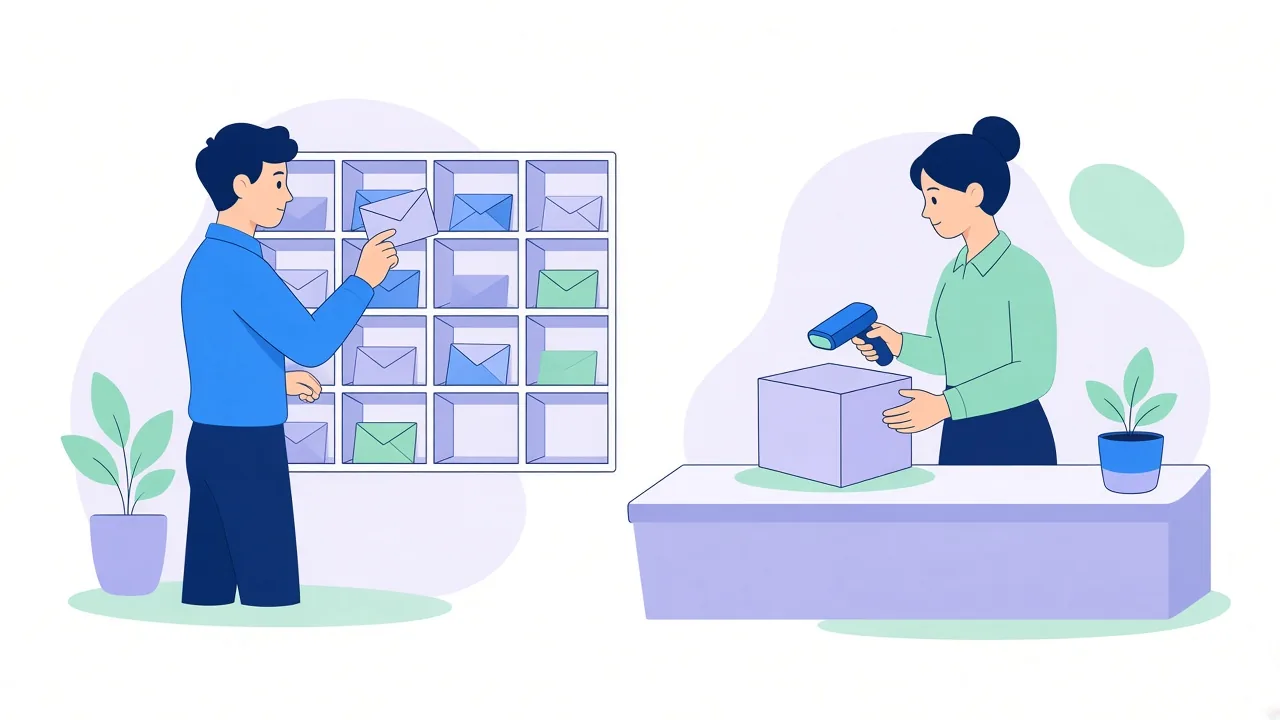
Mailroom clerk interview questions check three things: that you sort and route mail accurately, that you follow the rules for signed-for, confidential and suspicious mail, and that you can keep up with the volume and the lifting. The 20 questions below each come with a sample answer in plain spoken English, plus the facts behind the technical ones: Certified vs Registered Mail, postage meter dates, suspicious packages and post office hiring tests.
Start speaking with confidence today
Fluently is free to start. Take a free AI speaking assessment to see your level, then practice with games that build your vocabulary and pronunciation.


In this article
- Mailroom clerk interview questions about you (1–3)
- Mail sorting, accuracy and volume questions (4–7)
- Technical mail clerk questions: postage, signed-for mail, tracking and safety (8–12)
- Confidential mail, mistakes and people questions (13–16)
- Physical work, shifts and closing questions (17–20)
- More mailroom clerk interview questions
- Mail clerk and postal clerk hiring rules by country
- How to answer mailroom interview questions in clear English
- Practice a mailroom clerk interview question out loud
Mailroom clerk interview questions about you (1–3)
These questions also fit mail clerk, mail specialist and postal clerk interviews. A mailroom clerk moves letters and parcels to people inside an organization; a shipping and receiving clerk checks freight against orders (see shipping and receiving clerk interview questions). Names and numbers in the sample answers are examples: swap in your own.
1. “Tell me about yourself.”
Mailroom interviews can be short: one candidate on Glassdoor describes 10 to 15 minutes with the manager. Cover three points: what you do now, which part of it is like mail work, and why this job.
Tell me about yourself (with experience)
B1I’m a mail clerk at a law firm with about two hundred staff. I sort the morning mail, deliver it on two rounds and send the afternoon post.
Before that, I worked at a supermarket, so I’m used to busy hours, lifting boxes and helping people politely.
I’d like to join your mailroom because it handles more parcels, and I want to learn a tracking system.
Read it aloud
Listen to a model reading, then record yourself. You get your speaking pace, the share of words that came through clearly, and the words to repeat.
No mailroom experience? Use a job with the same habits: “I’ve just finished school. On weekends I worked at a pharmacy, where I checked the name on every bag before I handed it over. A mailroom needs the same check.”
2. “Why do you want to work in a mailroom?”
The interviewer wants a reason that will last through repetitive days, so link the job to something you like doing and can prove.
Sample answer: “I like work where I can see the result. At the end of a shift, every letter and parcel is with the right person. I’m organized, I don’t mind being on my feet, and in a mailroom you meet every department, so it’s a good way to learn how a company works.”
At a talent agency, one candidate was asked about favorite TV shows (Glassdoor), so prepare a line about the employer’s business.
3. “What mail handling experience do you have?”
Name the volume, the tools and one problem you solved. “I’ve handled a lot of mail” tells the interviewer nothing.
Say: “For two years I ran the mail desk at a student residence: about 150 letters and 60 parcels a day. I scanned each parcel, logged it and sent the student a pickup email. After the winter break we had a big backlog, so I sorted by room number first and cleared it in two days.”
Never worked with mail? Talk about anything you checked, counted or delivered, such as stocking shelves, food delivery or handing out exam papers, then say how you would use it in a mailroom.
Mail sorting, accuracy and volume questions (4–7)
Sorting questions test whether you have a system. O*NET, the US Department of Labor’s job database, starts its description with “Time-stamp, open, read, sort, and route incoming mail” (O*NET 43-9051, updated 2026).
4. “How do you sort and route incoming mail?”
A good answer sorts by category before it sorts by person. The US federal standard for mail clerks names the first split: mail to be opened, mail to be routed unopened, and mail that needs special handling, such as registered mail or mail containing valuables (OPM Mail and File Series, GS-0305).
You could say: “First I take out anything that needs a signature and log it. Then I time-stamp the mail the company opens and keep personal mail closed. I sort by department in the pigeonhole rack, check unclear names in the directory, and deliver on the set route, urgent items first.”
5. “How do you make sure mail reaches the right person?”
Accuracy is the core of the job: in O*NET’s survey, 68% of mail clerks said being exact or accurate is “extremely important”. Show two checks, not a promise.
Sample answer: “I read the full name and the department, not just the surname, because we have two people called Patel in finance. If an address is unclear, I check the directory or call before I deliver. Anything I can’t match goes in a ‘to check’ tray, never in the nearest pigeonhole.”
6. “How do you prioritize when everything arrives at once?”
Priority questions check that you know which mail cannot wait. First in, first out works for ordinary letters; signed-for, time-critical and legal mail goes first.
A strong answer: “I start with items that need a signature or have a deadline, like court papers or a next-day parcel. Then I do the regular sort, oldest first. I sort mail on the day it arrives, so nothing piles up for a weekly sort. If I can’t finish before the afternoon pickup, I tell my supervisor early.”
7. “Tell me about a time you handled a big volume of mail under a deadline.”
Behavioral questions want a real story told with STAR: Situation, Task, Action, Result (National Careers Service). Keep the result honest and small. The same story answers “How do you handle stress?”
A big volume under a deadline (STAR answer)
B1–B2Before a holiday, our mailroom got about three times the normal number of parcels, and one of us was off sick.
My task was to get everything to people before they left on Friday.
We started an hour early, I set up a separate parcel table, and I emailed staff so they could collect from the mailroom.
Every parcel was delivered or collected by three o’clock on Friday, and we used the same setup the next holiday.
Read it aloud
Listen to a model reading, then record yourself. You get your speaking pace, the share of words that came through clearly, and the words to repeat.
Technical mail clerk questions: postage, signed-for mail, tracking and safety (8–12)
Technical questions have right and wrong answers. The facts below are for US mailrooms using USPS; elsewhere, learn your national postal operator’s service names.
8. “Have you used a postage meter?”
A postage meter prints postage onto mail or a meter tape; meters come only from USPS-authorized providers, and you add postage (“reset” it) through the meter company (USPS postage options). One rule catches people out: mail with a full date in the imprint must be mailed on that date, or it needs a date correction (USPS Domestic Mail Manual 604).
Try: “Yes, every day. I weighed each piece, chose the service and checked the date and amount before printing. I looked at the meter balance every morning, so it never ran out during a mailing. Once we missed the Friday pickup, so on Monday I added a date correction.” Never used one? “Not yet, but I know it prints postage with the date, and I learn machines fast.”
9. “What is the difference between Certified Mail and Registered Mail?”
This question tests whether you know signed-for mail. According to USPS, Certified Mail lets the sender prove they sent it and see when it was delivered, with the recipient’s signature if Return Receipt is added. Registered Mail gives “maximum security” for valuable items, can be insured up to $50,000 and must be handed to a postal employee (USPS extra services).
Sample answer: “Certified Mail is for proof: legal notices, contracts, anything where we must show it was sent and delivered. Registered Mail is for valuable items, because it has the highest security and can be insured. Inside our building I treat both the same way: logged, signed for, and never left on a desk.”
10. “How do you log and track packages?”
Tracking questions check your chain of custody: who had the item, and when. The OPM standard calls this “maintaining control systems for the accountability of special communications”.
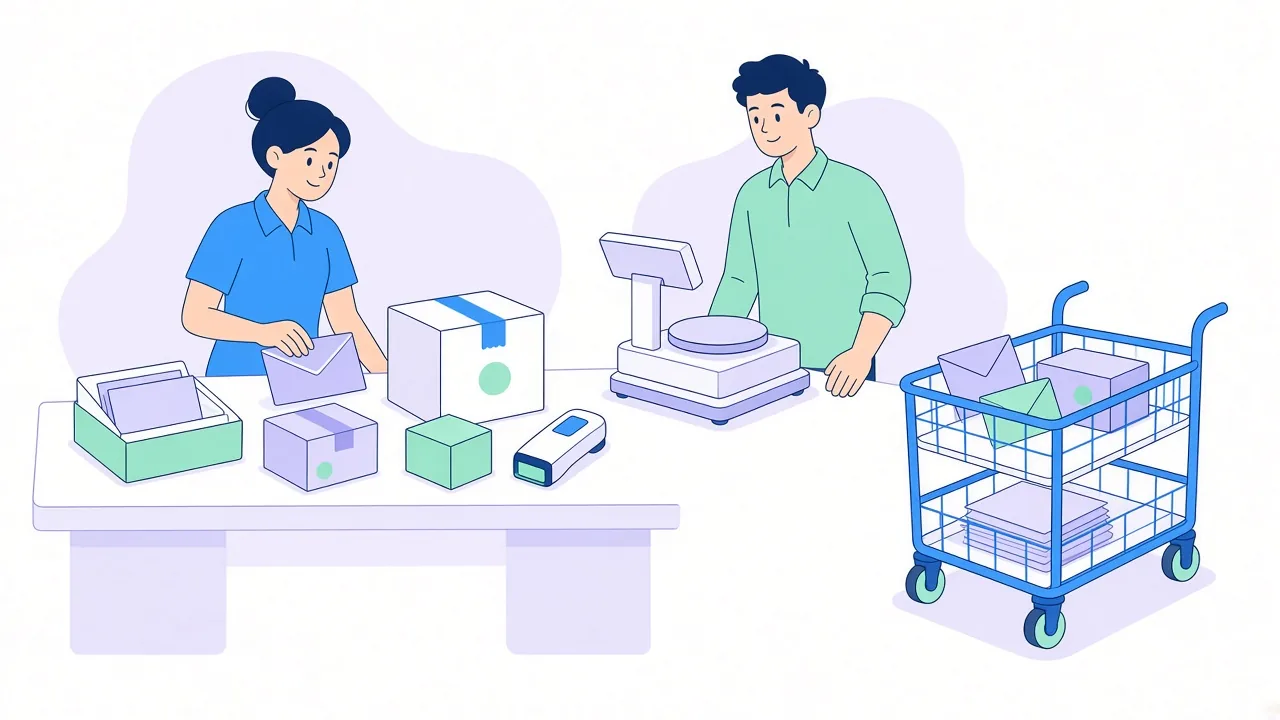
Say: “I scan every parcel when it comes in, so the system has the time and the carrier’s tracking number. It goes on a numbered shelf, and the person gets an email. They sign on the scanner when they collect it. If a parcel goes missing, the log shows where to look.”
11. “Someone wants to mail a box with phone batteries. What do you do?”
Outgoing mail questions check that you know some items are restricted. USPS treats lithium batteries, and flammable items such as most hand sanitizers, as hazardous materials: some are prohibited, some can be mailed if you follow the rules, and some can only travel by ground. Senders must check USPS Publication 52 (USPS shipping restrictions).
You could say: “I’d ask what’s inside and not guess. Batteries count as hazardous materials, so I’d check Publication 52 or ask my supervisor, choose a service that allows them and mark the box as required. If USPS doesn’t accept it, I’d explain that politely and suggest another carrier.”
12. “What would you do if you found a suspicious package?”
Never say you would open it to check. The US Postal Inspection Service lists the signs: no return address, excessive tape and postage, misspelled words; its poster adds oily stains, a strange odor, protruding wires and a lopsided shape. The steps: isolate the item, keep a safe distance, wash your hands and call (USPIS, Poster 84).
A strong answer: “I wouldn’t open it or move it around. I’d set it down, keep people away and tell my supervisor. Then I’d follow our procedure, which may mean calling the police or the Postal Inspectors, wash my hands and note who touched it. Checking what’s inside isn’t my job.”
Answers that worry a mailroom supervisor: “I’d open it to see what’s inside” (a suspicious package), “I’d leave it on their desk” (a signed-for letter), “If it’s marked personal, I open it anyway to save time” (confidential mail).
Confidential mail, mistakes and people questions (13–16)
13. “How do you handle confidential mail?”
Mail clerks see medical, legal and pay letters, so expect this question. Your answer is the written mail policy: which mail the company opens, and which goes to the person unopened. Mail privacy is also law: in the US, taking mail before it is delivered to the addressee and opening it “to pry into the business or secrets of another” is a federal crime (18 U.S.C. 1702).
Sample answer: “I open only what the policy says the mailroom opens. Anything marked personal or confidential goes to the person sealed, and HR or medical mail goes hand to hand, not into an open tray. And I never talk about what I see on envelopes.”
14. “A package was delivered to the wrong person. What do you do?”
Mistake questions test honesty more than the mistake itself: own it, fix it fast, then change the step that failed.
Say: “I’d check the log to see who signed for it, get it back and deliver it to the right person with an apology. Then I’d tell my supervisor, even if the mistake was mine. Last year I mixed up two people with the same surname, so now I always check the first name and department too.”
15. “An employee is angry that their parcel is late. How do you respond?”
Customer service in a mailroom means staying calm with colleagues, sometimes senior ones. Listen, check the facts and give a time.
Try: “I’d say, ‘I’m sorry, let me check right now,’ and look up the tracking number in our log. If we have it, I bring it straight away. If it hasn’t arrived, I show them the carrier’s tracking and call them when it comes. I don’t argue or blame the carrier.”
16. “Tell me about a conflict with a coworker.”
Use a small, real example with a calm ending, and don’t blame the other person.
Sample answer: “A coworker kept leaving unsorted parcels on my table at the end of his shift, and it made my morning round late. I asked to talk privately and explained the problem. We agreed he would log and shelve parcels before five, and I would cover the late deliveries. After that, the mornings were fine.”
Physical work, shifts and closing questions (17–20)
17. “Can you lift heavy parcels and push a mail cart all day?”
Be honest about weight and show safe technique. The US federal mail clerk standard describes one physical level as “recurring lifting and carrying of packages, pouches, or bags of moderate weight (under 50 pounds)” (OPM GS-0305). The UK Health and Safety Executive says: plan the lift, keep the load close to your waist, avoid twisting, use handling aids (HSE).
You could say: “Yes. I’m on my feet most of the day now, and I lift boxes of up to about 20 kilos. I use a cart instead of carrying things far, and I ask for help with anything awkward. When I lift, I keep the box close and turn with my feet, not my back.” Fresher version: “Not as a job yet, but I help with deliveries at my family’s shop, and I keep loads close and don’t twist.”
18. “What are your strengths and weaknesses?”
Pick a strength the mailroom needs and a real weakness that is not a core duty, plus what you do about it.
A strong answer: “My strength is accuracy: in two years at the residence desk, no parcel went missing. My weakness is that I used to try to do everything myself on busy days. Now I tell my supervisor early when the volume is too high, so we can plan together.”
19. “What hours can you work, and are you okay working alone?”
Hours follow the mail. “Are you willing to work long hours?” appears on Glassdoor’s mailroom clerk list, and postal processing can run around the clock: Royal Mail says its processing teams keep mail centers running “24 hours a day. 7 days a week” (Royal Mail careers). Give your exact availability now, not after the offer.
Sample answer: “I can start at seven every weekday and stay late in busy weeks if I get a day’s notice. Weekends are fine twice a month. I’m also comfortable working alone: at my last job I covered the evening desk by myself and kept the log up to date.”
20. “Do you have any questions for us?”
Ask about the work itself; two or three of these are enough:
- “How many letters and parcels come in on a normal day?”
- “Do you track packages with a scanner system or a logbook?”
- “What is the procedure for suspicious mail here?”
- “How are new clerks trained on the meter and the delivery routes?”
More mailroom clerk interview questions
Longer lists add these; one or two sentences each is enough. To keep a copy of the page, save it as a PDF from your browser.
| Question | What to say |
|---|---|
| “Why should we hire you?” | One reason with proof: “I’m accurate, and I haven’t missed a shift in a year.” |
| “Why did you leave your last job?” | No complaints: “The contract ended, and I want a permanent job.” |
| “What are your salary expectations?” | Check local pay first. O*NET’s 2025 US median is $18.89 an hour for mail clerks outside the Postal Service and $29.87 for USPS postal service clerks. Give a range. |
| “What do you know about our company?” | Two facts from their website, linked to the mailroom: “With four floors of offices, the internal rounds must matter.” |
| “How do you handle repetitive work?” | Small targets, like one shelf every half hour, and the same name check on the hundredth letter as on the first. |
| “A parcel arrives wet, leaking or crushed. What do you do?” | Don’t open it. Set it apart on a tray, photograph it, log the damage and tell your supervisor. Powder, oil or a smell: treat it as suspicious (question 12). |
| “What computer skills do you have?” | Name what you use. O*NET lists Microsoft Excel, Outlook and Postal Explorer among this job’s software. If the mailroom scans letters, see document scanning technician interview questions. |
| “How do you keep mailroom supplies stocked?” | Count envelopes, labels, tape and meter ink, and reorder at a set level, not when they run out. |
Mail clerk and postal clerk hiring rules by country
Private mailrooms set their own hiring steps; postal operators and governments add tests and checks. Steps change, so read the current posting.
| Where | Employer | Tests and requirements |
|---|---|---|
| United States | Company, university and hospital mailrooms | Usually a high school diploma or GED, though some jobs may not need one (O*NET 43-9051); the employer’s own interview and checks. |
| United States | US Postal Service | Most entry-level jobs require the Virtual Entry Assessment, such as exam 476 for mail processing clerks (USPS exams). Age 18 (or 16 with a diploma); background check, drug screening, medical assessment; US citizen, permanent resident or citizen of a US territory (USPS application process). |
| United States | Federal agencies (USAJOBS): Mail Clerk, Mail and File series GS-0305 | No OPM qualification standard of its own; agencies use the clerical group standard (OPM). |
| Canada | Canada Post: postal clerk | Online profile, interview in English or French, tests depending on the role (some by a third party), a reference check for some jobs, security screening for all new candidates (Canada Post recruitment journey). Mailroom clerks fall under NOC 74100: secondary school may be required; on-the-job training is required. |
| United Kingdom | Royal Mail: delivery, processing and collections | Online application, online tests if the role needs them, an interview with the hiring manager, then the offer and background checks (Royal Mail careers). Royal Mail’s 2015 recruitment guide says the interview asks for examples of your previous experience (PDF). |
| Ghana and other countries | National post offices and private companies | Rules vary. Ask the employer which tests, checks and documents it requires. |
How to answer mailroom interview questions in clear English
Mailroom work runs on short spoken exchanges: confirming a name, asking for a signature, explaining a delay. Use short sentences and stress the job words correctly:
| Word | Say it (US) | Example |
|---|---|---|
| envelope | EN-vuh-lohp /ˈen.və.loʊp/ or ON-vuh-lohp /ˈɑːn.və.loʊp/; both are correct | “Personal envelopes go to the person unopened.” |
| courier | KOOR-ee-er /ˈkʊr.i.ɚ/ (oo as in “book”) | “The courier comes at four.” |
| receipt | rih-SEET /rɪˈsiːt/ (the p is silent) | “Please sign the receipt here.” |
| postage | POH-stij /ˈpoʊ.stɪdʒ/ | “I check the postage before I print.” |
| parcel | PAR-sul /ˈpɑːr.səl/ | “Your parcel is on shelf B.” |
Pronunciations follow the Cambridge Dictionary. For more drills, see the English pronunciation practice guide; for phrases that open an answer or buy you a second to think, see English for job interviews.
Practice a mailroom clerk interview question out loud
A technical answer can bring a chain of “what if…?” follow-ups. Say the candidate’s lines out loud.
A certified letter for HR
B1–B2- Interviewer
A certified letter arrives for the HR manager. Walk me through what you do.
- Amina
I sign for it, scan it into our log with the time and mark it as signed-for mail.
- Interviewer
The HR manager is on holiday this week.
- Amina
I check who covers for her and keep it in the locked cabinet until someone authorized signs for it.
- Interviewer
Someone from sales says, “I’ll take it to HR for you.”
- Amina
I thank them, but I deliver it myself, because it needs a signature.
- Interviewer
The envelope is marked “Confidential”. Do you open it to see how urgent it is?
- Amina
No. It goes to HR sealed. If it might be urgent, I call HR and tell them it has arrived.
- Interviewer
And if nobody has collected it by Friday?
- Amina
I remind HR by email and tell my supervisor, so it doesn’t sit here over the weekend.
Practise this dialogue
Listen to the whole exchange, then take one role: your partner’s lines are read aloud, you say yours into the microphone and see which words came through.
For a timed run, the free browser mock interview asks screening and behavioral questions and reports answer length, pace and filler words; it has no mailroom track and does not check facts. For more practice questions, see mock interview questions and answers.
Say your answers out loud before the interview
Fluently is an AI speaking coach for non-native English speakers on iOS and Android. You answer out loud and get feedback on pronunciation, fluency, vocabulary and grammar. It is free to start: take a free AI speaking assessment to see your level, then practice with games that build your vocabulary and pronunciation. Conversations with your AI tutor come with Fluently Premium.
Frequently asked questions
What does a mailroom clerk or postal clerk do?
A mailroom clerk time-stamps, sorts and routes incoming mail and prepares outgoing mail and packages, including postage (O*NET 43-9051). A postal clerk at a USPS post office also sells stamps and money orders and checks mail for correct postage (O*NET 43-5051).
How do you become a mailroom clerk?
Apply for entry-level mail clerk or mail services assistant posts at companies, universities, hospitals or the national post, and show any experience with deliveries, stock or customer service. Training is on the job: from a few days to one year, according to O*NET.
Are mail specialist and mail sorter interview questions different?
Mostly no. O*NET lists mail clerk, mail handler, mail processor, mail sorter and postal clerk as job titles of one occupation, so the 20 questions above apply. Extra duties in the posting, such as driving or running an inserting machine, bring extra questions.
Is a post office or mail carrier interview different from a company mailroom interview?
Partly. A post office counter job adds customer and cash questions, because postal clerks sell stamps and money orders. Mail carrier jobs center on delivering a route on foot or by vehicle, and USPS tests carriers with a separate assessment, exam 474. Questions on accuracy, signed-for mail and suspicious packages stay the same.
Can I do a mailroom interview if English is my second language?
Yes. A mailroom needs clear, short English for names, signatures and delays, not perfect grammar; O*NET lists speaking and reading comprehension among the essential skills for mail clerks. To check your level, take the free English level test.