20 Grocery Store Interview Questions and Answers for Supermarket Cashiers
 Yurii Rebryk · Updated · 15 min read
Grocery store interview questions are short and practical: who you are, when you can work, how you handle cash and what you do with an upset customer. Below are 20 questions with sample answers in plain spoken English, for cashier, clerk and customer service jobs at a supermarket. The technical ones have a right answer: count your drawer, count change back, check ID, and follow store policy instead of your own rules.
Start speaking with confidence today
Fluently is free to start. Take a free AI speaking assessment to see your level, then practice with games that build your vocabulary and pronunciation.


In this article
- The 20 grocery store interview questions at a glance
- Grocery store interview questions about you (1–6)
- Cash handling and register questions (7–11)
- ID checks, SNAP and bagging questions (12–14)
- Customer conflict questions, with two worked examples (15–18)
- Availability and closing questions (19–20)
- More grocery store interview questions to prepare
- ID and checkout rules for cashiers by country
- What to expect at a grocery store interview, and what to wear
- Practice a grocery store role-play out loud
The 20 grocery store interview questions at a glance
These 20 questions cover a first interview for a supermarket cashier, grocery clerk or customer service associate. Stocker jobs share the first six; for trucks, lifting and stock rotation, see the stock associate interview questions.
| # | Question |
|---|---|
| 1 | “Tell me about yourself.” |
| 2 | “Why do you want to work at a grocery store?” |
| 3 | “Do you have cashier or customer service experience?” |
| 4 | “What skills does a good cashier need?” |
| 5 | “What are your strengths and weaknesses?” |
| 6 | “Why should we hire you as a cashier?” |
| 7 | “How do you handle cash, and what if your drawer is short?” |
| 8 | “How do you count back change?” |
| 9 | “How do you void an item or give a refund?” |
| 10 | “An item rang up higher than the shelf price. What do you do?” |
| 11 | “A customer wants to use an expired coupon. What do you say?” |
| 12 | “Someone buying beer or cigarettes looks young. What do you do?” |
| 13 | “Do you know how SNAP or EBT payments work?” |
| 14 | “How do you bag groceries?” |
| 15 | “Tell me about a time you dealt with an angry customer.” |
| 16 | “The store is busy and your line is long. What do you do?” |
| 17 | “What would you do if you saw someone stealing?” |
| 18 | “How do you work with a team?” |
| 19 | “Can you work weekends, holidays and long shifts on your feet?” |
| 20 | “Do you have any questions for us?” |
Grocery store interview questions about you (1–6)
Keep each answer under a minute. Every name, number and store detail in the sample answers is an example: swap in your own.
1. “Tell me about yourself.”
This opener asks for a short story in order: what you do now, one thing that fits a checkout job, and why this store. Listen to the model, then record your own.
Tell me about yourself (cashier)
B1Hi, I’m Ana. For two years I’ve worked as a cashier at a pharmacy, where I take cash and card payments and close my register at night.
I like busy shifts and talking to customers, and my drawer is almost always exact at the end of the day.
I shop at this store every week, I live ten minutes away, and I can work weekends. That’s why I applied.
Read it aloud
Listen to a model reading, then record yourself. You get your speaking pace, the share of words that came through clearly, and the words to repeat.
No job yet? Change the first line: “I’m finishing high school, and I volunteer at our school food drive, where I count donations and help people find what they need.”
2. “Why do you want to work at a grocery store?”
A specific reason beats “I need a job” or “nice store”: add one fact you know as a customer or neighbor.
Sample answer: “I like jobs where I talk to people all day, and a grocery store has regulars, so you get to know them. Your store is fifteen minutes from my home, so I can cover early shifts. I shop here too, and the staff are always friendly, which tells me it’s a good team.”
3. “Do you have any cashier or customer service experience?”
In a 2025 sample of 21 Ontario grocery store applicants collected by the job site WorkNearYou, 11 were asked about previous work, 8 about customer service and 4 about availability. Name the job, the matching tasks and one result.
Say: “Yes. For a year I worked the counter at a bakery café. I took cash and card payments, served about 150 customers on a Saturday morning, and closed the register at night. I haven’t used a grocery scanner yet, so produce codes are what I’d learn first.” Fresher: “Not paid work, but I ran the cash box at our school fundraiser and balanced it with the teacher.”
4. “What skills does a good cashier need?”
Pick three skills and prove one. The US Occupational Outlook Handbook (BLS) lists communication, customer service, dexterity, near vision and physical stamina; O*NET names integrity and dependability as its two work styles for cashiers.
A strong answer: “Accuracy, patience and speed, in that order. Accuracy, because the drawer has to match the sales at the end of the shift. Patience, because a calm cashier helps an upset customer faster. Speed comes from knowing the register, so I learn the produce codes in my first week.”
5. “What are your strengths and weaknesses?”
The weakness half checks honesty. “I’m a perfectionist” sounds rehearsed; give a real weakness that is not a core duty, then what you do about it.
You could say: “My strength is staying calm with people; at my last job I took the difficult customers. My weakness is speed on a new system. I’m slower than others in my first weeks, so I ask for the manual, practice on quiet shifts, and by week three I’m at normal speed.”
6. “Why should we hire you as a cashier?”
Give the three things every store manager needs (reliable shifts, careful cash, a friendly line) with proof for each.
Sample answer: “Because you can count on me. I don’t miss shifts, and I’ve covered weekends at short notice. I’m careful with cash: my drawer was short only twice last year, both times by less than a dollar. And customers leave my line in a better mood.” Fresher: “I’m new, so you can train me your way, and I can work every weekend and school holiday.”
Cash handling and register questions (7–11)
Cash and register questions have correct answers. O*NET lists cashier tasks such as counting “money in cash drawers at the beginning of shifts” and reconciling total payments “with total sales.”
7. “How do you handle cash, and what do you do if your drawer is short?”
The interviewer wants a routine, plus the promise that you report a difference instead of hiding it.
Say: “I count my drawer before I open, so I start with a known amount. I leave the customer’s bill on the ledge until I’ve counted their change. At the end of the shift I count again. If it’s short or over, I tell my supervisor right away and we check the receipts together. I never cover a difference with my own money.”
8. “How do you count back change?”
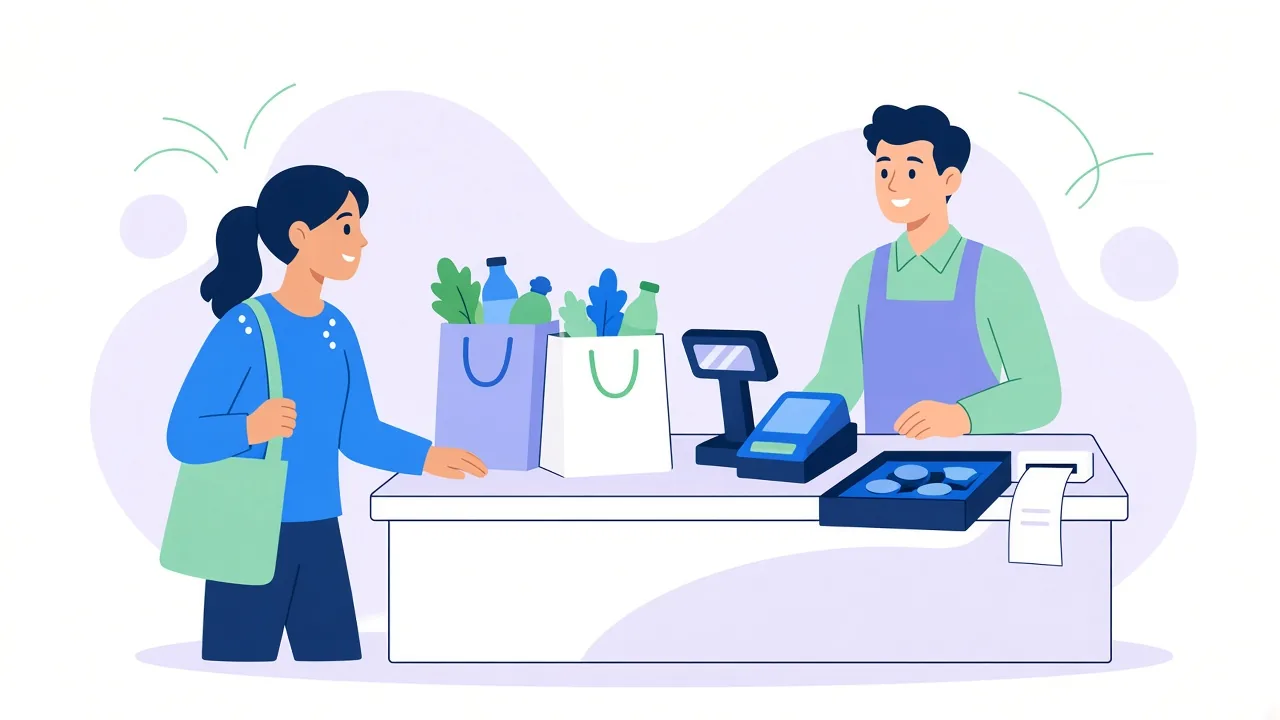
Counting back change means counting up from the total to the amount paid, out loud, so you and the customer can both check it. Example: the total is $13.47 and the customer gives you $20.
| Step | You hand over | You say |
|---|---|---|
| 1 | 3 pennies | “$13.50” |
| 2 | 2 quarters | “$14” |
| 3 | 1 dollar bill | “$15” |
| 4 | 1 five-dollar bill | “and $20. Thank you.” |
The change is $6.53 (3¢ + 50¢ + $1 + $5). Sample answer: “The register shows the change, but I still count it back, from the total up to what the customer paid. Counting out loud catches my mistakes and shows the customer the change is right.”
9. “Have you used a POS system? How do you void an item or give a refund?”
Every store’s register is different and training covers it, so describe the steps in general terms and name the rule you follow.
You could say: “At the pharmacy I used a touchscreen register with a scanner and a card reader. If I scanned something twice, I voided the line before payment. Customers tap or insert their own card; I never touch the PIN. For a refund I check the receipt, scan the item back and refund it the way they paid. With no receipt, I call my supervisor.”
10. “A customer says an item rang up higher than the shelf price. What do you do?”
Check before you argue. In Canada outside Quebec, stores that follow the Scanner Price Accuracy Voluntary Code give an untagged item free when it scans above the displayed price and is worth less than $10, or take $10 off a pricier one (Competition Bureau). Elsewhere, follow store policy.
Sample answer: “I’d apologize and ask a coworker to check the shelf tag, so the customer keeps their place. If the tag shows the lower price, I give that price the way store policy says and tell my supervisor, so the tag or the system gets fixed. If the tag is for a different size, I explain politely and offer to take the item off.”
11. “A customer wants to use an expired coupon, or two offers together. What do you say?”
Coupon questions test saying no without a fight: read the terms, explain, offer what works, and leave exceptions to the supervisor.
Try this: “I’d read the coupon first, because the rules are printed on it. If it has expired, I’d say: ‘I’m sorry, this one ended last week, so the register won’t take it. This weekly offer still works, though.’ If the customer is still upset, I call my supervisor, because some stores make exceptions and I don’t want to guess.”
ID checks, SNAP and bagging questions (12–14)
These three questions are about rules outside the store’s control. The BLS puts it plainly: “When selling age-restricted products, such as alcohol or tobacco, cashiers must verify the age of the purchasing customer.”
12. “Someone buying beer or cigarettes looks young. What do you do?”
In the US, no retailer may sell any tobacco product, including e-cigarettes, to anyone under 21, and since September 30, 2024 retailers must check a photo ID for anyone under 30 buying cigarettes, smokeless or covered tobacco products (FDA; 21 CFR 1140.14). The alcohol purchase age is 21 in every state (NHTSA). Other countries are in the table below.
Sample answer: “I ask for a photo ID whenever the customer looks under 30, even a regular, and check the date of birth. No valid ID, no sale, and I say it politely: ‘Sorry, I can’t sell this without ID. It’s the law.’ If they argue, I stay calm and call my supervisor. One lost sale is better than risking the store’s license.”
13. “Do you know how SNAP or EBT payments work?”
In the US, SNAP participants pay for food with an Electronic Benefits Transfer (EBT) card at authorized stores (USDA). SNAP cannot buy beer, wine or liquor, cigarettes or tobacco, vitamins or medicines, foods that are hot at the point of sale, or nonfood items such as pet food and cleaning supplies (USDA, 2025). Some states also bar soda or candy under USDA waivers (USDA, 2026).
Say: “SNAP benefits on an EBT card pay only for eligible food, not for alcohol, tobacco, hot food or paper towels. If an order has both, the card covers the food and the customer pays the rest another way. I’d explain that quietly and treat the customer like everyone else, because how someone pays is their business.”
14. “How do you bag groceries?”
Bagging is also a food safety question. US advice says: “When you check out, place raw meat, poultry, and seafood in separate bags from other foods” (FoodSafety.gov).
A strong answer: “Heavy, square things go at the bottom, like cans and milk, and bread, eggs and chips go on top. Cold and frozen items go together, raw meat goes in its own bag, and cleaning products stay away from food. I don’t overfill bags, and I ask if the customer brought their own.”
Customer conflict questions, with two worked examples (15–18)
Difficult customers come with the job: in O*NET’s survey of cashiers, 58% said they deal with unpleasant, angry or discourteous people “once a week or more but not every day.” Answer with STAR: Situation, Task, Action, Result.
15. “Tell me about a time you dealt with an angry customer.”
Interviewers listen for four moves: let the customer finish, apologize, fix what you can, and call a supervisor for the rest.
Example 1: the sold-out sale item
B1–B2Last December, a customer at my register was angry because the turkey in the weekly flyer was sold out. She said the store lied to get her in, and the line behind her was growing.
I let her finish and said, “I’m sorry, that’s really frustrating.” Then I called my supervisor, who offered a similar turkey at the sale price.
The customer took it and thanked me. Afterwards, I asked my supervisor to tell the other cashiers, so every customer got the same answer.
Read it aloud
Listen to a model reading, then record yourself. You get your speaking pace, the share of words that came through clearly, and the words to repeat.
Example 2: charged twice. Situation: a man said loudly he had been charged twice for milk. Task: fix it fast. Action: “Let me check your receipt with you.” I found the double scan and refunded it with my supervisor’s code. Result: he had his money back in two minutes, and I now watch the screen after every scan.
No customer story yet? Use the same four moves with “I would…”.
16. “The store is busy and your line is long. What do you do?”
Rush-hour questions check speed without mistakes, and whether you ask for help early.
Sample answer: “I keep the same order for every customer: greet, scan, total, pay, receipt. My talk stays friendly but short. If the line grows past four or five people, I call my supervisor to open another register, because that’s faster than rushing and making mistakes. To customers who have waited, I say, ‘Thanks for waiting.’”
17. “What would you do if you saw someone stealing?”
Theft questions check safety first: no chasing, no grabbing, no accusing. Many security guards are trained the same way: observe and report (see the security guard interview questions).
Say: “I wouldn’t accuse or chase anyone. It isn’t safe for me or for customers, and I could be wrong. I’d stay at my register and quietly tell my supervisor or loss prevention what I saw: what the person was wearing, what they took and where they went. Then I’d follow store policy.”
18. “How do you work with a team?”
The follow-up may be a coworker who does not do their share. Show that you help first and talk directly before going to a manager.
You could say: “I help where the store needs me: bagging when the line is long, facing shelves when it’s quiet. If a coworker kept leaving work to me, I’d talk to them privately first: ‘Can we split the returns? I’ll take the first half.’ Most problems end there. If not, I’d tell the supervisor and talk about the work, not the person.”
Availability and closing questions (19–20)
19. “Can you work weekends, holidays and long shifts on your feet?”
Cashier schedules “may vary to include early mornings, late evenings, weekends, and holidays”, part-time work is common, and cashiers spend most of their time standing (BLS). Give exact days and any limits.
Sample answer: “Yes. I can work Saturdays, Sundays, any evening after four and most holidays. I can’t work Thursday mornings until my class ends in June. Standing all shift is fine: my last job was eight hours on my feet. I can start two weeks after an offer.”
20. “Do you have any questions for us?”
Ask two questions about the job itself; they show you already picture the first month.
- “How long is training before I work a register alone?”
- “What do new cashiers find hardest in the first month?”
- “How far ahead are shifts scheduled?”
- “Do cashiers also bag, stock or watch the self-checkout?”
More grocery store interview questions to prepare
| Question | What to say |
|---|---|
| “Why are you leaving your current job?” | One neutral reason about the future (more hours, closer to home). Never criticize a former boss. |
| “What are your salary expectations?” | Check local pay first. The US median for cashiers was $15.81 an hour in May 2025, and $16.45 at food and beverage retailers (BLS). Give a range. |
| “A customer asks for an item that is out of stock.” | Apologize, offer a similar item, ask a coworker to check the back, and offer a rain check if the store gives them. |
| “What would you do if you saw a coworker stealing?” | Report it to a manager. Integrity is one of the two work styles O*NET lists for cashiers. |
| “Someone pays with a bill you think is fake.” | Follow store policy and call a supervisor. The Federal Reserve says detection pens “are not always accurate” and advises checking the watermark and security thread. |
| “A jar breaks and sauce spills in an aisle.” | Stand by the spill so no one slips, call for a wet-floor sign and cleanup. A Walmart applicant in the WorkNearYou sample reported this one. |
| “Would you ask customers to sign up for our rewards card?” | Yes, once, in one sentence, and accept a no. The BLS lists rewards sign-ups among typical cashier duties. |
| “Where do you see yourself in five years?” | Growing inside the store: head cashier, customer service desk or department lead. |
ID and checkout rules for cashiers by country
Age rules differ by country, and in the US and Canada by state or province. Check the rules where you will work; store policy can be stricter than the law.
| Where | Age-restricted sales | Other rules a cashier meets |
|---|---|---|
| United States | Tobacco and e-cigarettes: 21, photo ID for anyone under 30 (FDA). Alcohol: purchase age 21. | Seller age for alcohol varies by state; several states require a legal-age manager present when a younger employee sells (NIAAA APIS). SNAP limits apply. |
| Ontario, Canada | Tobacco and vapes: no sale under 19; ID for anyone who appears under 25 (Ontario). | Grocery staff who sell alcohol must be 18 or older and complete AGCO-approved training first (AGCO). Scanner price code at participating stores. |
| United Kingdom | Alcohol: no sale to anyone under 18 (GOV.UK). | England and Wales: from 1 January 2027, selling tobacco to anyone born on or after 1 January 2009 is an offense (Tobacco and Vapes Act 2026, s. 1). |
| United Arab Emirates | Tobacco: no sale under 18; the seller may ask for proof of age, and not knowing the age is no excuse (Federal Law No. 15 of 2009, Art. 5). | Other rules vary by emirate: ask the employer. |
| New Zealand | Alcohol: purchase age 18; anyone who sells to a person under 18 on licensed premises commits an offense (Sale and Supply of Alcohol Act 2012, s. 239). | A manager must be on duty whenever alcohol is sold to the public (same Act, s. 214). |
What to expect at a grocery store interview, and what to wear
Applicants describe short, informal interviews (“short and sweet”, as one grocery worker wrote on Indeed). In the WorkNearYou sample, most applicants who mentioned clothes wore casual outfits. Wear clean, simple clothes, bring your ID and your availability written down, and arrive ten minutes early.
Practice a grocery store role-play out loud
Here the interviewer plays the customer. Say the candidate’s lines out loud.
No ID, no sale
B1–B2- Interviewer
Let’s role-play. I’m a customer buying groceries, a six-pack of beer and cigarettes. Go ahead.
- Lina
Hi, did you find everything okay? Can I see a photo ID for the beer and cigarettes, please?
- Interviewer
I left it in the car. Come on, I’m 25.
- Lina
I’m sorry, I can’t sell those without ID. I can ring up the rest now, and I’ll keep the beer and cigarettes here if you want to get your ID.
- Interviewer
This is ridiculous. I shop here every week.
- Lina
I understand it’s annoying. It’s the law, and I check everyone who looks under 30. Would you like me to call my supervisor?
- Interviewer
Why didn’t you just make an exception for a regular?
- Lina
Because the rule protects the store and me. Saying no politely is part of the job.
Practise this dialogue
Listen to the whole exchange, then take one role: your partner’s lines are read aloud, you say yours into the microphone and see which words came through.
Checkout English is short and polite: “Did you find everything okay?”, “Would you like a bag?”, “Sorry about the wait.” For interview phrases, see the English for job interviews guide.
For a timed run, the free browser mock interview reports answer length, pace and filler words. It has no grocery track, so choose screening and behavioral questions; it checks how you speak, not whether your answer is right.
Say your answers out loud before the interview
Fluently is an AI speaking coach for non-native English speakers on iOS and Android. You answer out loud and get feedback on pronunciation, fluency, vocabulary and grammar. It is free to start: take a free AI speaking assessment to see your level, then practice with games that build your vocabulary and pronunciation. Conversations with your AI tutor come with Fluently Premium.
Frequently asked questions
Can I get a grocery store cashier job with no experience?
Yes. Cashiers “typically have no formal education requirement” and are trained on the job (BLS). Show reliability, volunteering with money or people, and wide availability, and answer scenarios with “I would…” instead of inventing a past job.
Are grocery clerk, stocker and cashier interview questions the same?
Mostly. Questions about you, availability and customers are shared. Stockers get more about lifting, trucks and stock rotation; cashiers get the cash, ID and coupon questions; customer service desk staff get more about returns and complaints. In-store cafés ask barista interview questions.
Is there a PDF of these grocery store interview questions and answers?
There is no separate PDF. The table of 20 questions at the top is the one-page version: use your browser’s Print option and choose Save as PDF. Then say each answer out loud at least twice; reading is not rehearsal.
What should I say if they ask what a cashier does?
Use the BLS list: greet customers, scan purchases, take payment, give change and receipts, bag purchases, process returns, and count the register at the start and end of each shift.
Can I do a grocery store interview in English if it is my second language?
Yes. The manager checks that customers can understand you, not that you sound like a native speaker. Use short sentences and ask “Sorry, could you repeat that?” when you need to. To check your level, take the free English level test.