20 Scanner Operator Interview Questions and Answers for Document Scanning Technicians
 Yurii Rebryk · Updated October 29, 2026 · 15 min read
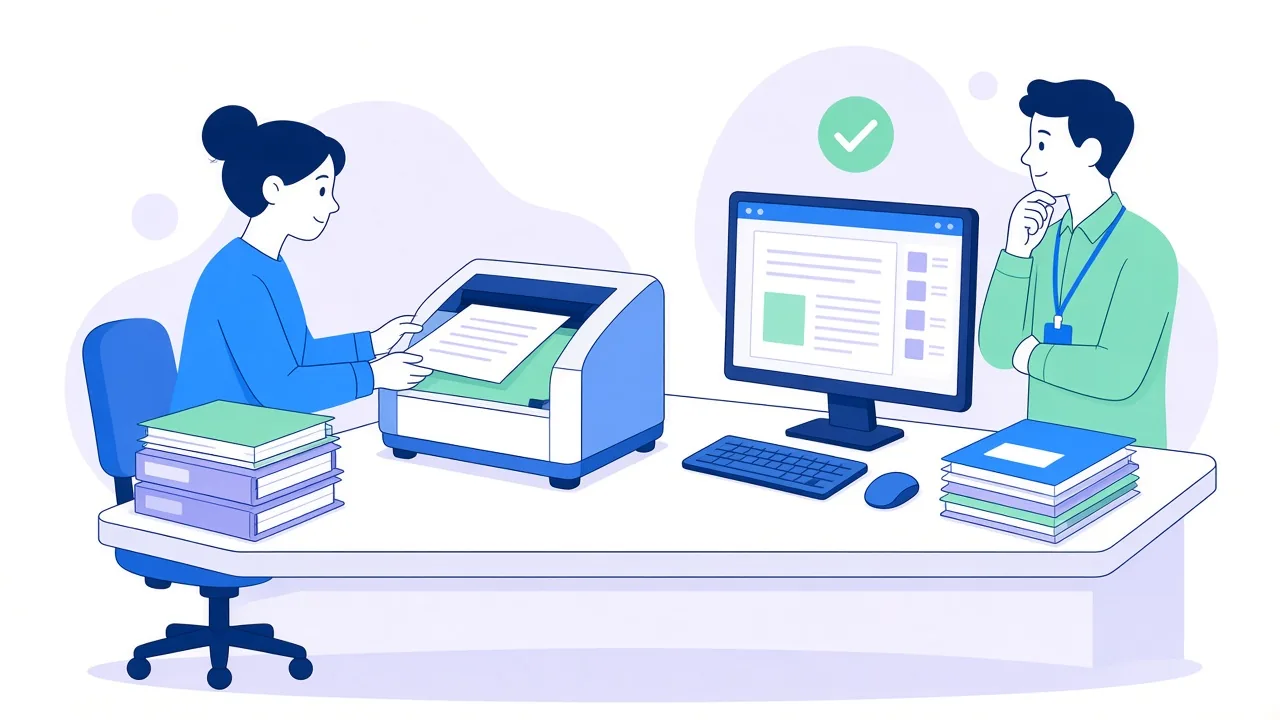
Scanner operator interview questions check three things: that you can prepare and scan documents without losing a page, that you check every batch for quality, and that you keep records confidential. The 20 questions below come with sample answers in plain spoken English and the settings to know, such as the US federal minimum of 300 ppi for text. Applying in Tanzania? There, “Scanner Operator II” is a port job that scans cargo with X-rays: see the Tanzania section.
Say your answers out loud before the interview
Download AppIn this article
- Which scanner operator job is your interview for?
- Scanner operator interview questions about you (1–4)
- Technical scanner operator interview questions (5–12)
- Confidentiality, volume and equipment questions (13–16)
- Work habit questions for scanner operators (17–20)
- More scanner operator interview questions
- Scanner operator interviews in Tanzania: the TPA Scanner Operator II post
- Rules that apply to scanning jobs, by country
- Practice a scanner operator interview answer out loud
Which scanner operator job is your interview for?
The title “scanner operator” covers three jobs, and their interview questions differ.
| Job | What gets scanned | Where |
|---|---|---|
| Document scanner operator (document scanning or imaging technician) | Paper records, turned into searchable files | Records offices, hospitals, archives, scanning companies |
| Cargo scanner operator (in Tanzania: TPA Scanner Operator II) | Trucks and containers, with X-rays | Ports and customs |
| CT scanner operator | Patients, for medical images | Hospitals; a radiologic technologist job (O*NET 29-2034) |
This page covers the first job, plus a section on the cargo post. A CT interview needs a medical imaging question set.
Scanner operator interview questions about you (1–4)
Keep each answer under a minute. Every name, number and year in a sample answer is an example: swap in your own.
1. “Tell me about yourself.”
“Tell me about yourself” wants 30 seconds: what you do now, your work with documents or computers, and why this job. Listen, then record your version.
Tell me about yourself (with experience)
B1I’m a scanning operator with two years of experience in a hospital records office. I prepare patient files, scan them on a high-volume scanner and check every batch before it goes into the system.
Before that, I worked as a data entry clerk, so I type fast and I’m careful with names and numbers.
I’m applying here because your team is digitising council records, and I like work where accuracy matters.
Read it aloud
Listen to a model reading, then record yourself. You get your speaking pace, the share of words that came through clearly, and the words to repeat.
No experience? Say: “I finished secondary school and a computer course last year. In a school office job I filed and photocopied documents and kept the sign-out book for files. I’m careful, and I type quickly.”
2. “Why do you want to work as a scanner operator?”
Give a reason that survives a day of repetitive work, and tie it to something you have done.
You could say: “I like seeing the result of my work. In my last job I filed about a hundred letters a day, and I liked getting each one in the right place. Scanning is the same kind of work on a computer: careful preparation, clean images and files people can find.”
3. “What scanners and scanning software have you used?”
Name the scanner type, the software and one task you did with them.
| Scanner type | Best for | What goes wrong |
|---|---|---|
| Flatbed | Single pages, fragile or bound documents, odd sizes | Slow for large batches |
| Sheet-fed (automatic document feeder) | Batches of loose, standard-size pages | Staples, folds and thin paper cause jams and double feeds |
| Production (high-volume) | Large back-file projects, many boxes a day | One wrong setting spoils a whole batch if nobody checks |
Say: “I’ve used a sheet-fed production scanner for daily batches and a flatbed for torn or bound pages. In the capture software I set the resolution, split batches with separator sheets and indexed each file. For a new brand, I’d ask for the manual and a short handover.” Fresher: “I’ve used office printer-scanners and photocopiers, and I learn software quickly.”
4. “What does a document scanning technician do?”
Answer with the workflow, in order. A 2022 Tanzanian land-records data conversion advert lists the same steps: sort the files, scan all documents, quality-check the scanned files, build the database and prepare daily progress reports (Ministry of Lands advert, PSRS, March 2022).
A strong answer: “A scanning technician turns paper records into digital files people can trust. I prepare the documents, scan them, check every image, index the files so they can be found, and track the boxes until they go back to storage.”
Technical scanner operator interview questions (5–12)
The numbers below come from the US federal rules for digitizing permanent records (36 CFR part 1236, subpart E). Your employer’s project spec always comes first.
5. “How do you prepare documents for scanning?”
Give the preparation steps in order:
- Count and log the box or file against the inventory.
- Remove staples, clips and sticky notes, and flatten folded pages.
- Set aside torn or fragile pages for the flatbed.
- Keep documents together: stapled pages stay one document, with separator sheets or one multi-page file.
- Batch the pages and write the page count on the batch sheet.
The federal rules ask the same question: “Does a folder contain multiple documents that are stapled together?” That link must survive scanning, through metadata, folders or multi-page files.

Sample answer: “First I check the box against the list. Then I remove staples and clips, flatten the pages and set torn ones aside for the flatbed. Separator sheets keep each document together, and the page count goes on the batch sheet, so we can prove nothing was lost.”
6. “What resolution and colour settings do you use?”
For typed or printed text, know 300 ppi (pixels per inch, often called dpi): the federal rules require “a minimum of 300 ppi” for modern textual paper records, in colour or grayscale. Colour matters when it carries meaning: stamps, blue-ink signatures, highlights, photos.
Say: “It depends on the project spec. For typed pages that’s usually 300 ppi, and higher for small print or maps if the spec allows. I use colour when stamps or signatures matter, and I test one page before running the batch.”
7. “Which file format do you save scans in, and why?”
For long-term storage, name PDF/A: a family of ISO standards (ISO 19005) for the long-term preservation of page-based documents, which does not permit encryption (Library of Congress, 2024). US federal agencies may keep digitized permanent paper records as TIFF, JPEG 2000, PNG or PDF/A.
You could say: “Whatever the records system requires. For records kept for years, PDF/A, because it’s built for long-term storage; some archives want TIFF. Either way, one document per file.”
8. “How do you check that your scans are good?”
Quality control means checking against a rule. Under the federal rules, an agency may inspect a random sample of at least 10 records or 10% of each batch, whichever is larger, at 100% magnification, looking for images that are cropped, flipped or skewed, or spoiled by dust or scan lines.
Say: “I compare the image count with the page count on the batch sheet. Then I check a sample at full size: every page there, straight, readable, not cut off, and backs scanned where they have writing. One problem means I check the whole batch.”
9. “A page comes out blurred, skewed or missing. What do you do?”
Fix the cause as well as the page. The federal threshold: if 1% or more of the examined records fail, find the source and scope of the errors, correct or re-digitize the affected records, and inspect again.
A strong answer: “I re-scan the page and put it back in its place in the file. Then I look for the cause: dirty glass, a folded corner, a wrong setting. If several pages share the problem, I tell my supervisor and we re-check the batch before it’s released.”
10. “What is OCR, and how do you improve its accuracy?”
OCR (optical character recognition) turns the picture of a page into text you can search. It is not always part of the job: the federal digitizing rules do not require OCR but do not prevent it.
Say: “OCR reads the text in the image so people can search the file. Clean, straight scans at the right resolution, with the right language set, give the best results. I still check names, dates and ID numbers by eye, because those are the fields people search for.”
11. “How do you index and name the files?”
Indexing means entering the details (file number, name, date, document type) that let someone find a file. A naming convention puts them in a fixed order:
| Part of the name | Example | Why it is there |
|---|---|---|
| Office or project code | LANDS | Shows where the file belongs |
| File or case number | 0142 | The number people search for |
| Document type | TITLE | Separates documents in one file |
| Scan date (year-month-day) | 2026-10-21 | Sorts files by date |
The result: LANDS_0142_TITLE_2026-10-21.pdf. Sample answer: “I follow the convention exactly and check the file number against the paper before saving, because one wrong digit hides a document.” Fresher: “At school I kept files in number order and logged every file that left the office. Indexing is the same idea on a computer.”
12. “The scanner jams or shows an error. What do you do?”
Fix simple problems safely and know when to report.
Sample answer: “I stop the batch and note the last good page, then clear the jam as the manual shows, check the page for damage, re-scan it and confirm the image count. If the error comes back, I clean the rollers or report it, and move the batch to another scanner.” Fresher: “I’ve cleared office printer jams, and I’d ask before opening any part I don’t know.”
Confidentiality, volume and equipment questions (13–16)
13. “How do you keep confidential documents safe?”
Scanning puts medical files and ID copies in front of you. In the US, the HIPAA Privacy Rule requires “appropriate administrative, technical, and physical safeguards” for protected health information (45 CFR 164.530). In Tanzania, section 27 of the Personal Data Protection Act requires “security safeguards” against negligent loss or unauthorised access. More countries are in the table below.
Say: “Every page is confidential. I read only what I need to index it, lock my screen when I step away and keep files in the scanning room. I save only to the approved system, never to a USB stick or my phone, and report anything misfiled at once.”
14. “What does chain of custody mean in a scanning project?”
Chain of custody is the record of who had each box or batch, and when, from pickup to return or destruction. It proves that no page was lost or added.
You could say: “It means every box can be traced. I sign for it, check the count, keep it in the locked area and log each move: prepared, scanned, checked, returned. If a count doesn’t match, I stop and report it.”
15. “How do you balance speed and accuracy on a high-volume job?”
Show that you know your numbers, and that accuracy wins when the two conflict.
Sample answer: “In my last job I prepared and scanned about 2,000 pages a shift. But a fast batch with missing pages costs more time than it saves, because someone has to find the box again. So I keep preparation steady and check each batch before starting the next.”
16. “How do you clean and maintain the scanner?”
Follow the manufacturer’s schedule, and report faults instead of repairing them yourself.
A strong answer: “At the start of each shift I wipe the glass and check for dust, and I clean the rollers on the schedule in the manual. I log page counts and error codes so the technician can see patterns, and I report worn parts.”
Work habit questions for scanner operators (17–20)
17. “How do you stay focused on repetitive work and long hours at a screen?”
Sitting and repetition come with the job. In O*NET’s file clerk profile, a closely related US occupation, 52% of workers surveyed said they sit “continually or almost continually” and 58% rated repeating the same tasks “extremely important” (O*NET 43-4071.00, 2026). In Great Britain, employers of daily screen users (an hour or more at a time) must assess workstations, plan breaks and provide an eye test on request (HSE).
Say: “I work one batch at a time, and checking each batch keeps my attention fresh. I set up my chair and screen properly and take my breaks.”
18. “Tell me about a mistake you made at work.”
Pick a real, small mistake: what happened, how you fixed it and what you check now. STAR (Situation, Task, Action, Result) keeps it in order.
Tell me about a mistake you made at work
B1–B2In my first month, I scanned a batch of fifty files and indexed two of them under the wrong file number.
I noticed the next morning, when the count in the system didn’t match my batch sheet. I told my supervisor straight away, found the two files and corrected the index.
Since then, I read the file number back from the paper before I save, and I check the totals at the end of every batch. It hasn’t happened again.
Read it aloud
Listen to a model reading, then record yourself. You get your speaking pace, the share of words that came through clearly, and the words to repeat.
Fresher: use a mistake from school, a shop or volunteering with the same shape.
19. “Are you available for shifts, and can you pass a background check?”
Candidates for scanning jobs report questions about availability, drug tests and background checks (Glassdoor). Give exact days and any limits.
You could say: “Yes. I can work early or late shifts and Saturdays, and I can start two weeks after an offer. A background check is fine; I understand it’s needed for confidential records.”
20. “Do you have any questions for us?”
Ask about the work itself:
- “What documents will I scan first, and how many pages a day do you expect?”
- “What resolution and file format does the project use?”
- “Who checks quality: me, a second person, or both?”
- “Who do I report missing or damaged pages to?”
More scanner operator interview questions
Longer lists add these; one or two sentences each is enough. Records jobs share many with the inventory clerk interview questions.
| Question | What to say |
|---|---|
| “What are your strengths and weaknesses?” | A strength with proof (“I find errors in numbers”), then a real weakness that is not a core duty, with your fix. |
| “Why should we hire you?” | One reason that fits the job, with proof: accuracy, a speed you can show, or confidential files handled. |
| “What are your salary expectations?” | A range based on the advert or local pay for similar jobs, open to the whole offer. |
| “What would you do if a coworker took files home?” | Remind them of the rule once; report it if confidential records are at risk. |
| “How would you handle a problem with your supervisor?” | Talk privately, with facts, and follow the decision once it is made. |
| “How do you keep up with new scanning technology?” | One real habit: the software’s update notes, a vendor training video, or asking the technician. |
| “How good are your computer skills?” | Name the programs (Word, Excel, Outlook) and shortcuts you use, such as Ctrl+C, Ctrl+V and Alt+Tab. |
| “What do you know about our company?” | Two facts from its website, such as what it scans and for whom, and how your experience fits. |
| “Have you ever suggested an improvement at work?” | One small change with a result, such as a batch checklist that cut rescans. |
| “How do you prioritise when everything is urgent?” | Ask which batch comes first, finish one batch fully, and warn your supervisor early if a deadline is at risk. |
Scanner operator interviews in Tanzania: the TPA Scanner Operator II post
In Tanzania’s public service, the PSRS post called Scanner Operator II is a port job. On 27 June 2025 the Public Service Recruitment Secretariat (PSRS) advertised 5 Scanner Operator II posts for the Tanzania Ports Authority (TPA). The duties describe a cargo X-ray scanner: receive the truck, check the driver’s consignment documents, direct the truck into the scanning zone, start the scan, make sure the image is captured and the container number matches, and stop scanning in an emergency (PSRS advert, Ref. JA.9/259/01/B/178).
The advert asked for an Ordinary Diploma in ICT, Medical, Accountancy, Tax Management or Laboratory sciences, or an equivalent. Applicants had to be Tanzanian citizens not above 45, applying only through the Ajira Portal. Its 3 ICT Officer II (Scanner) posts are a different job: analysing the X-ray images on a review workstation, for computer science or IT graduates.
| Stage (2025 round) | Date | Where |
|---|---|---|
| Screening interview (usaili wa mchujo) | 26 September 2025 | Online; centre announced via the Ajira Portal account and PSRS website |
| Practical interview (usaili wa vitendo) | 8 October 2025 | TPA headquarters, Dar es Salaam |
| Oral interview (usaili wa mahojiano) | 9 October 2025 | TPA headquarters, Dar es Salaam |
The call-to-interview notice of 17 September 2025 listed 1,728 candidates for the 5 posts (PSRS notice, Ref. JA.9/259/01/B/194). Its rules: bring original certificates and an accepted ID; result slips and testimonials are not accepted; copy your exam number from your Ajira Portal account beforehand; pay your own travel, food and accommodation.
Neither document describes the content of the screening test or the practical; formats vary between rounds and employers. Check the notice for your round on the PSRS website. For the oral interview, prepare from the duty list; these are practice questions, not known test questions:
| Duty in the advert | Question to prepare | What to say |
|---|---|---|
| Check the driver’s documents for the consignment | “What do you check before a truck is scanned?” | Those the procedure lists, matched to the truck and container; the advert’s ICT Officer II duties name the TANSAD, bill of lading, invoice and packing list. |
| Make sure the container number matches | “What if the recorded number does not match the container?” | Do not release the scan; recheck the physical number and report to the supervisor. |
| Keep the scanner and zone safe; stop in an emergency | “What would you do if someone walked into the scanning zone?” | Stop the scan at once, follow the site safety procedure and report it. |
| Send the truck back when the image is poor | “When do you ask for a re-scan?” | When the image is not clear enough for analysis; record the reason. |
| Report documents received and consignments scanned or not scanned | “How do you report your shift?” | Counts for each, with the reason for every consignment not scanned on time. |
Rules that apply to scanning jobs, by country
The PSRS adverts cited above ask for qualifications, not a licence. What changes by country is the data law, worth one sentence in your answer to question 13.
| Where | Rule that applies |
|---|---|
| Tanzania | Personal Data Protection Act, Cap. 44, section 27: “security safeguards” for personal data. |
| United States | HIPAA Privacy Rule (45 CFR 164.530) for health records; 36 CFR 1236 subpart E for federal digitizing. |
| India | Digital Personal Data Protection Act, 2023: covers personal data collected on paper “and digitised subsequently” (section 3) and requires “reasonable security safeguards” (section 8(5)); both apply from May 2027. |
| Kenya | Data Protection Act 2019, regulated by the Office of the Data Protection Commissioner. |
| Great Britain | HSE display screen equipment rules: workstation assessment, breaks and an eye test on request for daily screen users. |
Practice a scanner operator interview answer out loud
Technical answers get follow-ups. Say the candidate’s lines out loud.
A missing page in a batch
B1–B2- Interviewer
You finish a batch of 200 pages, but the scanner counted 198 images. What do you do?
- Amina
I don’t release the batch. I compare the images with the paper to find the two missing pages.
- Interviewer
You find them. They were stuck together.
- Amina
I separate them, scan both again and put the images back in the right place. Then I check the count again.
- Interviewer
The deadline is in one hour, and you have three more batches.
- Amina
I tell my supervisor now, not at the deadline. I can finish two batches with full checks. The third needs another person or more time.
- Interviewer
Why not skip the checks and finish on time?
- Amina
Because a missing page in a patient file or a land record causes problems later. A late batch is easier to fix than a lost page.
Practise this dialogue
Listen to the whole exchange, then take one role: your partner’s lines are read aloud, you say yours into the microphone and see which words came through.
For timed practice, the free browser mock interview reports answer length, pace and filler words; it has no scanning track, so choose its screening and behavioral questions. It checks how you speak, not technical content. Interview phrases are in the English for job interviews guide, and more general questions in mock interview questions and answers.
Say your answers out loud before the interview
Fluently is an AI speaking coach for non-native English speakers on iOS and Android. You answer out loud and get feedback on pronunciation, fluency, vocabulary and grammar. The download is free and starts with a free four-minute speaking assessment; full practice is a subscription after a free trial.


Frequently asked questions
What is a Scanner Operator II?
In Tanzania, Scanner Operator II is a Tanzania Ports Authority post on salary scale TPASS 3: the operator runs the cargo X-ray scanner for trucks and containers (PSRS advert, June 2025). With other employers, the number is their own grade, so read the duties to see which scanner you would run.
How do you become a document scanning technician?
O*NET puts file clerks, a closely related US occupation, in Job Zone 1–2: usually a high school diploma or GED, then on-the-job training from a few days to a year. Accurate typing and Microsoft Office help. In Tanzania, qualifications differ by post, so read each PSRS advert.
What is in the written test for scanner operator jobs?
It depends on the employer. The PSRS notices for TPA’s 2025 round give dates, places and rules, but not the test content. Prepare from the duties in the advert, follow the instructions in your Ajira Portal account, and practise the answers on this page out loud.
Is there a PDF of these scanner operator interview questions?
There is no separate PDF file. Use your browser’s Print option and choose Save as PDF to keep the questions and sample answers. Reading is not rehearsal, though: say each answer out loud at least twice.
Can I do a scanner operator interview in English if it is my second language?
Yes. Clear steps in simple English matter more than accent. In Tanzania, the 2025 TPA advert accepted application letters in Swahili or English. To check your level, take the free English level test.