20 Catering Assistant Interview Questions and Answers for School, NHS and Care Home Jobs
 Yurii Rebryk · Updated October 19, 2026 · 15 min read

Catering assistant interview questions test four things: food safety, allergens, customer service and how you cope in a busy service. Below are 20 questions with sample answers in plain spoken English, with school, NHS and care home versions. One habit matters most: you never guess about allergens. You check the information, and if you are unsure, you ask the cook.
In this article
- The 20 catering assistant interview questions at a glance (top 7 marked)
- Catering assistant interview questions about you (1–6)
- Food hygiene questions for catering assistants (7–11)
- Service, teamwork and pressure questions (12–15)
- School, NHS and care home catering assistant questions (16–18)
- Shifts and closing questions (19–20)
- More catering assistant interview questions to prepare
- Food hygiene training and background checks by country
- Catering assistant interview questions and answers for freshers
- How to prepare for a catering assistant interview
- Practise a catering allergen question out loud
The 20 catering assistant interview questions at a glance (top 7 marked)
The seven marked ✓ are the classics to prepare first. Need a PDF? Print this table and choose Save as PDF.
| # | Question | Top 7 |
|---|---|---|
| 1 | “Tell me about yourself.” | ✓ |
| 2 | “Why do you want to be a catering assistant?” | ✓ |
| 3 | “What does a catering assistant do?” | |
| 4 | “Do you have a food hygiene certificate or catering experience?” | ✓ |
| 5 | “Why do you want to work here?” | |
| 6 | “What are your strengths and weaknesses?” | |
| 7 | “How do you stop cross-contamination?” | ✓ |
| 8 | “What temperatures should hot and cold food be kept at?” | |
| 9 | “A customer asks if a dish contains nuts. What do you do?” | ✓ |
| 10 | “What would you do if you were sick before a shift?” | |
| 11 | “How do you store and label food?” | |
| 12 | “How do you cope with a busy service?” | ✓ |
| 13 | “A customer complains about their food. What do you do?” | |
| 14 | “How do you handle a disagreement with a coworker?” | |
| 15 | “Can you lift, stand all day and use cleaning chemicals safely?” | |
| 16 | “What would you do if a child told you something worrying?” | |
| 17 | “How would you deal with a rude child in the lunch queue?” | |
| 18 | “How would you serve a patient on a texture-modified diet?” | |
| 19 | “What hours can you work?” | |
| 20 | “Do you have any questions for us?” | ✓ |
Catering assistant interview questions about you (1–6)
Keep each answer under a minute. Names and numbers in the sample answers are examples: swap in your own.
1. “Tell me about yourself.”
“Tell me about yourself” is the warm-up: what you do now, the experience that fits a kitchen, and why you want this job.
Tell me about yourself (with experience)
B1I’ve worked for two years as a kitchen assistant in a café. I prepare salads and sandwiches, serve at the counter and close the kitchen at night.
I have a Level 2 food hygiene certificate, and I check the fridge temperatures every morning.
I’m applying because I want daytime hours, and I’d like to cook for the same children every day.
Read it aloud
Listen to a model reading, then record yourself. You get your speaking pace, the share of words that came through clearly, and the words to repeat.
No kitchen experience? “I look after two children and ran the cake stall at their school fair, so I’m used to queues and clean food.”
2. “Why do you want to be a catering assistant?”
Give a reason that will survive a hard week: fixed hours, practical work or a good team.
Sample answer: “I like practical work and seeing people enjoy their food. In my supermarket bakery job I liked the early starts and the routine. This job adds more contact with customers, and the school hours fit my family. I’m keen to learn the kitchen properly.”
3. “What does a catering assistant do?”
The National Careers Service (NCS) splits the job in two: kitchen assistants prepare food and keep the kitchen clean; counter staff serve, use a till and handle complaints.
Say: “Preparing salads, sandwiches and vegetables, setting up the counter, serving customers, using the till, washing up and cleaning down at the end. And following the hygiene and allergen rules on every shift, because that is what keeps customers and the business safe.”
4. “Do you have a food hygiene certificate or catering experience?”
An advert may ask for Level 2, but UK law does not: “food handlers do not have to hold a food hygiene certificate”, though staff must be trained for their role, including on allergies (GOV.UK, 2026).
Sample answer: “Yes, Level 2 Food Safety and Hygiene for Catering, from last year. In my café job I filled in the fridge temperature sheet every morning and printed the allergen labels for the sandwiches. I know the 14 allergens by heart.” Without one: “Not yet, but I’ve done the Food Standards Agency’s free allergy course, and I’ll do Level 2 in my first month.” The FSA course takes about three hours.
5. “Why do you want to work here?”
Name one fact about this kitchen and link it to yourself.
You could say: “Your kitchen cooks fresh meals for about 400 pupils, and I prefer cooking from scratch to reheating. I read your allergy policy on the school website, and I like that the menu changes every three weeks. I want a job where I can stay and grow.”
6. “What are your strengths and weaknesses?”
Pick one strength with proof and one real weakness that has nothing to do with food safety.
Try: “My strength is speed with care: in my café job I made 60 sandwiches before opening without missing a label. My weakness is that I don’t like asking for help when I’m busy. Now I tell the cook early if I’m falling behind, so the counter still opens on time.”
Food hygiene questions for catering assistants (7–11)
Expect several food safety questions. GOV.UK groups food hygiene into the ‘4Cs’: cooking, chilling, cleaning and avoiding cross-contamination (GOV.UK).
7. “How do you stop cross-contamination?”
Cross-contamination means bacteria spreading between food, surfaces or equipment. GOV.UK asks for separate boards and utensils for raw meat, fish or poultry, and hand washing between tasks (GOV.UK).
A strong answer: “I keep raw meat away from salads and cooked food, in the fridge and on the worktop. I use the right colour board and knife, and I wash my hands between tasks. I clean as I go: each surface is cleaned and disinfected before the next job, not at the end of the shift.”
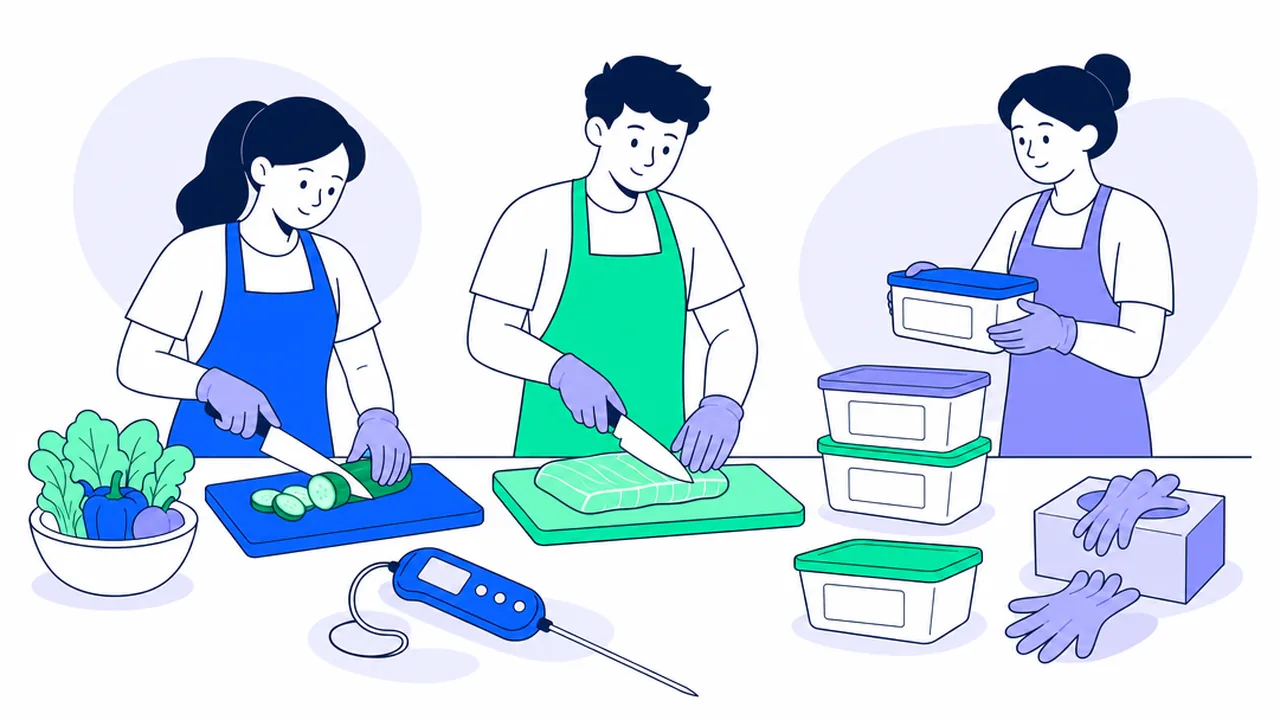
Disinfectants should show BS EN 1276 or BS EN 13697 on the label (GOV.UK).
8. “What temperatures should hot and cold food be kept at?”
These numbers come from GOV.UK’s cooking and chilling guidance:
| Food | Temperature | The rule |
|---|---|---|
| Chilled food | 8°C or below | Legal limit in England, Wales and Northern Ireland; set fridges to 5°C or below. |
| Cooking (core) | 70°C for 2 minutes | Or 75°C for 30 seconds. Use a clean probe. |
| Hot holding | 63°C or above | Below 63°C for up to 2 hours, then cool it or throw it away. |
| Chilled food left out | Up to 4 hours | Then throw it away. |
| Reheating | Steaming hot all through | Only once. |
Say: “Fridges at 5°C or below, and chilled food never above 8°C. Hot food on the counter stays at 63°C or more. I probe cooked food in the centre, for example 75°C for 30 seconds, and write the reading down. If a reading is wrong, I tell the cook at once.”
9. “A customer asks if a dish contains nuts. What do you do?”
UK food law lists 14 allergens that must be declared: celery, cereals containing gluten, crustaceans, eggs, fish, lupin, milk, molluscs, mustard, peanuts, sesame, soybeans, sulphur dioxide and sulphites, and tree nuts (FSA, 2026). School caterers must show allergen information too (DfE, 2026).
Sample answer: “I never guess. I check the allergen information for that dish, and if I’m not completely sure, I ask the cook or the manager before I answer. If the kitchen also uses nuts, I tell the customer that too. I’d rather say ‘Let me check’ than give a wrong answer.”
Two traps. Vegan does not mean allergen-free: the FSA warns of cross-contamination with egg, fish or milk. And a sandwich wrapped on site before anyone orders it needs a label with full ingredients, allergens emphasised (Natasha’s Law, since 1 October 2021; FSA).
10. “What would you do if you were sick before a shift?”
Question 10 checks honesty. Staff with diarrhoea or vomiting “must not return to work until they have had no symptoms for 48 hours” (GOV.UK).
Sample answer: “I’d phone my manager before the shift, not just send a message. With vomiting or diarrhoea I wouldn’t come in, and I’d stay off until I’d had no symptoms for 48 hours. I’d also tell them if someone at home had a stomach bug, because that matters too.”
11. “How do you store and label food?”
Raw food goes below ready-to-eat food, ingredients get labels (GOV.UK), and use-by dates are about safety while best before dates are about quality (GOV.UK).
Say: “Raw meat at the bottom of the fridge, ready-to-eat food above it. New deliveries go behind older stock, so we use the oldest first. Anything I open, cook or freeze gets a label with the name and the date. Food past its use-by date goes in the bin.”
Service, teamwork and pressure questions (12–15)
Answer with a real example in four parts (STAR): Situation, Task, Action, Result.
12. “How do you cope with a busy service?”
Interviewers want to hear that you get faster without cutting corners.
How do you cope with a busy service? (STAR answer)
B1–B2At my last job, a school group of 50 arrived 20 minutes early, with two of us on the counter.
I had to serve them fast without mixing up the special diets.
I asked the cook for the next trays, served the three allergy meals first from their labelled tray, and wiped the counter between groups.
Everyone was served in 25 minutes, with no wrong meals.
Read it aloud
Listen to a model reading, then record yourself. You get your speaking pace, the share of words that came through clearly, and the words to repeat.
No kitchen experience? Use any rush: a shop at Christmas or a family party you cooked for.
13. “A customer complains about their food. What do you do?”
Interviewers want calm listening and a quick fix.
A strong answer: “I listen without arguing and say I’m sorry they’re unhappy. If the food is cold or wrong, I replace it straight away. If they say it made them ill, or there’s something in it, I keep the plate, write down what they said and get the manager.”
14. “How do you handle a disagreement with a coworker?”
Kitchens are small and hot, so interviewers look for someone who sorts problems quietly.
You could say: “A coworker kept leaving the washing-up for the next shift. After service I asked for a quick word and suggested we each clear our own station before break. She agreed, and evenings got easier. If it hadn’t worked, I’d have gone to the supervisor, not argued in front of customers.”
15. “Can you lift, stand all day and use cleaning chemicals safely?”
HSE, Britain’s workplace safety regulator, names slips and trips, knives, musculoskeletal disorders and dermatitis as the main catering risks (HSE).
Say: “Yes. I’m on my feet all day now and used to lifting boxes of vegetables. I bend my knees, ask for help with heavy pans and clean up spills at once. I wear gloves with chemicals, keep them away from food and never mix products.”
School, NHS and care home catering assistant questions (16–18)
School and NHS catering assistant interview questions add the people you serve. Prepare for the setting in the advert.
| Setting | What the interview adds | A line you can use |
|---|---|---|
| School | Safeguarding, allergy plans, queue behaviour, DBS check | “Safeguarding is everyone’s job, kitchen staff too.” |
| NHS or private hospital | Diet codes, texture-modified food, NHS values | “I serve exactly what the diet code says.” |
| Care home | Residents’ preferences, soft and pureed diets | “I learn how each resident likes their tea.” |
| Events, hotels, contract caterers | Set-up, pack-down, last-minute changes | “When numbers change, I check the allergy list again.” |
16. “What would you do if a child told you something worrying?”
The Department for Education’s statutory guidance says safeguarding children “is everyone’s responsibility” and staff should “never promise a child that they will not tell anyone” about abuse (Keeping children safe in education 2026). Learn the name of the school’s designated safeguarding lead (DSL).
Sample answer: “I’d stay calm and let the child talk, without asking leading questions. I wouldn’t promise to keep it secret; I’d say I need to tell someone who can help. Then I’d report it to the designated safeguarding lead straight away and write down exactly what the child said.”
17. “How would you deal with a rude child in the lunch queue?”
Behaviour questions check that you follow the school’s rules instead of making your own.
Try: “I’d stay calm and polite, use the child’s name if I know it, and ask them to wait their turn. I wouldn’t shout or argue across the counter. If it carried on, I’d tell the lunchtime supervisor or a teacher, because they know the child and the behaviour policy.”
18. “How would you serve a patient on a texture-modified diet?”
NHS England says all food service staff should “be able to identify the dietary coding used on hospital menus”, including modified textures (NHS England, 2022). Textures may be described with the IDDSI framework: 8 levels from 0 to 7, drinks on levels 0–4 and foods on 3–7 (IDDSI).
Say: “I check the patient’s name, bed and diet code before I serve. I never change the texture of a meal or a drink myself, because that is the clinical team’s decision. If a patient asks for something that isn’t on their plan, or the code is unclear, I ask the nurse first.”
Shifts and closing questions (19–20)
19. “What hours can you work?”
Give exact days, start times and limits. The NCS lists evening, weekend and bank holiday shifts for kitchen assistants; school jobs may be term-time only, so ask.
Sample answer: “I can start at 7 a.m. any weekday, and I can work two weekends a month. I can’t work after 4 p.m. on Wednesdays because of childcare. I could start two weeks after an offer, and I can cover extra shifts in the holidays.”
20. “Do you have any questions for us?”
- “What does a normal day in this kitchen look like?”
- “How do counter staff get allergy and special diet information?”
- “What training do new staff get in the first month?”
More catering assistant interview questions to prepare
| Question | What to say |
|---|---|
| “Why should we hire you?” | One reason with proof: “I’m reliable on early starts. I haven’t missed a shift in two years.” |
| “Why did you leave your last job?” | One honest, positive reason (“The café closed”). Never criticise the old employer. |
| “What are your salary expectations?” | Quote the advert. The UK National Living Wage is £12.71 an hour for ages 21 and over from April 2026 (GOV.UK). |
| “Tell me about a mistake you made.” | A small, real one and the fix: “I put out a tray without its allergen label, took it back, labelled it and told the cook.” |
| “Guest numbers change an hour before an event. What do you do?” | Ask the supervisor for the new plan, check the allergy list again and recount plates. |
| “A child has no money on their lunch account. What do you do?” | Follow the school’s policy, never embarrass the child, and tell the cook or office quietly. |
| “Where do you see yourself in five years?” | Growth in the kitchen: the NCS says kitchen assistants can become trainee or junior chefs, or move into management. |
Food hygiene training and background checks by country
Most countries below require trained food handlers, not one named certificate. Rules change, so check with the employer.
| Where | Food hygiene training | Checks for school, hospital or care work |
|---|---|---|
| England | No certificate required; staff must be trained for their role and on allergens (GOV.UK). | Schools must obtain an enhanced DBS check; contract caterers’ staff need the right DBS level too (KCSIE 2026, paragraphs 313 and 369). |
| Wales and Northern Ireland | Same FSA guidance as England, including the 8°C legal limit and PPDS labels. | DBS in Wales; AccessNI in Northern Ireland. |
| Scotland | 8°C for chilled food is recommended, not a legal limit. | PVG scheme (Disclosure Scotland), required for regulated roles; membership lasts five years. |
| Ireland | Food handlers “must be supervised, and also instructed and/or trained”; a course is not always needed (FSAI). | Garda vetting for relevant work with children or vulnerable persons. |
| Australia | Since December 2023 (Standard 3.2.2A), staff handling high-risk unpackaged food need a food safety course or adequate skills, and the business needs a certified Food Safety Supervisor (FSANZ). | Every state and territory runs its own check for work with children; the name varies (Working With Children Check in most states, Blue Card in Queensland). |
| India | Food businesses appoint a FoSTaC-certified Food Safety Supervisor, who trains food handlers on site at least quarterly (FSSAI). | Varies by state and employer: ask about police verification. |
| South Africa | Regulation R638 (2018): food workers must be “suitably qualified or adequately trained” in food hygiene (Department of Health). | Ask the employer. |
| Kenya, Nigeria, Malawi, others | Rules vary: ask the employer or the local health authority. | Ask the employer. |
Catering assistant interview questions and answers for freshers
A fresher, someone with no catering experience, gets the same 20 questions. Show that you want to learn, and use proof from outside work:
| If you have done this | Use it for questions | What you can say |
|---|---|---|
| Cooking for a family | 7, 8, 11 | “I keep raw meat on the bottom shelf and check dates weekly.” |
| Shop or till work | 12, 13 | “I served long queues and handled complaints calmly.” |
| Parenting or school volunteering | 16, 17 | “I stay calm and kind with children who are upset.” |
| Free online training | 4, 9 | “I finished the FSA allergy course, so I know the 14 allergens.” |
Never invent experience: the follow-up question will find it. Other entry-level food jobs have their own lists, such as these food production worker interview questions.
How to prepare for a catering assistant interview
Learn the job, learn the food safety basics above, and say your answers out loud. Memory aids like “the three C’s” or “the 5 P’s” (proper preparation prevents poor performance) say the same.
- Read the employer’s website: menu, allergy policy and, for schools, safeguarding policy.
- Bring documents: ID, certificates and, in the UK, proof of your right to work.
- Dress clean and simple: hair tied back and no jewellery except a plain wedding band, as in GOV.UK’s kitchen hygiene rules.
- Panel or video: a school panel may have two or three people; on video, use a quiet room and keep short notes beside the screen.
- Practise out loud at least twice; reading an answer is not the same as saying it.
Say the allergen and kitchen words clearly
| Word | Say it | Example sentence |
|---|---|---|
| allergen | AL-er-jen | “Let me check the allergen chart for you.” |
| hygiene | HY-jeen | “I have a Level 2 food hygiene certificate.” |
| crustaceans | kruss-TAY-shunz | “Prawns and crabs are crustaceans.” |
| sesame | SESS-uh-mee | “The roll has sesame seeds on top.” |
| thermometer | thuh-MOM-ih-tuh | “I check the core temperature with a probe thermometer.” |
Capitals mark the stressed syllable, following the Cambridge Dictionary (UK). More drills: English pronunciation practice. Phrases to open an answer or ask for a question again: English for job interviews.
Practise a catering allergen question out loud
An allergen scenario rarely ends after one answer. Say Amara’s lines out loud.
A parent asks about nuts
B1–B2- Interviewer
A parent asks if today’s chicken curry is safe for her son, who has a nut allergy. What do you say?
- Amara
I say I’ll check, and I look at the allergen information for the curry before I answer. I don’t guess.
- Interviewer
The menu says the curry is vegan. Does that make it safe?
- Amara
No. Vegan means no animal products, but it can still contain nuts or traces of other allergens. I still check the chart.
- Interviewer
You find a wrapped sandwich on the counter with no label.
- Amara
I take it off sale. Food we wrap before people order needs a label with the ingredients and allergens. I tell the cook, and we label it again or throw it away.
Practise this dialogue
Listen to the whole exchange, then take one role: your partner’s lines are read aloud, you say yours into the microphone and see which words came through.
The free browser mock interview times your answers and counts filler words; it has no catering track, so choose Screening classics or Behavioral. It checks how you speak, not food safety. For a baseline, take the English speaking test.
Say your answers out loud before the interview
Fluently is an AI speaking coach for non-native English speakers on iOS and Android. You answer out loud and get feedback on pronunciation, fluency, vocabulary and grammar. The download is free and starts with a free four-minute speaking assessment; full practice is a subscription after a free trial.


Frequently asked questions
Is there a PDF of these catering assistant interview questions and answers?
There is no separate PDF. The table of 20 questions at the top is the one-page version: print it, or choose Save as PDF in your browser. Then say each answer out loud at least twice.
What questions are asked in an NHS catering assistant interview?
Expect food hygiene, allergens and patient diets (questions 7–11 and 18), plus questions on NHS values. The NHS Constitution lists six: working together for patients, respect and dignity, commitment to quality of care, compassion, improving lives, and everyone counts (NHS Constitution). Prepare an example for two of them.
Do school catering assistants need a DBS check?
In England, yes: schools must obtain an enhanced DBS check, with children’s barred list information for regulated activity, and contract caterers’ staff need the right level of check too. Scotland uses PVG membership; Northern Ireland uses AccessNI.
Are kitchen assistant and food service assistant interview questions different?
Mostly no. A kitchen assistant interview leans on preparation, cleaning and lifting (questions 7, 11 and 15); a food service assistant interview leans on the counter, the till and complaints (3 and 13). Hospital food service assistants who serve on wards also get question 18.
Can I do a catering assistant interview if English is my second language?
Yes. Interviewers check that people understand you and that you can read labels and allergen charts, not your accent. To check your level, take the free English level test.