20 Barista Interview Questions and Answers, With Coffee Test Answers and Fresher Tips
 Yurii Rebryk · Updated · 15 min read
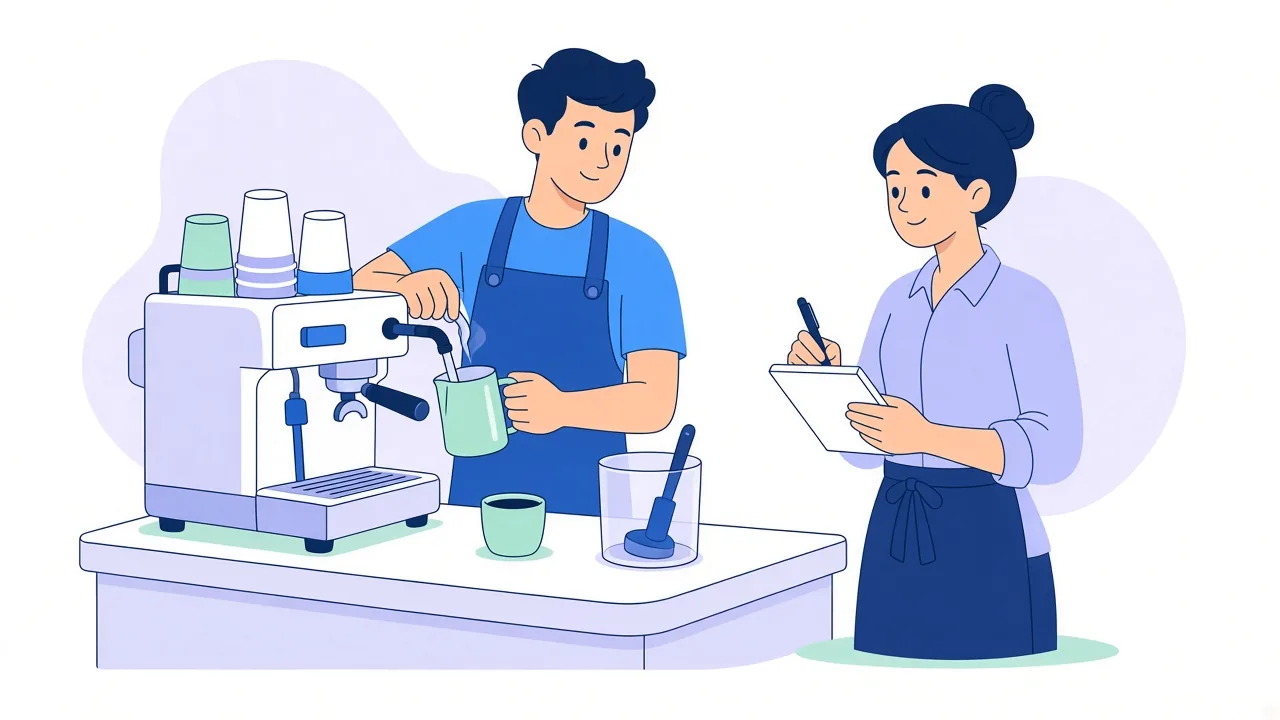
Barista interview questions check two things: whether you will be good with customers and a team, and whether you understand espresso, milk, cleaning and hygiene. Below are 20 common questions, each with a sample answer in plain spoken English, plus the correct coffee answers with their sources. Some cafés also ask for a short practical task, so practise saying the answers and doing the basics.
Start speaking with confidence today
Fluently is free to start. Take a free AI speaking assessment to see your level, then practice with games that build your vocabulary and pronunciation.


In this article
- What happens in a barista interview
- Barista interview questions about you (1–5)
- Barista test questions: espresso, milk, allergens and cleaning (6–11)
- Barista interview questions on hygiene and shifts (12–13)
- Customer service and pressure questions for baristas (14–18)
- Teamwork and final questions in a barista interview (19–20)
- More barista interview questions to prepare
- Barista test questions and answers (coffee quiz)
- Food hygiene and barista certificates by country
- Barista interview questions and answers for freshers (no experience)
- How to say coffee words clearly in a barista interview
- Practice a barista interview scenario out loud
What happens in a barista interview
Most barista interviews are a short conversation built from questions like the 20 below, and some add a hands-on task. One hiring guide for café owners suggests the same task for every candidate, such as reading a recipe card, organising a mock station or preparing a drink if they have experience (Espresso Outlet). During a practical test, say what you check, clean as you go and taste before you serve.
Barista interview questions about you (1–5)
Keep each answer under a minute. Every name and number in the sample answers on this page is an example: swap in your own.
1. “Tell me about yourself.”
A barista self-introduction has three parts: what you do now, the experience that matters here, and why this job.
Tell me about yourself (barista with experience)
B1I’m a barista with two years of experience at a busy café near a train station.
I make espresso drinks, steam milk for latte art and open the café three days a week, so I know the setup and the cleaning routine.
I’m applying here because you roast your own coffee, and I want to learn how a recipe is dialled in.
Read it aloud
Listen to a model reading, then record yourself. You get your speaking pace, the share of words that came through clearly, and the words to repeat.
No café experience? Start with service work: “For a year I worked at a supermarket checkout, where I learned to stay friendly in a long queue.” See the fresher section.
2. “Why do you want to work as a barista?”
The interviewer wants a reason that will still be true at six on a Monday morning.
Sample answer: “I like work where I see the result straight away: a good coffee and a friendly minute can change someone’s morning. I also like the craft side, making the same drink right every time, even in a rush. That mix of people and skill is why I want this job.”
3. “Why do you want to work at our café?”
Visit the café first, order something and read the menu. One true detail beats general praise.
You could say: “I came in last Saturday for a flat white. The bar was busy, but the team still talked to every customer. I want to work somewhere that cares about the coffee and the service, and I saw that you train new baristas.”
4. “What barista or customer service experience do you have?”
Name the type of café, your duties and one result. O*NET, the US Department of Labor’s job database, lists core barista tasks: preparing drinks, taking orders, processing payments and cleaning equipment (O*NET 35-3023.01).
Say: “Two years at an independent café: espresso bar, till and opening shifts. My manager put me on the weekend rush because I kept tickets moving and still talked to customers. I also trained two new baristas on our cleaning checklist.” Fresher version: “I haven’t worked in a café yet, but I spent eight months at a fast-food counter, taking orders and cash during the lunch rush.”
5. “What are your strengths and weaknesses?”
Prove a strength the café needs, then name a real weakness that is not a core duty and what you do about it.
A strong answer: “I stay calm in a queue, and I don’t skip steps when it gets busy. My weakness is latte art: my hearts are fine, but my rosettas aren’t consistent yet, so I practise on quiet afternoons when my manager allows it.”
Barista test questions: espresso, milk, allergens and cleaning (6–11)
Recipes differ between cafés, so give the principle, then say you will follow the house recipe.
6. “What is an espresso?”
Espresso is a small, strong coffee made by forcing hot water under pressure through finely ground, tamped coffee. The heritage Specialty Coffee Association of America (SCAA) definition is “a 25–35ml (.85–1.2 ounce [×2 for double]) beverage prepared from 7–9 grams (14–18 grams for a double) of coffee”, with water at 90.5–96.1°C (195–205°F), 9–10 atmospheres of pressure and a 20–30 second brew time (SCA, 25 Magazine).
Many baristas now work by weight: in a 2017 Barista Guild of America survey of 275 baristas, reported in the same article, 82% measured shots by weight, and the average shot used an 18–20 g dose to give 36.5 g of espresso in 25–30 seconds, a 1:2 ratio.
Sample answer: “Espresso is a short, strong coffee made by pushing hot water at about 9 bar through fine, tamped coffee. A common double is about 18 grams in and 36 grams out in 25 to 30 seconds. I’d weigh, time and taste to your recipe.”
7. “Your espresso tastes sour or bitter. What do you do?”
A sour shot is usually under-extracted, often because the grind is too coarse and the shot runs fast; a bitter shot is usually over-extracted. In UC Davis Coffee Center tasting panels on filter coffee, sourness rose as extraction fell, and bitterness rose with extraction and strength (SCA, 25 Magazine, Issue 13). At the espresso machine, baristas use the same direction as a rule of thumb.
| What you taste and see | Likely cause | First fix |
|---|---|---|
| Sour, thin, shot runs fast | Under-extracted (grind too coarse) | Grind a little finer |
| Bitter, harsh, shot runs slow | Over-extracted (grind too fine) | Grind a little coarser |
| Taste drifts during the day | Older beans, room temperature, a new bag | Weigh, time and taste again |
Say: “I taste it and check the time and the weight. Sour and fast: I grind a little finer. Bitter and slow: I grind coarser. I change one thing at a time, taste again and tell the next barista what I changed.” Never used a café grinder? “I haven’t dialled in yet, but I know sour usually means grind finer and bitter means grind coarser.”
8. “What is the difference between a latte, a cappuccino and a flat white?”
Here the interviewer checks that you can make what the customer expects. The five classics below all start with espresso; the milk, foam and cup size change, and sizes vary by café (core definitions: Cambridge Dictionary).
| Drink | What it is (typical; varies by café) |
|---|---|
| Cappuccino | Espresso and heated milk with a thick layer of foam |
| Latte | Espresso and warm milk with a thin layer of foam; usually the biggest cup |
| Flat white | Espresso and hot milk without much froth; a smaller cup with a stronger coffee taste |
| Macchiato | Espresso with a little foamed milk; some menus use the name for a bigger milk drink |
| Americano | Hot water added to espresso |
Sample answer: “They’re all espresso and milk, but the foam changes. A cappuccino has the thickest foam, a latte has more milk and a thin layer of foam, and a flat white is smaller and silky, so the coffee tastes stronger. I’d learn your cup sizes on day one.”
9. “How do you steam milk?”
Give the steps and a temperature: purge the wand, add air with the tip just under the surface, lower it so the milk spins until hot, then wipe and purge. In a 2022 International Dairy Journal study of milk steamed on a professional espresso machine at 30–80°C, the optimal final temperature for microfoam was 50–60°C (122–140°F) (Klimanova et al., 2022).
You could say: “I start with cold milk in a clean jug and purge the wand. I add air for a few seconds, then lower the tip so the milk spins until it reaches about 60°C. I wipe and purge the wand straight away, and I use a thermometer for extra-hot orders.”
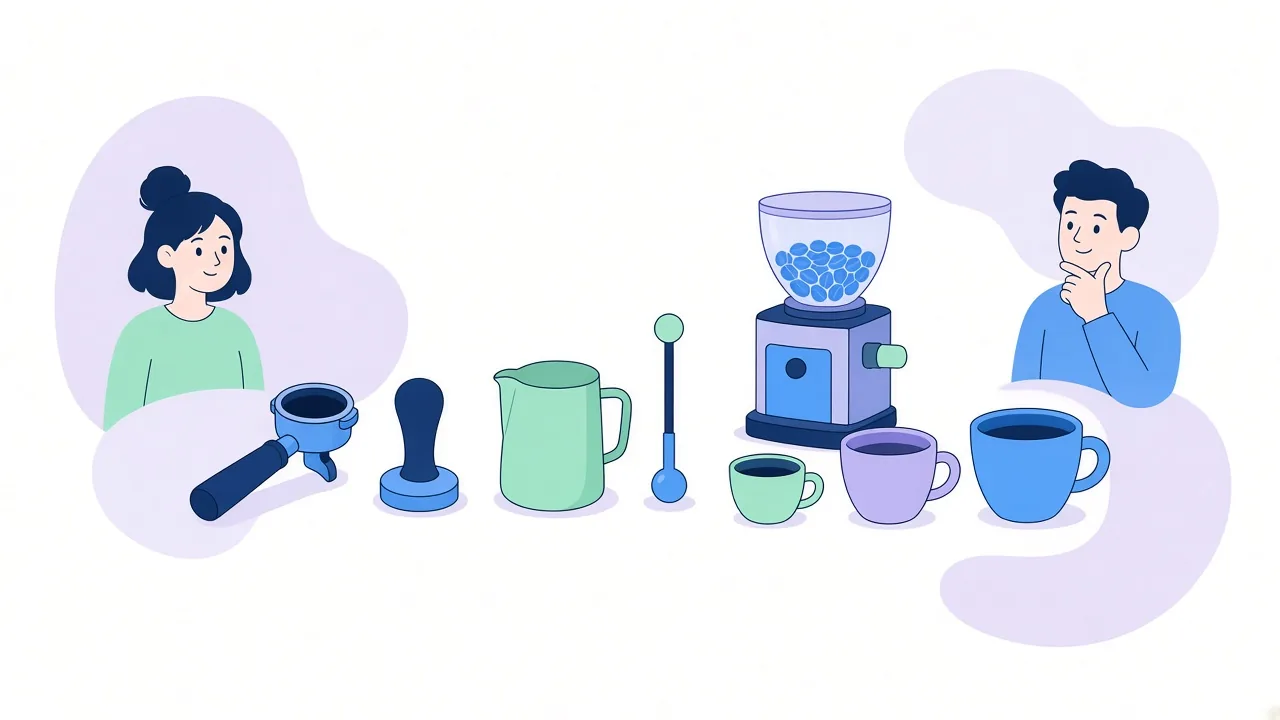
10. “A customer asks for oat milk and mentions an allergy. What do you do?”
Allergy questions test whether you check instead of guessing. Milk, soybeans and tree nuts such as almonds are among the UK’s 14 allergens, and oats are listed under “cereals containing gluten”. Food businesses in England, Wales and NI must train staff on allergens and should clean utensils before each use to avoid cross-contamination (GOV.UK allergen guidance, 2026). In the US, sesame became the ninth major food allergen in 2023 (FDA).
The milk jug and the steam wand touch every milk. A strong answer: “I ask what the allergy is, check the carton and syrup labels, use a clean jug, and purge and wipe the wand before and after. If I can’t be sure the drink is safe, I say so and call my supervisor.”
11. “How do you clean an espresso machine?”
The interviewer wants a routine, not just “I clean it”. A detergent backflush uses a blind (solid) basket, a little machine cleaner and short brew cycles, then a rinse with a clean blind basket and one discarded shot (Clive Coffee guide); how often depends on the machine, so follow its manual and the café’s checklist.
“During service I wipe and purge the wand after every milk drink and flush the group before each shot. At closing I backflush every group with cleaner and a blind basket, soak the baskets, clean the drip trays and brush out the grinder. Then I sign the cleaning checklist.”
Barista interview questions on hygiene and shifts (12–13)
12. “Do you have a food hygiene certificate?”
The certificate question checks whether you can start legally, and the answer depends on the country (see the certificate table). In the UK, no certificate is legally required, but food handlers must be “supervised and instructed and/or trained in food hygiene matters commensurate with their work activity” (Regulation 852/2004, Annex II).
Sample answer: “Yes, I have a Level 2 Food Hygiene certificate from last year, and I did allergen training at my last café. I can send you a copy today, and I’m happy to repeat any training you give new staff.” No certificate yet: “Not yet. I can complete the course before my first shift, or in my first weeks if you train new staff.”
13. “What do you do when you open or close a café?”
Opening and closing duties show you can work without being watched. O*NET lists checking the temperatures of fridges and freezers, cleaning and sanitising, and restocking service stations among barista tasks.
Say: “At opening I switch on the machine early, check the fridge temperatures, dial in the espresso and stock cups and milk. At closing I clean the machine and grinder, date and store the milk, count the till and leave a note for the morning shift.”
Customer service and pressure questions for baristas (14–18)
14. “How do you handle pressure during a rush?”
Pressure questions test calm, order and teamwork, so show a system: tickets in order, clear calls to the team, no shortcuts on recipes or cleaning.
Sample answer: “I work in ticket order and group what I can, like steaming milk for two lattes at once. I call drinks clearly and warn my teammate early when milk or cups run low. I clean as I go, because a messy bar slows everyone down. If the wait is long, I tell customers honestly.”
15. “A customer says their drink is wrong. What do you do?”
Remake first, discuss later: the interviewer listens for an apology, a quick fix and a lesson, with no blame on the customer or a coworker.
Say: “I listen to what they expected, say sorry and remake it straight away, even if I think I made what they ordered. Then I check the ticket. If it was my mistake, I tell my supervisor and change how I read tickets, so it doesn’t happen again.”
16. “Tell me about a time you dealt with an angry customer.”
Question 16 wants a real past event told with STAR: Situation, Task, Action, Result. Keep it short and end with the result.
Sample STAR answer: an angry customer
B1–B2Last winter, a regular customer shouted at me because his order took ten minutes. Our grinder had stopped, and the queue was out of the door.
I said, “I’m sorry, you’re right, that’s too long.” I explained the problem in one sentence, made his drink next and offered a free coffee next time, as my manager allows.
He thanked me the next day. After that, we put a sign on the counter whenever a machine was down.
Read it aloud
Listen to a model reading, then record yourself. You get your speaking pace, the share of words that came through clearly, and the words to repeat.
17. “How would you upsell without being pushy?”
Upselling is part of the barista job: O*NET lists describing menu items and suggesting products that might appeal to customers. One suggestion that fits the order works better than a script.
A strong answer: “I suggest one thing that fits the order. If someone orders a flat white in the morning, I might say, ‘The banana bread is fresh today, it goes well with that.’ If they say no, I drop it. I’d rather they come back tomorrow than feel pushed.”
18. “Are you comfortable handling cash and card payments?”
Accuracy matters more than speed here: say how you count change and what you do when the till does not balance.
You could say: “Yes, I’ve used two till systems. I count change back to the customer and keep the note on top of the drawer until the sale is done. If my till is short, I report it straight away and recount with my supervisor.” Fresher version: “I haven’t used a café till, but I handled cash at a market stall.”
Teamwork and final questions in a barista interview (19–20)
19. “Tell me about a conflict with a coworker.”
The interviewer checks that you solve problems calmly and keep the bar running, so choose a small conflict about work, not about someone’s personality.
Sample answer: “A coworker and I both wanted the espresso station on morning shifts, and we kept getting in each other’s way. I suggested we swap every hour and asked our supervisor to put it on the rota. The rush moved faster, and we stopped arguing about it.”
20. “Do you have any questions for us?”
Always ask one or two questions about the job itself:
- “What does training look like in the first two weeks?”
- “Which coffee and milk do you use, and who dials in the grinder each morning?”
- “Will there be a practical test or a trial shift?”
More barista interview questions to prepare
| Question | What to say |
|---|---|
| “Are you available early mornings, weekends and holidays? When can you start?” | Exact days, any limits and your start date. |
| “Why did you leave your last job?” | One neutral reason (hours, study, moving), nothing negative about the old employer. |
| “The machine stops in the middle of a rush. What do you do?” | Tell the supervisor and customers, and offer drinks you can still make. |
| “We’re running low on beans or milk.” | Tell the supervisor and the team early, before it runs out. |
| “You see a coworker skip handwashing.” | Tell them quietly at once; if it continues, tell the supervisor. |
| “How do you remember orders and regulars?” | Repeat orders back, write clearly on cups, learn regulars’ usual drinks. |
| “Which brewing methods do you know?” | The ones you have used, such as pour-over or French press. |
| “How do you take feedback?” | One example: what you were told, what you changed, the result. |
| “What are your salary expectations?” | A range based on local barista job ads, and flexibility for good training. |
| “What do you do when it’s quiet?” | Clean, restock and prep. |
Barista test questions and answers (coffee quiz)
Some cafés and training courses give a short written or spoken quiz. These barista test questions come up often.
| Test question | Correct answer |
|---|---|
| What is crema? | “A thin layer of light-brown foam” on top of strong coffee such as espresso (Cambridge). |
| What are dosing and tamping? | Dosing is measuring ground coffee into the basket; tamping is pressing it flat and even. |
| Americano or long black? | An americano is hot water added to espresso; a long black is espresso added to hot water (Cambridge). |
| Ristretto and lungo? | A short shot and a long shot; a quarter of surveyed baristas would pull them on request (SCA). |
| Water temperature for espresso? | 90.5–96.1°C (195–205°F) in the heritage definition; the survey average was about 93.5°C (200.3°F). |
| Coffee in a double shot? | 14–18 g in the heritage definition; most surveyed baristas used 18–20 g. Weigh to the house recipe. |
| Arabica or robusta: which has more caffeine? | Robusta: a 2014 study found higher caffeine accumulation in Robusta (Perrois et al., Planta). |
Food hygiene and barista certificates by country
There is no worldwide barista licence; employers check food hygiene training and sometimes a health certificate. Rules change, so open the official page before the interview.
| Where | What you may need |
|---|---|
| United States | Rules are set by states and local authorities, which use the FDA Food Code as a model. California, with exceptions: a food handler card within 30 days of hire, valid three years; the employer pays for training and cannot demand an existing card (§113948). |
| United Kingdom | No certificate required by law, but hygiene training or supervision is. Hartlepool Council, for example, suggests Level 2 food safety within three months for staff preparing open, high-risk food. |
| India | Food businesses need at least one trained and certified Food Safety Supervisor (FoSTaC) for every 25 food handlers or part thereof per premises (FSSAI, 2019). |
| Dubai, UAE | All food handlers “must be formally trained on food safety”; each establishment needs a certified Person in Charge (Dubai Food Code, 2013). |
| Qatar | A Ministry of Public Health food handler licensing exam (Arabic or English), not yet mandatory; since September 2026 it can optionally be taken abroad (QNA). |
| Kenya | A medical examination before employment and at least every 12 months; the official certificate form is valid for six months (Food Hygiene Regulations). |
| Nepal, Indonesia, elsewhere | Rules vary: ask the employer or the local food safety authority. |
| Optional, any country | SCA Barista Skills: Foundation (7 hours), Intermediate (14 hours), Professional (SCA). A course, not a licence. |
Barista interview questions and answers for freshers (no experience)
Cafés do hire beginners: O*NET puts baristas in Job Zone 1–2, where some jobs “may need little or no previous experience”. Answer the same 20 questions with proof from other work, school or volunteering.
| If you have done this | Use it for questions | What you can say |
|---|---|---|
| Fast food or a shop till | 4, 14, 18 | “I handled cash and a lunch queue every day.” |
| Waiting tables or hotel work | 15, 16, 17 | “I dealt with complaints and suggested dishes.” |
| Coffee at home or at events | 6, 7, 9 | “I’ve practised steaming milk, and I know what a sour shot means.” |
Never invent café experience: a follow-up such as “What grind setting did you use?” will expose it. Applying for kitchen jobs too? See the catering assistant interview questions.
How to say coffee words clearly in a barista interview
Clear drink names save remakes. Pronunciations follow the Cambridge Dictionary; the stressed syllable is in capitals.
| Word | Say it | IPA (UK / US) |
|---|---|---|
| espresso | es-PRESS-oh | /esˈpres.əʊ/ · /esˈpres.oʊ/ |
| latte | LAT-ay (UK), LAH-tay (US) | /ˈlæt.eɪ/ · /ˈlɑː.teɪ/ |
| macchiato | mak-ee-AH-toh | /ˌmæk.iˈɑː.təʊ/ · /ˌmɑːk.iˈɑː.t̬oʊ/ |
| cappuccino | kap-oo-CHEE-noh | /ˌkæp.uˈtʃiː.nəʊ/ · /ˌkæp.əˈtʃiː.noʊ/ |
| barista | bah-REES-tuh | /bɑːrˈiːs.tə/ |
| crema | KRAY-muh (UK), KREM-uh (US) | /ˈkreɪ.mə/ · /ˈkrem.ə/ |
For more drills, see the English pronunciation practice guide; for phrases that open an answer or buy a second to think, see English for job interviews.
Practice a barista interview scenario out loud
Barista interviewers often add follow-ups to a customer scenario. Say the candidate’s lines out loud.
A latte that is “too weak”
B1–B2- Interviewer
A customer brings back a latte and says it’s too weak. What do you do?
- Amina
I say sorry and ask how they usually have it, so I understand what “too weak” means for them.
- Interviewer
They say they always have two shots.
- Amina
If our latte has one shot, I explain that kindly and offer to remake it with an extra shot.
- Interviewer
What would you learn from this?
- Amina
To repeat the order back and ask “one shot or two?” when someone orders a latte.
Practise this dialogue
Listen to the whole exchange, then take one role: your partner’s lines are read aloud, you say yours into the microphone and see which words came through.
For a timed run, the free browser mock interview reports answer length, pace and filler words; it has no barista track, so choose its screening and behavioral questions. It checks how you speak, not your coffee knowledge.
Say your barista answers out loud before the interview
Fluently is an AI speaking coach for non-native English speakers on iOS and Android. You answer out loud and get feedback on pronunciation, fluency, vocabulary and grammar. It is free to start: take a free AI speaking assessment to see your level, then practice with games that build your vocabulary and pronunciation. Conversations with your AI tutor come with Fluently Premium.
Frequently asked questions
How do I prepare for a barista interview?
Visit the café and read its menu, learn questions 6–11, prepare two short stories (a rush and a difficult customer) and check your country’s hygiene rules. Wear clean clothes and closed shoes in case of a practical test, and practise every answer out loud.
Why should I hire you as a barista?
Give one reason with proof that matches the job ad: “Because I’m reliable on early shifts and calm in a queue. I opened my last café three days a week for a year without missing a shift.”
What are basic barista skills?
O*NET lists active listening, speaking and monitoring as essential barista skills, with cooperation and dependability among the work styles (O*NET). On the bar: a consistent espresso, steamed milk, cleaning as you go, accurate payments, and hygiene and allergen rules.
Is there a PDF of these barista interview questions and answers?
There is no separate PDF file: use your browser’s Print option and choose Save as PDF. Reading is not rehearsal, though, so say each answer out loud at least twice. To check your grammar and vocabulary level, take the free English level test.
What questions should a café manager ask a barista candidate?
Ask every candidate the same job-related questions and score them the same way; one suggested café scorecard weighs hospitality, reliability, workflow and safety, coffee skills and coachability (Espresso Outlet). Questions 4 and 6–19 here work as a candidate list.