Here's the thing nobody tells you at the start: IELTS speaking preparation is not the same as English studying. People spend weeks reviewing grammar rules, memorizing word lists, drilling vocabulary - and then walk into the speaking test and freeze up on Part 2 because they've never actually practiced speaking for two uninterrupted minutes in English. Ever.
The test is a face-to-face interview, 11 to 14 minutes, with an examiner who is quietly marking four things the whole time. If you don't know what those four things are, you can't prepare for them properly.
What you're actually being scored on
This is the part most guides skim over, and it's the most important thing in this article.
Fluency and coherence - whether you can speak without stopping every few seconds, whether what you say holds together as a coherent thought. The examiner notices pauses, self-corrections, lost trains of thought.
Lexical resource - not just knowing words, but using a range of them precisely. And being able to paraphrase when you can't find the exact word, which is its own skill.
Grammatical range and accuracy - variety of structures, not just accuracy. Someone who only uses simple sentences, even correctly, is limiting their score.
Pronunciation - and this matters more than people realize, because it's 25% of your score. The criteria isn't accent. It's clarity: can a listener follow you easily? Do you use natural stress and intonation?
These four criteria are weighted equally. Which means someone who's obsessing over vocabulary while ignoring fluency is working against themselves.
The three parts and what actually trips people up
Part 1 is relatively comfortable - the examiner asks about your daily life, your home, your hobbies, your routine. Most people can handle this. The mistake here is giving short answers. "I like music" is not a Part 1 answer. "I like music - I listen to it most mornings on my commute, it's probably the only time in my day where I actually switch off" is closer to what's needed.
Part 2 is where candidates drop. You get a task card, a minute to prepare, and then you speak alone for up to two minutes. No one responds. No one prompts you. It's just you and the examiner and a ticking clock.
Most people in their first attempt can barely fill 90 seconds. They run out of content around the one-minute mark and then either repeat themselves or trail off. This part needs specific practice - which means doing it repeatedly, not just knowing it exists.
Part 3 is harder than it looks. The examiner follows up on your Part 2 topic with more abstract discussion questions. "Do you think technology has changed how people help each other?" "How important is it for governments to preserve historical places?" You need opinions. You need to develop ideas at length. You need to handle follow-up questions you haven't prepared for.
What actually helps - and what doesn't
Memorizing model answers doesn't work. This is worth saying clearly because a lot of IELTS prep revolves around it. Examiners recognize scripted responses - the vocabulary suddenly sounds more sophisticated than the rest of your speech, the delivery is different. Marks come off under fluency and lexical resource when you're reciting rather than speaking.
What helps: practicing speaking, specifically and repeatedly, in the formats the test uses.
For Part 2, the preparation habit is simple. Every day, pick a task card topic - they're everywhere online for free - give yourself 60 seconds to make brief notes (bullet points, not sentences), then speak for two full minutes without stopping. Time yourself. Record it. Listen back. Do the same topic again and notice what's different.
The first handful of attempts will feel uncomfortable. That discomfort is useful - it means you're building something.
For Part 3, the problem is that you can't practice it alone very effectively, because it's a dialogue. The examiner responds to what you say and then pushes further. You need something that can actually respond to you, follow up on your answers, and introduce new angles.
This is where AI speaking tools have become genuinely useful. Fluently lets you practice extended conversations on abstract topics and responds in real time - which is much closer to Part 3 than sitting alone and monologuing about education policy. The feedback on fluency, vocabulary, and grammar accuracy also means you're not just practicing into a void. For a comparison of what's out there: 6 Best Apps to Study English and Improve Your Speaking Skills in 2026 covers the main options if you want to weigh them up.
Recording every practice session is uncomfortable and also one of the highest-return things you can do. Listen back with the four marking criteria in mind. Is this fluent? Do I repeat the same sentence structures? Can I actually follow my own logic? You catch things when listening that you can't catch in real time.
For vocabulary, thematic clusters work better than random word-of-the-day learning. Common Part 3 topics keep coming up - education, technology, the environment, healthcare, work and careers, urban development. Build vocabulary around those clusters, then practice speaking on those topics so the words get used, not just reviewed. English Vocabulary for Daily Life: 500 Essential Words and Phrases gives a solid base, though for IELTS you'll need to extend into more discursive and academic language beyond daily vocabulary.
Signposting - the underrated skill
One of the clearest markers of a well-organized response is signposting: using verbal signals to guide the examiner through your structure.
"To start with..." / "What I mean by that is..." / "To give you an example..." / "On the other hand..." / "What this leads to is..."
These phrases do two things simultaneously. They keep your answer coherent, which matters for the fluency and coherence criterion. And they buy you micro-seconds of thinking time that sound organized rather than hesitant. Practice weaving them in until they're automatic - not as formulaic openers, but as genuine structural signals.
Mistakes that quietly hurt band scores
Stopping completely when you lose a word. This kills fluency scores. The fix is learning to paraphrase - "I can't remember the exact term, but I mean the thing that..." is far better than a long pause.
Giving one-sentence answers in Part 1. The examiner isn't going to pull content out of you. You have to produce extended answers from the start.
Not using the preparation minute in Part 2. That minute is for mapping your two minutes, not for drafting sentences. Brief bullet points: the main points you'll cover, one or two specific examples to use. Then structure before you open your mouth.
Speaking too quietly or too monotonously. Both affect pronunciation scores directly.
How to structure 6-8 weeks of preparation
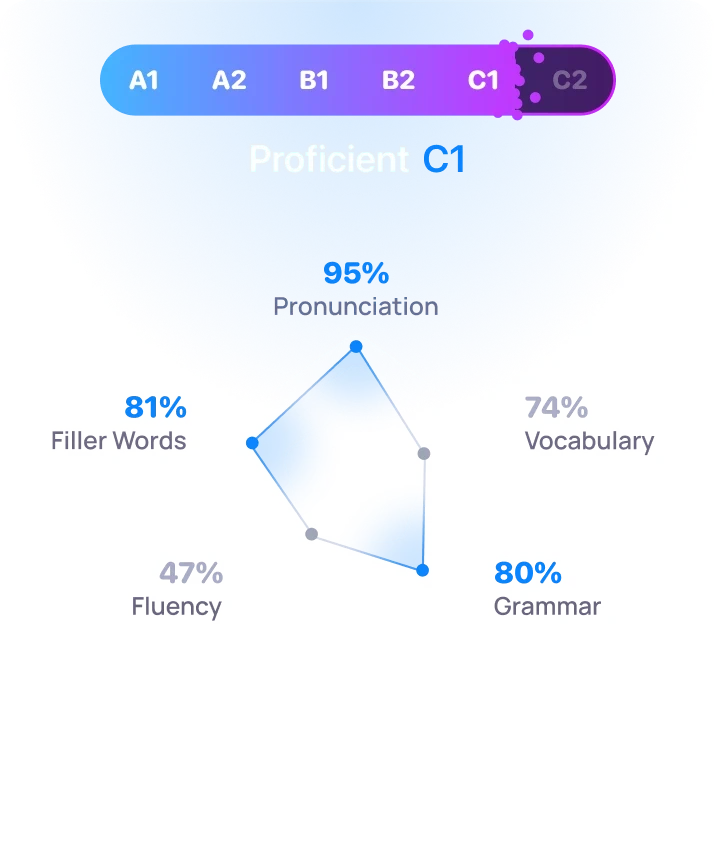
The English Fluency Test is a useful first step - it gives you an honest picture of where your speaking currently sits, so you're building a preparation plan around actual gaps rather than guessing.
If you're 8 to 12 weeks out from the test, the most practical structure is: daily unscripted conversation practice for fluency and coherence (AI tools work well here for volume), weekly Part 2 drill sessions on timed topics, and thematic vocabulary work that gets activated through speaking rather than just reviewed.
Human tutors are valuable for mock tests and examiner-level feedback. Less practical for the daily volume you need to build fluency. Most people end up using both - AI practice for the everyday work, a human tutor selectively for evaluation.
How Fluently Fits Into This
Fluently isn't an IELTS prep app specifically. What it does is build the underlying skill the test measures: the ability to speak fluently and accurately in unscripted conversation on a range of topics. That's the same thing IELTS speaking tests - just in a more structured format with a scorer.


The combination of real-time AI conversation with feedback on fluency, grammar, and vocabulary is directly useful for building Part 3 capacity. And because it tracks your patterns across sessions, you can actually see which areas are improving and which aren't.
Frequently Asked Questions (FAQ)
How long does it take to improve your IELTS speaking band score?
Realistically, 6-12 weeks of deliberate daily practice for most learners. The jump from band 5 to 6 tends to be faster than from 6 to 7 - the higher jump requires consistent grammatical accuracy alongside fluency, not just one or the other. Daily conversation practice with a tool like Fluently builds the underlying fluency faster than periodic study sessions alone.
Is it worth hiring a human IELTS tutor?
For mock tests with proper examiner-level feedback, yes. For the volume of daily speaking practice you need in the weeks leading up to the test, it's expensive and logistically hard to sustain. Most people do best with a combination - AI conversation practice for daily volume, human tutoring used selectively for evaluation.
Can I use slang or informal English in the speaking test?
The test allows for natural spoken English, which includes some informal language. Heavy slang or consistently limited vocabulary is what hurts scores, not sounding conversational. Part 3 often benefits from slightly more sophisticated language since you're discussing abstract topics - but you're not expected to sound like a textbook.
What's the best way to extend Part 1 answers?
The "why and example" method: after every answer, add either a reason or a specific example. "I like cooking because..." or "For instance, last weekend I..." almost always produces a natural extended response without feeling forced.
Do I need to agree with the examiner in Part 3?
No - and politely disagreeing, with reasoning, can demonstrate more language range than agreeing with everything. "I see what you mean, though I'd actually argue the opposite..." is a strong pattern to have ready. The examiner isn't scoring your opinions. They're scoring how well you express and develop them.
How important is pronunciation really?
More important than most candidates realize - it's a quarter of the score. What matters isn't your accent. It's whether a listener can follow you easily and whether your stress and intonation patterns are natural. Clarity, not approximating a British or American accent.
Conclusion
IELTS speaking isn't a test you can prepare for by studying more. It's a performance, and performances improve through repetition - through doing the specific formats again and again until they stop feeling unfamiliar.
Record yourself on Part 2 topics. Practice Part 3 discussions on abstract topics daily. Get feedback on your actual speech. That combination, maintained for 6 to 12 weeks, is what moves band scores.