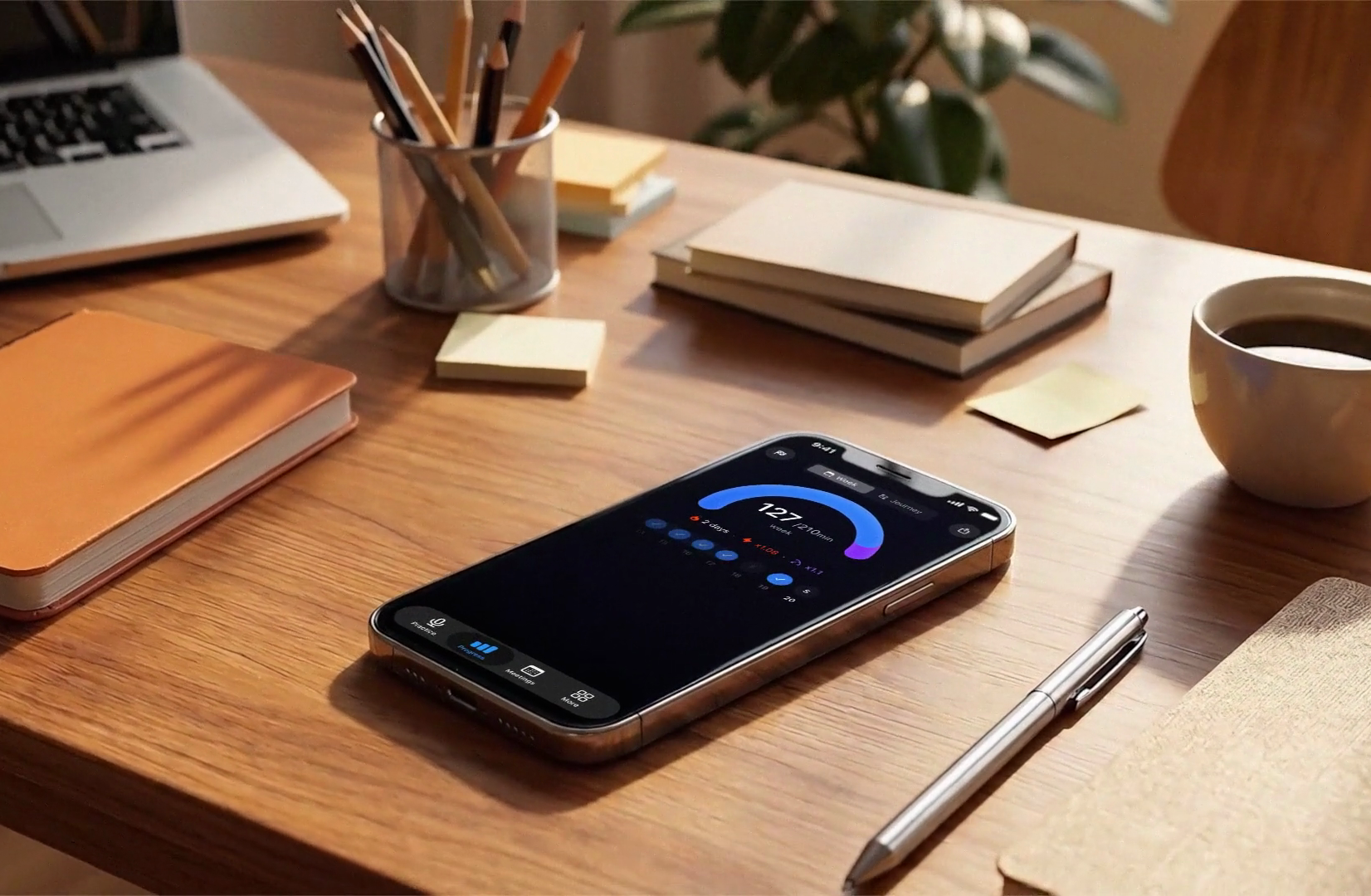
How to Improve English Speaking: A Practical Guide
 Yurii Rebryk · Updated September 6, 2026 · 11 min read
English speaking improves through one mechanism: producing speech out loud, with feedback, more often than you do now. The fastest route is a short daily loop — pick a real situation, speak for one or two minutes, review one problem, then repeat the same task with a fix. This guide shows how to find your specific bottleneck, which practice techniques target it, and how to fit the whole cycle into 15–20 minutes a day.
In this article
“Practice more” is where most advice stops. This guide goes one level deeper: identify what specifically limits your speech, pick the technique that targets it, and run a loop that turns each session into a measurable fix.
Find your speaking bottleneck first
Spoken English is a bundle of separate skills: keeping speech going, being understood, finding words fast, staying grammatical, and responding to what you hear. Few learners are weak at all five at once, so generic practice wastes effort on skills that already work. Match the symptom you notice most often in real conversations to the row below, and start with the one that causes the most friction.
| What you notice | Likely bottleneck | First action |
|---|---|---|
| Long pauses, restarts, answers that trail off | Fluency | Speak daily in short, low-stakes sessions on familiar topics, and resist the urge to restart sentences |
| People often ask you to repeat yourself | Pronunciation and clarity | Drill the specific sounds and word stress that get misheard — start with pronunciation practice |
| You know the idea but can’t find the wording fast enough | Word and phrase retrieval | Learn reusable phrases inside real situations and force yourself to say them out loud |
| The same grammar errors keep muddying your message | Accuracy | Record short answers and fix one repeated error at a time — technique 3 below shows how |
| You understand but freeze when it’s your turn | Response speed and confidence | Build rhythm with listen-and-imitate drills, then add a time limit to your answers — technique 5 |
Treat the table as a reflection aid, not a verdict. For an outside read, a short English speaking test will show which of the four scored areas (pronunciation, fluency, vocabulary, grammar) lags behind. Either way, stay on one bottleneck for a few weeks before switching.
Five English speaking practice techniques that work
Every technique below forces production: you, speaking out loud, with some feedback signal attached. That pairing of output and feedback separates practice that changes your speech from practice that just fills time. The list is ordered by how much active speaking each technique generates.
1. Practice real conversations, on a schedule
Nothing improves speaking faster than actual conversation, because it exercises everything at once: retrieval, pronunciation, listening and response under time pressure. A partner, a tutor, a conversation group or an AI conversation partner all work; what matters is that the other side responds and you must react.
Anchor each session to a situation from your own week rather than an abstract topic. If most of your English happens at work, rehearse the exchanges you actually face: a status update, disagreeing politely, explaining a delay. Not travel small talk.
2. Learn phrases and chunks, not isolated words
Slow retrieval usually means you assemble sentences from single words in real time. Conversational speed comes from chunks: prefabricated phrases like “the way I see it”, “it depends on” or “could you walk me through it”, stored and recalled as one unit.
Learn them inside a situation (ordering, disagreeing, giving an update), then deliberately use them in your next practice session. Three phrases said out loud beat thirty phrases in a notebook.
3. Record and review short answers
Recording is the cheapest feedback there is. Speak for one or two minutes on a real prompt, then listen once and note three things:
- The longest pause. Where your speech stopped, and for how long.
- The least clear sentence. The one a stranger would ask you to repeat.
- The mistake that appeared twice. That one becomes the target for your next attempt.
Most learners have never heard themselves speak English; the first recording is uncomfortable and unusually informative.
4. Ask for focused feedback on one or two targets
Broad feedback like “your English is fine, just practice more” changes nothing. Before a session with a partner or tutor, name the target: “stop me every time I drop an article” or “tell me which words were hard to catch”.
One or two targets, no more; attention doesn’t split five ways. If your practice tool gives post-session feedback, read it the same way: pick the one recurring issue and carry that single fix into the repeat.
5. Turn listening into imitation and reaction practice
Listening alone won’t make you speak better; it builds comprehension, and speaking is a separate production skill. Listening plus imitation will.
Take one sentence from a podcast or a show, replay it, and say it back matching the rhythm and stress, not just the words. Once that feels easy, add a reaction-speed drill: answer a familiar question with a three-second limit before you must start talking. Response speed is trainable, and it is what stops the freeze in real conversations.
Get feedback on every practice session
Fluently is an AI speaking coach built for exactly this loop: you hold a voice conversation on an everyday or work topic, and after each answer it shows what to fix in your pronunciation, grammar and vocabulary, plus how a native speaker would have phrased the same thought. When you get stuck mid-sentence, it suggests what to say next. iOS and Android; free to download, with a subscription for regular practice.


How to start an English conversation as a beginner
Most beginner advice says “just talk to people”, which is exactly what feels impossible. What helps is a formula: comment on the shared situation, then ask an open question.
You don’t need clever lines; you need a prepared structure, so your working memory stays free for listening. Openers that work in almost any setting:
- “This is my first time at this event. What did you think of the talk?”
- “I liked your question in the meeting. How long have you been on that team?”
- “How did you get into your field?” Questions starting with how or what keep the other person talking while you plan your next line.
- React briefly, then hand the turn back: “That sounds difficult. What happened next?”
- The universal fallback: answer whatever you were asked, then add “What about you?”
Prepare before you need it: three openers and three follow-up questions, rehearsed out loud, cover most first conversations. If you run short of material to practice with, the free conversation question generator produces prompts by topic and difficulty. And close in English too: “It was great talking to you, I need to head out” is a complete, polite exit line.
Where to practice English speaking
The practice venues are not interchangeable. Each one trades feedback quality against availability and social pressure.
| Option | What it gives you | The catch |
|---|---|---|
| Alone at home (recording, shadowing) | Always available, zero social pressure, full control of topics | No response pressure; you need recordings or an app to get any feedback signal |
| Language exchange partner | Real interaction with a real person, usually free | Half the session runs in your language, and feedback tends to be polite rather than precise |
| Conversation group or meetup | Group pressure close to real-life settings, unfamiliar people to respond to | Little individual speaking time and almost no correction |
| Human tutor | Targeted correction and a plan from a professional | The most expensive option, and practice stops between booked lessons |
| AI conversation app | On-demand speaking with instant feedback, no scheduling and no judgment | Doesn’t fully reproduce the unpredictability of talking to a human |
The strongest setups combine two of these: something daily and low-friction at home, plus something with real people every week. The English speaking practice guide compares the formats in more depth.
A daily routine that fits in 15–20 minutes
Whichever techniques and venues you pick, run them through the same loop. This loop is the difference between practicing and just talking:
- Choose a real situation — one you will actually face this week.
- Speak or record a short answer, one to two minutes, without stopping to fix every sentence.
- Review it once against one target: your own recording, a partner’s note, or automated feedback.
- Pick one or two changes worth keeping: a phrase, a fixed error, a shorter pause.
- Repeat the same task with those changes applied.
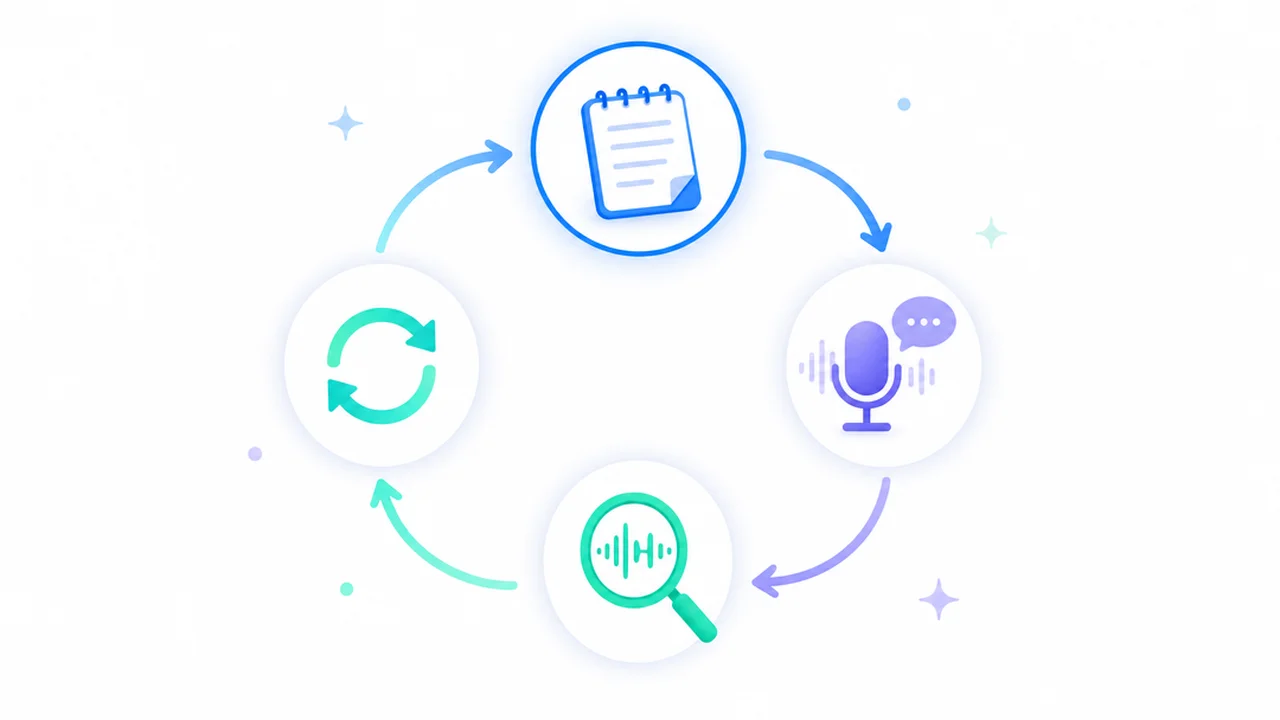
The repeat is the step learners skip, and it is where the improvement happens. On a first attempt, most of your attention goes to deciding what to say; only on the second pass is attention free to change how you say it. Switching topics every session feels productive but resets the cycle before the fix lands.
A minute-by-minute version of one session:
- Minutes 1–3: pick one situation (a self-introduction to a new team, returning a purchase, a status update) and prepare two or three phrases to use in it.
- Minutes 4–6: speak or record your answer for one to two minutes. No mid-sentence corrections; keep going.
- Minutes 7–10: review against one target only: pauses, clarity, phrase retrieval or a repeated error.
- Minutes 11–15: repeat the same situation with the one or two improvements applied.
- Minutes 16–20 (optional): one more repeat, or write down the phrases that worked so tomorrow’s session can reuse them.
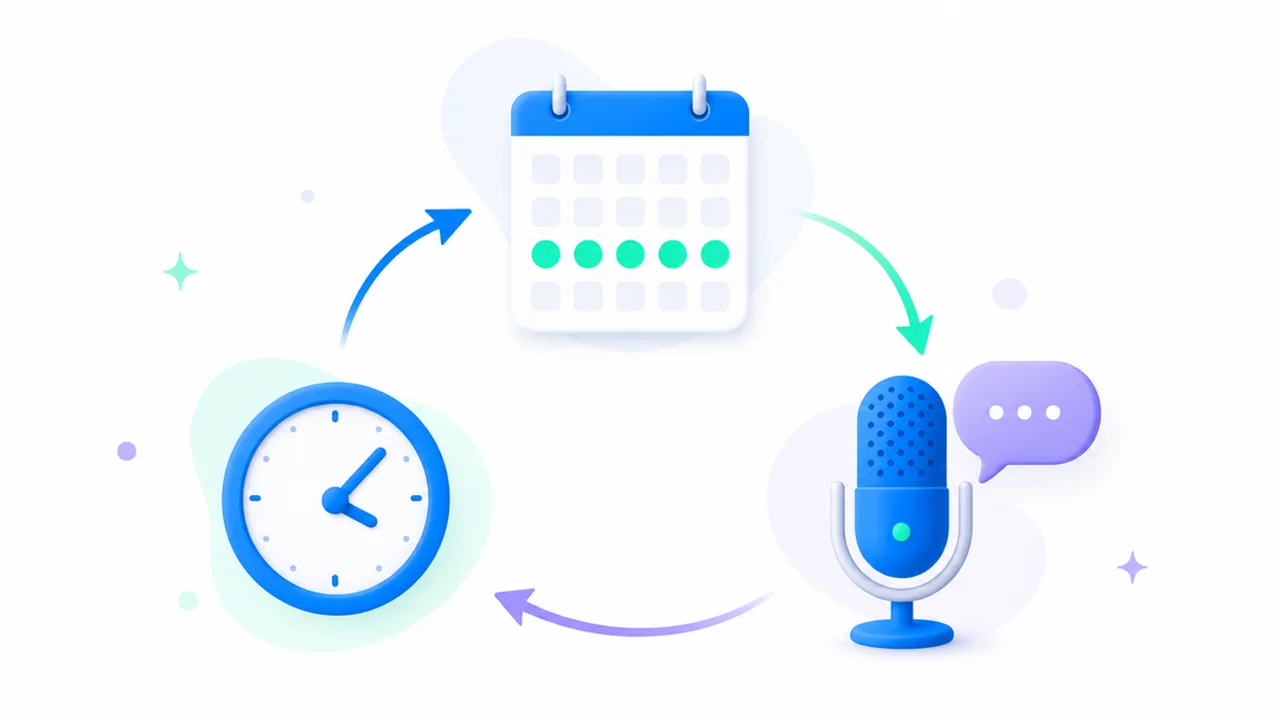
Stretched over a month, the same loop becomes a 30-day plan without any new machinery:
- Week 1. Rotate three situations you face constantly, one per day, each with a repeat.
- Week 2. Keep the situations and add one new phrase per session, checking that it actually appears in the recording.
- Week 3. Add the reaction-speed constraint and start answering within three seconds.
- Week 4. Re-record the week-1 situations and compare them with the originals — that final comparison is your progress report, in your own voice.
Common mistakes that stall spoken English
Most speaking practice fails in the execution, and the failure points repeat from learner to learner:
- Consuming without producing. Series, podcasts and reading feel like practice, but input is not output. If a week contains ten hours of English and zero minutes of speaking, speaking will not move.
- Waiting to feel ready. There is no vocabulary threshold after which speaking becomes comfortable. Comfort comes from repetitions of speaking itself, at whatever level you have now.
- Translating full sentences in your head first. It doubles the mental work and kills your response time. Start with the chunk you know is right and build the rest while talking.
- Changing topics every session. Novelty resets the loop before the fix lands. Stay on one task until the improvement survives a repeat.
- Correcting everything at once. Five simultaneous targets means none gets enough attention to change. One or two, then move on.
- Tracking time instead of change. “I practiced 40 minutes” measures effort, not progress. Track what changed: a pause removed, an error gone, a phrase that came out unprompted.
How to tell your speaking is improving
Progress in speaking is measurable without any formal exam. Watch for these signals on the same task over time:
- Fewer and shorter pauses on a task you have repeated.
- People stop asking you to repeat yourself.
- Phrases arrive faster, with less silent translating before you speak.
- Follow-up responses come without rehearsal.
- The error you targeted stops appearing in your recordings.
The cleanest measurement is a pair of recordings of the same prompt a few weeks apart, listened to back to back. For an outside reference point, take a free English level test before you start and again after a month of consistent loops; to map the result onto a standard scale, the official CEFR global scale describes what each level sounds like in practice.

None of this requires talent, and very little of it requires money. It requires the same 15–20 minutes, most days, pointed at one bottleneck at a time. Speaking is the skill people postpone because it is the least comfortable to practice, and a month of honest loops is enough to hear the difference.
Frequently asked questions
How can I improve my English speaking at home?
Run the improvement loop solo: pick a real situation, record a one-to-two-minute answer on your phone, listen back against one target (pauses, clarity or a repeated error), then redo the same task with a fix. Add shadowing for rhythm: replay one sentence of native audio and say it back matching the stress. Done daily, home practice covers most of what a conversation partner gives you except unpredictability, so add a live or AI conversation when you can.
Where can I practice English speaking if I have nobody to talk to?
You need production plus a feedback signal, not a partner as such. Three options work entirely alone: recording and reviewing yourself, shadowing native audio, and speaking with an AI conversation app that responds and corrects you. Language exchange communities and local conversation meetups add real people once you want them. Combine two sources: shadowing for rhythm and phrasing, plus recorded self-review or AI conversation for retrieval and accuracy.
What is the easiest way to learn English speaking?
The easiest method that still works is short daily speaking on familiar topics: two minutes out loud about your day, your work or your plans, at whatever level you have now. It removes the two usual blockers, scheduling and fear of an audience, while still forcing production. Easy does not mean passive, though. Watching series or listening to podcasts on their own will not improve speaking, because speaking only improves when you produce speech.
What are the best ways to practice English speaking daily?
Rotate three formats across the week so daily practice stays sustainable: conversation, with a person or an AI tutor, for full-skill practice under time pressure; recording plus self-review for accuracy work; and shadowing for pronunciation and rhythm. Keep each session at 15–20 minutes, tie it to a real situation from your week, and always repeat the same task once with one fix applied. Consistency beats length: five short sessions outperform one long weekend session.
How can I build confidence speaking English?
Confidence in speaking is downstream of repetitions, not the other way around. Nobody talks themselves into feeling confident first; the freeze fades after you have said similar things out loud many times in low-stakes settings. Start where mistakes cost nothing: alone with a recorder, or with an AI conversation partner. Then move up to meetups and real conversations. Preparing three openers and three follow-up questions before an event also removes most of the fear of going blank.